
Lead-Gen now on Auto-Pilot withBuild My Campaign
Valasys Media — Empowering marketers with powerful insights

The elaborative benefits of Targeted Lead Generation

Targeted lead generation is one of the trending topic in the market. Explore its detailed benefits in this blog.

Alok Chakraborty
Alok Chakraborty
Last updated on: Apr 8, 2026
The elaborative benefits of Targeted Lead Generation

What proportion of leads that go into your sales funnel become customers? You might gain from targeted lead generation if your lead-to-customer conversion rate dissatisfies you.

Too many low-quality leads entering your sales funnel is the likely cause of poor sales conversion rates. They are the outcome of a lead generating engine that generates random leads that might not actually be interested in your product because it doesn’t apply precise criteria to segment and pre-qualify leads.

Why is lead generation vital for businesses?

What Justifies the Importance of Lead Generation for Business?

A business that lacks a lead generation strategy is vulnerable. Its income and expansion will be dependent on the whims of a target market that may or may not be aware that it even exists. You won’t have any “leads” for potential sales.

Why are leads crucial, then? Because it’s difficult to maximize growth and income without them.

The process of generating leads increases a target audience’s awareness, credibility, trust, and interest (potential leads). It can therefore help drive traffic from high-quality prospects by concentrating on lead generation. High-value customers also follow high-quality prospects.

In other words, more money coming into your company. You may expand your business and the lifetime worth of each customer with effective lead generation tactics.

What is the concept of Targeted Lead generation?

When you divide a broad market into smaller groups in order to concentrate on a specific demographic of potential clients, you are creating targeted leads. It decreases churn and generates higher-quality leads.

Regardless of how desperate you are for leads; you cannot squander limited resources by pursuing the whole market and stuffing your sales funnel with unqualified leads. The leads you target need to have the best chance of becoming clients.

When you target the entire market, you are overextending yourself and are more likely to receive cold leads that are unlikely to be interested in what you are selling.

Your target leads should be reduced to those who are most likely to convert to customers so that you may focus on each one separately.

Market segmentation and targeted lead generation are similar in many ways. Let’s discuss some of its varieties to better appreciate the idea of targeted sales leads.

Top 4 market segmentations

The process of generating targeted leads includes a stage known as market segmentation. It divides your entire addressable market into sections you can target separately.

Based on the following, you can define a sector of possible clients:

  • Segmenting based on demographic factors such as gender, age, marital status, education, religion, and race.
  • User status, spending or buying patterns, brand interactions, etc. are all examples of behavioral segmentation.
  • Beliefs, values, personality, interests, way of life, etc.: psychographic segmentation
  • Area codes, neighborhoods, regions, cities, countries, etc. come under the geographic regions.

Top 3 strategies of Targeted Lead Generation

Utilize automation and AI

According to Gartner’s research, artificial intelligence (AI) will soon rule the market. It will eliminate the need for manual lead generation by lead generation specialists.

Chatbots and virtual assistants can be used as a part of your lead generation efforts. They also nurture leads and boost website engagement.

The greatest technique to produce sales leads with the resources you currently own is in this manner. You may connect machine learning processes to company apps like Slack, Google Analytics, and email automation software, as well as integrate bots with CRM systems.

The acquired data can then be analyzed by AI systems to reveal information about the origin and qualities of your leads.

Implement video marketing

For a few reasons, video marketing should be a part of your lead generating strategy. Services like YouTube serve as both video hosting services and search engines where users may find what they’re looking for.

The average daily viewing time on YouTube is 16 minutes and 44 seconds, with 122 million active users. The reading of manuals, unboxings, and product presentations are not as popular as tutorials. This makes using video marketing to generate leads for your goods and services very effective.

Build My Campaign

You don’t need a lot of subscribers at initially if you use this strategy in conjunction with other lead generation techniques. Ensure that your video material is optimized to rank in Google.

Utilize SEO and competitive research

Due to its low client acquisition cost, search engine optimization (SEO) is one of the online lead generating tactics with the highest return on investment (ROI).

By doing keyword research, you may create tailored leads that will increase the lead-to-sale ratio. Start by looking up broad topic concepts in SEMrush or Ahrefs that are pertinent to your company. They provide you with long-tail keywords (three to five phrases), which are more targeted and enable you to more accurately target your ideal client.

Take your SEO lead generating strategies to the next level by looking at what your rivals are emphasizing. To comprehend the market better, you can determine what kind of content is effective for them.

5 benefits of Targeted lead generation

Because it results in a more comprehensive marketing plan, targeted lead creation is crucial. It requires the marketing and sales teams to collaborate in order to develop an ideal customer profile that focuses and streamlines lead generation.

Following a targeted lead generation plan is essential for the following 5 reasons:

Keeps you zeroed down

You may be more particular about your brand orientation, objectives, and marketing tactics thanks to targeted lead generation, which is one of its main advantages.

Because you are concentrating your lead generation efforts on a certain consumer profile, you can develop a more focused strategy that unites your entire organization. Your marketing and business plans will be more clearly defined.

Facilitates the conversion of leads into consumers

You may communicate with a smaller subset of prospects more affordably by using targeted lead generation. Additionally, you are more likely to win their trust, comprehend their problems, and effectively match them with the appropriate answers when you speak directly to your target market.

Opens up fresh perspectives for improving products

Deepening your understanding of your clients might provide you a fresh viewpoint on your goods and services.

Understanding your market can help you see things from their perspective and more readily put yourself in their position.

You will have the information you need to make your offerings better with the insights you gather from that. It’s possible that a free service may always be offered, but it will only be accessible off-peak.

Raises your visibility

You will undoubtedly see a rise in client satisfaction if you stop approaching everyone in a general way and start picking a specific strategy instead.

Customers are more likely to choose your brand over a rival that isn’t specifically targeting them if they can relate to your brand and your unique selling points.

Opens up fresh perspectives for improving products

Deepening your understanding of your clients might provide you a fresh viewpoint on your goods and services.

Understanding your market can help you see things from their perspective and more readily put yourself in their position.

You will have the information you need to make your offerings better with the insights you gather from that. You can start determining which features your product could need in order to best serve your clients.

Final words

Lead generation is a continuous effort that needs to change over time. What works this year might significantly change the following. Therefore, it’s imperative to keep up with the evolving trends of your customer base.

Your lead generation initiatives can be kept as effective as possible by routine testing and upgrading.

Related Posts

Facing Construction Delays? Experienced Lawyers Help Address Contractual Disagreements Effectively

Facing Construction Delays? Experienced Lawyers Help Address Contractual Disagreements Effectively

Guest Author

Most delay disputes are lost on paper, before any hearing. A single missed notice can sink an otherwise strong claim. When schedules slip, both sides reach for the contract. A seasoned construction attorney treats that document as a recovery map. Clauses on extensions, damages and dispute procedure each carry weight. Excusable delays, notice rules and shared fault all shape outcomes. So does choosing the right forum for resolution. Field records, written months earlier, can carry the decisive proof. Paperwork, in short, decides who absorbs the cost of lost time. Delay Claims Start With Contract Wording Each agreement allocates the risk of lost time differently. Some grant extra days without extra money; others allow both. Liquidated damages clauses set a fixed daily charge for late completion. A lawyer studies these terms before anyone files a claim. That early review can reveal leverage a site team overlooks. Which Setbacks Justify a Time Extension? Not every holdup earns extra days. Courts and arbitrators separate excusable events from contractor-caused ones. Recognized grounds for relief include: Owner-directed design changes alter the original scope of work. Unforeseen site conditions differ sharply from the bid documents. Severe weather exceeds the averages the contract anticipated. Late owner approvals halt crews waiting on decisions. Missed Notice Deadlines Destroy Valid Claims Here, timing matters more than merit. Standard forms demand written notice shortly after a delay begins. Courts enforce those windows strictly, even against legitimate claims. A construction attorney builds a notice calendar at project kickoff. Each letter then cites the clause, cause and expected impact. Such discipline turns routine correspondence into admissible evidence. What If Both Parties Caused the Slippage? Concurrent delay is where disputes turn technical. Picture an owner releasing drawings late while crews sit short-staffed. Neither side can pin the whole period elsewhere. Experts run critical path analysis against the baseline schedule. Superintendent daily logs supply the raw evidence for that analysis. Counsel then apportions responsibility one day at a time. Why Try Mediation Before Filing Suit? Litigation can outlast the project it concerns. Mediation brings a quicker, confidential route: Work continues while talks proceed. Costs stay far below trial. Business relationships survive the dispute. Parties control the final terms. If talks collapse, arbitration remains available. Many contracts mandate this stepped sequence. A neutral mediator tests each side’s numbers privately. The Superintendent’s Logbook Settles More Disputes Delay disputes look like legal battles from the outside. In practice, the superintendent’s daily log decides most of them. Critical path experts and polished briefs rest on those entries. A crew count noted at dawn can outweigh testimony. Lawyers can argue only what someone recorded at the time. Sloppy logs leave sharp advocates with little to prove. So real protection begins long before counsel enters the room. FAQs When should a contractor contact a lawyer about delays? Before signing is best, while risky clauses remain negotiable. At minimum, call once the first schedule slip surfaces. Prompt advice protects notice rights with short expiry windows, and waiting costs leverage. Can an owner recover money for late completion? Yes, through liquidated damages or proven actual losses. The contract decides which route applies. Excused delays can reduce those charges, and penalty-style amounts may face court challenge. Does a no-damages-for-delay clause bar all compensation? Such a clause does not settle every case. Courts recognize exceptions for active interference or bad faith. Enforceability shifts between jurisdictions, making legal review essential before conceding anything. How long does a delay dispute take to resolve? Mediation can conclude in a few weeks of focused sessions. Arbitration and litigation can stretch across months or years. Schedule complexity and expert involvement drive that timeline.

Cloud-Based LinkedIn Prospecting Tools_ Features and Safety Compared

Cloud-Based LinkedIn Prospecting Tools: Features and Safety Compared

Guest Author

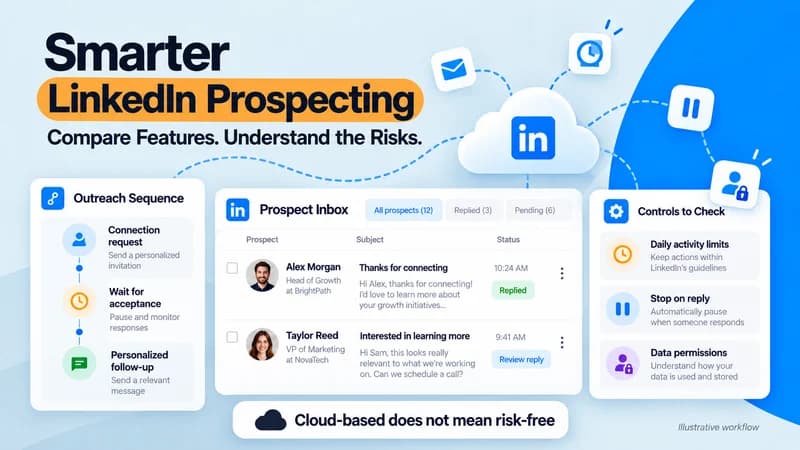
Follow-ups slip when your calendar fills up. Campaigns stop when your laptop sleeps. And every vendor page calls its tool “safe,” so no claim is easy to trust. The short answer: cloud-based tools keep sequences running without your device, but none removes account risk. Compare them on targeting, sequence logic, pacing controls, reply handling, and data practices. Below are the rules to know first, the features worth paying for, the safety settings to check, and a pilot test to run before you commit. Start with the rules, because they shape every safe setup. Know the Rules Before You Automate LinkedIn’s User Agreement prohibits bots and unauthorized automated activity, so every third-party tool carries some account risk. A vendor can reduce that risk through pacing and design, but cannot remove it. Privacy law matters too. Business contacts are still people, and these rules for business-to-business marketing explain when messaging them needs a lawful basis. Under UK data protection law, serious breaches can bring fines of up to £17.5 million or 4% of global annual turnover, whichever is higher. LinkedIn Message Automation: What It Does and What to Automate Managing connection requests, messages, and follow-ups takes time. With LinkedIn message automation, software handles these tasks based on rules you set. It does not pick your audience or write a strong offer for you. Teams use it to automate LinkedIn connection messages and set up automated LinkedIn follow-ups, helping them keep conversations moving after a request is accepted. Good candidates to automate: A short, truthful connection note, or no note A first message after acceptance One or two follow-ups with delays Stop-on-reply logic Keep these human: replies, objection handling, and anything that needs judgment. Cloud-Based vs. Desktop vs. Browser Extension Tools Where the software runs affects reliability and how your activity looks to LinkedIn. Cloud-based LinkedIn automation tools: run on vendor servers, so campaigns continue when your device is off. Ask how the vendor handles IP addresses and sessions. Desktop apps: run on your computer and usually need it on. Browser extensions: run inside your LinkedIn session and typically need the browser open. LinkedIn’s rules cover third-party software and extensions alike. Cloud deployment doesn’t make a tool safe. It only makes steady pacing easier to control. Features That Matter When You Compare Tools LinkedIn reports more than 1.3 billion members, so volume is never your constraint. Targeting is. Compare these features: Lead sourcing: LinkedIn search, Sales Navigator lists, CSV imports, or a built-in database Sequence logic: delays and if/else conditions that branch on acceptance or reply Personalization: variables you can verify, plus AI drafts you can edit Reply handling: a unified inbox, labeling, and stop-on-reply Multichannel flow: LinkedIn and email in one sequence, so the same prospect isn’t contacted twice Team controls: workspaces, permissions, and white-label options Integrations: CRM sync or API access, so replies reach your system of record Skylead, for example, runs LinkedIn messages, InMails, and email in one sequence with if/else conditions. It adds a B2B database, AI enrichment, and an AI SDR for replies. Safety Settings to Compare LinkedIn publishes no single universal message limit, so a tool’s controls matter more than any headline number. Look for: Adjustable daily limits per account A gradual ramp-up for new or inactive profiles Sending windows that match the prospect’s working hours Randomized delays between actions Automatic pause when LinkedIn shows warnings or actions fail Stop-on-reply on every follow-up Clear documentation on how sessions and IPs are handled A practical rule: the pattern to avoid is a sudden jump from no activity to full volume. Steady, gradual increases look far more like normal use. Treat any safety guarantee as a red flag. No vendor controls LinkedIn’s decisions. How Pricing Models Differ Prices change, so compare structure instead of numbers. Check whether you pay per seat, per LinkedIn account, flat for a team, or by usage credits for data and AI. Then ask what is included, such as email sending, enrichment, AI replies, extra accounts, and white-labeling. Model cost at the number of accounts you expect to run in 12 months. Which Setup Fits Your Team The right tool depends on who is sending. Solo founder or small sales team: choose simple 2 to 3 step sequences, warm segments, and strong pacing controls. Recruiting team: prioritize a shared inbox, permissions, and careful handling of candidate data. Agency: look for workspaces, per-client permissions, white-labeling, and pricing that doesn’t grow with every seat. Larger or regulated company: ask for written documentation on data handling before procurement review. The Pilot Test Most Comparisons Skip Feature lists don’t show how a tool behaves under real conditions. Before rolling out to a team, run a small pilot: Pick one warm, well-defined segment, such as people who engaged with a relevant post. Start below the vendor’s suggested limits and raise them gradually while watching acceptance and warnings. Reply to your own test campaign from a second account and confirm the sequence stops. Change one variable at a time, such as the first message or send time. Check export options, so your data can leave with you. Then score each tool from 1 to 5 on stability, control clarity, support response, and data export. Here is an illustrative example, not real results. Tool A scores 5, 4, 4, and 5, for 18 out of 20. Tool B scores 4, 3, 3, and 2, for 12. Tool A wins even if both tools had similar early replies. Data Privacy Rules for US Prospecting US teams face state privacy laws too. If you handle personal information about California residents, California privacy law requirements may apply to how you collect, store, and delete prospect data. Collect only what you need, honor deletion and opt-out requests, and confirm the details with legal counsel. Where to Start Pick one warm segment, shortlist two or three tools, and run one pilot. Confirm the safety controls work before you add volume. If running LinkedIn and email from one sequence is your gap, Skylead’s free trial is an

Exploring Montana MSB Insights and Future Potential Opportunities

Exploring Montana MSB Insights and Future Potential Opportunities

Guest Author

To maximize your experience with this innovative financial tool, familiarize yourself with its intuitive interface, which prioritizes user engagement. Its layout is designed for seamless navigation, enabling immediate access to various functionalities without unnecessary complexity. Take advantage of the real-time analytics functionalities available. These insights allow users to monitor transactions and assess performance metrics, providing a clear picture of financial standing and facilitating informed decision-making. The integration of advanced reporting tools can significantly enhance your ability to manage finances effectively. Consider utilizing the customizable features tailored to meet specific business needs. By adjusting parameters and options, users can align the system with their operational objectives, ensuring a personalized approach to transaction management and client relations. For optimal security, leverage the multi-layered protection protocols in place. This system employs cutting-edge encryption methods and regular security audits to safeguard personal and financial information, instilling confidence in users regarding data integrity. Engagement with available support channels is recommended for troubleshooting and maximizing the platform’s capabilities. Real-time assistance and extensive resource libraries can provide clarity and enhance overall functionality, ensuring users can navigate any challenges confidently. Understanding the User Interface of Montana MSB Begin with the dashboard, which acts as the central hub for navigation within the Montana MSB platform. Familiarize yourself with key sections such as transactions, reports, and user management that are easily accessible from the main menu. Utilize the search functionality for quick access to relevant data; this feature is particularly beneficial during high-traffic periods. Pay attention to customization options available in settings, allowing users to tailor notifications and preferences. Tooltips offer immediate guidance on various features, simplifying the learning curve. Regularly review updates to ensure you maximize the utility of modifications, as user feedback often leads to enhancements in layout and functionality. Integrating Payment Solutions within Montana MSB Choosing suitable payment gateways is critical for streamlined operations. Focus on integrating solutions that support multiple currencies and payment methods. Compatibility with popular options like credit cards, e-wallets, and bank transfers increases accessibility for users globally. API Integration Utilize robust APIs for seamless payment processing. This allows for real-time transaction handling, which enhances user experience and reduces waiting times. Ensure your development team is well-versed in API documentation to facilitate smooth integration. Security measures cannot be overlooked. Implement strong encryption protocols, such as SSL, to protect sensitive data during transactions. Regularly update security features to guard against potential threats and comply with industry standards. User Interface and Experience Design an intuitive user interface for payment processes. Simplifying the steps reduces cart abandonment rates. Consider features like one-click payments or saved payment methods to enhance user satisfaction. Monitoring transaction performance through analytics tools offers valuable insights into customer behavior. Analyze data to identify popular payment methods and adjust strategies accordingly. This ensures resources are allocated efficiently and user preferences are met. Collaboration with payment service providers is beneficial. Establish partnerships with reputable firms to access exclusive rates or services. This can give you an edge in competitive markets and enhance your offerings. Regular testing of payment systems is advisable to ensure compatibility and functionality. Conducting these tests post-integration will help identify any issues before they affect users. Continuous improvements keep the transaction process running smoothly. Security Protocols Implemented in Montana MSB Utilizing advanced encryption standards is critical to securing sensitive financial data. The encryption process converts information into a format that can only be read by authorized entities, thus preventing unauthorized access. Adopting AES-256, which is widely recognized for its robustness, ensures that data remains protected throughout transactions. Multi-Factor Authentication Incorporating multi-factor authentication (MFA) significantly enhances security layers. By requiring users to provide two or more verification factors, such as something they know (password) and something they have (a one-time code sent to their mobile device), the risk of unauthorized access diminishes. This method adds complexity to the login process, deterring potential breaches. Regular security audits are indispensable for identifying vulnerabilities. Conducting these assessments at predetermined intervals allows for timely updates to security protocols, ensuring alignment with current threats. The feedback from audits should inform continuous improvement in protection measures. Real-Time Monitoring Systems Implementing real-time monitoring systems allows for immediate detection of suspicious activities. These systems analyze user interactions and flag anomalies that could indicate fraud or cybersecurity threats. Quick response capabilities to detected issues minimize potential damage and ensure a prompt reaction to incidents. Analyzing Customer Support Options on Montana MSB To enhance user experience, consider utilizing live chat features for immediate assistance. This instant communication facilitates real-time problem resolution and can significantly boost user satisfaction. Support Channels Email Support: Allows for detailed inquiries and documentation. Response times can vary, so users should be prepared for potential delays. Phone Support: Ideal for urgent matters, offering direct contact with support agents. Check operating hours to maximize availability. FAQs: A well-structured FAQ section can address common concerns efficiently. Regular updates are key for accuracy. Evaluating response times is paramount. Generally, live chat offers the quickest turnaround, while email may require a longer wait, typically ranging from a few hours to a couple of days. Additional Resources Knowledge Base: Access to articles and guides can empower users to solve issues independently. Community Forums: Engaging with fellow users fosters knowledge sharing and may lead to quicker solutions. Feedback mechanisms play a vital role in service improvement. Encourage users to rate their support experiences and provide comments to refine offerings over time. Finally, comprehensive training for support staff is essential. Ensuring representatives are knowledgeable about the services and common issues can enhance the efficiency of assistance provided.