
Direct Answer
The future of ABM is moving toward AI-driven personalization, predictive account prioritization, automated journey orchestration, and real-time engagement insights. AI will not replace ABM strategy, but it can make account selection, messaging, and timing more precise at scale.
Introduction
In the ever-evolving landscape of marketing, a seismic shift is underway that’s redefining how businesses engage with their most coveted prospects. Welcome to the dawn of AI-Driven Account-Based Marketing, where the fusion of artificial intelligence and strategic precision propels your campaigns into uncharted realms of success through automating Account-Based Marketing using AI. Gone are the days of casting wide nets, hoping your message finds its mark. The rise of Account-Based Marketing (ABM) introduced a tailored approach, focusing on high-value accounts rather than generic demographics. But as the digital arena swelled with opportunities, so did the complexity of customization, leading to the natural integration of AI. Enter the game-changer: Artificial Intelligence. It’s not just a tool; it’s the catalyst that’s reshaping the marketing landscape by automating Account-Based Marketing using AI. Picture this: your marketing efforts guided by an intuitive digital brain, an AI that doesn’t just analyze data, but deciphers intentions and predicts actions. This isn’t science fiction; it’s the present and future of successful marketing. The convergence of ABM and AI is more than a marriage – it’s a symbiotic partnership that propels your campaigns from mundane to extraordinary through the automation of Account-Based Marketing using AI. It’s all about resonance – that perfect harmony between your brand and your audience’s desires, achieved through automated AI-powered processes. AI doesn’t just understand these needs; it anticipates them, paving the way for personalized journeys that forge deep connections. In the realm of marketing, adaptability is gold. The modern consumer isn’t static, and your strategy shouldn’t be either. With AI automating your campaigns, they become dynamic, shifting seamlessly in response to evolving behaviors, crafting an experience that’s as fluid as it is unforgettable. We stand at the nexus of innovation and practicality, at a crossroads where those who embrace AI-powered automation are rewriting the rules of engagement. The future isn’t a distant horizon; it’s the very air we breathe. AI-driven automated buyer journeys are more than a trend; they’re the cornerstone of success in a world where personalization isn’t just appreciated – it’s expected. So, if you’ve been lingering in the realm of traditional ABM, it’s time to heed the call of transformation through AI-powered automation. The symphony of AI and Account-Based Marketing is playing, and those who hesitate risk being left in the dust. In this expedition, we’ll dive deep into the realm of AI’s influence on automated ABM strategy, unlocking doors to a future where every interaction is an opportunity, and every engagement is a masterpiece of personalization and automation. In this narrative-altering journey, we’ll traverse the metamorphosis of Account-Based Marketing, exploring how AI breathes life into personalized strategies that were once deemed dreamscape, now made real through the power of automation. We’re here to walk you through real-world examples, where industry trailblazers are leveraging AI to automate their ABM efforts into something almost magical. Welcome to the evolution, welcome to AI-Driven Account-Based Marketing through automation.
The Evolution of ABM Marketing
Account-based marketing (ABM) has been a cornerstone of strategic outreach for quite some time, yet its journey has been transformed by the advent of artificial intelligence (AI). In the not-so-distant past, marketers meticulously curated lists of prime target accounts, fashioning bespoke campaigns and messages tailored to each. While undoubtedly effective, this approach demanded substantial time and resources. Enter the age of AI-driven ABM, a paradigm shift that has elevated precision and efficiency to unprecedented heights. This evolution is akin to swapping a manual typewriter for a lightning-fast digital keyboard. The traditional process, while impactful, resembled a labor-intensive art form; AI-infused ABM, on the other hand, mirrors a symphony of automation and insight. AI-powered ABM grants marketers the ability to sift through colossal volumes of data identifying. The crème de la crème of target accounts with an unparalleled finesse. These digital assistants then seamlessly weave personalization into campaigns and messages. A feat that previously demanded significant investment in time and resources. But here’s where the magic truly unfolds: AI is more than just a time-saver; it’s a master detective. That uncovers hidden patterns and illuminating insights, often escaping human radar. While the dawn of AI-driven ABM is nothing short of remarkable, it’s crucial to comprehend its role vis-à-vis human creativity and intuition. AI is a wondrous guide that navigates the labyrinthine terrain of data, but it thrives when complemented by human ingenuity. The marriage of AI and human oversight ensures campaigns are not just personalized, but also in harmony with the overarching marketing strategy. In essence, ABM’s evolution from manual to AI-driven is a tale of progress where the mundane transforms into the extraordinary. Think of it as a gallery of finely crafted sculptures, each one uniquely tailored and brought to life through the power of AI. However, even in this age of technological marvels, the brushstrokes of human expertise remain essential, ensuring that the masterpiece created by AI resonates profoundly with the hearts and minds of the intended audience. 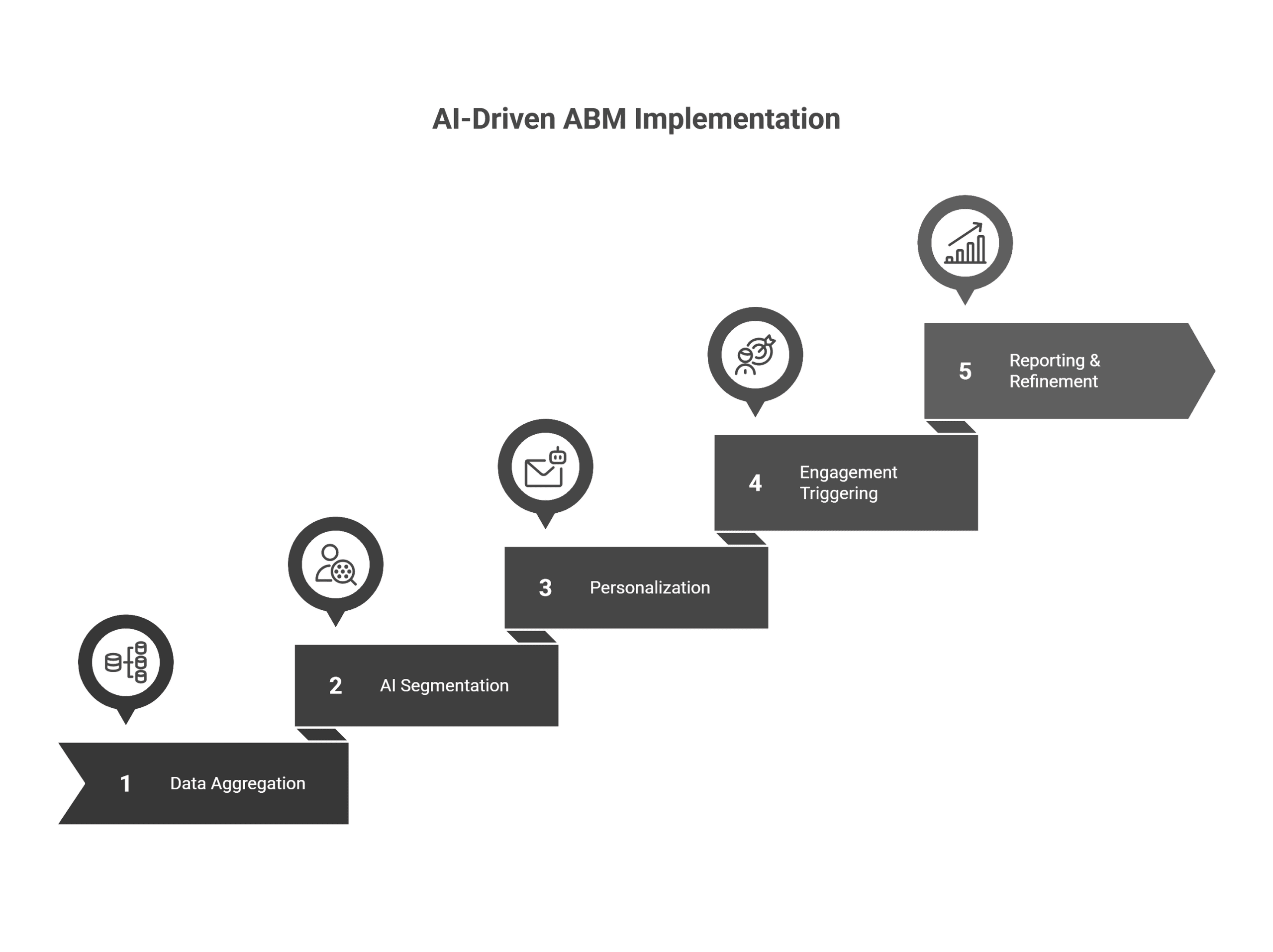
What Is Account Based Marketing?
Account-based marketing (ABM) is a strategic approach that zeros in on individual customer or prospect accounts. Instead of casting a wide net with generic campaigns, ABM directs its focus toward specific accounts, delivering tailor-made messages and offers that cater directly to their needs. In a world where personalization reigns supreme, ABM stands out as a beacon of precision. It’s like having a conversation with a friend, where every word carries significance. And now, the emergence of AI has breathed new life into this approach, ushering in a realm of automated possibilities. Imagine ABM infused with the prowess of artificial intelligence—a symphony of efficiency and personalization. This is the heart of “AI-driven automation in ABM,” where technology becomes the catalyst for building meaningful relationships. Through automated personalized outreach with AI, the traditional barriers of time and resources are dismantled, allowing for a fluid conversation tailored to each account’s unique characteristics. The foundation of this revolution lies in “AI-powered account selection for ABM.” Picture an algorithmic tour guide that swiftly identifies the most promising accounts, ensuring your efforts are focused on the cream of the crop. In turn, this streamlined process is all about “Streamlining ABM processes with artificial intelligence.” Mundane tasks are automated, freeing you to infuse creativity and strategy into your campaigns. Efficiency extends to lead scoring as well, as demonstrated by “Automated lead scoring in account-based marketing.” With AI as your guide, you can swiftly sift through data oceans, identifying the hottest prospects with precision. The result? “AI-driven ABM campaigns for efficiency,” a realm where your messages resonate with impeccable timing and relevance, thanks to the strategic orchestration of AI. In a landscape where staying ahead requires innovation, the fusion of AI and ABM is the beacon guiding us forward. It’s not just about automation; it’s about crafting a narrative that speaks directly to the hearts of your chosen accounts. This is the future of marketing, where “Automating Account-Based Marketing using AI” isn’t just a strategy—it’s a transformation that leaves a lasting impression.
Harnessing AI for Enhanced Personalization Solutions
In the realm of account-based marketing (ABM), B2B companies often grapple with hurdles that impede their stride towards effectiveness. However, the beacon of artificial intelligence (AI) holds immense promise in illuminating the path forward. Here’s an exploration of how AI can serve as a solution to these challenges:
- Unraveling Data Insights: The brilliance of AI algorithms lies in their capacity to dissect vast datasets sourced from diverse channels – CRM systems, website activity, social media, and email interactions. This analytical prowess empowers marketers to delve deeper into the nuances of their target accounts, fashioning buyer personas that are not only accurate but also pertinent. By employing AI, B2B enterprises can surmount the limitations of limited data. This technology stitches together insights from multiple sources, painting a holistic portrait of the target account’s landscape.
- Harmonious Alignment: AI’s transformative touch extends to fostering alignment within teams. Empowered by AI, tools offer a panoramic view of the customer journey, nurturing a unified perspective. Through AI-powered account scoring, the spotlight shines on accounts with high conversion potential, guiding sales teams in directing their efforts optimally. The handoff between marketing and sales teams, a crucial juncture, is streamlined through AI automation. This orchestration ensures a seamless and consistent customer experience, erasing misalignments from the equation.
- The AI Impact: In the landscape of limited data, personalization scalability, and seamless alignment, AI emerges as a beacon of hope for B2B companies. It equips them with the tools to conduct robust data analysis, craft personalized content, and weave a unified narrative of the customer journey.
- Personalizing Websites in Real-Time: AI-driven personalization empowers businesses to craft dynamic website encounters customized for each visitor. By analyzing current data and customer actions, AI algorithms can deliver individualized content, product suggestions. And offers that match personal preferences As an example, a clothing retailer could exhibit pertinent items based on a shopper’s browsing history and past purchases, boosting the likelihood of conversion and contentment.
- As AI-driven account-based marketing continues to evolve, personalization at scale is becoming a key differentiator for high-performing teams. Platforms like Folloze enable marketers to deliver highly tailored buyer experiences by combining AI insights with dynamic content journeys. By leveraging behavioral data and real-time engagement signals, these platforms help organizations create more relevant interactions across the buyer lifecycle, ultimately improving conversion rates and strengthening account relationships.
- Customized Email Campaigns: Email marketing remains a potent means of engaging consumers, further amplified by AI. AI-fueled personalization allows marketers to design highly targeted and individualized email campaigns that strike a chord with recipients. Through segregating the audience by interests, behaviors, and demographics, AI algorithms can formulate tailored subject lines, content, and product recommendations that captivate interest and stimulate interaction. The outcome? Elevated rates of opening, clicking, and converting.
- Foreseeing Content Preferences: AI-driven personalization goes beyond basic grouping. It employs predictive analysis to anticipate customer inclinations and actions, equipping businesses to proactively propose content. By scrutinizing historical data and trends, AI algorithms can foresee the form of content that will likely resonate with each customer. This empowers marketers to deliver fitting content at opportune moments, boosting engagement and establishing a more personalized user journey.
- Personalized Interaction via Chatbots: Chatbots have become integral to customer service, with AI-powered iterations taking the concept a step further. These intelligent virtual aides grasp and respond to customer queries on a personalized level. Leveraging natural language processing and machine learning, AI chatbots can tailor responses grounded in customer history, preferences, and previous interactions. This not only elevates customer contentment but also economizes precious time and resources for enterprises.
As AI technology continues to evolve, it’s only natural to anticipate a surge in B2B companies capitalizing on AI’s prowess to enrich their ABM strategies. This evolution holds the promise of refining marketing outcomes and steering the B2B realm towards a future brimming with success.
AI-Driven ABM Statistics
The statistics and case studies around AI-driven ABM are impressive. According to a survey by Demandbase, 80% of marketers who use AI-driven ABM report that it outperforms traditional marketing methods. Another study by Salesforce found that companies that use AI in their marketing are 1.8 times more likely to achieve their revenue goals than those that don’t.
Challenges and Limitations of AI-Driven ABM
Despite the advantages offered by AI-driven Account-Based Marketing (ABM), it is essential to acknowledge the associated limitations and challenges. One significant obstacle is the imperative for high-quality data. The effectiveness of AI hinges on robust data to detect patterns and glean insights; hence, inadequate, inaccurate, or biased data can impede the success of campaigns. Another complexity arises from the necessity of human supervision. Although AI can automate numerous ABM facets, it still demands human involvement and oversight. To ascertain campaign effectiveness and alignment with broader marketing strategies. Furthermore, AI has its confines. While adept at detecting patterns and insights within data, it cannot replicate human ingenuity and intuition. Striking the right equilibrium between automation and human input remains pivotal for marketers.
Best Practices for AI-Driven ABM
Effectively harnessing AI for ABM demands adherence to certain guidelines to guarantee successful campaigns. Key recommendations encompass:

- Commence with modest endeavors and progressively expand
- Employ data-driven methodologies to pinpoint your intended client accounts
- Tailor messages and initiatives uniquely to individual accounts
- Leverage a variety of communication channels (e.g., email, social platforms, direct mail) to engage designated accounts
- Consistently monitor and assess outcomes to fine-tune campaign strategies
Scaling Strategic Precision with Expert Partnerships
As enterprises navigate the transition toward AI-powered automation, the ability to operationalize these strategies becomes the primary differentiator. For organizations looking to implement high-level personalization at scale, The ABM Agency provides the specialized expertise required for complex 1:1 and 1:few account-based marketing. By aligning advanced data processes with the unique needs of industries such as SaaS, cybersecurity, and financial services, they help global brands transform visionary AI concepts into measurable engagement outcomes. Integrating this level of full-service strategic precision ensures that ABM efforts remain agile and impactful in an increasingly automated landscape.
The Future of AI-Driven ABM
The horizon for AI-driven ABM appears promising. As AI technology advances, we can anticipate the emergence of more intricate and sophisticated marketing strategies. Here are some trends on the horizon: Enhanced Personalization: AI’s evolution will facilitate even deeper personalization, tailoring messages and content precisely to the unique needs and challenges of each target account. Profound Insights: Marketers will harness AI to delve even further into target accounts, gaining insights into buying behaviors and preferences that were previously elusive. Unified Multichannel Initiatives: AI will empower marketers to forge more impactful multichannel campaigns, ensuring a consistent message and content across various platforms. Elevated Automation: As AI technology refines itself, expect more ABM tasks to be automated, granting marketers the freedom to channel their efforts into strategy and imaginative endeavors.
Use Case Examples of AI driven ABM Marketing
Prominent corporations are increasingly adopting artificial intelligence (AI) for personalized marketing, notably in the realm of personalization. These AI-driven tools capitalize on copious data to assist marketers in crafting bespoke messages and content that resonate with their desired audience. As a consequence, numerous B2B enterprises are tapping into AI’s potential to enhance their personalization strategies within marketing campaigns. For instance:
- Adobe: Adobe, a technology company catering to creative and marketing professionals, employs AI to personalize its Account-Based Marketing (ABM) initiatives. The company leverages data from diverse sources like emails, websites, and social media to analyze. This analysis unveils the preferences and needs of target accounts, enabling Adobe to curate individualized content that aligns with their interests. This personalized approach resulted in significant successes. For instance, by analyzing an enterprise account’s website data, Adobe identified pain points and interests, enabling the creation of a tailored landing page. This led to a remarkable 30% surge in account engagement.
- Amazon: Beyond Alexa, Amazon employs AI extensively in its operations. Predictive analytics allows Amazon to recommend and pre-emptively ship products to customers based on their data. Additionally, Amazon’s pioneering Amazon Go stores use AI to streamline retail experiences. Cameras track customers’ actions, facilitating automatic billing through the Amazon Go app.
- Salesforce: Salesforce integrates AI-powered ABM tools into its Digital 360 platform. These tools encompass Einstein Key Accounts Identification for identifying and prioritizing. Valuable accounts, Einstein Engagement Scoring for assessing engagement levels. Einstein Campaign Insights for refining campaign performance. Salesforce asserts that these tools can bolster conversions, retention, and revenue for sales teams.
These instances underscore AI’s efficacy in enhancing ABM personalization. By harnessing data, machine learning, natural language processing, and predictive analytics. Marketers can deliver personalized encounters to their target accounts. Demonstrations from companies like Adobe, Amazon, and Salesforce underscore AI’s prowess in refining ABM personalization and enhancing marketing outcomes.
Conclusion
In the realm of contemporary marketing, a paradigm-shifting force is at play: the automation of Account-Based Marketing using AI. This fusion of technology and strategy is revolutionizing how businesses approach their marketing. Endeavors, birthing a landscape defined by unprecedented effectiveness and engagement. The power of AI to analyze data and personalize campaigns is a revelation in itself. Through the lens of “Automating Account-Based Marketing using AI,” marketers are empowered. To craft campaigns that resonate on a deeply personal level. The result? An orchestra of engagement where every note strikes a chord with the intended audience. It’s true that this innovative path comes with its fair share of challenges and limitations. Yet, the benefits that unfurl before us far outweigh the risks. This journey into AI-driven ABM is a voyage that aligns perfectly with the trajectory of technological evolution. With each passing day, AI technology grows more sophisticated, promising a future where marketing tactics are not just advanced, but awe-inspiring. As we arrive at the conclusion of this exploration, the horizon appears radiant with opportunities. The narrative of marketing excellence is far from over—it’s an ongoing saga that AI has embraced as its own. So, take the helm of your marketing efforts, emboldened by the harmonious blend of AI’s capabilities and your ambition. The canvas of tomorrow’s marketing landscape awaits, painted with the vibrant hues of “Automating Account-Based Marketing using AI.”
Frequently Asked Questions
What is future of ABM AI personalization automation?
The future of ABM is moving toward AI-driven personalization, predictive account prioritization, automated journey orchestration, and real-time engagement insights. AI will not replace ABM strategy, but it can make account selection, messaging, and timing more precise at scale.
Why does this topic matter for ABM and B2B growth?
It matters because ABM performance depends on choosing the right accounts and acting on reliable signals. AI and data tools can improve prioritization, personalization, and speed when governed properly.
How can B2B teams apply this in practice?
Define the ICP clearly, clean the account data, and align scoring or segmentation rules with actual revenue outcomes. Use AI outputs as prioritization guidance, then validate them with sales feedback and conversion data.
What is the most common mistake to avoid?
The most common mistake is trusting tool output without validating data quality, ICP fit, and sales relevance. Bad inputs can make AI-driven ABM faster, but not better.