- Target audience
- Value proposition
- Service provided

LinkedIn shines in the B2B sector. Boosting Best LinkedIn b2b tips company page enables marketers to reach influential decision-makers.


Guest Author
Prospects, investors, job candidates, and journalists often check a company’s website before they ever speak to anyone there. Within a minute, they decide whether the business looks credible, understandable, and worth contacting. Effective corporate website design turns that first visit into confidence by combining clear positioning, easy navigation, and visible proof of expertise. The principles below draw on Halo Lab’s work on more than 500 projects since 2013, including corporate sites for fintech, HR tech, healthcare, insurance, marketing companies, and other industries. What makes a corporate website effective? Visual polish draws attention, yet a corporate website becomes effective through less visible work: wording, structure, evidence, and technical quality. The following principles cover these layers. Clear messaging and brand identity The homepage headline should state what the company does and for whom in one plain sentence. Visual identity then reinforces that message through consistent color, type, and imagery across every page. Sometimes the gap runs deeper than copy. When Halo Lab worked with Stay, a Munich-based insurance brokerage for expats, the company’s former name, MW Expat, no longer matched the credibility it had built. The rebrand introduced speech-bubble elements as a symbol of open dialogue, and the website carried that motif straight into its hero section. Afterward, visitors could find the right type of coverage faster, and the brand looked the same across the website, client portals, and other channels. A useful check: if the logo were removed, would visitors still recognize the business from its tone and visuals? Simple navigation and user experience Navigation works when the menu mirrors how visitors think about the company rather than how its departments are organized. Five to seven top-level items usually cover the essentials, such as solutions, industries, customers, resources, and company information. Structure comes before screens. Experienced teams draft the sitemap and test it before any page gets designed: a short tree test with people from the target audience shows whether they can find pricing, a relevant case study, or open positions by labels alone. When a page proves hard to find, the wording of its label is often the cause, so renaming usually fixes more than moving items around. It also pays to treat navigation as a system rather than a single menu. The same pattern for product, industry, and company pages keeps the site predictable when new sections appear years after launch. Trust signals and relevant content Corporate buyers look for proof before they request a call. Signals that answer their doubts include: Client logos and case studies with measurable outcomes. Specific figures about scale, such as transaction volume or the number of integrations. Certifications, security standards, and compliance details. Named leadership and clear contact information. Placement matters as much as the proof itself. Teams experienced in website design services tend to put each signal next to the claim it supports: an integration count beside the product overview, a security badge beside the contact form, a short case result beside the related service. Proof gathered on a single About page rarely reaches visitors at the moment their doubts appear. Mobile experience, speed, and accessibility Many first visits happen on a phone, often after a link in an email or a LinkedIn post. A layout that works on small screens, loads fast, and stays readable for people with visual or motor impairments keeps those visitors from leaving early. Several benchmarks, three of them from Core Web Vitals, make these goals measurable: Largest Contentful Paint within 2.5 seconds, so the main content appears quickly. Interaction to Next Paint under 200 milliseconds. Taps and clicks get a fast response. Cumulative Layout Shift below 0.1, so elements stay in place while the page loads. Compliance with WCAG 2.2, covering contrast, keyboard navigation, and alt text. Animation needs special care on mobile. A practical rule is to keep the motion that orients visitors, such as a page-load effect or a menu transition, and drop decorative effects that make small screens heavier. Testing on a mid-range Android phone over a throttled connection, rather than on the team’s latest devices, shows how the site behaves for a large share of real visitors. That balance is typical of thoughtful corporate web design. Corporate website design ideas and examples No single visual style suits every company, so the right direction depends on the audience, the market, and how competitors already look. The corporate website examples below show approaches and the situations where each pays off. Minimalist and clean design Minimalism relies on generous white space, a restrained palette, and few elements per screen. It suits enterprise software, consulting, and financial services, where buyers value clarity and calm over spectacle. The business benefit lies in focus: with less competition for attention, the value proposition and calls to action stand out. Minimalism also demands discipline in the details, because flaws that a busy layout hides become obvious on an empty screen. Consistent spacing, a strict type scale of three or four sizes, and high-quality photography carry the visual weight that decoration would otherwise provide. The main risk is sameness. When most competitors use similar airy templates, minimalism stops setting a company apart, and a stronger visual voice becomes worth considering. Bold typography and visual identity Large, expressive types and strong accent colors help a company stand out in a crowded category. This approach fits creative agencies, consumer-facing brands, and challengers entering a market dominated by look-alike sites. Stone, a brand strategy studio from Colorado, faced exactly that problem. Before designing anything, Halo Lab’s team spent two days analyzing four competitors and found that most relied on minimalist layouts built around case-study imagery. To break from that pattern, the designers replaced Stone’s black-and-white palette with red accents for calls to action and paired a tall condensed headline font with the Neue Plak grotesque for body text. They also built an unusual grid that highlights key data, introduced a stone-shaped graphic language, and added transitions in which media shrinks into the text on scroll. Within three months, Stone received a launch-ready site

Pranali Shelar
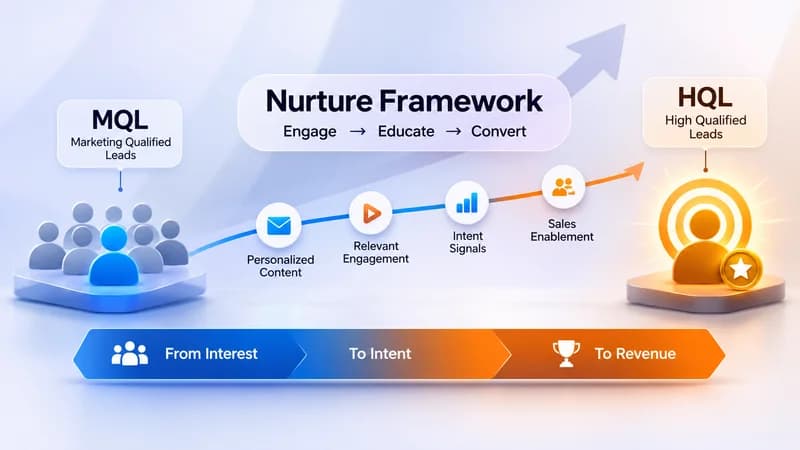
Your MQLs are opening emails, downloading reports, and attending webinars. But are your nurture campaigns helping them move closer to becoming HQLs? An MQL shouldn’t reach sales with nothing more than a lead source and a trail of email clicks. Nurturing needs to do more than maintain engagement. It should help marketing understand what prospects are interested in, what business challenges they’re exploring, and what they need to move forward. Here’s how to structure that process. What Is an MQL-to-HQL Nurture Framework? An MQL-to-HQL nurture framework is a structured process that uses relevant content, behavioral signals, and timely follow-ups to develop the context needed to move a Marketing Qualified Lead (MQL) toward Highly Qualified Lead (HQL) validation. It connects prospect engagement with business needs and buying interests, helping marketing assess whether further qualification is justified. A MQL has engaged with marketing and shown potential interest but isn’t necessarily ready for a sales conversation. As the lead progresses, teams need to evaluate whether the available evidence meets their HQL qualification requirements. Since HQL criteria vary by organization, Marketing and Sales should agree on the evidence required before a lead progresses to that stage. Why Traditional MQL Nurturing Doesn’t Always Create Progress A prospect can download several reports and attend a webinar without getting any closer to a purchase decision. That’s because engagement alone doesn’t tell marketing what the prospect needs next or whether their interest connects to a business requirement. Three issues can get in the way: Calendar-led follow-ups: Prospects receive scheduled emails regardless of whether their interests or engagement have changed. Engagement mistaken for progress: Clicks and downloads are treated as buying signals without enough context. Disconnected communication: Automated sequences continue even when a prospect has replied or needs a human response. A structured MQL-to-SQL nurturing process can help teams connect these interactions through more consistent follow-ups and relevant content. The Four Stages of an MQL-to-HQL Nurture Framework Each stage should help marketing understand something new about the prospect. The objective is to make the next interaction more relevant than the previous one. Stage 1: Start With the Original MQL Interaction Begin with the action that qualified the prospect as an MQL. Someone who downloads a product comparison guide has shown a different interest from someone who registers for an introductory webinar. Review the information already available: Content consumed: Was it an introductory resource, a comparison, or a product-specific asset? Topic of interest: What challenge or business function does the interaction relate to? Conversion source: Did the prospect arrive through a campaign, organic search, or an event? Available lead information: What do you know about their role, company, and industry? Use this information to decide where the conversation should begin. Don’t restart every MQL with the same introductory sequence. Build on what the prospect has already shown you. Stage 2: Develop Business Context Through Relevant Content Once you understand the initial interest, use subsequent content to explore the business problem behind it. For example, a prospect who downloads a guide on marketing automation could receive an article about campaign execution challenges, followed by a resource on measuring automation performance. The content should build on the previous interaction rather than repeat it, with its relevance and timing aligned to the buyer’s needs and journey stage, as B2B content marketing research explains. Consider using: Educational articles to explain the problem and its implications. Industry reports to provide broader business context. Webinars to explore specific challenges and practical approaches. Case studies to show how similar organizations addressed those challenges. Product or solution resources when the prospect shows interest in evaluating potential approaches. Don’t send every asset simply because it belongs to the same topic category. Choose the next resource based on what the prospect has already explored and what they may need to understand next. Stage 3: Use Follow-Ups to Develop a Conversation Content engagement can indicate interest, but follow-ups help establish whether that interest connects to an actual business requirement. A useful follow-up acknowledges the prospect’s previous interaction and gives them a relevant reason to respond. Instead of sending another generic promotional email, ask a question connected to the challenge they explored. For example, after a prospect attends a webinar about lead qualification, a follow-up could ask whether their team currently struggles more with inconsistent MQL criteria or limited visibility into buying intent. A sample sequence might look like this: Timing Prospect interaction Suggested follow-up Day 0 Downloads an MQL qualification guide Send the resource and a related introductory article Day 3 Engages with the related article Share a practical resource on qualification challenges Day 7 Attends a qualification webinar Ask a relevant question about their current process Day 10 Visits a solution or service page Consider a more specific conversation or Sales follow-up The timing is illustrative, not a fixed rule. Adjust it based on the content, prospect behavior, and your audience’s engagement patterns. If a prospect replies with a specific question, pause the automated sequence and respond. If they request a conversation, route that request rather than making them complete the remaining nurture steps. For syndicated leads, follow-up timing and ownership may need to account for the original content interaction and lead source. Valasys’ 30-day content syndication follow-up plan provides a practical example. Stage 4: Transition From Nurturing to HQL Validation Nurturing should eventually give marketing enough context to determine whether a lead is ready for further qualification. Review the evidence gathered during the sequence: Does the prospect’s interest connect to a relevant business challenge? Has their engagement moved beyond general educational content? Have they responded, asked a specific question, or shown interest in evaluating a solution? Is there enough information to support the next qualification step? A content download alone may not justify an HQL transition. The objective is to pass forward the context gathered through nurturing, not simply report that a prospect completed a sequence. Marketing should share the original conversion, relevant content interactions, responses, and the reason for recommending further qualification as part of a clear

Pranali Shelar
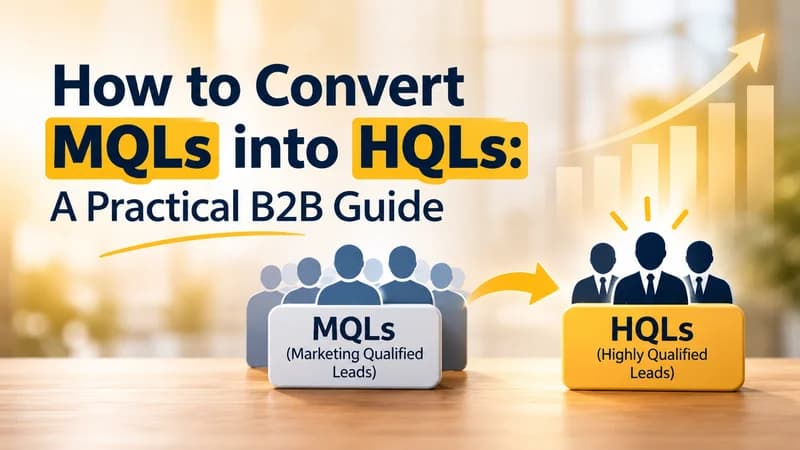
An MQL score of 85 looks impressive on a dashboard. But ask sales what that number tells them about the prospect’s buying plans, and the answer may be surprisingly little. Did the account identify a business problem? Is someone evaluating solutions? Are other stakeholders involved? Or did one contact simply accumulate enough points through content downloads and website visits? The problem with many MQL-to-HQL conversion strategies isn’t a lack of engagement data. It’s the assumption that engagement automatically translates into buying readiness. A scoring threshold can identify active contacts, but qualification requires evidence that their activity connects to a potential business decision. Moving MQLs into HQLs requires a process that does more than identify promising leads. Teams must understand what’s preventing an MQL from advancing, take relevant actions to develop buying interest, and validate whether the resulting engagement justifies sales attention. How do you convert MQLs into HQLs? Converting MQLs into HQLs requires evaluating existing leads, identifying qualification gaps, and taking targeted actions to establish buying readiness. Teams should assess contact and account fit, use relevant nurturing to develop interest, monitor buying signals, evaluate account-level activity, and validate qualification with sales. Leads should advance when their business relevance and buying evidence meet agreed HQL criteria, rather than simply crossing an engagement-score threshold. Before improving conversion, teams need to rethink what qualifies an MQL for further evaluation. 1. Stop Treating Every MQL as an Equal Opportunity Two MQLs can have identical engagement scores and entirely different commercial potential. Consider these examples: Lead A downloads three resources, attends a general industry webinar, and subscribes to your newsletter. Their activity shows interest in the subject, but there’s no clear indication of an active evaluation. Lead B visits product and pricing pages, returns to a solution comparison page, and interacts with content about implementation. Their activity suggests a more specific interest in evaluating a solution. A conventional scoring model might rank both leads similarly if it assigns points to downloads, attendance, and page visits. A stronger qualification approach recognizes that the second lead has more meaningful evidence. Engagement shows that someone interacted with your brand. Buying progress suggests those interactions connect to a potential business decision. When teams overlook this distinction, activity-heavy leads can crowd out contacts with stronger commercial potential. These MQL conversion gaps often begin when engagement is mistaken for buying readiness. Start by segmenting your existing MQLs according to their conversion readiness. Instead of sending every MQL through the same follow-up process, examine what the available evidence suggests about their next step. MQL segment What the available evidence suggests Recommended action Strong fit, meaningful buying signals The contact and account are relevant, with evidence of solution evaluation Prioritize for sales validation and timely follow-up Strong fit, incomplete buying signals The account matches your ICP, but the business requirement or evaluation stage remains unclear Move into targeted nurturing and monitor new activity High engagement, weak account fit The contact is active, but the organization or role may not match your target market Investigate fit and data accuracy before advancing Weak fit, limited engagement Neither the profile nor activity supports further qualification Deprioritize or disqualify based on your criteria These aren’t universal qualification rules. They’re a practical way to decide where existing MQLs need attention. To understand the difference, examine the context behind each interaction: What was the person researching? Did they explore a specific solution or remain at the general information stage? Were their interactions recent and consistent? Did their activity indicate a developing business requirement? A lead’s activity history should tell a story. If the only evidence is a collection of unrelated clicks, the qualification decision needs another look. 2. Evaluate the Evidence Behind Buying Intent Not all engagement signals carry the same meaning. A newsletter subscription, a product comparison, and a request for implementation details represent different levels of interest. The challenge is interpreting those actions without assuming that every high-intent-looking interaction signals an immediate purchase. Consider three broad categories: Signal category What it indicates Examples General engagement Interest in a topic or brand Blog visits, newsletter subscriptions, introductory downloads Solution exploration Interest in addressing a particular problem Product-page visits, feature comparisons, integration research Purchase evaluation Possible movement toward a buying decision Pricing research, demo requests, implementation questions These categories provide context, not automatic qualification rules. For instance, a pricing-page visit may indicate commercial interest. It could also come from a competitor, a student, or someone conducting general research. Similarly, a demo request can be a strong signal, but it doesn’t establish that the account has a relevant business need. The same action can mean different things depending on who performs it and what happens before or afterward. Use the signals to determine what the MQL needs next. For example: A prospect engaging with general educational content may need resources that help clarify the business problem. Someone researching product capabilities may benefit from a relevant solution comparison or customer use case. A contact exploring pricing and implementation may warrant a more direct conversation about their requirements. A previously active prospect who has stopped engaging may need a different approach rather than another automated promotional email. This makes nurturing more relevant because the next interaction responds to the prospect’s actual behavior. Consider recency and consistency A prospect who visited your product page six times in one afternoon may appear highly engaged. But what if those visits happened several months ago? Another prospect who returned twice this week to explore a particular feature may offer stronger evidence of current interest. Look at: Recency: How recently did the activity occur? Frequency: Is the person returning to relevant content? Consistency: Do interactions point toward the same business problem? Progression: Is the person moving from general research toward solution evaluation? This prevents outdated or isolated interactions from carrying too much weight. It also makes qualification more responsive to changing buyer behavior. A lead that once showed strong interest may no longer be actively evaluating a solution. Conversely, a previously quiet contact may begin showing