
Lead-Gen now on Auto-Pilot withBuild My Campaign
Valasys Media — Empowering marketers with powerful insights

LinkedIn B2B Marketing: 10 Things You Should Know

This article outlines the top 10 things you need to know to create a successful LinkedIn B2B marketing campaign.

Valasys Media
Valasys Media
Last updated on: Dec 18, 2025
LinkedIn- B2B- Marketing-: 10- Things- You- Should- Know

Are you struggling to reach your target audience with B2B marketing?

If so, you’re not alone. Many businesses find it challenging to reach their target audience on LinkedIn, the world’s largest professional networking platform.

But what if there was a way to use LinkedIn to reach your target audience and achieve your marketing goals?

In this article, we’ll discuss the top 10 things you should know for LinkedIn B2B marketing. We’ll cover everything from optimizing your company page, creating effective content, and running ads.

By the end of this article, you’ll understand how to use LinkedIn to reach your target audience and achieve your marketing goals.

Learn about the benefits of incorporating LinkedIn into your B2B marketing strategy with these valuable advantages:

  • LinkedIn has a large and engaged audience. There are over 830 million members on LinkedIn, many actively looking for new products and services.
  • LinkedIn is a highly targeted platform. You can target your marketing messages to specific demographics, industries, and job titles.
  • LinkedIn is a great way to build relationships with potential customers and partners. You can connect with people in your industry, share content, and participate in discussions. Using a reliable LinkedIn lead generation tool can further streamline this process and help you identify the right prospects more efficiently.

Read till the end to uncover some proven expert tips for LinkedIn B2B Marketing.

10 Things you Should Know for LinkedIn B2B Marketing

1. Work on the Header Image

Ensuring that the header image of your LinkedIn profile resonates with your target audience is the primary step towards acing LinkedIn B2B marketing.

The header image is the first impression of your company to your target audience, which is why it is essential you create something that is catchy as well as informative of what your company is doing.

For example, you could take inspiration from Neil Patel’s LinkedIn profile. They have a header image which clearly shows what they do and who their prospects are, and why value do they bring to the table.
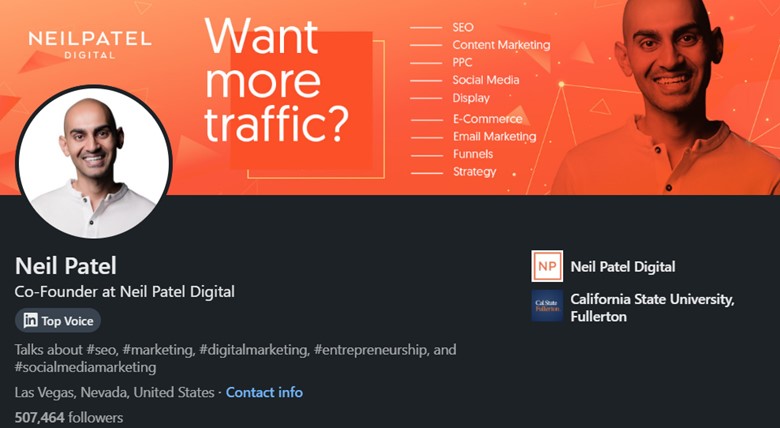
Screenshot of Neil Patel’s LinkedIn header image for LinkedIn B2B marketing

Some other ideas for an on-point header image are:

  • Add the feature image of a case study or a guide that reflects your services
  • An achievement that also reflects your USP (you can take inspiration from HubSpot)
  • Something you can do for free – like maybe an SEO audit.

The key is to advertise indirectly. There are many ways to advertise indirectly on LinkedIn. You can create informative content, offer free trials, or sponsor events that your target audience is interested in. The key is to find ways to show your target audience that you understand their needs and that you have something valuable to offer them. By following these tips, you can increase your chances of success on LinkedIn.

2. Draft a Compelling Company Description

Let’s be honest. Most of the people that actually click on a company’s “see more” tab in their description are job seekers.

So, if you want your potential clients to hit that “see more” tab, you need to write those first two lines of the company description in a way that compels them to continue reading. And as mundane as it may sound, you need to make your company stand out. Which clearly means not stating the usual how many employees your company has or when was it founded. If you must, you can include these later in the paragraph, but not in the first two sentences.

Your first two sentences should clearly define three things:

  • Your target audience
  • Your value proposition, and
  • What services you provide

For example, if you are a B2B company providing financial consulting your first two lines could be something like this:

We specialize in providing comprehensive financial consulting services (services provided) to businesses (target audience), helping them optimize their financial strategies and achieve sustainable growth. Our team of experts combines industry knowledge and cutting-edge solutions to deliver tailored financial solutions that drive results and add value to our clients’ bottom line (value proposition).

This will drive your target prospect to not only continue reading your whole company description but also visit your website. Hence, ensuring that your website is updated with all the latest information is always a good practice.

3. Utilize Showcase Pages

For businesses that have multiple subsidiaries offering different services to the same target audience, LinkedIn Showcase Pages are the best option. LinkedIn showcase pages are a great way to highlight specific aspects of your business or organization. They can be used to showcase your products or services, your team members, or your events.

Consider adding LinkedIn showcase pages to your strategy. They offer great benefits, such as:

  • Increased visibility: Showcase pages can help you improve your visibility on LinkedIn. They can be found in search results and linked to your company’s website or blog.
  • Targeted audiences: Showcase pages can be targeted to specific audiences. This means you can show your content to the people most likely to be interested in it.
  • Brand awareness: Showcase pages can help you build brand awareness. They can show potential customers, partners, and employees what your company is all about.
  • Lead generation: Showcase pages can help you generate leads. If you include a call to action on your showcase page, you can encourage people to contact you or learn more about your business.

To maximize the impact of your Showcase pages, consider the following strategies:

  • Optimize for Conversion: Ensure your Showcase page is designed with conversion in mind, just like your company page. Create compelling content, incorporate persuasive elements, and provide a clear call to action to encourage visitors to take desired steps.
  • Keep the Page Name Concise: A short page name is crucial to avoid truncation in the display sidebar. This ensures that the full name is visible and readily comprehensible to your audience, making it more effective in capturing their attention.
  • Use Audience-Friendly Terminology: When naming your Showcase page, incorporate a word or phrase that resonates with and is effortlessly comprehended by your target audience. This establishes a connection and helps them quickly grasp the purpose and relevance of the page.
  • Broaden Your Lead Generation: Consider Showcase pages as an additional avenue to expand your reach and attract more targeted leads genuinely interested in your product or service. By casting a wider net through these pages, you can capture the attention of a broader audience and generate more potential leads.

By enforcing these strategies, you can optimize your Showcase pages to drive conversions, increase visibility, and attract quality leads specifically interested in what your business offers.

4. Groups are the Star-Performers of LinkedIn B2B Marketing

LinkedIn offers a range of community features that facilitate seamless communication with other users, clients, or partners, ultimately expanding your network. The two primary types of community features on LinkedIn are groups and influencers.

Groups: Joining groups that align with your interests or expertise allows you to stay updated on industry developments and maintain connections within your network. Additionally, you can create a group for your company, providing a platform to expand your influence and engage in discussions with other members.

Influencers: LinkedIn influencers are thought leaders who share valuable insights and discuss trending topics. Engaging with these influencers by commenting on their posts allows you to participate in meaningful discussions and gain visibility within the LinkedIn community.

By leveraging these community features effectively, you can establish connections, stay informed, and actively contribute to discussions, enhancing your professional presence on the platform.

5. Identify your Target Audience

Identifying your target audience in LinkedIn B2B marketing involves segmenting professionals based on industry, job title, company size, and location. Creating buyer personas helps tailor messaging and content to resonate with the audience’s needs. LinkedIn’s analytics and audience research provide insights for refining targeting strategies. Understanding the target audience allows for more effective B2B marketing, relevant content delivery, and meaningful connections on LinkedIn.

Build My Campaign

If you want to learn more about generating leads through LinkedIn, read this blog: 11 Steps to Use LinkedIn Marketing Platform for Lead Generation.

6. Publish Relatable Content

Stating the obvious but utilizing LinkedIn’s robust content publishing platform is essential for effective LinkedIn B2B marketing strategies. By creating high-quality content, you can shift from outbound marketing, which relies on ads to grab attention, to an inbound strategy that attracts genuinely interested users.

To achieve this, publishing content as an individual and as a company on LinkedIn is recommended. A notable example on the company side, Adobe sets a great example by sharing colorful and inspiring stories about their employees rather than adopting a dry and purely corporate tone. This approach draws attention to the brand without being pushy or overly sales oriented.
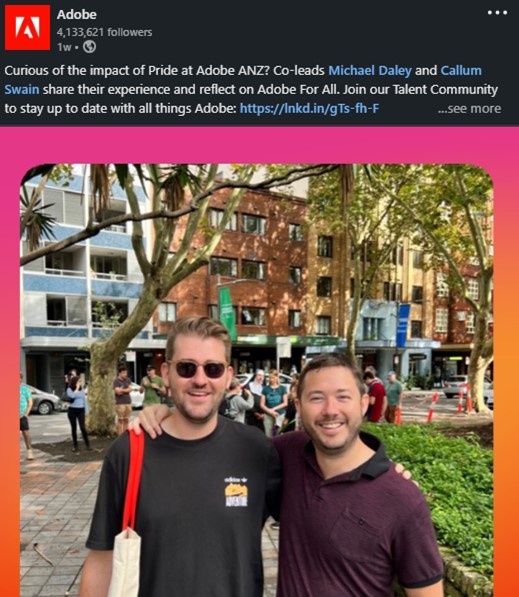
Screenshot Adobe’s posts as a good strategy for LinkedIn B2B marketing

If you have publishing access on LinkedIn, leverage this platform to increase your exposure.

Rather than posting randomly, scheduling posts on LinkedIn ensures you’re publishing during your best hours when your audience is most engaged. Many LinkedIn members who have utilized the publishing feature have reported experiencing considerable success.

7. Save Search

When conducting a highly specific and targeted search, it is essential to save your progress to facilitate ongoing prospecting efforts. Acing LinkedIn B2B marketing requires consistent activity to maintain a steady sales pipeline.

To save a search, simply access the “Save search” option in the upper right corner of your advanced search interface. Creating a saved search allows you to quickly retrieve the exact search parameters in the future. Also, it enables you to set up alerts for new relevant results.

Although, you can only save up to three searches if you have an essential subscription. Therefore, upgrading your subscription may be necessary to save a more significant number of inquiries and enhance your prospecting capabilities.

8. Optimize Page Performance

If prospects do not click through to your company website from the company information section, you can still reach them by posting updates. As long as you post updates regularly, you will have an active and engaging feed. The best way to generate leads from this section is to post updates that are directly aimed at your target audience. You can post blog updates, link to your infographics, and share other information, but keep in mind that you are looking for click-throughs from information-seekers.

These are the basic steps to optimizing a company page. If your industry has broad appeal, you will likely see quite a few leads by incorporating in your LinkedIn B2B marketing strategy. However, if you are in a very small niche, you will need to focus on other strategies to generate leads.

9. LinkedIn Ads for LinkedIn B2B Marketing

LinkedIn Ads offers various campaign options that effectively drive brand awareness and generate leads, presenting marketers with diverse opportunities. The commonly utilized ad formats include Sponsored Content, Sponsored InMail, and Text Ads. The latest and highly anticipated addition to this lineup is LinkedIn Video Ads.

Sponsored Content is LinkedIn’s native advertising, allowing publishers to boost regular posts with an allocated ad budget.

With Sponsored InMail, marketers can send personalized messages directly to their target audience using the platform’s private messaging system, enabling direct content delivery.

Text Ads appear at the top or right side of users’ feeds, typically consisting of concise text accompanied by optional small images. They are often used to drive leads and promote specific offers.

LinkedIn Video Ads automatically play within users’ feeds, offering an effective means to increase engagement and views for your content.

10. Testing is the Key

Determining your business’s most effective tactics and strategies and conducting A/B testing is crucial. This process allows you to identify and implement the optimal solutions, ensuring that your campaigns are executed effectively, targeting key prospects, and saving time and budget by eliminating ineffective methods.

Conclusion

LinkedIn is a powerful tool for B2B marketers. Using the tips and strategies outlined in this blog, you can increase your visibility, generate leads, and grow your business.

Here are some more bonus tips for you:

Maximize your LinkedIn presence by showcasing your identity and making a positive impression. Adjust your visibility settings in the Privacy & Settings section to allow others to see your profile. Additionally, take advantage of the “Who’s Viewed Your Profile” feature to gain insights on visitors and identify potential connections.

To further enhance your profile, utilize LinkedIn’s media features to add videos, images, documents, links, and presentations that showcase your work. Utilize SlideShare integration to create interactive presentations. By leveraging these tools, you can effectively showcase your accomplishments and skills, making a lasting impact on LinkedIn.

Stay tuned for more such information.

FAQs

Is LinkedIn an effective platform for B2B marketing?

Absolutely! But its benefits go beyond that. LinkedIn perfectly showcases profile information and shared content, making it an ideal platform for refining business searches. You can access members’ interests, education, and experience with just a click. LinkedIn is tailor-made for B2B marketing, offering unparalleled targeting opportunities.

How frequently should B2B marketers post on LinkedIn?

For optimal results, B2B marketers should aim to post two to five times per week, totaling up to 20 monthly posts. It’s advisable not to exceed one post per weekday to maintain a consistent and engaging presence.

Why is LinkedIn a must-have for B2B marketers?

LinkedIn campaigns produce impressive results. The ability to target professionals based on specific companies or industries and filter by job title empowers B2B marketers to reach decision-makers effectively. This makes LinkedIn an indispensable and potent tool for B2B companies, driving impressive results.

Related Posts

Gaming Ad Spend Hit $25 Billion and Attention Became the Bottleneck

Gaming Ad Spend Hit $25 Billion and Attention Became the Bottleneck

Guest Author

Mobile game companies spent about $25 billion on user acquisition in 2025, according to the State of Gaming for Marketers report that the attribution company AppsFlyer published in January, which put the increase over 2024 at 3.8%. Installs that publishers paid for rose by roughly a tenth over the year, while the ads they ran were seen about a fifth more often. According to the report, the largest game advertisers each produced between 2,400 and 2,600 versions of their ads per quarter in 2025. Part of this work is done by outside art studios, and Innovecs Games lists key art, store screenshots, social media visuals and motion graphics for ads among the services on its game marketing art page. Where the $25 billion was spent in 2025 About 35% of the money came from publishers based in China, whose spending on Android rose by 29% in 2025 and on iOS by 10%, according to AppsFlyer. The report also found that 57% of paid game installs worldwide were on Android devices, a share that AppsFlyer linked to lower costs in markets outside the West. Spending fell by about 5% in the United States, which still accounts for close to half of the total, and rose by 29% in Turkey and by 19% in India. Publishers based in China increased their share of global spend by 22% over the year. Year Paid installs Ad impressions 2024 100 100 2025 110 120 On iOS, paid installs made up 44% of all game installs in 2025, AppsFlyer said, while the rest came from people who found a game in the App Store, through friends or in some other way without clicking on an ad. Paid installs by genre in 2025 Purchases inside games were still concentrated in Western markets, which produced 55% of in-app purchase revenue on Android and 66% on iOS in 2025, and the United States alone produced about 45% of the iOS total, according to AppsFlyer. According to AppsFlyer, casual games took more than half of all acquisition budgets in 2025, and their Android spending fell by 7%. Hypercasual publishers bought 81% of their Android installs and 67% of their iOS installs, according to the report. Hypercasual games cut iOS spending by 14% On iOS, spending on hypercasual games fell by 14%, while the genre kept growing on Android, where an install costs less. On Android the share of casual game installs that were bought through ads went up by 18%, while the amount casual publishers spent there dropped by 7%. Brazil and Mexico were among the fastest growing markets for paid installs in 2025, according to AppsFlyer, with most of the growth on Android. AppsFlyer linked that growth to games that earn money both from in-app purchases and from ads shown to their players. Midcore games on iOS Midcore games, a group that includes strategy and role playing titles, grew strongly on iOS, where their acquisition budgets rose by 26% and the share of their installs that came from paid ads grew by more than 30%. Players of these games spend more money over time than casual players, so publishers can afford to pay more for each install. Publishers of midcore games have found it harder to reach these players on iPhones since April 2021, when iOS 14.5 began asking users whether each app could track them across other companies’ apps and websites. Flurry Analytics, then owned by Verizon, reported in May 2021 that 96% of users in the United States had said no, and Meta told investors in February 2022 that the change would cost it about $10 billion in revenue that year. What business to business advertisers can take from the games market LinkedIn, where many B2B companies buy much of their advertising, says it has more than one billion members in over 200 countries and territories. Those members are also among the people who saw 20% more game ads in 2025 than a year earlier, according to the AppsFlyer report. At 2,400 to 2,600 versions per quarter, the largest advertisers in the AppsFlyer data made between 185 and 200 new versions of their ads each week in 2025, about a quarter more than in 2024, while paid installs across the games market grew by about a tenth.

How to Standardize IT Procurement Across Multiple Countries

How to Standardize IT Procurement Across Multiple Countries

Guest Author

The first time a company opens an office in a second country, procurement usually still feels manageable. Someone emails a local supplier, someone else approves the invoice, and the laptops turn up. By the fifth country, that same improvised habit has quietly become five purchasing cultures, five hardware standards, and a finance team that cannot say with confidence what the business spent on equipment last quarter. Standardizing procurement across borders is not about forcing every office to buy the identical machine from the identical vendor. Customs rules, power standards, keyboard layouts and local warranty coverage make that fantasy expensive. What it actually means is building one shared set of rules about how buying decisions get made, so the outcome stays predictable even when the supplier on the invoice does not. Done well, the result is boring in the best possible way. A new hire in Manila receives the same class of device as a new hire in Madrid, the approval takes a day rather than a fortnight, and nobody has to reconstruct the logic of a purchase eight months after the fact. Centralized Policy Beats Centralized Purchasing The instinct, when procurement gets messy, is to pull every purchase into headquarters. It rarely survives contact with reality. A regional manager who needs a replacement laptop on Thursday will not wait nine days for a committee in another time zone, so they buy one on a corporate card and the policy loses credibility the first week it exists. Centralizing the policy instead of the transaction solves the same problem without the bottleneck. The central team owns the specification, the approved supplier list, the spend thresholds and the record that has to exist afterwards. Local teams keep the authority to execute inside those rails, which is where their knowledge of local lead times and import paperwork is worth far more than any central process could be. Hardware Standards Work Better as Tiers Than as Model Numbers A standard that names one exact model breaks the moment that model goes out of stock in one market, which happens constantly. Tiers hold up better. Define three or four profiles by what the work demands: a light profile for sales and support, a standard profile for most knowledge workers, a heavy profile for engineering and design, and a shared or loaner pool for contractors and short assignments. Each tier gets minimum specifications rather than a part number: memory, storage, processor class, warranty length, encryption support and the management features your endpoint tooling needs to enroll the device. Now a buyer in São Paulo can satisfy the standard with whatever is genuinely available there, and the fleet stays coherent anyway. The secondary benefit is negotiating power, because tiered demand is forecastable demand, and suppliers discount volume they can predict. Supplier Databases Are the Piece Most Companies Skip Every multinational accumulates supplier knowledge, and almost all of it lives in individual inboxes. A supplier database is unglamorous insurance against that: one record per vendor, covering the countries they actually ship to, negotiated pricing, typical lead times, warranty terms and who last dealt with them. It is also where the regulatory detail belongs, because that detail varies enormously and nobody memorizes it. Importing communications equipment into Indonesia, for instance, requires local testing and a certificate from the national digital infrastructure authority, as the U.S. Commerce Department’s import documentation guidance sets out. Tariffs are a softer constraint than most teams assume, since the WTO’s Information Technology Agreement covers participants representing roughly 97 percent of world trade in IT products and commits them to eliminating duties on covered goods. Knowing which of those two worlds a given shipment sits in is the difference between a week and a month. Approval Workflows Should Turn on Thresholds The last piece is the one people overbuild. An approval workflow exists to catch the unusual purchase, not to re-examine the ordinary one. If a request matches an approved tier, comes from a listed supplier and falls under a set value, it should clear automatically with a record written and the budget holder notified. Anything outside those lines routes to a human, and because that queue is now small, the human can look at it properly. Workflows only stay honest if the record is automatic. Ask people to update a spreadsheet after the fact and you will have partial data within a month, which is worse than none, since partial data still gets used for budgeting. Running the process through a single global it procurement platform keeps the request, the approval, the order and the resulting device assignment attached to each other, which is exactly what auditors and finance ask for and exactly what scattered email threads cannot produce. Where the Groundwork Pays Off Standardization tends to get sold as a cost exercise, and it does save money, mostly by ending duplicate purchases and emergency retail buying at list price. The larger return is speed. A company that can equip a new office in three weeks instead of three months can open offices more willingly, and that changes what the business is able to attempt. Infrastructure choices compound the same way, which is why it helps to read procurement alongside the physical and hosted infrastructure decisions sitting underneath it. None of this has to land at once. Most teams get the largest gain from the first two steps alone, because a written policy and a tiered specification remove most of the ambiguity that makes cross-border buying slow. The supplier database and the workflow stop that gain from eroding as staff change and country count grows. The test is simple enough to run today. Pick a country you entered in the last two years and ask who approved the most recent hardware order there, what was bought, and where those machines are now. If answering takes more than a few minutes, the problem is not the people; it is that nothing in the process was ever designed to hold the answer.

Checking Geo-Targeted Campaigns Before Launch: A Practical QA Routine for B2B Marketers

Checking Geo-Targeted Campaigns Before Launch: A Practical QA Routine for B2B Marketers

Guest Author

Multi-region campaigns fail in quiet ways. The German landing page loads in English. The UK form routes leads to the US sales team. The ad that should run in Singapore never shows at all. These are examples of launch defects worth catching before paid traffic arrives. A useful QA routine checks the ad, the landing page and the lead handoff separately. No single preview reproduces every buyer’s experience, but each check can catch a different kind of failure. Why Geo QA Matters for ABM and Multi-Region Campaigns Account-based and multi-region campaigns depend on precision. You’re paying to reach specific companies in specific places, often at high cost per click. A mismatch in currency, language or form behaviour can lose a lead even when the targeting is right. For ABM, confirming that the enquiry reaches the correct account owner matters as much as confirming that the page looks right. Some of these errors are easy to miss from your own desk. Ad platforms, websites and search engines adjust what they show by location, so the version you see in the office isn’t the version your buyers see. Spot-Check IP-Based Regional Behaviour A Free VPN can help spot-check IP-based regional behaviour when its available exit locations include the country you need. Check the current plan and app first: location choice varies by service and platform, and a free plan is not automatically suitable for every market. Connect to an available target region, then open the campaign’s landing-page URL directly. Changing the public IP is only one part of the test. Browser language, cookies, account settings and device location can influence what appears. A VPN does not change GPS coordinates or turn your device into a local buyer’s phone. If a result is important or unexpected, ask a colleague in the market to reproduce it. Two rules keep this clean: Avoid searching for and clicking your own live ads. Use the platform’s preview tools and open the destination URL directly, rather than creating unnecessary impressions or clicks. Start a fresh private browser session without signing in. This reduces carry-over from ordinary browsing, but does not remove every location or personalisation signal. Test returning-visitor behaviour separately when it matters. Record the exit region, browser language, device and consent state alongside each result. Without those details, two testers may be comparing different conditions rather than finding an intermittent bug. Use the Built-In Previews First For ad eligibility, use the platform’s own tools before drawing conclusions from a live search. A missing ad in one VPN session is not proof that a campaign is broken. Google Ads’ Ad Preview and Diagnosis tool shows whether your search ads are eligible to appear for a keyword in a chosen location, without creating impressions. Google Search Console’s URL Inspection helps check indexing and Google’s access to a page. It is not a regional ad preview or a conversion test; some paid landing pages are intentionally not indexed. Social ad platforms offer creative and placement previews; check which formats the platform supports. These tools answer different questions. An ad preview does not verify the full journey through redirects, forms and CRM routing. Check that journey separately, including a real mobile browser when mobile traffic is part of the plan. A Five-Point QA Checklist for Each Market Before testing each country, write down the expected language, offer, destination URL and receiving sales team. Then run these checks: Language. The page, form labels, error messages and thank-you page match the intended audience. Test automatic redirects and any manual language selector; do not assume a buyer’s language preference from their IP location alone. Currency and pricing. If prices are shown, confirm the intended currency, offer and tax wording with the owner of that market’s campaign. Do not assume every regional page needs a different currency. Consent and privacy. Test the market’s approved consent setup: accept, reject and change preferences, then check form behaviour. Confirm expected tracking with the privacy and analytics owners; a banner appearing is not proof of legal compliance. Form routing. Agree on test contact details first. Submit a clearly labelled test lead and verify the confirmation page or email, campaign fields and receiving CRM owner. Exclude the test from lead scoring, sales outreach and reporting where your systems allow it. Page speed. Use a performance test with a probe in or near the target region and a stated device/network profile. A VPN adds its own routing and latency, so its load time is not a reliable local-speed benchmark. Record expected versus actual results in a shared sheet, with the URL, test conditions, date, evidence and person responsible for the fix. Use synthetic test data and redact screenshots before sharing them. Agree what blocks launch. A form that loses submissions or routes them to the wrong team needs fixing and retesting. A minor spacing issue can have a different priority. Sign off the affected journey after a fix, rather than relying on a screenshot of the corrected page alone. Set a Simple Team Policy Geo checks work best when everyone uses the same approved tools on company devices. Agree on which VPN and browsers the team uses, who runs checks for which markets, and where the evidence is stored. If your marketers work on MacBooks, X-VPN for Mac is one option your IT team can review and approve for these checks. A campaign that’s right in every market looks effortless to the buyer. Behind it is usually a short check in each region, done before launch rather than after the budget is gone.