
The Psychology of Gratitude Marketing: Why Empathy Converts Better Than 70% Off
Discover how gratitude marketing builds trust, emotional loyalty, and long-term conversions often outperforming heavy discounts and offers.


The marketing world is undergoing a shift. A meaningful one. And to be honest, it has been overdue for a long time.
For more than a decade, brands have leaned on the same predictable playbook: countdown timers, urgency banners, repetitive discount codes, and one too many “exclusive limited time offer” pop-ups. These tactics had power once, back when digital audiences were less fragmented and novelty still existed.
Now the reaction has flipped. What used to create excitement now creates fatigue. The average buyer is numb to sales language. Discounts are no longer persuasive; they are expected. Buyers know when urgency is manufactured, and they can tell when a business is trying to push rather than serve.
Meanwhile, something quietly powerful has been outperforming traditional persuasion models.
Not louder messaging, not deeper discounting, not more aggressive funnels.
Instead, the winning brands are building connections. They are choosing warmth over pressure and relationship over urgency. They are replacing transactional tactics with human recognition.
That shift is gratitude marketing.
It is not a soft, sentimental approach. It is rooted in behavioral psychology, emotional memory, trust formation, and long-term loyalty mechanics. Gratitude is not just a thank-you message after purchase. It is a system for retention, belonging, and advocacy.
Welcome to a marketing era built not on extraction, but on connection.
Why Gratitude Works: The Psychology Behind It
Human beings are wired to respond to appreciation. The moment someone acknowledges our effort, identity, or presence, the brain activates the reciprocity instinct. We feel compelled to mirror the energy and respond positively.
When a brand expresses genuine gratitude, several psychological responses occur:
Trust increases; fear decreases.
Belonging increases; purchase resistance decreases.
This is not theoretical. It is biological.
Gratitude quietly flips four of the brain’s emotional switches, and that’s why it lands so powerfully in marketing.
- Dopamine fuels the sense of progress and keeps people leaning in.
- Oxytocin deepens trust and makes the relationship feel genuinely collaborative.
- Serotonin brings emotional steadiness, so the experience feels safe and satisfying.
- Endorphins lock in a warm memory of the interaction, making the brand feel good to return to.
Discounts create urgency, and gratitude creates attachment.
A discount might close a sale once, but gratitude keeps a customer for years.
Why Traditional B2B Messaging is Losing Power
Brands across SaaS, coaching, consulting, and B2B services were told that professionalism meant stripping away personality. The outcome is painfully familiar. Websites read like rulebooks instead of invitations. Onboarding emails feel like internal memos meant for a compliance team. Social posts land with the energy of a monthly expense report. It’s communication that technically “says something,” but emotionally says nothing.
Modern buyers are surrounded by content that feels alive; creator-led insights, conversational newsletters, transparent founders, and brands that talk like actual humans. So when B2B companies show up with language that feels cold, stiff, or automated, buyers immediately detach. There’s no connection, no moment of recognition, no sense of “you get me.”
And at the end of the day, the person evaluating your product is still a human being navigating pressure, deadlines, and the fear of making the wrong call. Even the most analytical decision-maker experiences the emotional ripple before the logical justification kicks in. That means the internal dialogue they’re having sounds less like a cost-benefit analysis and more like:
- Can I trust this team to support me?
- Do they understand the real challenges of my role?
- Do they treat me like a partner or a transaction?
- Will I feel confident presenting this choice to my leadership?
Traditional, transactional messaging rarely addresses these deeper questions. It focuses on claims, features, and credentials; all functional, none relational. Gratitude-led communication, however, acknowledges progress, effort, learning curves, and the emotional stakes tied to business decisions. It builds security. It builds respect and builds affinity.
And in an environment where products look similar and offers blur together, the brands that make buyers feel seen are the ones that consistently win.
The Gratitude Marketing Flywheel
Gratitude marketing is not about random appreciation. It is about designing a relationship-building system that compounds emotional trust over time.
Here is the flywheel:
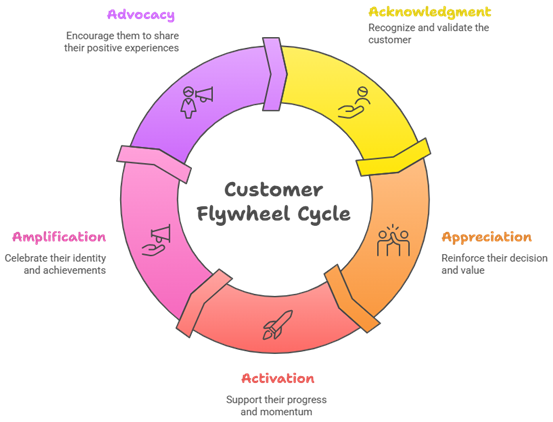
This model works beautifully across SaaS onboarding journeys, coaching cohorts, retention programs, service delivery pipelines, community ecosystems, and membership models. Funnels end. Flywheels compound.
HubSpot is one of the clearest real-world examples of this approach. Their entire growth engine is built on the flywheel : Attract, Engage, Delight. Customers aren’t the “final stage”; they’re the force that keeps the wheel spinning. Every milestone triggers acknowledgment, every resource feels like a supportive nudge, and every user win is amplified across their ecosystem. Happy customers become promoters, feeding the wheel with referrals, community contributions, and repeat engagement; creating a growth loop instead of a one-off path.
How to Apply Gratitude in B2B Models
Gratitude shows up differently depending on the business model, but the emotional principle is consistent: people stay loyal where they feel seen.
SaaS companies, gratitude can appear as personalized onboarding flows, customer milestone recognition, feature release updates crediting user feedback, and supportive messaging rather than pressure messaging.
For service businesses, gratitude can appear through kickoff messages acknowledging trust, transparent communication throughout the project, client celebration content, and end-of-engagement recognition rather than simply sending an invoice and goodbye.
For education and coaching brands, gratitude can appear through identity affirmation. Students are not just buying information. They are buying transformation. Key touchpoints such as welcome videos, milestone praise, community recognition, and progress reflections strengthen emotional belonging.
Gratitude becomes a cultural operating system, not a marketing tactic.
Messaging Templates in Practice
Here are examples that demonstrate the shift.
| Traditional Messaging | Gratitude-Grounded Messaging |
| Your trial expires soon. Upgrade now. | You started something meaningful. If you want support taking the next step, we’re here when you’re ready. |
| Final reminder before we close the cart. | Thank you for considering working with us. Whether the timing is now or later, we respect your decision process. |
| We noticed you have not logged in. | Your tools are waiting, and we’d love to help you build momentum again if you’d like guidance. |
The language feels human. It respects autonomy. It removes pressure and increases emotional safety.
Real B2B Brands Applying Gratitude
Several successful modern brands are already modeling this approach.
- Zapier writes onboarding copy that reduces overwhelm and emotionally normalizes learning. It also supports community sharing through its public Templates Gallery, where user created workflows are highlighted as contributions, not commodities.
- Notion publicly celebrates user created templates and community contributions. Its Template Gallery elevates creators, gives them visibility, and treats their work as part of the product ecosystem instead of side content.
- HubSpot treats education as a gift, not a funnel tactic. Its free resources, guides, and success frameworks are framed as support systems designed to help users grow regardless of their purchase stage.
- ClickUp acknowledges users when feature requests become product updates. Users are notified when their request moves through stages, creating a visible loop of gratitude, recognition, and transparency.
These companies are not treating customers as recipients of marketing. They are treating them as collaborators in growth.
The ROI of Gratitude Marketing
Gratitude is measurable. Brands applying this model see increases in:
- Customer lifetime value
- Renewal and retention
- Referral rate
- Product adoption
- Community engagement
- Review and testimonial velocity
People rarely share a discount. They share how a brand made them feel.
The Future of Marketing Looks Human
Artificial intelligence will continue to automate communication. Competition will continue to grow. Information will continue to flood every platform.
What will differentiate brands is not availability or visibility. It will be an emotional presence.
Gratitude is not a strategy to appear likable. It is a strategic advantage that builds deep loyalty and long term revenue resilience.
The future belongs to brands that make people feel respected, supported, and valued.
Not because they offered the lowest price.
But because they offered the highest humanity.
FAQs
1. What is gratitude marketing?
Gratitude marketing is about making people feel seen and valued. It’s not a thank-you email after a sale; it’s a system that builds trust, loyalty, and emotional connection over time.
2. Why does empathy convert better than discounts?
Discounts get a one-time reaction. Empathy sticks. When brands acknowledge effort, identity, or progress, it creates trust, belonging, and long-term attachment.
3. How can B2B brands show gratitude?
Through personalized onboarding, milestone recognition, supportive messaging, and transparent communication. It’s about making clients feel like partners, not transactions.
4. What is the gratitude marketing flywheel?
It’s a system that compounds trust through acknowledgment, appreciation, activation, amplification, and advocacy. Happy customers feed the loop instead of being the end point.