How AI is Reshaping Revenue Teams, Processes, and Outcomes
Discover how AI transforms Revenue Operations by enhancing predictive forecasting, personalizing buyer journeys, and improving data quality for strategic growth.


It’s likely that you have sensed this seismic shift occurring beneath your feet if you are reading this. Algorithms and predictive models are replacing the spreadsheets that used to dominate your quarterly business reviews. And the data reconciliation by hand that took up your weekends? That’s a thing of the past now.
However, after observing hundreds of revenue teams go through this transition, I’ve discovered the following: Human judgment will not be replaced anytime soon in the future of revenue operations in an AI-driven world.
What is RevOps Today?
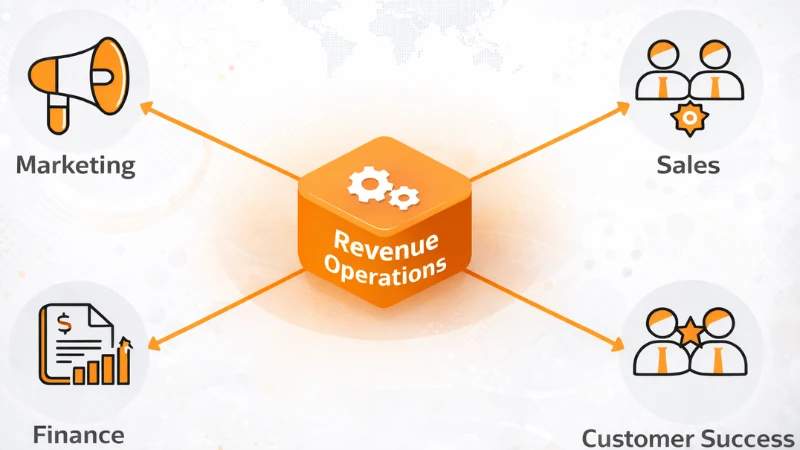
Let’s look at the present before we dive into the promises of tomorrow. The concept of Revenue Operations, or RevOps, was born out of the realization that generating revenue is a company-wide issue that necessitates close coordination between the teams responsible for customer success, marketing, and sales.
Picture RevOps to be your revenue engine’s nervous system. RevOps brings together data, processes, and insights across departments to promote steady business growth, just as your nervous system connects signals between your brain and your muscles in order for you to walk. Revenue technology and analytics, customer success operations, sales and marketing operations, and revenue strategy and planning are the primary pillars of RevOps.
Manual process management, report generation, and data hygiene take up about 60% of the time of traditional RevOps teams. As this quarter’s deals are already falling through the cracks, they’re always catching up and piecing together last quarter’s story. Does that sound familiar?
Why AI is the Inflection Point
This is where the interesting part begins. AI is radically altering the game instead of being just another tool in your RevOps toolbox. We have advanced from basic automation, which is still useful, to proactive decision-making, personalization, and prediction.
Consider this analogy: Having a good rearview mirror is exactly like using traditional RevOps tools. They provide a crystal-clear picture of your exact location. For RevOps, AI is similar to having an advanced GPS that provides real-time traffic information, accident notifications, and route optimization. It not only indicates your current location but also your destination and the most efficient route to get there.
Replacing human decision-making is not the point of inflection. It involves using machine intelligence, which can process enormous volumes of data, spot patterns that are invisible to the human eye, and make recommendations quickly, to supplement human judgment.
5 Key Ways AI is Transforming RevOps
1. Predictive Forecasting & Pipeline Intelligence
Gone are the days when your quarterly forecast was essentially an educated guess wrapped in confidence intervals. AI-powered pipeline intelligence analyzes historical deal patterns, sales behaviors, market conditions, and hundreds of other variables to provide forecasts that are both more accurate and more actionable.
Modern AI systems don’t just tell you that you’re tracking 15% behind quota. They identify which specific deals are most likely to slip, which sales behaviors correlate with higher close rates, and which market segments show the strongest buying signals. One RevOps leader I know describes it perfectly: “Instead of managing by exception, we’re now managing by prediction.”
The impact is measurable. Teams implementing AI-driven forecasting typically see forecast accuracy improvements of 20-40% within the first year, with some achieving variance reductions of less than 5% by their second year of implementation.
2. Hyper-Personalized Buyer Journeys
Revenue operations automation powered by AI enables personalization at scale that would be impossible manually. Instead of treating all prospects in your “Enterprise Healthcare” segment the same way, AI analyzes individual company characteristics, buying committee composition, previous interaction history, and market timing to recommend personalized engagement strategies.
This goes beyond just personalizing emails. We are talking about tailored pricing models that maximize both conversion and margin, dynamic sales playbooks that adjust according to prospect behavior, and content recommendations that correspond with each buyer’s stage of the decision-making process.
The outcome? Conversion rates increase as a result of your message resonating with the unique context and needs of each buyer, and sales cycles grow as a result of each touchpoint feeling pertinent.
3. Autonomous Deal Coaching & Playbooks
Instead of providing contextual coaching during monthly one-on-ones when opportunities have passed and memories have faded, AI-driven sales operations teams are developing systems that do so when needed.
The most advanced implementations include autonomous playbook optimization in addition to coaching. The system automatically updates recommendations to reflect the most recent successful tactics as it continuously learns which approaches are most effective for various deal types, buyer personas, and market conditions.
4. Real-Time Revenue Attribution & ROI Analysis
Trying to solve a thousand-piece puzzle while wearing blindfolds is exactly what traditional revenue attribution feels like. Which marketing touchpoints had a genuine effect on the transaction? How much of an impact did that product demo have? How much of the upsell was due to the customer success team’s expansion efforts?
By measuring the impact of each interaction, assessing the entire customer journey across all touchpoints, and offering a clear picture of what is truly generating revenue, artificial intelligence (AI) solves the attribution conundrum. This makes it possible to plan the RevOps strategy for 2025 using accurate performance data as opposed to mere hypotheses.
More importantly, AI-driven attribution happens instantly. Instead of waiting until the end of the quarter, you can better understand what worked by optimizing campaigns, changing messaging, and reallocating resources while opportunities are still in flight.
5. Self-Healing Data & System Integration
Since CRM systems first appeared, RevOps teams have struggled with data quality. By establishing self-healing data ecosystems that recognize discrepancies, complete missing data, and automatically maintain data hygiene, artificial intelligence (AI) alters this dynamic.
Envision a system that automatically standardizes the entry and updates historical records when a sales representative types “IBM” in one field and “International Business Machines” in another. or a system that identifies anomalous deal velocity trends and signals possible problems with the quality of the data before they affect your prediction.
AI makes it possible for genuine system integration that goes beyond data syncing and data cleansing. Your marketing automation, CRM, customer success tools, and analytics platforms will all be able to tell the same story thanks to these systems’ ability to maintain consistency across platforms and comprehend the relationships between various data points.
“In RevOps, AI is giving human judgment superpowers, not replacing it.”
The Reality Check
Let’s talk about the difficulties you will encounter. Using AI in RevOps is not a panacea that will fix every issue in a day. The following are the most typical mistakes I observe teams making:
Quality of the data is still critical. Garbage in still means garbage out, and artificial intelligence is only as good as the data it works with. A reliable, and extensive data system must exist before setting AI solutions into operation. This frequently calls for a sizable initial investment in data hygiene as well as continuous dedication to data governance.

When AI is involved, change management becomes more complicated. AI-driven coaching recommendations may encounter resistance from sales representatives who were already dubious about the adoption of CRM. Algorithmic recommendations for budget allocation may irritate marketing teams. Effective change management that prioritizes augmentation over replacement is necessary for success.
In the AI field, tool sprawl can happen very quickly. A disjointed ecosystem of point solutions that don’t integrate well can result from every vendor claiming AI capabilities. Instead of concentrating on the best-of-breed tools for every single function, concentrate on platforms that can manage multiple use cases.
The ethical issues surrounding AI’s application in marketing and sales are still developing. How much personalization powered by AI becomes manipulation? How much transparency should potential customers expect regarding AI’s role in their purchasing process? The answers to these questions aren’t simple, but they do demand careful thought.
Action Plan for Leaders: Your 3-Phase Roadmap
Phase 1: Assess
Do a thorough audit of your present RevOps maturity first. What proportion of our choices are based on data as opposed to intuition? In comparison to strategic analysis, how much time do we spend on manual data manipulation? What are our largest blind spots in forecasting?
Take an honest look at your data infrastructure. Clean, integrated data from all revenue systems is necessary for AI. You’re not prepared to use AI if your marketing and sales teams have different ideas about what a “qualified lead” is.
Survey your team’s AI readiness. The most successful AI implementations happen when teams are excited about augmentation possibilities rather than fearful of replacement.
Phase 2: Pilot
Choose one specific use case for your initial AI implementation. I recommend starting with predictive forecasting or pipeline scoring because the impact is measurable and the change management is relatively straightforward. By partnering with reliable ai and machine learning development services, you can choose the correct one and gain momentum with small victories.
Do a thorough audit of your present RevOps maturity first. What proportion of our choices are based on data as opposed to intuition? In comparison to strategic analysis, how much time do we spend on manual data manipulation? What are our largest blind spots in forecasting?
Take an honest look at your data infrastructure. Clean, integrated data from all revenue systems is necessary for AI. You’re not prepared to use AI if your marketing and sales teams have different ideas about what a “qualified lead” is.
Phase 3: Scale
Widen your AI implementation to more use cases based on results of your pilot. Instead of trying to change everything at once, the secret is to gain momentum with small victories.
Make an internal AI literacy investment. Your team doesn’t need to become data scientists. They must know how AI recommendations are made and know when to trust (or doubt) algorithmic insights.
Provide frameworks for governance in AI decision-making. When should human opinion take precedence over AI input? How do you harness AI’s potential while sticking to moral principles? As AI grows more integrated into your RevOps, these frameworks become more vital.
The Human Element: AI as Your Co-Pilot
Something that frequently gets overlooked in conversations about AI is this: Revenue operations’ future depends on people performing more meaningful work, not on fewer people.
Roles that didn’t exist five years ago begin to emerge. Revenue Data Strategists who connect business strategy and technical AI capabilities. AI Whisperers who optimize machine learning models for particular business uses. Analysts of customer intelligence who convert AI findings into workable marketing and sales plans.
The most prosperous RevOps professionals I know are learning to work with AI rather than fighting its adoption. They are aware that AI can handle computational labor. This helps them focus on developing relationships, thinking strategically, and coming up with original solutions to problems.
“The future belongs to RevOps teams who treat AI as their co-pilot, not their replacement.”
Your role is not going away. You’ll spend time analyzing insights instead of cleaning data and creating reports. You’ll avoid issues before they occur instead of tackling them after they do. You’ll know with certainty and clarity what will push growth in the upcoming quarter.
Tools Leading the Innovation
It is important to note that a number of platforms are expanding the possibilities of AI-driven RevOps without resorting to overt advertising. Gong and Chorus are transforming deal coaching and conversation intelligence. AI is being extensively incorporated into the core platforms of Salesforce and HubSpot. AI-first strategies for revenue operations and predictive analytics are being developed by more recent firms like People.ai and Valasys.
Selecting the appropriate tool for your unique context, data maturity, and organizational readiness is more important than picking the “best” tool. The world’s most advanced AI platform won’t be of any use if your team isn’t ready to implement its recommendations.
The Road Ahead: Your Next Chapter
In an AI-driven world, revenue operations’ future is already here; it’s just not evenly distributed. With AI, some teams are already living in this future. They can coach sales reps in real time, optimize marketing spend with unthinkable precision, and predict deal outcomes with astounding accuracy.
Will RevOps be transformed by AI? Will your team be spearheading that change or will they be rushing to catch up? The question is that. Teams that begin experimenting now, learn from their mistakes fast, and spread AI literacy across their organizations will be the ones that succeed.
This isn’t about flawless execution right away. It all comes down to starting, learning from the experience, and moving forward in iterations. Businesses that wait for AI to “mature” will have to contend with rivals who have been honing their AI-powered strategies for years.
Choosing whether to view AI as a threat to human relevance or as a tool to enhance human potential is the first step in your RevOps transformation. The teams that opt for amplification are already creating the revenue streams of the future today.
RevOps teams that recognize that AI isn’t the end goal but rather the means to get there more quickly, effectively, and confidently than ever before will rule the future. Your adventure begins right now. The future is waiting, but it won’t wait forever.