
Are MQLs the Missing Link Between Leads & Revenue?
Discover how MQLs bridge the gap between leads and revenue. Learn why focusing on quality leads can boost sales and improve ROI.


Introduction: Beyond Lead Quantity vs. Quality Dilemma
Every quarter, marketing loves to pop champagne when dashboards glow with “20,000 new leads this month.” Meanwhile, Sales sits in the corner muttering, “Great, but only five of those actually had a budget.”
Sound familiar? That disconnect between activity and actual revenue isn’t just a cultural meme. It is the operational choke point for most revenue teams.
Dashboards can scream growth. Ads, gated eBooks, and webinars flood the CRM with contacts. Leadership praises the volume. But down in the trenches, Sales sees something different: a bloated funnel, stalled opportunities, and only a sliver of contacts with real buying power. Conversion velocity slows. Forecasts slip. Revenue targets wobble.
You know the funnel framework itself isn’t broken. The breakdown happens in the middle, specifically at the MQL stage. This is where interest should transform into intent. Yet in many organizations, it becomes a grey zone of finger-pointing, vanity metrics, and stalled velocity.
MQLs are not just another stage. They are the hinge holding the entire revenue conveyor belt together. If you are not defining, qualifying, and nurturing them with discipline, you are compounding inefficiencies at scale. The real debate isn’t whether MQLs exist, but whether they are still the bridge between lead generation and SQLs or whether intent-driven, ABM-style qualification has made them obsolete.
1. Where MQLs Actually Sit Between Raw Leads and SQLs
Think of your funnel as an assembly line:
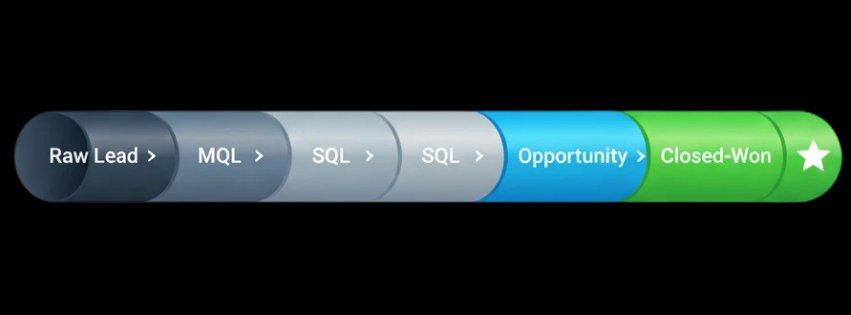
On paper, it looks clean. In practice, the belt jams.
Raw leads are like window shoppers. They showed up at your store but haven’t picked up a cart. A form fill, an event registration, or a whitepaper download doesn’t mean they are ready to buy.
MQLs are when curiosity meets conditions. They have crossed a signal threshold like ICP fit, budget potential, or repeated engagement. They are not ready to talk pricing yet, but they are leaning into your category.
SQLs are the true shopping carts. At this stage, Sales can run a discovery call without it feeling like a cold pitch.
Skip or fuzz the MQL stage, and the conveyor belt breaks. SDRs (sales development representatives) waste cycles, sales grind through junk, and pipeline velocity turns to molasses.
The nuance is everything. Not all engagement equals intent. A lead scoring matrix that blends firmographic fit (title, company size, industry) with behavioral signals (pricing page visits, competitor comparisons, multi-touch engagement) separates tire-kickers from future revenue.
2. The Risks of Ignoring the MQL Framework
When the stage of MQL is defined poorly or skipped, you don’t just create inefficiency. You sabotage growth due to the following:
- Pipeline distortion. The funnel looks fat, but 70% of “leads” are not sales-ready. The pipeline isn’t strong; it’s inflated.
- Forecasting failures. Executives assume X leads = Y revenue. If MQL framework criteria are flimsy, the math is fiction. Targets are built on fiction, not fact.
- GTM dysfunction. Marketing brags about “record engagement” while Sales wastes time on ghost accounts.
Case Examples:
- Agencies like Uncommon Logic have documented SaaS clients where scaling paid campaigns spiked lead volume, but SQL numbers stayed flat because qualification was too shallow. More ads meant more form fills, but without stricter MQL rules, Sales burned time on vanity contacts instead of revenue opportunities.
- Cognism highlights how treating all webinar attendees as sales-ready backfires. Webinars often pull in low-intent audiences, and without deeper ICP checks, only a small fraction qualify. Companies that auto-push such names to sales create pipeline bloat instead of velocity.
The lesson: skipping MQL discipline doesn’t accelerate revenue. It slows it down.
3. The Most Common Mistakes in Classifying MQLs vs SQLs
Even organizations that use MQLs often trip up. The usual suspects:
- Over-indexing on surface signals. One eBook download does not equal buying intent.
- Loose ICP fit. Flagging every “Manager” as an MQL without checking purchase influence floods the funnel with noise.
- Premature SQL push. Under pressure, raw leads get fast-tracked to sales. SDRs waste time qualifying what should have stayed in nurture.
- Misaligned definitions. Marketing calls every form fill an MQL. Sales only wants leads with budget authority. That disconnect corrodes trust.
Example: A manufacturing solutions company classified every form-fill as an MQL. Sales discovered 80% lacked purchasing authority. Conversion velocity collapsed, leadership lost confidence, and it took a painful reset to rebuild trust.
When MQL vs SQL classification is sloppy, the fallout isn’t just wasted time. It is broken alignment.
4. Nurturing MQLs Into SQLs: A Systematic Path
An MQL isn’t a finished product. It is a work in progress. The transition to SQL should be deliberate, blending education, validation, and persuasion at the right moments.
- Early-stage MQLs. Deliver broad educational content: research reports, benchmarks, and guides to build credibility.
- Mid-stage MQLs. Provide validation: case studies, ROI examples, and peer-led webinars prove outcomes.
- Late-stage MQLs. Accelerate evaluation: pricing calculators, competitor comparisons, and demos enable decisions.
Examples:

- HubSpot’s customer Talmundo, an HR tech company, doubled MQL conversions by implementing automated nurture and personalized follow-up instead of pushing every lead directly to sales. Their CPL (cost per lead) dropped while conversion rates climbed, showing how behavior-triggered nurturing pays off .
- Marketo customer stories demonstrate how segmenting leads into distinct nurture tracks (e.g., researchers vs. evaluators) can shorten sales cycles and increase SQL conversion rates. In several cases, conversion times were cut nearly in half when nurture was aligned with persona-specific behavior .
So, discipline beats speed when nurturing MQLs.
5. The Trap of Over-Indexing on Lead Volume
Chasing raw lead volume feels good. It makes dashboards glow. But it usually backfires. For example:
- Company A (volume-chasing): 50k leads, SQL conversion 2%. SDRs burn out, CAC (Customer Acquisition Cost) explodes.
- Company B (Sales Qualified framework-led): 15k leads, SQL conversion 8%. SDRs stay focused, CAC stays lean, and deals close faster.
HES FinTech scaled inbound campaigns aggressively, generating thousands of low-quality contacts. Sales teams wasted hours on leads that never converted. After implementing an AI-driven intent-based lead scoring model (trained on 3 years of CRM & AI scoring model for lead qualification data), they filtered out poor-fit prospects. The result? Sales effort dropped on bad leads, deal size grew, conversion rates improved, and the funnel finally aligned with revenue goals.
The result: “The funnel is filled with more leads, but the pipeline is filled with better leads.”
6. Why Frameworks Solve the Chaos
So your sales team and marketing team actually agree on what an MQL is, or is it more of a ‘choose your own adventure’ situation?
The ugly truth is most companies treat MQL definitions as tribal knowledge. Sales has one version, marketing has another, and nobody codifies it.
A standardized MQL framework ends the chaos:
- Scoring rubric. Weight signals like ICP fit, engagement depth, and budget indicators.
- Handoff contract. Both marketing and sales agree on what “sales-ready” means.
- Scalable process. No more quarterly debates. Just repeatable, data-backed qualification.
For example, Level Agency ran a structured lead-quality program that increased SQLs by 139% while cutting CPL. By introducing clearer scoring thresholds, SDRs focused on real revenue opportunities instead of wasting cycles on unqualified names.
7. Invest in AI Lead-Scoring Software: Turning Data Into Predictable Revenue
Manual scoring often collapses under pressure. Static triggers like “webinar attended” miss nuance. They cannot account for layered behaviors, account-level intent, or velocity.
This is where the best lead gen software becomes an edge:
- Dynamic weighting of behaviors plus firmographic fit
- Integration of third-party intent data
- Continuous recalibration as markets shift
How Valasys VAIS Helps
Valasys’ VAIS (Valasys AI Score) platform goes beyond static scoring. It adapts in real time:
- Engagement scoring across webinars, competitor content, pricing revisits
- Firmographic alignment against ICP before Sales ever sees the lead
- Intent signal integration to flag accounts heating up in your category
- Adaptive recalibration that evolves as buying behavior changes
Instead of dumping every attendee into Sales’ lap, the VAIS model highlights who is actually ready. This builds predictable revenue pipelines and reduces funnel leakage.
8. The Future of MQLs: From Static Stage to Dynamic Signals
If MQLs were “dead,” why are the smartest RevOps teams doubling down on it, just with way better tech? The truth is, MQLs are not dead. They are evolving. The future is about dynamic, intent-driven, account-level signals.
- Account-based qualification. Multiple stakeholders, like the CFO, IT Director, and Procurement, generate signals that together equal readiness.
- Predictive analytics. AI flags patterns in closed-won deals to score new leads against lookalikes.
- Intent data streams. Surges in research activity spotlight accounts before they ever hit your site.
- RevOps integration. Unified RevOps owns the framework, collapsing silos between Marketing Ops and Sales Ops.
The principle doesn’t change. Discipline at the MQL stage is still the strongest predictor of downstream velocity. The smarter tools and richer data just make that discipline sharper than ever.
Conclusion: Are MQLs the Missing Link or the Evolving One?
For too long, MQLs have been treated as a friction point. They have been an excuse for sales vs. marketing spats, a checkbox in reports, and a political football. But when designed with discipline, they become the most powerful hinge in the revenue machine.
The difference between a bloated pipeline and a lean, high-conversion funnel isn’t lead volume. It is how rigorously you define, qualify, and nurture MQLs.
MQLs are not obsolete.
They are evolving. MQLs are not just a marketing metric. These are shared accountability measures between Sales and Marketing. When executed with rigor, they transform your CRM from a graveyard of unqualified names into a predictable revenue engine.
So here is the move: stop debating what counts as an MQL. Start scaling with a shared framework.