
7+ Factors That Go Into ABM Scoring in VAIS
Discover 7+ key factors that drive ABM scoring in VAIS, helping you prioritize high-value accounts, improve targeting, and boost conversions

You can have the cleanest ABM strategy, the sharpest messaging, and a sales team ready to close. And still spend months chasing accounts that were never going to convert.
In the competitive world of B2B marketing, identifying the right accounts to target is no longer a guessing game. Account-Based Marketing (ABM) has emerged as the gold standard for aligning sales and marketing efforts around high-value prospects. According to G2, 87% of ABM marketers say ABM outperforms other marketing initiatives. But ABM is only as effective as the intelligence behind it, and that is where the Valasys AI Score (VAIS) comes in.
“Think of ABM without scoring, like sending VIP invites without checking the guest list. You might fill the room, but not with the people who matter.”
VAIS is a proprietary ABM alignment score that measures how well a product or service fits a prospects account, backed by years of market research, millions of data points, and a sophisticated AI engine that blends predictive analytics with deep market intelligence.
In this blog, we break down the 7+ key factors that go into ABM scoring in VAIS, so you understand exactly what powers this score and why it makes Valasys AI Score unlike any other B2B SaaS platform.
What Is the VAIS?
The VAIS is an alignment score between your product or service and your prospect accounts. The higher the score, the better the fit, and the more ideal the account is for your product.
“If lead scoring tells you who raised their hand, VAIS tells you who’s actually worth shaking hands with.”
This score is generated by computing a range of market-driven and firmographic parameters, including demand, relevance, success stories, competition, revenue potential, and the market share of the product. It also factors in company-specific details such as company size and revenue, ensuring the best-fit accounts are surfaced for every product.
Since the inception of Valasys Media in 2015, the market research team has been continuously monitoring and researching each of these parameters. Over the course of nearly a decade, the team has reviewed more than 50,000 products, classified them across 293 sub-categories, and conducted surveys covering over 2.5 million data points, including decision-makers, product owners, and industry influencers.
Breaking Down the VAIS Scoring Parameters
VAIS is built on a multi-layered framework of research inputs and AI-driven analysis. Here are the core factors that go into generating the VAIS:
1. Demand of the Product
Demand is the foundational signal of product-market fit. VAIS evaluates how much market appetite exists for a given product or solution category. This includes assessing market penetration levels, growth potential, and the profitability and ROI that prospects can expect from using the product.
“No demand? No deal. It’s like launching umbrellas in a desert, technically functional, strategically pointless.”
The market research team uses web scraping, surveys, and historical data from the Valasys database to collect and validate product details. This demand intelligence helps the VAIS engine determine whether an account is operating in a space that would genuinely benefit from the product, well before a single sales call is made.
2. Success Stories of the Product
Social proof is one of the most powerful signals in B2B buying decisions. VAIS accounts for the success stories and proven outcomes associated with a product, drawing from social proof platforms, product websites, customer testimonials, and case study data.
“In B2B, nobody wants to be the first penguin jumping into the water. Success stories show it’s safe and profitable.”
By analyzing where a product has succeeded and in what type of accounts, VAIS can better predict which prospect accounts resemble those success patterns, enabling far more targeted and confident ABM outreach.
3. Competition of the Product
Understanding the competitive landscape is crucial for ABM prioritization. VAIS evaluates the competition surrounding a product, including incumbent solutions already used by target accounts, emerging competitors, and white-space opportunities.
“Sometimes the opportunity isn’t building demand. It’s replacing something that’s already underperforming.”
This competitive intelligence, sourced from market research reports by organizations such as Gartner and McKinsey, helps sales teams understand where displacement opportunities exist and which accounts are most likely to be receptive to a better alternative.
4. Revenue Potential of the Product
Not every account represents equal value. VAIS incorporates revenue potential as a scoring parameter, factoring in the size of the opportunity, the account’s spending capacity, and the scalability of the product within the account’s environment.
“All leads are not created equal. Some are coffee chats. Some are quarterly targets.”
This is further enriched by product market share data, angel investments, and funding information, which give a real-world sense of how products are growing and where the revenue opportunity is strongest. It ensures sales teams focus their energy on accounts that deliver the highest return.
5. Product and Industry Relevance
A product may be excellent, but if it is not relevant to a specific industry or use case, it will not resonate with an account. VAIS applies industry-specific rules to evaluate how closely a product aligns with the vertical and operational context of each prospect’s account.
“Right product, wrong context is still a no. Relevance is where good products become must-have solutions.”
This factor uses feedback from review platforms like G2 to understand market positioning, sentiment analysis, and trending industry needs, ensuring that scoring reflects real-world industry dynamics and not just generalized market signals.
6. Best-Fit Company Size and Revenue
Firmographic fit is an essential dimension of ABM scoring. VAIS uses company size and revenue data to identify whether a prospect’s account falls within the ideal customer profile (ICP) for a given product.
“Selling enterprise software to a startup is like offering a jet to someone who needs a bicycle, impressive, but impractical.”
This is not just about headcount or annual revenue figures. VAIS cross-references firmographic details with product usage patterns and historical data from Valasys’ extensive database. According to G2, organizations with a strong ICP achieve 68% higher account win rates.
7. Product Brand Value
Brand value is an often-underestimated factor in B2B buying. Accounts are more likely to invest in products from recognized, trusted vendors, and VAIS captures this by incorporating brand equity into its scoring model.
“In high-stakes deals, brand is shorthand for risk. Familiar names lower friction before the first demo even happens.”

This is evaluated through a questionnaire-based survey of industry influencers and product owners, combined with product review data and social proof signals. Brand value data helps contextualize how a product is perceived in the market and whether accounts are likely to perceive it as a credible solution.
8. Product Usage Details: Retention, Renewal, and Spend
How accounts actually use a product, and whether they continue using it, speaks volumes about product stickiness and customer satisfaction. VAIS analyzes product usage details, including retention rates, renewal patterns, and the actual spend of accounts on the product.
“Acquisition gets attention. Retention builds empires.”
These insights come from historical data points and feedback forms within the Valasys database. They allow VAIS to identify accounts that mirror the behavior of existing loyal customers, making it far easier to predict long-term account value and prioritize outreach accordingly.
Beyond VAIS: The Power of Intent Data
The VAIS (Valasys AI Score) becomes even more powerful when combined with Intent data, creating what Valasys AI Score describes as a double-layered AI insights and two-tiered scoring system.
“Fit tells you who could buy. Intent tells you who’s already halfway to checkout.”
While VAIS uses predictive analytics to evaluate product-account alignment, the Intent layer uses Natural Language Processing (NLP) for real-time sentiment analysis, powered in association with Bombora. The intent engine monitors 5,000 B2B websites, tracks over 16,000 B2B topics, and researches approximately 16.2 billion events monthly, generating surge scores for 4 million domains every week.
According to G2, 91% of B2B technology marketers use intent data to prioritize accounts. Here is how VAIS (Valasys AI Score) + Intent drives strategic decisions:
- High VAIS + High Intent: Call Now. These are your hottest accounts, actively conducting in-depth research on the product category.
- High VAIS + Medium Intent: Run targeted ads and email campaigns. The account is interesting but needs a structured nudge.
- High VAIS + Low Intent: Nurture with relevant content. The product fit is strong, but the timing is early in the buyer journey.
- Medium VAIS + High Intent: Targeted outreach. The intent signal is strong; focus on deepening product relevance for the account.
Low VAIS + Low Intent: Monitor or disqualify. Avoid spending pipeline resources on accounts with poor fit and no active buying signal.
How Is VAIS Data Collected?
The integrity of the VAIS depends entirely on the quality of data feeding into it.
“Good AI is not magic. It is just very, very disciplined data.”
Valasys’ market research team employs multiple methods to ensure comprehensive, accurate, and up-to-date inputs:
- Market Surveys: Web scraping, surveys, and historical data from Valasys’ proprietary database
- Product Reviews: Insights from review platforms such as G2 for sentiment analysis and market positioning.
- Research Reports: Data from trusted industry sources such as Gartner and McKinsey research reports.
- Questionnaire-Based Surveys: Direct surveys of industry influencers and product owners.
- Feedback and Review Forms: Structured data collection from end users and active buyers.
- Social Proof and Product Websites: Brand signals and product reputation data from across the web.
Why VAIS Transforms Your ABM Strategy
Traditional ABM scoring often relies on basic firmographic filters or simplistic lead scoring models that do not account for product-market dynamics. VAIS changes this fundamentally by grounding every score in real market data, product intelligence, and account-level fit signals. Studies show that companies using ABM report up to 208% increase in revenue compared to those that do not.
“It’s the difference between targeting accounts that look right and accounts that actually convert.”
The result? Sales and marketing teams using VAIS can:
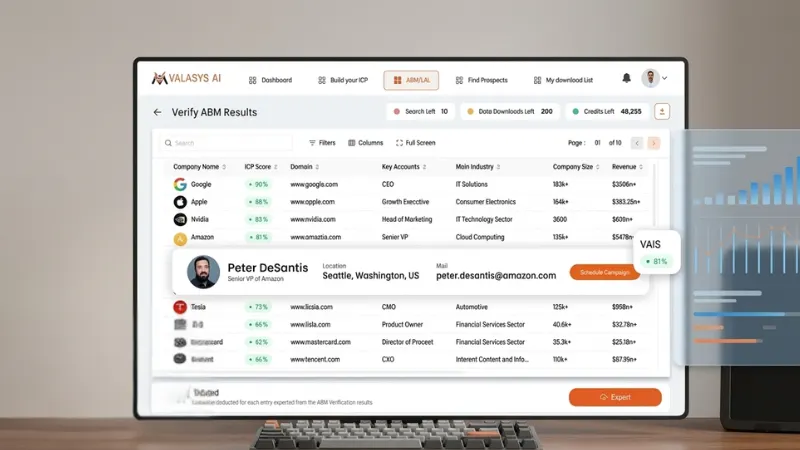
- Build smarter ABM lists with accounts that are genuinely aligned to your product, using the ABM Builder on VAIS.
- Prioritize outreach based on a combination of account fit and real-time buying intent signals.
- Personalize messaging with confidence, knowing the account’s context, needs, and stage in the buyer journey.
- Reduce wasted spend on low-fit accounts. Research shows ABM can reduce wasted sales time by 50% on unproductive prospecting.
- Close more deals faster, backed by data-driven insights and AI scoring algorithms, for end-to-end pipeline support.
Final Thoughts
ABM scoring in VAIS is not built on a single metric or a simplistic model. It is the product of over a decade of market research, 50,000+ product reviews, and 2.5 million+ surveyed data points, all funneled through a sophisticated AI engine that weighs demand, success stories, competition, revenue potential, brand value, firmographic fit, industry relevance, and product usage in a unified, intelligent score.
“When data, timing, and fit align, sales stops feeling like outreach and starts feeling like inevitability.”
When layered with Intent data, VAIS becomes a powerful two-tiered system that tells you not just who fits your product, but who is actively looking for it right now.
For B2B marketers and sales leaders who are serious about putting client acquisition on autopilot, VAIS is the intelligence engine that makes it possible.
Ready to find your next best customer? Explore Valasys AI Score or reach out to the team at info@valasys.ai.
Frequently Asked Questions (FAQs)
Q1. What is the VAIS and how is it different from traditional lead scoring?
The VAIS is an ABM alignment score that measures how well a product fits a prospective account, factoring in 8+ parameters like demand, competition, brand value, and firmographic fit. Unlike traditional lead scoring which focuses on individual behavior, VAIS evaluates account-level fit backed by over a decade of market research and 2.5 million+ data points.
Q2. How many factors go into the VAIS?
VAIS computes 8+ scoring parameters, including product demand, success stories, competition, revenue potential, industry relevance, company size and revenue, brand value, and product usage details like retention and renewal. Each parameter is continuously updated by Valasys’ dedicated market research team.
Q3. What is VAIS + Intent, and why does it matter?
VAIS + Intent combines the VAIS alignment score with real-time buyer intent data powered by Bombora. While VAIS tells you which accounts are the best fit for your product, Intent tells you which of those accounts are actively researching right now, helping you prioritize outreach at exactly the right moment.
Q4. How does VAIS collect and validate its scoring data?
Valasys AI’s market research team gathers data through web scraping, surveys, review platforms like G2, research reports from Gartner and McKinsey, and direct questionnaire-based surveys of industry influencers and product owners. The team has reviewed over 50,000 products across 293 sub-categories since 2015.
Q5. Who should use VAIS for ABM scoring?
VAIS is built for B2B sales and marketing teams that want to move beyond guesswork in account targeting. If you are running ABM campaigns, building target account lists, or trying to reduce wasted spend on low-fit prospects, VAIS gives you the data-backed scoring to focus on accounts that are most likely to convert.