
10 Essential Steps for a High-Performing B2B Sales Process
Learn the 10 essential steps to optimize your B2B sales process. From ICP definition to post-sale follow-up, increase conversion rates, shorten sales cycles, and build lasting client relationships.

Your B2B sales results could be better. The reason?
The world of selling to businesses is evolving. It’s no longer simple like it used to be. With an abundance of information at their fingertips, buyers have become smarter than ever.
If you’re to pitch in, you don’t face that run-of-the-mill man in a tie, but you sit across someone who is a professional, he who is a demanding buyer, or worse you face an entire buying committee, leading to much longer sales cycles.
To win them here, you need to know more than just the ABC’s of your businesses. You need a high-performing B2B sales process that is clear, organized, and built for today’s complicated market.
This article is a 10 steps guide that will improve your sales velocity and conversion rates. It has everything you are looking for.
What is the B2B Sales Process?
To put it simply, a B2B sales process is a process of selling products or services from one business to another, and B2C is a process of selling products or services from a business to a consumer.
B2B sales are far more complex transactions when compared to B2C, often with multiple decision-makers and a longer sales cycle. The agenda here is simple, it’s to effectively guide prospects from initial awareness of a product or service to conversion into a paying customer, and preferably, a long-term client.
In B2B, understanding the needs of the business you are about to pitch-in, is a must, as it helps you demonstrate value, build trust, and provide personalized solutions. Which is why it includes a consultative approach and detailed presentation. Whereas B2C sales are generally transactional with shorter cycles, that focus on individual needs, emotional appeal, and immediate gratification involving a single decision maker.
Why a High-Performing Process Matters Today
In a market where change is the only constant, a high-performing B2B sales process is not an option but a must. Buyers already have a lot of information, stats say they are almost 67% in, digitally even before speaking to a sales representative. Meaning, you can’t bore them with basics. This creates a need for a well-defined, optimized sales process. Inefficiency isn’t tolerated in this market.
Many businesses partner with an inside sales outsourcing company to streamline their processes and ensure that qualified leads are consistently entering the pipeline. This allows internal teams to focus on closing deals instead of spending too much time prospecting.
To meet these demands, your sales process must strategically include Account-Based Marketing (ABM) to target high-value accounts, using intent data to understand buyer signals, implementing solid CRM systems to manage interactions, and employing sophisticated nurture campaigns to guide prospects. For a better sales process, businesses need to define each step and integrate their tech tools skillfully. When this is done proactively, the sales team connects to potential clients at the right moment with the right information. This approach not only enhances how often they turn prospects into customers but also helps build lasting relationships.
If you are convinced that the B2B sales process is more than just closing a deal then let’s get into that 10-step process; mind you, this creates repeatable, scalable systems that build relationships and drive long-term revenue.
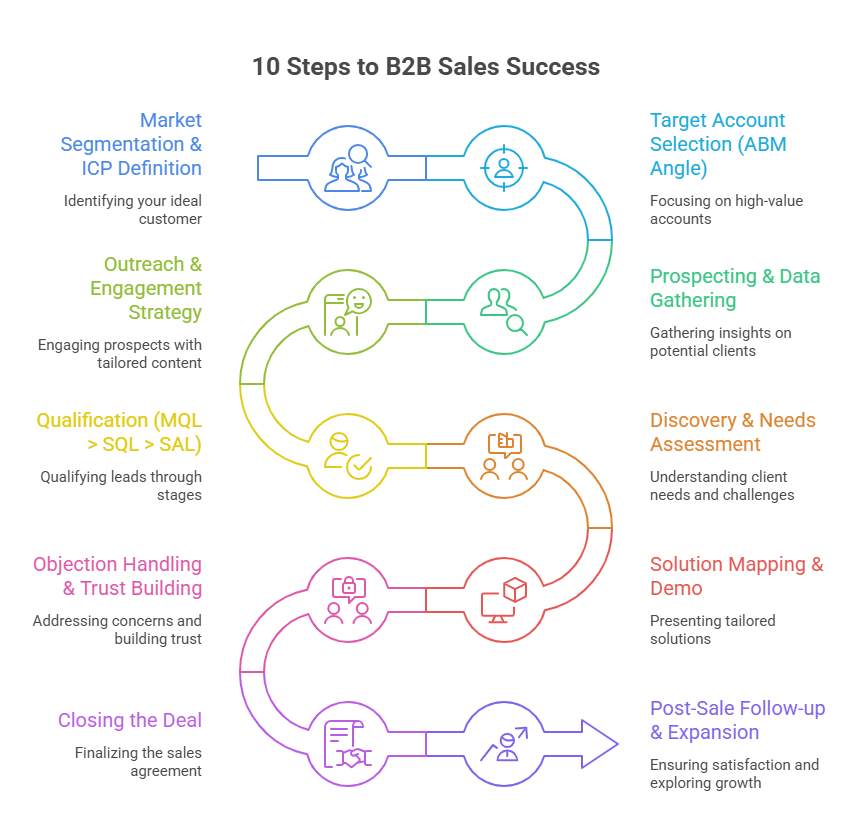
10 Steps of a High-Performing B2B Sales Process
Step 1: Market Segmentation & ICP Definition
Defining your ICP is not rocket science. It is figuring out exactly who your best customers are and grouping them clearly. This is like a starting point. When you have a clear ICP, you focus on your best bet and send them the right message. But when you try focusing on everyone, you often end up with zero results, it’s like expecting to top without studying at all (ain’t gonna happen unless you’re Einstein)
And if this sounds like a lot of work, it’s not. There are tools like CRM (a customer database), firmographic filters (to sort companies by size, industry, etc.), and predictive analytics (software that forecasts likely outcomes).
Use VAIS (Valasys’s AI Solution) to define your ICP. It combines real-time intent data (something companies are constantly searching for) with firmographics to find your exact target quickly.
Step 2: Target Account Selection (ABM Angle)
This is about picking out the exact, most valuable companies you want to sell to, based on who your ICP is. From here sales and marketing work in tandem with companies most likely to bring in the most money. Here if you run after big names without looking for buying signals, you are setting yourself up for failure (facts are facts).
But the good news is, you can use ABM platforms, TAM calculators (to figure out your Total Addressable Market), and intent data providers (companies that offer insights into buyer research).
Step 3: Prospecting & Data Gathering
This involves finding correct, current contact details and company information for the key decision-makers within your chosen target accounts. Even the best sales messages won’t work if the data is bad. To avoid that one should not rely on a single data source or old contact lists. Tools like LinkedIn Sales Navigator come handy in this step.
Step 4: Outreach & Engagement Strategy
Creating custom messages and reaching out through various ways like email, LinkedIn, paid advertisements, and showing ads again to people who’ve already interacted is the way to move forward. As the buyers interact in many places. Consistent and relevant messages across all these points increase the chances of a sale.
While automation is always smart, using it too much can hamper the results as it can feel generic if the attention to where the buyer is, is compromised. While you can use tools like HubSpot Sequences, Outreach.io, LinkedIn InMail, and retargeting pixels. Our team connects multichannel campaigns to buyer behavior triggers, ensuring your messages land when they matter most.
Step 5: Qualification (MQL > SQL > SAL)
This is done in 3 phases:
-
MQL: Marketing thinks they’re interested (e.g., content download).
-
SQL: Sales confirms they’re a real opportunity (e.g., meet BANT criteria).
-
SAL: Sales accepts the SQL for active pursuit.
This helps you ensure your sales team spends time and effort on leads that are ready to close. A lot of times businesses lack clear rules for qualification or end up assessing leads too early or too strictly.
Step 6: Discovery & Needs Assessment
This is the time when you are supposed to have a core understanding of your buyer. It’s a focused conversation to pinpoint their problems, goals, and what actually drives their decisions. This is where you build trust, which also helps you tailor your pitch exactly to their needs. Skip this step and you become one of too many, and your pitch? Yea that’s just white noise then.
A relationship analogy that works in business as well:
-
Talk less, listen more.
-
Focus on emotional cues more than plain facts.
-
And ask questions to uncover the root causes.
You can always rely on tools like Gong or Chorus for review and coaching. And use methods like BANT or MEDDIC to guide your questions.
At Valasys, we practice EQ-led consultative selling. This means using emotional intelligence to build genuine connections. This approach leads to higher closing rates and stronger, lasting client relationships.
Step 7: Solution Mapping & Demo
A step where you directly connect your product’s value to the buyer’s needs. This is done through a customized demonstration. And it’s that exact moment when your buyer will decide if you are giving the solution they seek or not.
A strong demo is what translates features into desirable benefits. Utilizing software like custom sales decks, and interactive product tours to deliver personalized, impactful presentations can be beneficial.
At Valasys, we map every solution pitch directly to the buyer’s KPIs, which helps in ensuring that your value is clear, measurable, and directly contributes to their business goals, significantly increasing your win rates.
Step 8: Objection Handling & Trust Building
This is an important step. Here you respond to the concerns and solidify trust in your solution. Conflicts are part of the process, and how you deal with them determines if you end up losing trust or gaining a client.
Expect through questioning about your products or services and brace yourself to be calm and answer everything in detail without sounding like you are getting defensive there. Don’t go around offering discounts just for the sake of closing them, instead opt for win-loss analysis tools to improve your approach.
Step 9: Closing the Deal
In this phase terms are finalized and expectations for the next step are stated. It is important as a clean, efficient close ensures faster ROI and smoother onboarding process.
If the follow ups are not done well or lack urgency the deal gets affected, to avoid this opting for e-signature platforms, contract automation software, and robust proposal builders can be a smart move.
Step 10: Post-Sale Follow-up & Expansion
This is the final step; this is where you take the feedback and identify upselling opportunities, also a great time to generate referrals and ensure long-term retention. Why this matters is because your future revenue depends on a loyal and happy customer.
When you go silent after a sale, you fail to track customer satisfaction and miss cross-sell opportunities. At valasys we advocate for customer success platforms, Net Promoter Score (NPS) tools, and CRM automations.
Valasys Media: Case Snapshot
Valasys can help you finesse your selling skills.
Take a recent case: A SaaS provider ended up wasting time on poor prospects which led to long cycles and low conversions. After we got them on board the first thing we did was we implemented a stricter qualification framework, the sales cycle was reduced by 30% and there was 15% increase in qualified opportunities.
Best Practices to Optimize Your Sales Process
First and foremost, use a CRM system. This will help you centralize data and track your interactions, you can also manage your pipeline and ensure that you don’t miss any leads. And you continuously refine your ICP. When you know your customers well, you can focus on high-potential leads.
Also your sales team needs to keep evolving, they need to know what’s hot in the market. It’s no secret that well-trained tech-savvy team sales are better. Then use the content strategically. If you intend to build trust, share relevant whitepapers and case studies. Last but not least, analyse where your prospects drop in the funnel. This will help you fix it.
At valasys we integrate AI and ABM to pinpoint your ICP, hyper-personalize the content and automate follow-ups making your sales process highly effective.
Conclusion
A well-defined, high-performing B2B sales process is not merely an option, it’s a must. By following this 10 steps plan, you can guide any prospects through their journey and form stronger relationships. Every effort must translate into a conversion.
So, if you want to revamp your sales process with the power of intent data and Account-Based Marketing? [Book a demo with Valasys today]
Frequently Asked Questions (FAQs)
1. What are the 5 steps of a B2B sales process?
To state 5 steps of the B2B sales process will be Market Segmentation & Defining ICP, Prospecting & Data Gathering, Qualification, Solution Mapping & Demo, and Closing the Deal. These steps give us a structured approach from identifying ideal clients to securing a partnership, guiding prospects effectively through a typically complex buying journey.
2. How is B2B sales different from B2C?
B2B sales process is a process of selling products or services from one business to another, and B2C is a process of selling products or services from a business to a consumer. B2B sales are far more complex transactions when compared to B2C, often with multiple decision-makers and a longer sales cycle.
3. What tools help streamline the B2B sales process?
Effective B2B sales rely on many tools like CRMs like Salesforce or HubSpot to centralize data. LinkedIn Sales Navigator. E-signature tools and contract automation streamline closing. Besides, customer success platforms and NPS tools are crucial for post-sale engagement, ensuring smoother operations from start to end.