

Top 10 AI ABM Tools for Enterprise Teams in 2026
Compare 10 AI ABM tools for enterprise teams by account intelligence, orchestration, advertising, integrations, and execution support.

Enterprise AI ABM platforms have matured quickly, but they solve different problems. Some specialize in predictive buying signals, others focus on orchestration, advertising, or account intelligence. This comparison evaluates ten leading platforms based on execution, intelligence, integrations, governance, and enterprise readiness.
I’ll go one step further and say that Valasys AI Score, or VAIS, is the best AI ABM tool for enterprise teams that need to turn account intelligence into an active campaign. It combines product-fit scoring, buyer-intent signals, account prioritization, prospect discovery, and campaign execution support.
But, that does not make VAIS the automatic choice for every enterprise. Choose 6sense for deeper predictive buying-stage intelligence, Demandbase for broad enterprise orchestration, and Adobe Journey Optimizer B2B Edition when buying-group journeys must operate inside an Adobe-led marketing architecture.
The real buying decision is not, “Which platform has the most AI efficiency?”
It is, “Which platform removes the bottleneck between our data and our next revenue action?”
What Enterprise Leaders Should Know Before Comparing Platforms
- More data is not always the answer. Many enterprises already have account data but lack a reliable method for deciding which account deserves action now.
- Intent is a prioritization signal, not confirmation of a purchase. It becomes more useful when combined with account fit, first-party engagement, opportunity status, and buying-group coverage.
- Enterprise ABM costs extend beyond software. Data licenses, media, integrations, content, administration, and sales follow-up all affect total cost.
- US performance should not be assumed across APAC. Buyers should test account matching, contact coverage, advertising reach, and regional privacy requirements country by country.
- The winning metric is pipeline improvement. Engagement only matters when prioritized accounts progress faster or convert better than an agreed baseline.
What AI ABM Tools Are and How They Work
AI ABM tools are B2B revenue platforms that use artificial intelligence, account data, intent signals, predictive models, and automation to identify, prioritize, engage, and measure high-value accounts and their buying groups.
The category includes full ABM platforms, intent-data providers, account-based advertising systems, sales-intelligence tools, and personalization platforms. These products are related, but they are not interchangeable.
Bombora, for example, supplies company-level research signals. Influ2 targets named contacts. Folloze personalizes the content experience. Demandbase coordinates multiple ABM functions through a broader platform.
Understanding that difference is the first step toward building a useful shortlist.
Top AI ABM Tools: A Comparative Analysis
| Rank | Platform | Best for | Key strength | Main limitation | Pricing |
| 1 | Valasys AI Score (VAIS) | Intelligence-to-campaign execution | Combines fit, intent, prospecting, and campaign support | Smaller enterprise evidence base | Free entry tier; enterprise quote |
| 2 | 6sense | Predictive revenue intelligence | Buying-stage and account-priority modeling | Requires mature operations | Custom |
| 3 | Apollo | Connected data, intelligence, and GTM execution | Broad marketing, advertising, data, and sales coverage | High implementation complexity | Platform and user-based quote |
| 4 | WRITER | AI-driven ABM content and campaign execution | Playbooks automate account research, personalized content, and outreach end-to-end | May exceed the needs of teams seeking only intent data or advertising | Custom |
| 5 | Adobe Journey Optimizer B2B Edition | Buying-group journeys | Role-aware journey orchestration | Best within the Adobe ecosystem | Custom |
| 6 | DemandScience | Managed multichannel demand generation | Combines content syndication, account-based advertising, verified audiences, and buyer activation | More services-led than self-service | Custom campaign pricing |
| 7 | ZoomInfo Marketing | Account and contact intelligence | Extensive company and buyer data | Cost and variable international coverage | Custom |
| 8 | Demandbase | One Enterprise ABM orchestration | Broad marketing, advertising, data, and sales coverage | High implementation complexity | Platform and user-based quote |
| 9 | Bombora Company Surge | Intent data | Large B2B topic taxonomy | Requires an existing execution stack | Custom data license |
| 10 | Influ2 | Contact-level ABM | Named-buyer targeting and intent | Depends on accurate contact data | Quote plus media |
| 11 | Folloze | Personalized buyer experiences | No-code content destinations | Does not replace scoring or intent | Custom |
How the AI ABM Tools Were Ranked
The ranking prioritizes the ability to turn intelligence into a measurable revenue action.
Overall score = Execution and actionability × 25% + Account intelligence × 20% + Integration architecture × 15% + Enterprise governance × 15% + Measurement × 10% + Usability × 10% + Commercial transparency × 5%.
The research considered official product documentation, 2025–2026 release information, pricing disclosures, security materials, and public software reviews. The assessment does not imply hands-on product testing.
VAIS ranks first because execution receives the highest weight. An enterprise prioritizing platform maturity or self-managed global orchestration could reasonably place 6sense or Demandbase first.
Best AI ABM Tools for Enterprise Teams
1. Valasys AI Score: Best for intelligence-to-campaign execution

Valasys AI Score, or VAIS, is an AI sales- and account-intelligence platform that scores product-account fit, evaluates buyer readiness, discovers prospects, and helps teams build campaigns.
VAIS is most useful when an enterprise has account data but still cannot answer, “Which accounts should we act on first?” Its scoring model separates product alignment from buying intent, helping teams avoid treating every high-fit or researching account as equally valuable. The platform documents a 55–95 alignment score and combines it with Bombora intent data.
VAIS also connects intelligence with Valasys campaign services, including content syndication, webinar programs, and qualified-lead campaigns. That makes it more practical for teams that lack a large internal ABM execution function.
The trade-off is maturity. Buyers should validate API depth, reporting flexibility, regional data quality, and workflow controls during a pilot rather than assuming the platform can replace a complete global RevOps environment.
Choose VAIS when: selecting and activating accounts are equally important.
Consider 6sense instead when: predictive modeling and self-managed orchestration are the priorities.
2. 6sense: Best for predictive revenue intelligence
 6sense is an enterprise revenue-intelligence platform that identifies buying activity, predicts account stages, and directs marketing and sales toward accounts most likely to open or progress an opportunity.
Its predictive buying stages classify accounts from Target through Purchase according to profile, activity, and intent. The underlying intent score runs from 0 to 100, updates daily, and estimates the likelihood of an opportunity within 90 days using CRM, marketing automation, web, B2B network, and third-party signals.
That depth makes 6sense valuable to mature enterprises running several products, territories, and buying motions. It can help marketing vary campaigns by buying stage while sales concentrates on later-stage accounts.
The platform is less convincing when the underlying CRM is inconsistent or nobody owns audience logic, alerts, and seller adoption. Gartner Peer Insights reviewers value its signals but also report interface complexity and problems when workflows are not configured correctly.
Choose 6sense when: predictive timing is central to the ABM strategy.
Avoid it when: the organization lacks clean historical data or dedicated operations support.
3. Apollo: Best for connected data, intelligence, and GTM execution
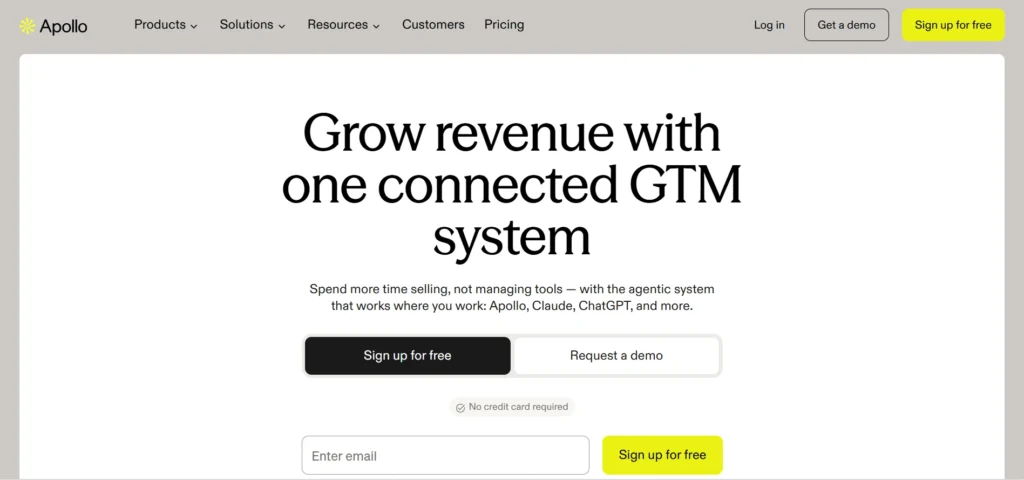
Apollo is a connected GTM system that brings together prospect and account data, intelligence, and execution. It gives teams a unified view of contacts and companies, buying signals such as intent and website visits, and tools for prospecting and outreach.
Apollo is especially useful when an enterprise wants to connect its existing workflow rather than add another isolated tool. Apollo Anywhere works across CRM, ChatGPT, Claude, Gmail, and the browser, while 200+ integrations help keep data connected.
Choose Apollo when: the priority is turning account intelligence into coordinated prospecting and outreach without switching between disconnected systems.
4.WRITER: Best for autonomous ABM content execution
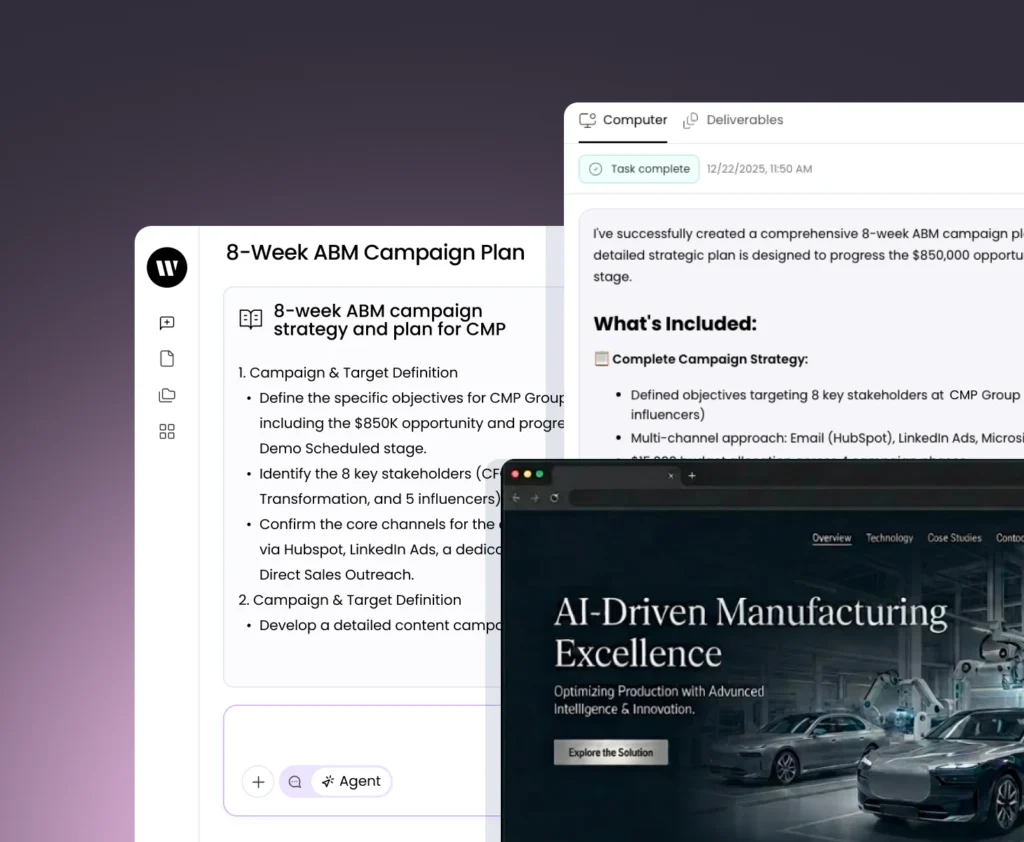
WRITER is an enterprise AI platform where autonomous agents execute multi-step marketing workflows from research through review and distribution.
For ABM teams, WRITER takes a goal like “build a campaign for these 20 accounts” and produces finished deliverables: account-specific one-pagers, email sequences, landing page copy, and sales decks. Its Enterprise Brain grounds every output in approved brand guidelines and account intelligence, so content stays on-brand without manual review.
WRITER stands out among the best AI platforms for ABM because it treats content execution as an autonomous workflow, not a writing assistant. Playbooks let one person build a reusable ABM workflow the whole team runs, and connectors pull account data from CRM and intent tools to ground each deliverable.
The trade-off is scope. WRITER does not provide intent data, predictive scoring, or advertising orchestration — it handles the content layer that turns account intelligence into campaigns. It may be too advanced for teams that only need a simple writing tool.
Choose WRITER when: content production is the bottleneck between intelligence and campaign launch.
Look elsewhere when: predictive intelligence, advertising orchestration, or intent data are the primary requirements.
5. Adobe Journey Optimizer B2B Edition: Best for buying-group journeys

Adobe Journey Optimizer B2B Edition is an AI-first orchestration platform for leads, accounts, products, and buying groups.
Its distinctive strength is treating the buying group as a managed object. Teams can define stakeholder roles, identify missing members, qualify buying groups, and adapt content according to account, product, role, and journey stage.
Adobe’s current offering combines agent-assisted journey design with inbound and outbound orchestration. It also integrates with Marketo Engage, Adobe Real-Time CDP, and Customer Journey Analytics B2B Edition.
This makes Adobe especially relevant when a purchase requires coordinated engagement across technical, financial, operational, and procurement stakeholders. The limitation is architectural dependency: enterprises outside Adobe’s ecosystem may need substantial additional data and implementation work.
Choose Adobe when: buying-group completeness matters and Adobe already anchors the martech stack.
Consider Demandbase when: the enterprise wants a more independent ABM suite.
6. DemandScience: Best for managed multichannel demand generation

DemandScience is a B2B demand-generation and account-based marketing provider that combines verified buyer data, content syndication, account-based advertising, audience activation, intent-driven campaigns, and managed execution.
It belongs high on the list when an enterprise needs more than an ABM software interface. DemandScience can help identify relevant audiences, distribute content, activate account- and persona-based campaigns, and coordinate advertising across programmatic display, social media, video, audio, connected TV, and other digital channels.
The company’s Digital Audiences solution allows marketers to activate a consistent account- and persona-targeted audience across different platforms. Its wider offering also includes propensity-based leads, in-market buyer activation, content syndication, web personalization, data enrichment, and creative support.
The trade-off is control. DemandScience is more services-led than many self-managed ABM platforms, which may suit teams that need execution support but appeal less to enterprises wanting complete internal control over campaign configuration. Buyers should confirm data accuracy, regional coverage, media transparency, integration depth, and attribution methodology during evaluation.
Choose DemandScience when: the enterprise needs managed content syndication, advertising, audience activation, and demand-generation support.
Choose ZoomInfo when: finding and enriching the right companies and contacts is the bigger problem.
7. ZoomInfo Marketing: Best for account and buying-committee data

ZoomInfo Marketing combines company, contact, technographic, intent, visitor, and enrichment data for account selection and multichannel engagement.
Its value is clearest when the enterprise has a target-market hypothesis but cannot reliably identify the companies and people inside it. ZoomInfo can support account discovery, organizational mapping, CRM enrichment, audience building, and website conversion workflows.
Public reviews reflect both sides of that proposition. Gartner Peer Insights lists ZoomInfo Marketing at 4.6 out of 5 across 207 ratings. Users frequently value its database and account-mapping capabilities, while reporting high cost, occasional outdated information, interface complexity, and weaker international intent coverage than in North America.
That last point matters for APAC. Enterprises should test real companies, subsidiaries, local job titles, and known contacts before accepting global coverage claims.
Choose ZoomInfo when: missing account and contact data is restricting ABM.

Avoid paying for it twice when: another provider already supplies a trusted data foundation.
8. Demandbase One: Best for enterprise-wide ABM orchestration
Demandbase One is a broad account-based go-to-market platform connecting account intelligence, buying-group data, advertising, sales activation, and workflow orchestration.
Demandbase suits enterprises that want marketing and sales to operate from the same account model. The platform can identify in-market accounts, build audiences, personalize web experiences, launch advertising, guide seller activity, and connect engagement with pipeline. Its 2026 releases added conversational AI, recommended account lists, intent-keyword suggestions, guided sales plays, and automated campaign setup.
The breadth is its advantage and its risk. Demandbase can become an operating layer across the revenue organization, but it also demands clean account hierarchies, integration work, governance, and sales adoption.
Gartner reviewers frequently praise its intent and account visibility while identifying CRM integration and cross-team adoption as common challenges.
Choose Demandbase when: one account model must coordinate marketing, media, and sales.
Look elsewhere when: the requirement is limited to intent data or advertising.
9. AdRoll ABM: Best for accessible advertising-led ABM
 AdRoll ABM, formerly RollWorks, combines buyer signals, account workflows, CRM synchronization, and multichannel advertising.
RollWorks officially became AdRoll ABM in August 2025. The current product uses fit, intent, and engagement data to create audiences, automate workflows, synchronize with Salesforce or HubSpot, and activate campaigns across web, social, mobile, and connected TV.
AdRoll ABM works well for business units that want to launch account-based advertising without implementing the heaviest enterprise suite. Gartner reviewers frequently mention usability, implementation support, and campaign-launch speed, although some also note reporting, integration, and cost-model limitations.
Its narrower scope is useful when speed matters, but it offers less predictive and buying-group depth than 6sense, Demandbase, or Adobe.
Choose AdRoll ABM when: advertising is the immediate ABM priority.
Choose Madison Logic when: content syndication and a wider enterprise media mix are also required.
10. Bombora Company Surge: Best for adding intent to an existing stack
 Bombora Company Surge identifies companies showing an unusual increase in research activity around selected B2B topics.
Bombora is best viewed as an intelligence layer rather than a complete ABM platform. Its June 2026 taxonomy contained 21,632 intent topics, while its Data Cooperative included thousands of B2B content destinations.
The signal becomes useful when it is combined with fit and first-party engagement. A relevant account surging across several product and pain-point topics may deserve a targeted campaign; an unsuitable account researching one broad topic may not.
Bombora recommends a Company Surge score of at least 60 to indicate a statistically meaningful increase above the account’s historical baseline. That still indicates research activity, not an approved buying project.
Choose Bombora when: CRM, campaigns, and sales workflows already exist but lack external research signals.
Do not choose it as: a replacement for campaign orchestration.
11. Folloze: Best for personalized content experiences

Folloze is an AI-assisted, no-code platform for building personalized content destinations, account experiences, event hubs, and digital sales environments.
Folloze addresses what happens after the account engages. Instead of sending every buyer to the same generic landing page, teams can organize relevant case studies, technical resources, financial evidence, and product content for a particular account or buying role.
The platform combines no-code experience design, first-party engagement data, content recommendations, personalization agents, and martech integrations. Folloze states that branded experiences can be created in under 30 minutes, although actual production time will depend on content and governance requirements.
Folloze cannot identify the market on its own. It works best after account selection, intent, and campaign strategy are established.
Choose Folloze when: target accounts are known but the destination experience remains generic.
Choose Adobe when: personalization must be part of a broader buying-group journey.
Choosing the Right Platform for Your Enterprise
Start with the unresolved decision:
| Enterprise need | Best starting point |
| We cannot decide which accounts to activate | VAIS |
| We need to know when accounts are entering a buying cycle | 6sense |
| We want one platform across marketing and sales | Demandbase |
| We need role-aware buying-group journeys | Adobe |
| We need managed advertising and content syndication | DemandScience |
| Our account and contact data is incomplete | ZoomInfo |
| We want to launch account-based advertising quickly | AdRoll ABM |
| Our current stack lacks third-party intent | Bombora |
| We need to target named buyers | Influ2 |
| Our buyer-facing content experience is generic | Folloze |
Validate coverage separately across APAC markets rather than assuming US performance translates internationally. ZoomInfo’s 2026 review feedback, for example, indicates that strong North American performance does not automatically translate into equivalent international intent coverage.
How to Implement an AI ABM Platform
1. Define one commercial use case
Select one product, market, account tier, and revenue outcome.
“Improve enterprise ABM” is too broad. “Create qualified cloud-security opportunities among US and Australian financial-services accounts” is testable.
Output: A written use-case charter.
2. Audit the underlying data
Review account hierarchies, duplicates, opportunities, contacts, consent, customer status, and suppression rules.
The platform should not enter production until the enterprise knows which system owns each field.
Output: A data-readiness report.
3. Test vendors with the same accounts
Give every shortlisted vendor an identical sample covering the US and priority APAC markets. Measure account match, buying-role coverage, freshness, workflow compatibility, and data accuracy.
Output: A comparable vendor scorecard.
4. Connect every signal to an action
Define who responds, what they do, how quickly they respond, and which accounts must be suppressed.
A surge, score, or website visit that has no owner is only another dashboard notification.
Output: A signal-to-action matrix.
5. Measure commercial lift before scaling
Compare prioritized accounts with a suitable baseline. Track sales acceptance, buying-group coverage, opportunity creation, pipeline velocity, and conversion.
Scale to more regions or products only after the initial model proves useful.
Output: A pilot decision report.
What to Check Before Purchasing
- The initial product and account segment are clearly defined.
- Marketing and sales agree on account ownership and qualification.
- US and APAC data coverage has been tested separately.
- CRM and marketing-automation integrations have been demonstrated.
- Users can understand why an account received its score.
- Consent, suppression, deletion, and retention processes have been reviewed.
- Platform, data, media, services, and implementation costs are separated.
- A named platform owner and executive sponsor are assigned.
- Sales has capacity to respond to the expected signal volume.
- Success will be measured against an agreed commercial baseline.
The Biggest Mistakes That Create ABM Waste
Treating every intent signal as a buying event
Research may come from students, competitors, consultants, existing customers, or early-stage evaluators. Combine intent with fit, first-party engagement, and opportunity status.
Buying before defining the operating model
A platform cannot align sales and marketing when the organization has not agreed on account ownership, qualification, or follow-up.
Testing only familiar US accounts
Large US companies are usually the easiest records to match. Include subsidiaries, private businesses, local domains, and regional job titles in APAC tests.
Paying several vendors for overlapping data
Multiple sources can improve coverage, but they can also create contradictory scores and duplicate costs. Give every provider a defined role.
Measuring influence instead of incrementality
A platform may claim credit for every opportunity exposed to a campaign. Leadership should ask whether the program improved performance compared with what would otherwise have occurred.
Internal Teams vs. Professional Support for Enterprise ABM
| Factor | Internal implementation | Professional support |
| Cost | Lower external fees; higher internal time | Higher service fees |
| Control | Maximum control | Shared with vendor or partner |
| Expertise | Requires RevOps, data, media, and ABM skills | Adds specialist experience |
| Speed | Depends on internal availability | Can accelerate defined work |
| Main risk | Slow adoption or poor configuration | Partner dependency |
| Best for | Mature ABM organizations | First-time or multiregion deployments |
Professional support is most useful when the implementation covers several regions, multiple CRM instances, complex account hierarchies, or substantial media execution.
The enterprise should retain ownership of account selection, qualification rules, privacy decisions, and financial measurement regardless of who implements the technology.
Choosing the Right AI ABM Tool for Your Enterprise
VAIS is the leading choice for enterprise teams that need to connect account scoring and buyer intent with practical campaign execution. 6sense is the strongest alternative for predictive revenue intelligence, while Demandbase is better suited to organizations building a broad, self-managed ABM operating layer.
The final decision should depend on one question: Which platform removes the most expensive constraint in the current revenue process?
Define that constraint, test each vendor with the same US and APAC data, and scale only after the selected platform demonstrates measurable pipeline improvement.
The strongest AI ABM platform is not the one with the longest feature list. It is the one that helps your teams identify the right accounts, act on them faster, and produce measurable pipeline growth.
Frequently asked questions (FAQs)
-
What is the best AI ABM tool for enterprise teams?
There is no single best platform for every enterprise. VAIS ranks first in this evaluation because execution received the highest weighting, while organizations prioritizing predictive buying intelligence may prefer 6sense and those seeking broader orchestration may favor Demandbase.
-
How much do enterprise AI ABM platforms cost?
Most enterprise vendors use custom pricing. Total cost can include the platform, user seats, data, intent topics, media, implementation, integrations, content, and professional services. Demandbase publicly describes a platform fee plus a flat per-user charge, while AdRoll offers several package types.
-
What is the difference between intent data and predictive scoring?
Intent data identifies changes in research behavior, while predictive scoring combines several signals to estimate a commercial outcome. A predictive model may use intent, firmographics, website activity, CRM engagement, and historical opportunities. Intent is therefore one potential input, not the complete score.
-
Can AI ABM tools support APAC campaigns?
Yes, but coverage and compliance must be validated by country. Australia, India, Japan, Singapore, and Southeast Asian markets differ in available account data, languages, job-title conventions, media reach, and privacy requirements. A global contract should not be approved using US data tests alone.
-
Do AI ABM platforms replace CRM?
No. CRM generally remains the primary system for accounts, contacts, ownership, opportunities, and revenue. The ABM platform adds intelligence, prioritization, audiences, or orchestration and then sends relevant data back into CRM and marketing workflows.
-
How can an enterprise prove that an ABM platform works?
Compare prioritized accounts with a meaningful baseline. Track sales acceptance, account-to-opportunity conversion, buying-group coverage, pipeline velocity, win rate, and revenue. Impressions and aggregate account engagement can diagnose activity, but they do not independently prove commercial value.