
Lead-Gen now on Auto-Pilot withBuild My Campaign
Valasys Media — Empowering marketers with powerful insights

Valasys Media launches AI-powered Account Intelligence feature in VAIS

Valasys Media launches AI-powered Account Intelligence in VAIS to help businesses identify, understand, and engage high-value accounts.

Pranali Shelar
Pranali Shelar
Last updated on: Aug 21, 2026

New capability combines Bombora intent signals with VAIS AI to help revenue teams understand account activity, buying context, and potential next steps before outreach.

August 21, 2026: Valasys Media has launched AI-powered Account Intelligence in VAIS, expanding the platform from identifying account activity to helping sales teams understand what those signals may mean and how they can respond.

Starting with a company domain, VAIS analyzes available company-level intent activity, including topic-level signals and historical activity from Bombora. It then evaluates changes in those signals, groups related topics and applies AI to generate a structured Account Intelligence brief.

When sufficient underlying data is available, the brief can be generated in approximately three seconds. Intent history is maintained at weekly granularity, with ongoing synchronization helping the analysis reflect relatively recent account research activity.
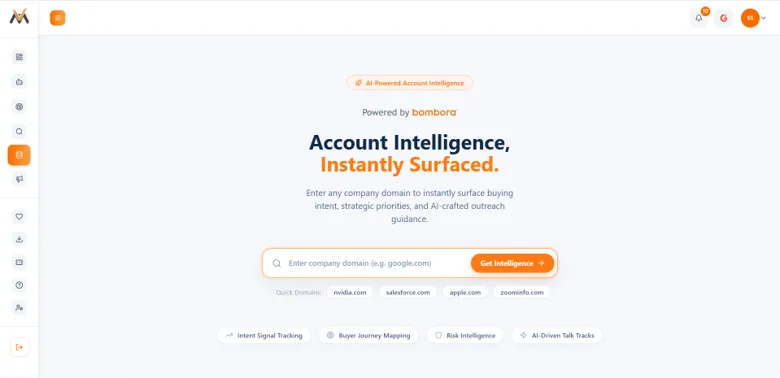
Valasys Media AI-powered Account Intelligence feature in VAIS

Users can enter a company domain in VAIS to generate an AI-powered Account Intelligence brief.

What Is VAIS Account Intelligence?

VAIS Account Intelligence turns company-level intent signals into an AI-generated sales intelligence brief.

The brief can help teams understand:

  • What topics an account appears to be researching
  • How that activity is changing
  • Where the account may be in its buying journey
  • Which business priorities or initiatives may be connected to those signals
  • Which stakeholder personas may be relevant
  • What a salesperson could investigate or discuss next

Bombora provides the underlying topic-level intent signals associated with company domains.

VAIS adds the interpretation layer by organizing those signals, identifying patterns and momentum, and using AI to translate them into business and sales context.

In simple terms:

Bombora provides the intent signal → VAIS organizes and enriches it → VAIS AI turns it into account intelligence and recommends sales action.

“Revenue teams have made significant investments in data, technology, and buyer signals, but the value of that information depends on how effectively it supports decision-making,” said Prachi Shah, CFO at Valasys Media. “Account Intelligence is designed to reduce the work required to interpret account activity and give teams additional context when prioritizing where sales resources should be focused.”

From Intent Signals to Account Context

VAIS follows an evidence-first process:

Signal → Momentum → Meaning → Action

The platform first evaluates observable account research activity and changes in the underlying intent signals.

Topic movement can be classified as Surging, Rising, Stable, Cooling or Declining, helping users understand whether interest around a subject is accelerating, remaining consistent or losing momentum.

VAIS AI then uses those processed signals to generate hypotheses around:

  • Strategic priorities
  • Likely initiatives
  • Potential business pressures
  • Buyer stage
  • Relevant stakeholder personas
  • Why-now factors
  • Account priority
  • Suggested outreach

The buyer-stage view can place an account across Awareness, Consideration, Active Evaluation, Vendor Selection and Decision.
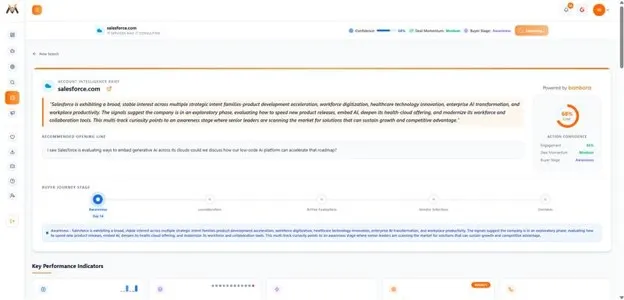
AI-powered Account Intelligence feature in VAIS

The Account Intelligence brief brings together account context, confidence, buyer stage and recommended opening guidance.

“Intent data can help a salesperson determine where to look, but the seller still needs context before deciding whether and how to engage,” said Rameshwar Thakur, Head of Sales at Valasys Media. “Account Intelligence gives representatives a structured starting point by bringing relevant signals and account context together. Sellers can then validate those insights before engaging the account.”

What Do Confidence and Deal Momentum Mean?

VAIS is designed to distinguish between observed signals and AI-generated interpretations.

A confidence indicator shows how strongly the available evidence supports a particular interpretation. It does not indicate the probability that the company will make a purchase.

For example, a high-confidence strategic priority means the available signals provide stronger support for that interpretation. It does not mean VAIS has confirmed an internal project or buying decision.

Likely initiatives, business pressures, and stakeholder recommendations should therefore be treated as data-backed sales hypotheses that sellers can investigate and validate.

Where data is limited, the analysis may carry lower confidence. If there is not enough meaningful underlying information for a domain, VAIS may return no result rather than presenting unsupported certainty.
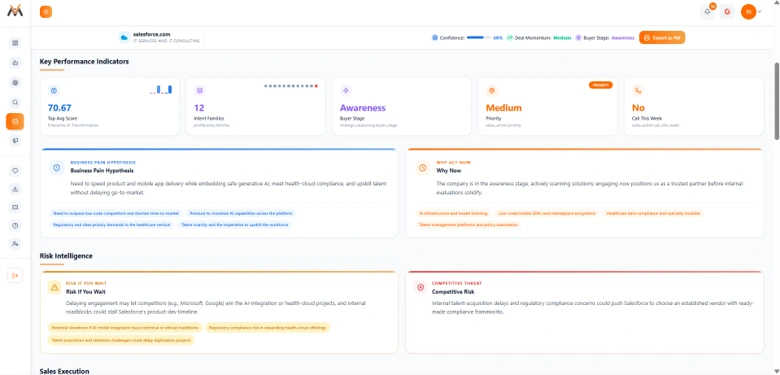
VAIS abm tool

VAIS surfaces indicators such as intent score, buyer stage, deal momentum, business priorities and risk intelligence in a single account view.

Moving From Account Research to Sales Action

Account Intelligence is designed to help sales teams decide what to investigate after an account signal appears.

The platform can suggest:

  • relevant personas;
  • conversation themes;
  • an opening message;
  • potential outreach direction;
  • and an outreach sequence across email, LinkedIn and phone.

These recommendations are intended to support seller preparation. VAIS does not automatically send emails, execute LinkedIn outreach or initiate phone calls through Account Intelligence.

The final engagement decision remains with the salesperson.

“AI should help salespeople understand available evidence without creating the impression that they know something about a buyer that has not been verified,” said Mohammad Tareequddin, CEO of Valasys Media. “Our approach is to use AI to organize signals, identify patterns and make uncertainty visible. The objective is to give sellers a stronger basis for investigation and decision-making while keeping human judgment at the center of the process.”

How Account Intelligence Fits Into VAIS

The new capability extends the broader VAIS revenue intelligence workflow.

Within the platform:

Valasys AI Score can help teams evaluate accounts.

Intent-based account lists can surface organizations showing relevant research activity.

Account Intelligence can help explain what that activity may mean and what sales teams should investigate next.

Prospect discovery capabilities can then help users identify potentially relevant contacts within those accounts.

Together, the workflow is designed to move revenue teams from simply identifying account activity to understanding why an account may warrant attention, who may be relevant and what context should inform outreach.

Built for Faster Account Research, With Human Judgment Intact

The approximately three-second brief-generation time refers specifically to the time VAIS takes to produce Account Intelligence from available data.

It should not be interpreted as a claim that every sales research process will always be reduced to three seconds.

The feature is designed to reduce fragmented account research by bringing intent strength, momentum, buyer-stage context, confidence, priorities, personas and recommended next steps into one view.

Valasys Media is not currently claiming a specific improvement in response rates, conversion, revenue, sales-cycle length or ROI from Account Intelligence because verified customer results establishing those outcomes have not yet been published.

The goal is to give sales teams an evidence-backed starting point for deciding which accounts deserve attention, what may be happening within those accounts and what should be investigated before outreach. 

About Valasys Media

Valasys Media is a global B2B marketing and sales solutions company helping brands build predictable growth engines through services like Lead Generation, ABM and Content Syndication.

Its proprietary VAIS platform powers data-driven prospecting by identifying ideal buyers, prioritizing accounts, and guiding outreach with actionable intelligence. Backed by data insights and a dedicated team of experts, Valasys enables clients to engage, convert, and retain the right prospects while maximizing ROI.

Recognized for its continued innovation and growth, Valasys Media has been featured on the Inc. 5000 list of America’s fastest-growing private companies.

Compliance and Data Ethics

Valasys Media processes business-contact data only using permissioned and consent-aligned signals. All outreach honors opt-outs and local regulations, including GDPR and CCPA/CPRA. SOC 2-aligned security and data protection practices, access management and operational safeguards are maintained across our processes. Data is verified for accuracy and recency, and suppression and do-not-contact lists are enforced across campaigns.

Media Contact: pr@valasys.com

Related Posts

Anthropic's IPO Could Raise $64.4 Billion as AI Investment Accelerates

Anthropic’s IPO Could Raise $64.4 Billion as AI Investment Accelerates

Mansi Hake

November 10, 2026: Artificial intelligence company Anthropic could raise up to $64.4 billion through its proposed initial public offering (IPO), according to an updated prospectus reported by Reuters. The IPO, combined with a separate $26 billion private placement involving major technology investors, could bring the total fundraising to approximately $90.4 billion. However, the $64.4 billion IPO figure includes shares sold by both Anthropic and existing shareholders. The company will not receive proceeds from shares sold by existing shareholders. The proposed IPO values the offering at an indicative share price of $70 to $78. Anthropic plans to sell 801.35 million shares, while existing shareholders will sell an additional 23.65 million shares. The separate private placement involves seven major technology investors: Google, Nvidia, AMD, Broadcom, Micron, Microsoft and TSMC. Anthropic, the developer of the Claude family of AI models, made its initial registration statement public on October 26. It subsequently filed an updated amendment, Amendment No. 2, with the U.S. Securities and Exchange Commission (SEC) on November 10, containing revised IPO details. The proposed Nasdaq listing is expected to trade under the ticker symbol ANT.  According to its amended SEC filing the fundraising plans come as the company reports rapid revenue growth driven by enterprise adoption. Anthropic recorded $33.24 billion in revenue for the nine months ended September 30, 2026, compared with $2.55 billion during the same period last year,  Its enterprise customer base also expanded significantly. More than 11,900 customers generated at least $100,000 in trailing-twelve-month (TTM) revenue by September 30, up from more than 950 customers a year earlier.  However, this expansion has required substantial infrastructure investment. Anthropic reported $18.8 billion in computing and infrastructure expenses during the first nine months of 2026, compared with $4.38 billion in the corresponding period last year. This represents a 329% year-over-year increase, reflecting the growing computing capacity required to develop and operate its AI models.  Despite the substantial infrastructure spending, Anthropic reported a GAAP operating loss of $1.26 billion for the nine months ended September 30, 2026, against revenue of $33.24 billion. This provides a clearer picture of its operating performance, separate from the much larger net loss reported for the period. The company also reported a generally accepted accounting principles (GAAP) net loss of approximately $104 billion for the period. However, much of this figure resulted from non-cash fair-value accounting adjustments rather than cash operating losses. The filing attributed $94.3 billion to changes in the fair value of convertible notes, derivative liabilities and simple agreements for future equity (SAFEs), primarily reflecting increases in the estimated value of these financial instruments as Anthropic’s enterprise valuation grew. By comparison, Anthropic reported $5.59 billion in adjusted net income, a company-defined non-GAAP financial measure that excludes selected expenses and accounting adjustments. The figure provides an alternative view of the company’s financial performance but differs from its GAAP-reported net loss.  The proposed listing comes as investors assess whether the commercial potential of advanced AI can justify the capital required to develop and operate increasingly sophisticated models. “There is still enormous excitement about AI’s potential to transform businesses, turbocharge productivity and reshape entire industries, but investors are becoming more discerning,” said Susannah Streeter, chief investment strategist at Wealth Club. Thomas Hayes, chairman of Great Hill Capital, also commented on investor expectations surrounding the offering. He described the IPO as being “for the faithful” and suggested that committed investors would eventually expect a return on their invested capital.  Anthropic’s proposed IPO could become a major test of investor appetite for AI businesses as they move from private funding rounds to public markets. Its combination of rapid revenue growth, rising infrastructure costs and substantial fundraising ambitions will put the economics of developing advanced AI under greater scrutiny.

How to Identify the Economic Buyer in B2B Qualification

How to Identify the Economic Buyer in B2B Qualification

Mansi Hake

How Do You Identify the Economic Buyer in B2B Sales? To identify the economic buyer in B2B sales, find who can authorize funding for this specific purchase, then verify that authority. Separate final financial approval from budget administration and internal advocacy. The economic buyer may be one executive or an approval group, so confirm the approval route, not just a name or title. Key Takeaways Seniority tells you where to look. It proves nothing about who can approve this purchase. The person who manages a budget and the person who can approve spending from it are often two different people. Ask what limits apply and who else has to sign.  What a contact tells you stays a lead until the approver confirms it. Unresolved authority calls for a dated next step, not a hopeful forecast. Why Does Identifying the Economic Buyer Matter in BANT Qualification? A deal can look healthy for weeks on the strength of one friendly contact. They answer emails, book the demo, and say finance won’t be a problem. Then the proposal lands on the desk of someone who was never part of the conversation. Within BANT, the Authority assessment looks at who controls the budget for a purchase and which stakeholders are involved in the decision. The modern BANT qualification framework treats authority as a buying condition that sales teams need to verify rather than assume from a job title. Identifying the economic buyer establishes who can authorize the spending. The urgency of the need and the feasibility of the buying timeline still require separate evaluation. Economic Buyer vs. Budget Holder vs. Decision-Maker: What Is the Difference? On a small tool, one department head can be champion, budget holder, and approver all at once. On a larger purchase, those roles split, and that is where discovery notes start to blur. Most deals will not have five different people filling these roles, so use the table to see which functions are present and who covers each. Role Typical responsibility What does not establish final funding authority Economic buyer Holds final authority over whether the purchase is funded; may be a person or a group  A title alone, or seniority in an unrelated function Budget holder Manages an allocated budget Managing a budget does not mean authority to approve or redirect it Champion Supports the purchase internally; a separate role from the economic buyer  Enthusiasm, responsiveness, or access Technical evaluator Assesses fit, security, and integration A positive technical review Procurement or contract signatory Runs the buying process, negotiates terms, or signs the agreement Processing or signing a contract A complete BANT authority assessment also distinguishes the financial decision-maker from people responsible for technical reviews, procurement, and contract execution. How to Identify the Economic Buyer in Six Steps 1. Define the Purchase and Its Funding Requirements Start with the thing being bought: the solution, its scope, the expected financial commitment, the contract length, and the business units it touches. Approval authority attaches to a purchase, so a pilot for one team and a multi-year rollout can land on different desks in the same company. You can move on once the buyer agrees your description of the purchase is accurate. 2. Identify Who Owns the Business Outcome Look for the person who answers for the result the product is meant to improve, such as pipeline quality or forecast accuracy. Accountable leaders often sponsor spending, so this person is a strong candidate. They are still only a candidate. Caring most about the outcome and holding the authority to release funds are separate facts. Write the name down as a hypothesis and carry it into the next steps. 3. Trace the Funding and Approval Route Ask where the money would come from. It could sit in an existing allocation, a requested budget, a discretionary pool, or a funding request that hasn’t been written yet. Then ask what has to happen before anyone can commit it, such as a business case or a finance review. A budget holder can often spend an allocation without being able to change it, so the route matters as much as the name. Hold off on advancing until you can describe the path from request to approved funds. 4. Check Approval Limits and Veto Authority Find out what spending thresholds exist, who holds delegated authority, and what extra sign-offs apply. Two powers get confused here. Security, legal, and technical reviewers can stop a deal without owning the funding decision, and the person who owns funding may never see the technical review. A contract that crosses someone’s limit also hands the final call to somebody else. Your output is the threshold that applies to this deal, plus a list of who can block it and which of those people also control funds. 5. Validate the Candidate With Buyer Evidence Sort everything you know into three piles: inference from a job title or company research, information reported by a champion or another stakeholder, and confirmation from a person responsible for the approval. Practitioners recommend writing the buyer hypothesis down and then confirming it. The strength of your evidence depends on what was verified. If a champion says “the VP signs off,” you have verified what the champion believes, nothing about the VP. Every fact should carry its pile before you advance. 6. Confirm the Route to Financial Approval Agree on a next step that tests your candidate. That might be an introduction to the financial decision-maker, a walkthrough of the approval process, or confirmation from another authorized person such as a finance partner.  You do not need to meet the CEO or CFO; plenty of purchases are approved far below that level. When direct access isn’t available, stay on good terms with the gatekeepers and influencers who can help, send specific questions through them, and record the answers as reported. If your contact resists an introduction, ask what the approver would need to see and offer to supply it. Leave the step with a dated action agreed. What Questions

Deloitte Launches Converge Front Office AI Suites

Deloitte Launches Converge Front Office AI Suites for Marketing and Sales

Priyanshi Kharwade

The new agentic AI offering connects marketing and sales systems, with Deloitte executives outlining its capabilities and industry experts examining the wider business impact. TL;DR Deloitte Digital launched Converge Front Office on November 16, 2026, introducing AI-powered marketing and sales solutions. Converge Marketing and Sales support campaign management, prospect research, sales workflows, and performance tracking. Deloitte executives highlighted disconnected systems and challenges affecting enterprise AI adoption. One client pilot showed outbound email response rates rising from 17% to approximately 56%. Planned expansion includes commerce, customer service, and customer strategy solutions. Nov. 16, 2026 – Deloitte Digital has launched Converge™ by Deloitte Front Office, a new suite of AI-powered tools designed to connect enterprise marketing and sales operations. Announced in New York, the offering helps businesses work across existing software, customer data, and internal systems without replacing their current technology. According to Deloitte’s official announcement, the launch includes Converge Marketing and Converge Sales. The company also plans to introduce solutions for commerce, customer service, and customer strategy. The announcement follows Deloitte Digital’s 2026 Personalization Trends research, which found that 97% of surveyed brand leaders believe AI is developing faster than their organizations can use it effectively for personalization. Another 76% said their existing systems and processes do not adequately support AI value creation. Deloitte Leaders Share Their Views on the Launch Mike DeLone, U.S. head of Deloitte Digital, highlighted the challenges businesses face when marketing and sales teams use disconnected systems. He said Converge aims to bring customer information and business activities together to help organizations make better use of their technology investments. Sundhar Sekhar, Deloitte’s chief services officer, focused on customer experience. He explained that connecting customer-facing operations could help businesses manage customer relationships more consistently across different channels. Mark Singer, marketing services lead and CMO of Deloitte Digital, identified disconnected workflows and operating models as barriers to AI adoption. He said businesses need better coordination between their technology, data, and teams to move AI projects into regular operations. Soumendra Mohapatra, Deloitte Digital’s national sales domain leader, discussed sales productivity. He said connecting existing sales applications could reduce manual tasks and support more coordinated customer interactions. How Converge Marketing and Sales Work Converge Marketing uses four types of AI agents: research, build, execution, and monitoring. These agents support audience research, campaign planning, content development, campaign execution, and performance tracking. Marketing teams continue making key decisions. Converge Sales helps teams research prospects, prioritize opportunities, manage incoming leads, and update forecasts. Deloitte says the technology can reduce quotation preparation from days to minutes, with human review included. In a report published by Digiday, Umberto Castaldo, Deloitte Digital’s Converge marketing go-to-market lead, demonstrated how AI agents could reuse existing brand assets to create campaigns for different audiences. Abe Awasthi, Deloitte Digital’s AI sales transformation leader, explained that administrators can control whether AI agents suggest actions, prepare drafts, or complete specific tasks. Early Client Results and Industry Perspective According to Digiday, one Deloitte client tested its sales system with half of its 300 business development representatives. During the three-month pilot, outbound email response rates reportedly increased from 17% to approximately 56%. After wider deployment, response rates settled in the 30% range. Awasthi also reported a 20% increase in team sales quotas. These figures come from one client and do not represent guaranteed results. Jay Wilson, a Gartner vice president and analyst, noted that consulting firms have established relationships with senior business leaders. He also highlighted the growing influence of CFOs in marketing spending decisions as companies face pressure to demonstrate financial returns. What Does the Launch Mean for Enterprise Marketing? Deloitte’s launch reflects growing interest in connecting marketing and sales activities through AI rather than managing them with separate tools. For businesses considering such platforms, integration costs, data security, human oversight, and measurable results will be important factors. Deloitte plans to expand Converge Front Office into commerce, service, and customer strategy, although specific release dates remain unconfirmed. The platform’s long-term impact will depend on whether businesses achieve consistent improvements in productivity, customer engagement, and sales performance.

Valasys Media Launches AI-Powered Account Intelligence in VAIS