
AI-Powered Account Intelligence: How B2B Sales Teams Turn Buyer Intent Into Action
Discover how B2B sales teams use AI-powered account intelligence to turn buyer intent signals into actionable sales opportunities.

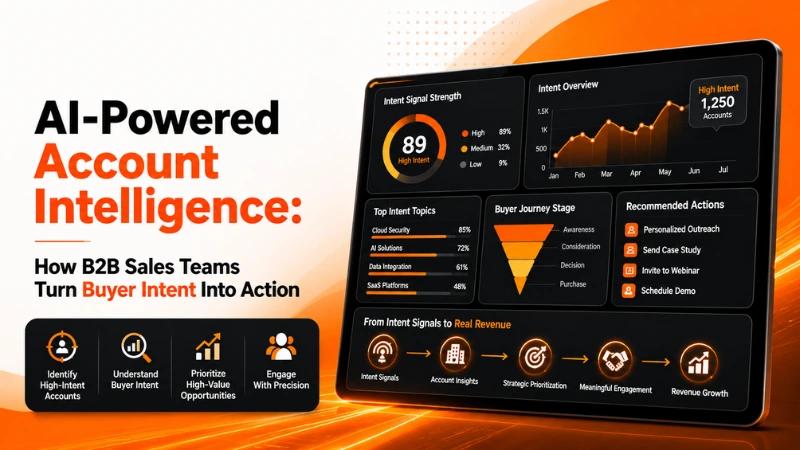
Intent data has created a funny problem for B2B sales teams: we finally know more about what accounts are researching, and we still manage to open the first call with, “So, tell me about your priorities this year.”
That is not a data problem. It is an interpretation problem.
An account can be surging on cybersecurity, cloud infrastructure, workplace productivity, or customer experience. Great. But a topic surge still does not tell a rep:
- Why the interest is happening
- How far the account may be into a buying decision
- Which internal pressure could be driving it
- Whether the person getting the email will care
Bombora defines intent data as a way to understand when buyers are actively researching a solution. The hard part starts after the signal arrives.
This is where the new AI-powered Account Intelligence feature in Valasys AI Score (VAIS) becomes useful. Enter a company domain, and VAIS organizes available intent and account signals into a sales brief covering buying stage, confidence, deal momentum, business priorities, likely initiatives, pressures and risks, stakeholder roles, and suggested outreach.
If your team already uses the Valasys AI Score or builds high-intent ABM lists, Account Intelligence helps answer the next question: what should sales understand before reaching out?
What is AI-powered account intelligence?
AI-powered account intelligence turns account-level buying signals into context a seller can actually use.
In VAIS, that means using account signals and AI to build a working view of what an account may care about, where it may sit in the buying journey, what initiatives or pressures could be shaping its research, which roles may matter, and how a salesperson could start the conversation. It is not certainty. It is a better-informed hypothesis.
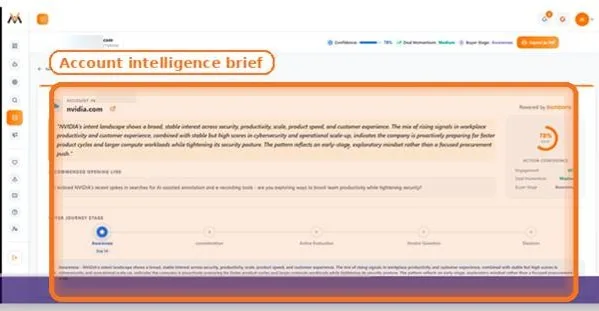
VAIS Account Intelligence brings the account summary, action confidence, buying context, and a recommended opening line into one view.
The Real Problem With Intent Data Is What Happens After the Alert
Intent data is excellent at making an account look interesting. Sales still has to decide whether the activity is meaningful.
Take cybersecurity:
- A company researching security tools could be modernizing its infrastructure.
- It could be responding to a new risk.
- It could be expanding into regions with stricter compliance requirements.
- It could also be doing broad, early research with no active project behind it.
If all four situations trigger the same pitch, the signal did not really improve the selling.
VAIS Account Intelligence is designed to add the missing context. The feature can help surface what the company may currently be interested in, what business problem it may be trying to solve, what products or services it may be researching, and how sales could approach the account.
Intent tells you where to look. Account intelligence helps you decide what is worth asking.
That distinction sounds small. In practice, it is the difference between personalization that feels relevant and personalization that feels like someone read your browsing history.
Buying Stage Changes the Meaning of the Same Signal
Two accounts can research the same product category and need completely different conversations.
VAIS estimates where an account may sit across five stages:
- Awareness
- Consideration
- Active Evaluation
- Vendor Selection
- Decision
An awareness-stage account may still be naming the problem. An account in Active Evaluation may already be comparing approaches. Vendor Selection is a different conversation again, because proof, differentiation, and stakeholder confidence start carrying more weight.
This is why buyer intent without buying context can create false urgency. A signal is not a stopwatch.
For the scoring layer that comes before this, see VAIS score calculation. Account Intelligence is less about giving the account one more number and more about helping the seller interpret what those numbers may mean.
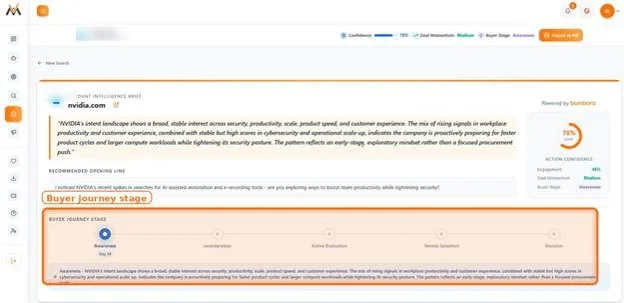
Buyer Journey Stage helps sellers frame outreach around how mature the account’s research activity may be.
Confidence and Deal Momentum Keep the AI From Becoming a Fortune Teller
A useful AI system should make uncertainty clearer, not hide it behind a polished dashboard.
VAIS provides indicators such as confidence, deal momentum, and buyer stage. Confidence reflects how strongly the available signals support the interpretation. Deal Momentum helps frame whether the opportunity appears weak, medium, or strong.
The important bit is what those indicators do not mean.
- A 78% confidence score is not a 78% probability that the account will buy.
- A likely initiative is not a confirmed project.
- A recommended stakeholder is not proof that person sits on the buying committee.
Treat the output as a research advantage, then validate the important assumptions.
That is a more credible use of AI than pretending a model has somehow been invited into the prospect’s internal planning meeting.
Business Priorities Give Intent Topics an Actual Plot
Intent topics are useful until there are twelve of them, five are rising, three look related, and somebody still has to explain what the account appears to care about.
VAIS can group the account context around priorities such as cybersecurity modernization, employee productivity, business expansion, faster product development, and improved customer experience. Each priority can carry a relative strength score.
Now the seller has something closer to a business story.
A cybersecurity surge alongside infrastructure expansion suggests a different conversation than cybersecurity appearing beside workplace productivity. Same category. Different context. Different reason to care.
This is where account intelligence earns the word intelligence. It is not just collecting more signals. It is organizing them into something a human can use.
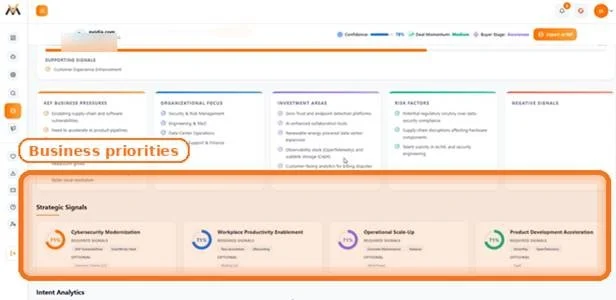
VAIS connects account activity with business pressures, organizational focus, investment areas, risk factors, and strategic priorities.
Likely Initiatives Are Most Useful When You Treat Them as Hypotheses
This may be the most practically useful part of the feature, and also the easiest one to misuse.
VAIS can surface likely initiatives that fit the account’s signals. Examples in the feature include improving security systems, introducing AI collaboration tools, expanding data-centre capacity, improving cloud monitoring, and launching customer analytics capabilities.
That gives a seller a sharper discovery hypothesis. It does not give them permission to state the initiative as fact.
Bad outreach says: “I saw that you are implementing a zero-trust program.”
Better outreach says: “We are seeing stronger activity around security modernization. Is that becoming a priority for your team this quarter?”
One sounds clever for six seconds and creepy for the next sixty. The other opens a real conversation.
The job of account intelligence is not to make the seller sound omniscient. It is to help the seller ask a better first question.

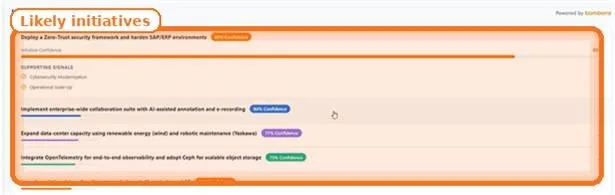
Likely Initiatives turns observed account signals into possible projects that sellers can validate during discovery.
Business Pressure Is the Part That Answers ‘Why Now?’
Buyers rarely wake up excited to purchase software. Something changes first.
- Costs rise.
- Security exposure becomes uncomfortable.
- A competitor moves faster.
- Customer-service problems start showing up in revenue conversations.
- A supply-chain issue stops being an operations problem and becomes a board-level one.
VAIS can surface possible pressures such as increasing costs, security threats, supply-chain problems, pressure to launch products faster, customer-service issues, and competitor activity. It can also show possible risks of waiting.
Priority tells you what may matter. Pressure helps explain why it may matter now.
That is a stronger basis for a sales conversation than parroting the top intent topic back to the account.
Then You Still Need the Right Human
Account intelligence does not close the deal. People still have to speak to people.
VAIS can recommend roles that may be relevant to the account’s likely priorities, including Chief Information Security Officer, Vice President of IT, Infrastructure Director, Head of Collaboration, and Knowledge Management Head.
That is where Find Prospect becomes a natural next step. Account Intelligence helps narrow the type of stakeholder who may matter. Find Prospect helps teams identify actual contacts inside the target account.
It is a cleaner handoff than dumping an account name into LinkedIn and hoping the first senior title is the right person.
The Last Mile Is Not ‘Generate Email.’ It Is ‘Give Me a Reason to Email.’
Most AI sales tools can generate a competent-looking email. That is no longer the impressive part.
The useful part is whether the message has a credible reason to exist.
VAIS can recommend a personalized opening line, a message angle, relevant conversation topics, and a suggested outreach sequence across email, LinkedIn, and phone.
Those recommendations become more useful because they are tied back to the account context. A salesperson can work from likely priorities, buying stage, pressures, and stakeholder relevance instead of starting with a blank page and the phrase ‘hope you’re doing well.’
The AI should give the rep a better brief. The rep should still decide what deserves to be sent.
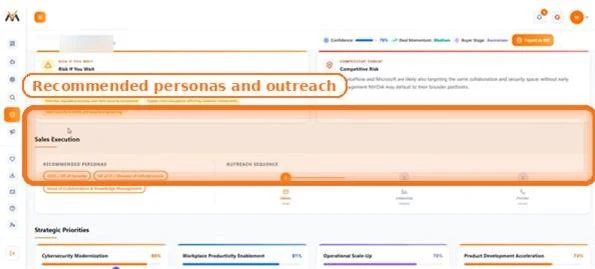
VAIS connects account insights with recommended personas, risk context, and a suggested multichannel outreach sequence.
Where Account Intelligence Fits in the VAIS Workflow
Account Intelligence makes the most sense as part of a connected workflow, not as another tab sellers are expected to remember.
Valasys AI Score helps teams evaluate accounts. High-intent ABM lists help organize which accounts deserve attention. Account Intelligence helps sales understand what may be happening inside those accounts. Find Prospect helps move from the account to relevant people.
That is the point. Sales should not have to choose between more data and more manual research.
The better outcome is less time piecing together a company story and more time validating the parts of that story that could actually affect the deal.
What B2B Teams Can Actually Do With This
The same account brief can be useful in different ways depending on who is looking at it.
- SDRs can use buyer stage, pressure, and recommended personas to decide why an account may be worth contacting now, not simply whether it is on a list.
- Account Executives can turn likely initiatives and business priorities into discovery hypotheses to validate on the first call.
- ABM teams can use stronger account themes to shape messaging around the issues that appear most relevant to the account.
- Sales leaders can use confidence and momentum as context for prioritization while still requiring reps to validate the important assumptions.
None of that requires pretending the AI knows the buyer better than the buyer knows themselves. It requires using the brief as a smarter starting point.
Final Thoughts
B2B teams do not have a shortage of signals. They have a shortage of time to interpret them well.
The interesting part of AI-powered account intelligence is not that it can produce another score or another paragraph of account research. It is whether it helps a seller move from “this company is active” to a more useful set of questions.
What may matter here? Why might it matter now? Who is likely to care? What should I validate before I reach out?
That is the standard.
VAIS Account Intelligence is designed to give sales teams that starting point by bringing buying context, priorities, likely initiatives, pressures, stakeholder roles, and outreach guidance into one account brief.
It does not replace seller judgment. It gives judgment better material to work with.
Turn Buyer Intent Into a Better First Conversation
If your team already knows which accounts are showing intent, the next advantage is understanding what those signals could mean before the outreach begins.
Ready to transform your demand generation strategy? Contact Valasys Media to learn how our data-driven approach and VAIS Account Intelligence can accelerate your pipeline.
Frequently Asked Questions (FAQs)
1. When should a sales rep act on a buyer-intent signal?
A rep should act when the signal is strong enough to justify research and there is a credible reason for outreach. In practice, that means looking beyond the topic itself and checking buyer stage, confidence, deal momentum, business pressure, and stakeholder relevance before deciding whether to contact the account now.
2. How should sales validate an AI-predicted initiative before mentioning it?
Treat the initiative as a hypothesis, not a fact. Look for supporting public evidence, check whether related intent themes are rising, and phrase the first conversation as a question. The goal is to validate the possibility without implying access to private information.
3. What should a rep do when confidence is high but deal momentum is only medium?
High confidence means the interpretation has stronger support. Medium deal momentum means the account may still need time or additional signals before aggressive outreach. A sensible move is to research the priority, identify the right stakeholder, and use a low-friction message rather than assuming the account is ready for a sales cycle.
4. How should outreach change when the buyer stage is Awareness?
Awareness-stage outreach should focus on the problem and business context rather than a hard product pitch. The seller’s job is to confirm whether the issue is real, understand how the account frames it, and earn the right to move into solution discussion.
5. What information from an account-intelligence brief should be checked before a first call?
Check the top business priorities, buyer stage, confidence level, likely initiatives, key pressures, recommended stakeholder role, and any suggested opening line. Then verify the two or three assumptions that would make the biggest difference to the conversation.
6. How can sales use business-pressure insights without sounding intrusive?
Talk about the business issue, not the surveillance. Instead of saying you know the company has a specific internal problem, reference the broader challenge and ask whether it is relevant. Good account intelligence should make outreach feel informed, not observed.
7. What is the safest way to use an AI-generated opening line?
Use it as a draft, then rewrite it in the seller’s own voice. Remove any claim that cannot be verified, keep the reason for contact specific, and make sure the message gives the prospect an easy way to correct the assumption.
8. How can account intelligence improve discovery-call preparation?
It gives the rep a short list of informed hypotheses before the call: what the account may prioritize, what could be creating urgency, which initiative may be emerging, and which stakeholder concern is likely to matter. Discovery then becomes validation instead of starting from zero.
9. How can marketing and sales use the same account-intelligence brief differently?
Marketing can use the account themes to shape messaging and campaign relevance. Sales can use the same themes to prioritize outreach, prepare discovery questions, and choose stakeholder-specific angles. The shared brief creates common context without forcing both teams into the same workflow.
10. What should teams avoid putting into CRM from AI-generated account intelligence?
Do not record predicted initiatives, buyer roles, or business pains as confirmed facts unless they have been validated. Label them as hypotheses, signals, or AI-generated insights so future users can distinguish observed evidence from interpretation.