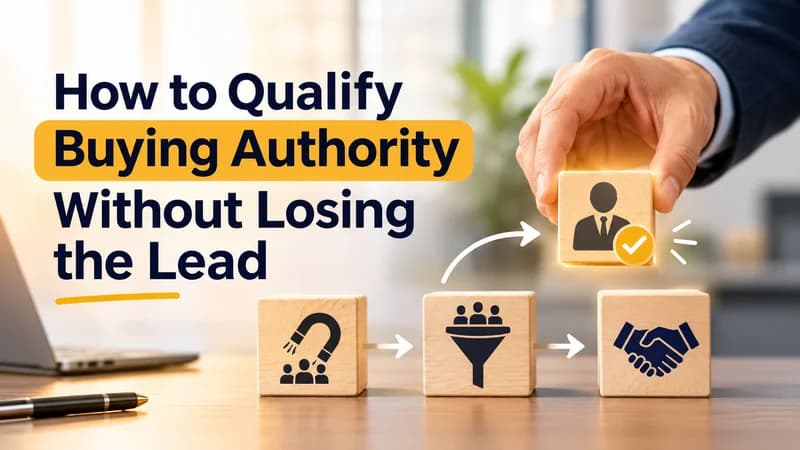
How Can You Qualify Buying Authority Without Losing the Lead? To qualify buying authority without losing the lead, ask how the buying decision is made instead of asking whether your contact has power. Use process-based questions about roles, approvals, and previous purchases, explain why you are asking, offer to help the contact secure approval, and keep them involved in every next step. Key Takeaways Learn about the decision process before you question anyone’s personal authority. Treat evaluators and influencers as valuable, even when they cannot approve the spend. Explain why approval questions matter so they sound like help, not a test. Involve other stakeholders for a clear business purpose. Record what you don’t know, and agree on a useful next step. The fastest way to make an interested prospect feel unimportant? Ask whether they’re the real decision-maker. To a salesperson, it sounds like a routine qualification question. To a prospect, it can suggest that their input only matters if they control the budget. But avoiding the question isn’t the answer either. You still need to understand who evaluates the solution, who influences the decision, and who can approve the purchase. The difference lies in how you approach that conversation. Effective authority qualification is about understanding the buying process while giving that person a reason to help you move it forward. Why Is Buying Authority Distributed Across Multiple Stakeholders? In B2B purchases, buying authority rarely sits with one person. Different stakeholders contribute to the decision based on their responsibilities, expertise, and influence within the organization. One person may identify the need and evaluate potential solutions, while another checks technical requirements, reviews the budget, or gives final approval. For instance, an operations manager might lead the search for a tool and recommend a vendor based on its ability to solve a workflow problem. The IT team may assess integration and security requirements, while finance reviews the cost and available budget. A department head or senior executive may then approve the purchase. Each stakeholder influences the outcome differently. The evaluator shapes the shortlist, technical teams determine whether a solution meets internal requirements, finance assesses commercial feasibility, and the final approver authorizes the spend. In some organizations, procurement also manages vendor checks and purchasing procedures. This is why identifying only the person who signs the contract gives sales teams an incomplete picture. Understanding who evaluates, recommends, influences, and approves the purchase helps reveal how the decision actually moves forward. Why Do Authority Questions Sometimes Create Friction? A question can be meant as qualification and still be heard as a ranking. “Are you the decision-maker?” sorts the opportunity for the seller, but the prospect may hear a verdict on their own importance. Not every buyer reacts this way, but enough do that this wording deserves care. Timing adds to the problem. Learning the buyer’s business context and priorities before moving into sensitive purchasing topics is important because probing questions can feel intrusive before trust exists. Questions also land better when they match the buyer’s situation and stage. The modern BANT (Budget, Authority, Need, Timeline) qualification framework helps teams assess buying conditions without treating a contact’s job title as proof of authority. How to Qualify Buying Authority Without Making Prospects Defensive Understand Their Role Before Asking About Approval Start with what your contact owns. Do they run the evaluation, influence the choice, recommend a vendor, or manage the project afterward? “What’s your part in this project?” gets the answer without implying a ceiling. Understanding the contact’s role is only one part of mapping buying authority; teams must also identify the decisions and approvals required for the purchase. Ask How Decisions Are Made, Not Whether They Have Power Shift the focus from the person to the process. Ask how similar purchases were handled before, who else takes part, and what steps follow a recommendation. Answers about the process reveal authority without forcing your contact to defend theirs. Explain Why You Need to Understand the Buying Process Give a reason. “I’d like to understand the approval steps so I don’t surprise anyone later or send a proposal that misses a requirement” turns the question into support. Avoiding surprises, shaping the proposal, and meeting requirements early are all reasons a buyer can accept. Keep Your Contact Involved in the Next Step Offer to help the contact secure approval instead of asking for direct access to other stakeholders. If another person needs to be involved, propose a joint conversation around the business problem, with your contact included. Understanding the approval process is not the same as having influence over it. A contact may know who approves the budget and what steps are required without having the ability to shape the recommendation or move it forward. Sales teams can distinguish between the two by asking what role the contact plays after the evaluation, whether their recommendations carry weight internally, and whether they can coordinate the next steps with other stakeholders. For instance, someone who can prepare a business case, recommend a vendor, or arrange a discussion with finance has an active role in advancing the purchase. Someone who can only describe the approval hierarchy may have useful information but limited influence over the outcome. The goal is to understand how much the contact can contribute to the buying process and support them accordingly, rather than bypassing them to reach someone more senior. What Authority Qualification Questions Can You Ask Without Sounding Pushy? Good phrasing keeps the purpose of the question and removes the judgment. This is a reference. Instead of asking Try asking What the answer tells you “Are you the real decision-maker?” “How does your team usually make a decision on something like this?” The process, the participants, and your contact’s place in it “Do you have authority to buy?” “What approvals would be needed if the solution meets your requirements?” Which approvals exist and who gives them “Can you get me to your boss?” “Would it be useful to involve anyone else so we can address their requirements