


How Automated Redaction Saves Time in Business Workflows
Discover how automated redaction revolutionizes business workflows by eliminating manual errors, accelerating document processing, and ensuring compliance at scale for various departments.

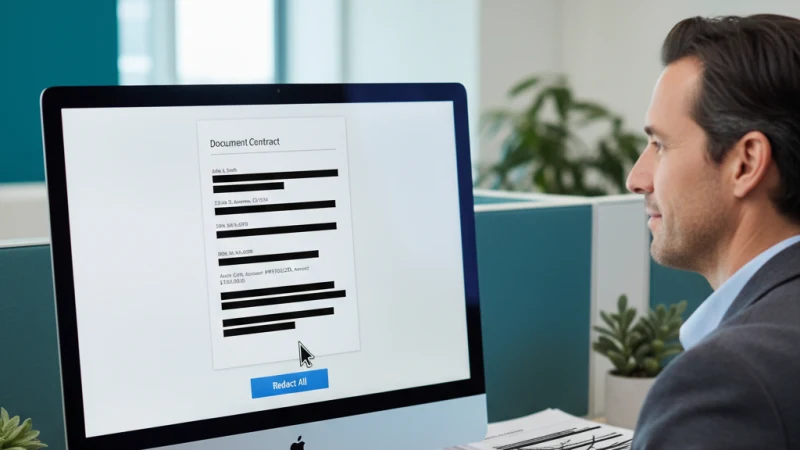
Information is the lifeblood of any modern organization and it flows continuously. Documents in various forms are created, edited, reviewed, and shared not only within departments but also across platforms at a speed that is increasing every year. No matter if a company deals with contracts, financial reports, employee records, customer data, or compliance documents, teams need accurate and efficient workflows to be able to carry out the daily operations smoothly.
However, with the rise of digital information, there has also been an increase in the number of sensitive content details that have to be hidden or removed from documents before they can be shared either internally or externally. In the past, redaction was considered a tedious, manual task that was done at the end of a workflow. Employees line up through pages line by line, try to locate private information, and manually block it out before they send a document forward.
Such a manual process throttles the speed at which teams work, can cause errors due to mistake and thus creates bottlenecks which become more and more serious as organizations grow. More and more companies are realizing today that automated redaction should not only be seen as a convenience but rather as a necessity. Automated redaction is time saving, it makes work more efficient, it is more accurate, and it helps an organization’s security efforts by ensuring that the organization does not leak sensitive data by mistake.
By the time companies are willing to adopt automation in every aspect of their operations, they integrate automated redaction into document workflows as a must for modern business.
The Inefficiencies of Manual Redaction
In order to fully grasp the concept of automation time-saving, one should picture the amount of labor that manual redaction entails. A simple file such as a contract or a report can have up to dozens of sensitive elements: names, addresses, ID numbers, financial data, internal notes, or confidential strategy details.
When the workers decide to do it by themselves, manually redacting the documents, the process becomes tedious and slow. They have to read every line carefully, highlight each element precisely, and make sure that no text is left in the document’s metadata or the underlying file structure. They might have to check the information, compare different versions, or make changes before they share the final copy.
It is especially hard to do when there are a lot of documents. Teams can spend hours or even days going through a large number of files for regulatory submissions, legal discovery, compliance audits, or internal data requests. The more the documents are, the more the workers get tired and make mistakes.
Moreover, manual redaction needs the opinion of several people e.g. legal, compliance, or management teams that slow down the workflow even more. Documents get stuck in inboxes. Projects pause. Deadlines become harder to meet.
And if, after all these efforts, there is still one single missing piece of information, it can be a very expensive mistake. For organizations that deal with sensitive information on a daily basis, manual redaction is not a solution that can be scaled up. According to official guidance from the National Institute of Standards and Technology (NIST), manual security processes introduce higher risk because human oversight becomes increasingly unreliable at scale.
Why Automation Changes Everything
Automated redaction technology aims to lessen the work of manual review. Rather than a team of employees hunting for sensitive data to remove, automated tools do a complete scan of the document within seconds, find patterns, and redact the information as per the set rules.
It removes repetitive work for a different number of hours. What a human team would have taken several days to do, automation can accomplish in minutes or even seconds.
Consistency is also brought by automation. Instead of every employee understanding the guidelines differently, automated systems use the same logic and rules for all documents. Besides speed enhancement, this also guarantees a standardized approach that lessens the risk.
By handing over the most time-consuming part of redaction to software, companies are making their teams available for more valuable tasks such as strategy, analysis, communication, and decision-making instead of the boring manual cleanup.
Reducing Bottlenecks Across Departments
One of the biggest sources of delays in business workflows is document processing. When a file requires redaction before it can move forward, the entire workflow may pause until someone completes the task.
This affects multiple departments:
- Legal teams waiting for contract reviews
- HR teams preparing onboarding or exit documents
- Compliance teams fulfilling regulatory requests
- Finance handling audits or investor reports
- Customer service preparing case files
- Operations moving documents between vendors and partners
Every delay compounds the next one. But when redaction is automated, documents move faster and so does the entire organization.
Teams no longer wait for manual review. Bottlenecks disappear. Processes that once required back-and-forth communication now happen instantly, enabling smoother collaboration and faster turnaround.
Organizations that want to streamline their workflows and reduce time-consuming manual tasks often explore tools that simplify redaction and guarantee accuracy. Many teams choose solutions that allow them to click here to process documents quickly, securely, and consistently. With automated redaction, companies can eliminate repetitive work and ensure every document is ready for sharing without delays or risk of exposure.
Redaction at Scale: How Automation Handles Volume
When businesses handle a vast number of documents, manual redaction becomes almost infeasible. It doesn’t matter if new legal files are being made from hundreds of documents, thousands of records are being prepared for an audit, or internal workflows are ongoing, in all cases, the volume of work leads to the failure of manual processes.
An automated redaction tool is designed to be extended. Machines can handle several hundred or several thousand files at the same time without losing precision. Patterns are detected in a flash, details are removed in a uniform manner, and very few supervision is needed for the completion of whole lots.
So, redaction is not only faster but also more certain. Instead of making a guess of how long a document review by a team will take, companies are able to depend on the automated turnaround times which are always the same.
Such scalability means a lot to the companies which are still growing. The process of redacting files is no longer the cause of a company’s expansion being limited.
The Competitive Advantage of Faster Workflows
Today’s business environment moves at extraordinary speed. Companies that can process information faster gain a significant competitive advantage. Automated redaction directly supports this by reducing delays in critical workflows.
Faster contract cycles mean deals close sooner.
Faster compliance processes reduce audit pressure.
Faster information-sharing improves collaboration.
Faster document preparation accelerates decision-making.
When organizations eliminate slow, inconsistent manual redaction, they position themselves for greater agility, responsiveness, and operational efficiency.
Final Thoughts
Automated redaction is reshaping business workflows by cutting out lengthy manual processes that are typical of most businesses, increasing accuracy, lessening bottlenecks, and facilitating the scalable handling of documents. Automation, which was once considered a mere option, has now become a necessity.
Organizations, by the use of automated redaction as part of their everyday operations, are able to save time, strengthen compliance, cut down human errors, and produce smoother workflows that every department can be benefited from.
The next wave of document management will not be dependent on the slow manual review but rather on smart automation that safeguards sensitive information while still allowing the business to progress. Automated redaction is an important move in that direction.

