Turn First-Party Data Into Pipeline Growth
Explore proven ways to capture, organize, and activate customer data for smarter B2B marketing decisions.
 Lead-Gen now on Auto-Pilot with
Build My Campaign
Lead-Gen now on Auto-Pilot with
Build My Campaign

Learn the key differences between first-party and third-party data, and how B2B marketers can use each to improve targeting, personalization

Turn First-Party Data Into Pipeline Growth
Explore proven ways to capture, organize, and activate customer data for smarter B2B marketing decisions.
Your buyer just researched your category, compared three vendors, and formed an opinion. They used your content to do it. You have no idea it happened, because they never filled out a form.
That is not a future problem. It is happening in your pipeline right now.
The data conversation has shifted in ways most marketing teams haven’t fully caught up to yet. It is no longer just about what you collect. It is about signal quality, consent architecture, and whether your data ecosystem is actually built to support the way buyers research and buy in 2026. This guide breaks down what first-party, zero-party, second-party, and third-party data actually mean, where each type still earns its place, and what separates teams with clean data advantages from teams burning budget on bad signals.
Most conversations treat this as a simple binary. First-party good, third-party bad, end of story. That framing is already behind where the market has moved.
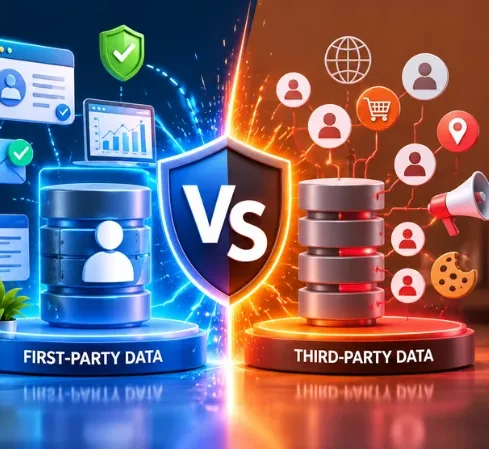
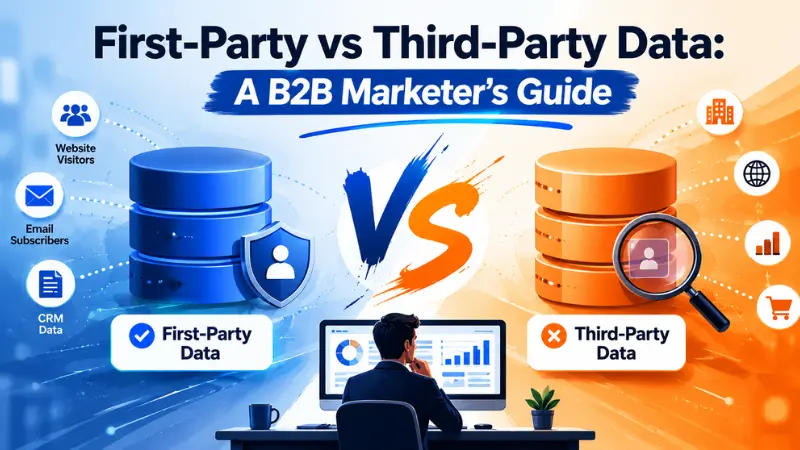
Simply, the main difference is ownership and source (origin). First-party data is information you collect directly from your own audience through your website, CRM, or emails, making it highly accurate and compliant. Third-party data is collected and sold by outside vendors who have no direct relationship with the user.
First-party data is information your organization collects directly through channels you own or control. Website behavior, email clicks, CRM records, form fills, product usage, event attendance, support history. You collected it with consent. You hold it. No platform policy update, cookie regulation, or algorithm change can take it from you.
Here is where most teams lose the thread. Zero-party data is a distinct and arguably more valuable subset: information people give you intentionally
Turn First-Party Data Into Pipeline Growth
Explore proven ways to capture, organize, and activate customer data for smarter B2B marketing decisions.
For the operating workflow, see how to combine first-party and third-party intent data.. Preference center selections, onboarding survey answers, quiz results, in-product feedback. The person knows exactly what they are sharing and chooses to share it. In a regulatory environment that keeps tightening around inferred behavior, that explicit consent is not just a compliance checkbox. It is a signal quality multiplier.
The practical gap most teams fall into is believing they already have a first-party data strategy when what they actually have is a CRM with incomplete records and a Google Analytics dashboard someone glances at quarterly. That is data accumulation. A strategy connects that data to defined outcomes, routes it through a scoring system, and turns it into action inside a predictable window. For a deeper breakdown of how these data types map to actual pipeline outcomes, the Valasys First-Party Data guide covers the full picture.
Second-party data is another company’s first-party data accessed through a direct partnership or data-sharing agreement. Think co-marketing relationships, clean room collaborations, or publisher-audience deals. The consent chain is cleaner than third-party, and the signals are more contextually relevant.
Third-party data is information aggregated by external vendors, often scraped, inferred, or licensed from multiple sources, and packaged into segments or contact lists you can buy or rent. You did not collect it. You do not have a direct relationship with the people in it. And increasingly, you cannot verify how it was gathered. It is not dead. But it is doing a lot less heavy lifting than it used to.
| Data Type | Source | Consent Quality | Business Value |
| Zero-Party Data | User-provided (forms, preferences, surveys) | Fully explicit | Very High |
| First-Party Data | Your own channels (web, email, CRM, product) | Explicit or implied | High |
| Second-Party Data | Partner data sharing agreements | Varies | Medium |
| Third-Party Data | Data brokers, ad networks, co-op platforms | Often unclear | Declining fast |
The direction of travel is clear. The further up that table you operate, the more defensible your data position becomes.
Third-party data still has legitimate uses: cold outreach at scale, Total Addressable Market (TAM) sizing, and identifying net-new companies in expansion markets. The problem is using it as a substitute for first-party data in your core activation channels, where accuracy and consent determine whether the message lands or gets flagged as spam. When properly validated and combined with first-party signals, third-party data remains valuable for enterprise organizations with mature data operations teams.
When running account-based programs in particular, relying on unverified third-party streams creates massive waste. Revenue teams that have solved this problem tend to use internal scoring frameworks that cut through the noise. One example: the Valasys AI Score (VAIS) engine maps fragmented contact activities to a unified corporate entity and scales account scores from 55 to 95 based on live enterprise behaviors against Ideal Customer Profile (ICP) rules. The result is that cross-functional teams prioritize actual corporate engagement instead of rented, noisy third-party signals.
Third-party data did not become controversial because privacy advocates got louder, though they did. It became a structural problem because the infrastructure supporting it started collapsing from the inside out.
Google’s long-running attempt to phase out third-party cookies in Chrome ultimately reversed course in 2024, pivoting to a user-choice model rather than a hard deprecation. That reversal did not restore confidence in third-party data. It just confirmed how structurally unstable the infrastructure always was. Apple’s App Tracking Transparency (ATT) framework gutted mobile targeting regardless. Meta disclosed a $10 billion revenue impact from ATT in their Q1 2022 earnings call which triggered an infrastructure shift that revenue teams are still recovering from today. That is one regulation, one platform, one year.
Regulations have teeth now. The General Data Protection Regulation (GDPR) Enforcement Tracker has logged cumulative fines well past the €4 billion mark since enforcement began in 2018. The California Consumer Privacy Act (CCPA) in California set a template that multiple U.S. states are following. Brazil’s Lei Geral de Proteção de Dados Pessoais (LGPD), Canada’s Personal Information Protection and Electronic Documents Act (PIPEDA) updates, and India’s Digital Personal Data Protection (DPDP) Act. The regulatory patchwork is becoming a quilt, and every thread tightens around third-party data practices.
And here is the part the industry does not talk about enough: While premium vendors like ZoomInfo and Apollo have improved data verification processes, the overall market still shows significant quality variance. A 2016 Ponemon Institute study on third-party data risk found that approximately half of data broker records showed reliability issues, though quality varies significantly by vendor and data type. That number has not dramatically improved. When you are paying for audience segments built on inferred behaviors and stale records, you are spending the media budget on assumptions.
Every martech vendor, consultant, and conference keynote will tell you that first-party data is the future. They are right. But there is a catch that gets skipped over in the sales pitch.
“First-party data delivers maximum value when you have sufficient volume, proper structure, and intelligent activation systems in place.
For mature enterprise organizations with years of CRM data, proprietary intent signals, and robust marketing automation, first-party data is genuinely transformative. For a mid-market company with 3,000 contacts in a half-maintained HubSpot instance and inconsistent UTM tracking, “first-party data strategy” can become an expensive distraction before the foundation is built.
Research indicates most marketers recognize first-party data’s importance but struggle with implementation
That gap is where most organizations actually live. The strategy exists in a deck. The execution lives in a spreadsheet named something like “final_final_v2_REAL.xlsx.”
The “first-party vs. third-party” framing is a vendor narrative. Sophisticated organizations do not choose sides. They use both and stop using third-party data as a replacement for relationship intelligence.
HubSpot has described how its marketing team layers first-party behavioral data (product usage, content engagement, and email interaction) with third-party firmographic enrichment to build a fuller account picture, a model they outline in their HubSpot Marketing Blog on first-party data. The first-party signals tell you who is active and how. The third-party enrichment tells you what kind of company they are and what they are likely to need. Neither alone is sufficient for accurate scoring.
Mid-market companies can apply similar principles using tools like Pipedrive’s Smart Contact Data or Mailchimp’s Customer Journey Builder, focusing on progressive profiling and behavioral triggers rather than complex scoring algorithms.
Snowflake built a significant use case around Snowflake Data Clean Rooms: environments where two organizations can run joint analytics on combined datasets without either party exposing their raw data to the other. This is second-party data collaboration at scale, with privacy compliance built in. It is how media companies, retailers, and technology vendors are maintaining targeting precision in a post-cookie environment without relying on third-party brokers. Organizations looking to implement these advanced data-sharing capabilities often rely on Customized Snowflake Implementation Services and Solutions to build secure, scalable, and compliant collaboration environments.
Intent data is where the first-party/third-party debate gets genuinely nuanced. Tools like Bombora, G2, and TechTarget aggregate behavioral signals across the web, content consumption patterns that indicate research activity, and sell them as third-party intent data. Technically third-party. But qualitatively different from a bought contact list.
When an account is consuming content about “cloud migration challenges” across multiple publisher sites, that is a real signal. It is not perfect. But it is directional, and direction matters when your sales team has limited bandwidth. Bombora’s Definitive Guide to Intent Data documents how layering these signals into outreach prioritization consistently improves pipeline conversion rates.
When running account-based programs, relying on fragmented third-party signals creates waste fast.
This is where frameworks like the Valasys AI Score (VAIS) become useful operationally.
Instead of treating every isolated engagement equally, the VAIS engine maps fragmented contact-level activity back to unified corporate entities. Accounts are dynamically scored between 55 and 95 based on:
That means teams prioritize actual buying momentum instead of reacting to noisy, rented signals from disconnected databases.
This creates an approach focused less on a ‘spray and pray’ mentality and more on signal intelligence backed by structured logic.
Here is the uncomfortable reality. Marketing teams that treat data compliance as someone else’s job are the same teams that end up in the news for the wrong reasons.
Third-party data sourced from brokers without clear consent chains is a liability. Not hypothetically. Demonstrably. Under GDPR Article 14, receiving personal data from a third party doesn’t transfer the compliance burden to the vendor. You inherit it. You cannot point at the spreadsheet later and claim you didn’t know.

What does compliant third-party data use actually look like in practice?
And first-party data is not automatically safe either. A broken consent banner or a vague privacy policy can create just as much legal exposure. Consent management platforms, clear privacy notices, and preference centers are baseline requirements, not differentiators and revenue teams that need to swap vendors are increasingly weighing ՕneTrust alternatives as a normal procurement step rather than an edge case.
Rather than “use first-party data,” here is an actual decision framework for where each type earns its place:
Use first-party data for:
Third-party data works best for:
Use second-party data for:
The mistake most organizations make is using third-party data as a crutch for first-party data they should have built. If your CRM is thin, the answer is not more list purchases. It is understanding why your data capture mechanisms are not working in the first place.
This is where theory meets execution. A few things that consistently separate programs that generate revenue from programs that generate strategy decks:
Progressive profiling over form interrogation. Asking for 14 fields on a gated asset is how you kill conversion rates and guarantee incomplete data from the records that do come through. HubSpot Breeze Intelligence (formerly Clearbit Reveal) and HubSpot’s progressive profiling let you collect data incrementally across multiple interactions, enriching records without demanding information upfront. Lower friction almost always equals better data.
Webinars and events as demand generation assets, not just awareness plays. Most organizations treat webinars like temporary campaigns. That is a significant missed opportunity. Attendance duration, poll responses, Q&A participation, repeat attendance, and post-event engagement: these are high-quality first-party signals. They should flow directly into scoring systems, not sit in a CSV on a marketer’s desktop.
Product usage data as the crown jewel. For SaaS businesses especially, product behavior is the highest-intent signal available.
This data should be feeding sales teams in near real-time. Gainsight PX is purpose-built for operationalizing those usage signals into retention and expansion workflows before churn becomes visible.
Community and content engagement. If you run a community, publish content, or host any owned platform where your audience spends time, that engagement data is yours. Most teams collect it and do nothing structured with it.
Every martech vendor is claiming AI capabilities. Fair enough. But there is a practical question underneath all the positioning: what kind of data does AI actually need to produce results worth trusting?
The answer is first-party data. Specifically, structured, clean, consented, and recent first-party data.
Large language models used for personalization, scoring, and content generation can be fine-tuned on proprietary data. Predictive models trained on your CRM’s historical patterns outperform generic industry models because they have learned your specific customer behavior. AI-powered lead scoring built on your first-party intent signals produces results that bought data simply cannot replicate.
The competitive moat is not the model. Anyone can access the same foundation models. The moat is the data those models train on, and that data advantage only compounds if you are building first-party assets consistently.
Volume is not quality. This gets said constantly. It rarely gets operationalized.
A database of 500,000 records with 40% inaccurate emails, outdated job titles, and misclassified company sizes is worse than a database of 50,000 clean, verified, consented records. Worse because it costs more to process, degrades sender reputation, wastes sales team time, and generates false signals in your scoring models. Poor data quality has cascading effects, degrading performance across scoring models, email deliverability, and sales prioritization systems.
According to Gartner’s research on data quality costs, poor data quality costs organizations an average of $12.9 million annually. That is the accumulated cost of bad decisions made on bad data, across hiring, targeting, forecasting, and operations.
Data hygiene is not glamorous, but the alternative is significantly more expensive. If your current database needs a proper audit, Valasys Data Solutions is a practical starting point.
The first-party vs. third-party framing helps understand the landscape, but the real question is more specific: what data do you need to make better decisions and build better relationships?
For net-new prospecting, third-party data still has a selective role when used compliantly. For relationship-based activities, personalization, scoring, retention, and expansion, first-party data is non-negotiable. Organizations investing in building it now will have a structural advantage competitors can’t buy their way out of.
Ready to audit where your data program stands and build a strategy that fits your business context? Valasys Media’s Data Solutions team can help you build that competitive moat.
The main difference is ownership and source. First-party data is information you collect directly from your own audience via your website, CRM, or emails, making it highly accurate and compliant. Third-party data is collected, aggregated, and sold by outside vendors who have no direct relationship with the user.
Yes, but primarily for top-of-funnel reach. While it shouldn’t be used for deep personalization, third-party data is incredibly useful for:
First-party data is more accurate because it is based on real, documented interactions with your brand. Because you control the collection process, you don’t have to worry about the data decay, outdated records, or guessed behaviors common with brokered third-party datasets.
Zero-party data is information customers intentionally and proactively share with you. Examples include preference center choices, survey responses, and onboarding quizzes. It matters because it gives you explicit customer intent and zero privacy headaches; no guesswork required.
AI and machine learning models are only as good as the data feeding them. First-party data provides the clean, proprietary, and structured behavioral signals needed to train models for accurate lead scoring, predictive analytics, and automated personalization.
Second-party data is another trusted company’s first-party data that you gain access to through a direct partnership.
Example: A software company and a consulting firm co-host a webinar and securely share the attendee list to run a joint marketing campaign.
The best approach is a blended strategy: Use third-party intent data to flag accounts researching relevant topics across the web, then cross-reference those accounts with your first-party data (like recent website visits or content downloads). This helps your sales team prioritize accounts that are both in-market and familiar with your brand.
Progressive profiling is the practice of gathering user data incrementally across multiple interactions rather than asking for everything at once.
This builds a rich data profile over time without hurting form conversion rates.
Turn First-Party Data Into Pipeline Growth
Explore proven ways to capture, organize, and activate customer data for smarter B2B marketing decisions.