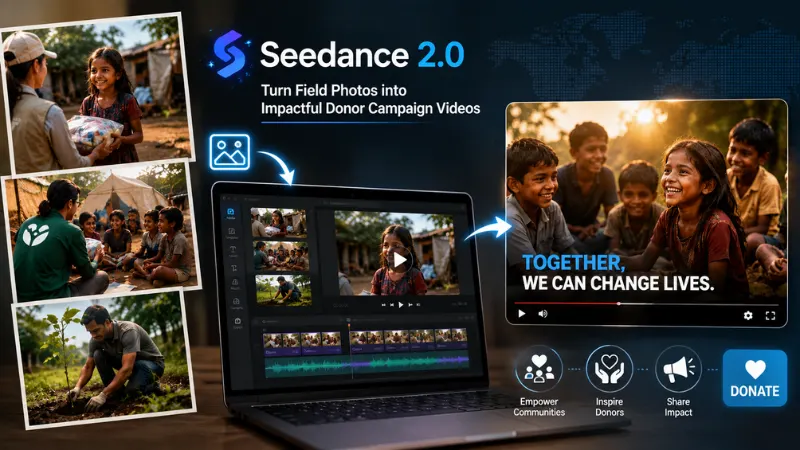
How Nonprofits Use Seedance 2.0 to Turn Field Photos into Donor Campaign Videos
Discover how nonprofits use Seedance 2.0 to transform field photos into compelling donor campaign videos that boost engagement

I handle development communications for a mid-size nonprofit working on clean water access in a few East African countries, which means I’m the person responsible for turning what our field teams document into something that actually moves donors to give. Video consistently outperforms static appeals in our testing, sometimes by a wide margin, and for most of the years I’ve done this job, video meant either sending someone with a camera on a field trip we could barely afford, or going without.
Why Video Matters So Much in This Work
The gap between a photo and understanding
A photo of a completed well is a photo of a well. It doesn’t show the walk a family used to make every morning before it existed, it doesn’t show water actually flowing, it doesn’t communicate the specific thing a donor needs to feel to understand what their contribution actually changed. We’ve run enough A/B tests on our own appeals to know, with real data behind it, that a moving image of water flowing from a new well outperforms a static photo of the same well by a meaningful margin every time we’ve tested it.
The cost of getting that footage
Sending a videographer into the field alongside our program staff is expensive in ways that go beyond the day rate. Travel to the actual sites we work in often means multiple flights and long overland trips, and every dollar spent on production is a dollar our board and our most engaged donors rightly expect to see going toward the actual mission instead. We do it sometimes, for major campaigns, but it’s never been something we could do for every project update or every smaller appeal throughout the year.
Working From Our Existing Photo Archive
We have an enormous archive of field photography going back years, most of it taken by program staff on their phones during regular monitoring visits rather than by professional photographers. Good composition, often, but static, and until recently that archive just sat there as documentation rather than becoming donor-facing content.
I started experimenting with Seedance 2.0 using photos from a completed well project, generating a short clip showing water movement from a still photo of the well itself. The result gave us something we’d never had for that project: a sense of the well actually functioning, water actually flowing, without sending anyone back to a site we’d already completed work at and had no other reason to revisit.
Where I set firm limits
This is where I have to be very direct about boundaries, because this is genuinely different territory than a lot of the other uses of this technology I’ve read about. I will not generate anything involving people from our archive photos, not community members, not children, not program participants in any context. Our field photography almost always includes people, since the work is fundamentally about people, and using a technology to alter or animate a real person’s image without their explicit understanding and consent crosses a line I’m not willing to cross, regardless of how compelling the resulting content might be. Every photo I run through this tool is one I’ve specifically selected because it shows infrastructure, landscape, or water itself, never a person’s face or body.
What we don’t touch
Beyond photos with identifiable people, I also avoid anything depicting hardship or crisis conditions directly, even without a visible face. Our appeals do sometimes need to communicate need, that’s an honest part of fundraising for the kind of work we do, but I use unaltered, straightforwardly documented photography for anything depicting the conditions we’re working to address. Adding any kind of processed motion to imagery of genuine hardship felt, to me and to our program director when we discussed it, like exactly the wrong place to apply this, since it risks the appearance of manufacturing emotional impact from real suffering rather than documenting it honestly.
What This Has Actually Looked Like in Practice
Completed infrastructure updates
For projects that are finished and where our only goal is showing donors what their past giving accomplished, this has filled a real gap. Wells, water points, completed pipeline sections, these are all things I can now show with a sense of function and movement rather than a static photo, using archive material we already had rather than commissioning new footage of a site with no active program need for a visit.
A specific campaign
We ran a year-end appeal built around three completed well projects from earlier in the year, using generated clips of water flow from each site alongside the honest, unaltered photography we always use for anything involving the actual communities we serve. That appeal outperformed our previous year’s year-end campaign by a noticeable margin, and while I can’t isolate exactly how much of that was the added motion versus other changes we made to the appeal that year, our team felt strongly enough about the difference that we’ve built this into our standard process for any completed infrastructure update going forward.
A Quick Note on the Platform
If you’re researching tools in this space and run into a broken link, it’s probably because Seedance2.ai transitioned to Seevio.ai — I found this out myself when a link shared in a nonprofit tech newsletter pointed to the old domain.
What I’d Tell Other Nonprofit Communicators
Set your ethical boundaries before you start experimenting, not after, and hold them even when the temptation to bend them promises better-performing content. For us that meant a hard line around never generating anything involving real people from our field archive, and a separate line around never adding processed motion to imagery depicting hardship, regardless of how technically capable the tool might be of doing so convincingly. Within those boundaries, this has genuinely helped us do more with an archive we already had, showing donors the tangible results of completed work without the cost of sending a production team somewhere we had no other reason to go. Outside those boundaries, I don’t think it belongs in this kind of work at all, and I’d encourage any other communications staff considering this to think through where their own lines sit before a deadline pressures them into a decision they haven’t fully thought through.