

How to Use Look-Alike Modelling in VAIS?
Discover how to use Look-Alike Modelling in VAIS to identify high-potential accounts, improve targeting, and enhance your marketing strategy with AI-powered insights.

Building a target account list in B2B marketing often feels like trying to find the right coffee in a massive ocean of super markets. You know the type of aroma, taste and texture you prefer. Now imagine someone else who can do that for you. Finding you the exact thing you want without the hassle. Sound’s amazing right?
Similarly most marketers have been there, scrolling through company databases, applying filters, checking LinkedIn profiles, and still wondering:
“Are these actually the right accounts to target?”
It’s a process that easily eats up hours of manual effort, and even then, the results are uncertain. You know the type of companies you want, but identifying exactly where they are can take hours of research, spreadsheets, and educated guessing.
But what if instead of guessing which companies might buy your product, you could simply replicate the ones that already do?
That’s exactly what VAIS, Look-Alike Modelling (LAL) is designed to do.
Instead of manually hunting for accounts, LAL analyzes your best-performing domains, evaluates their Valasys AI Score against a product subcategory, and finds other companies that share the same sub-industry and alignment score.
The result?
You spend less time guessing and more time targeting accounts that are statistically aligned with your product.
The fastest way to find your next best customer is to replicate the ones you already have.
Let’s understand how it works.
What Is Look-Alike Modelling in VAIS?
Look-Alike Modelling (LAL) in Valasys AI Score (VAIS) is a recommendation engine that helps marketers discover new companies similar to their best-performing accounts.
It analyzes:
- Your uploaded domain list
- The product subcategory you are targeting
- The Valasys AI Score (VAIS) of those domains
- The sub-industry classification of those companies
It then scans the VAIS database and identifies other companies that share the same alignment score and sub-industry profile.
In many ways, Look-Alike Modelling works like cloning your best customers for your pipeline. Instead of randomly searching for new accounts, the system studies the DNA of your top-performing domains and finds companies that share the same traits.
How Look-Alike Modelling Works in VAIS
The system relies on two key signals:
- Valasys AI Score (VAIS)
This score measures how closely a company aligns with a specific product subcategory. - Sub-Industry Matching
Companies are grouped into detailed sub-industries to ensure highly relevant targeting.
Together, these signals allow VAIS to identify companies that are structurally similar buyers for your product.
Example: Look-Alike Modelling in Action
Let’s say you are running a campaign for 5G Home Internet. You upload Domain A, which belongs to the Retail sub-industry.
The system calculates its Valasys AI Score as 88 for the 5G Home Internet subcategory.
VAIS then identifies that Domain A belongs to the Retail sub-industry.
Next, the platform scans its database and retrieves all companies in the Retail sub-industry that also score around 88 for 5G Home Internet.
The result is a curated list of retail companies with a similar product alignment profile.
These are companies your team may never have discovered manually, but the algorithm identifies them as strong potential buyers.
Step-by-Step: Using Look-Alike Modelling in VAIS
Using the LAL/ ABM feature inside VAIS is simple and quick.
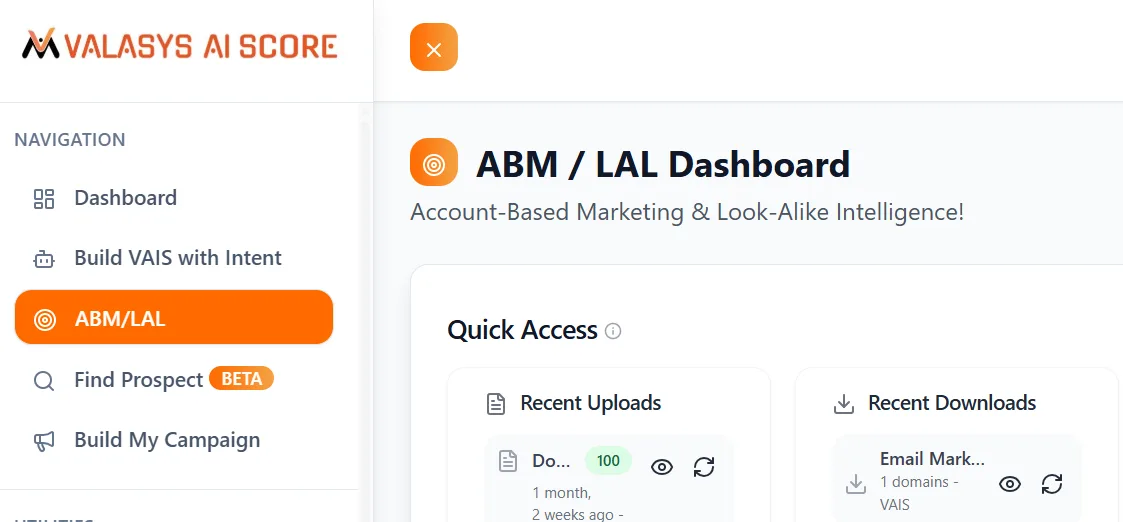
1. Open the Look-Alike Modeller
Log in to VAIS and navigate to the Look-Alike Modeller from the dashboard.
2. Select Your Product Subcategory
Choose the product category your campaign focuses on.
For example:
- Cloud CRM
- Cybersecurity
- 5G Home Internet
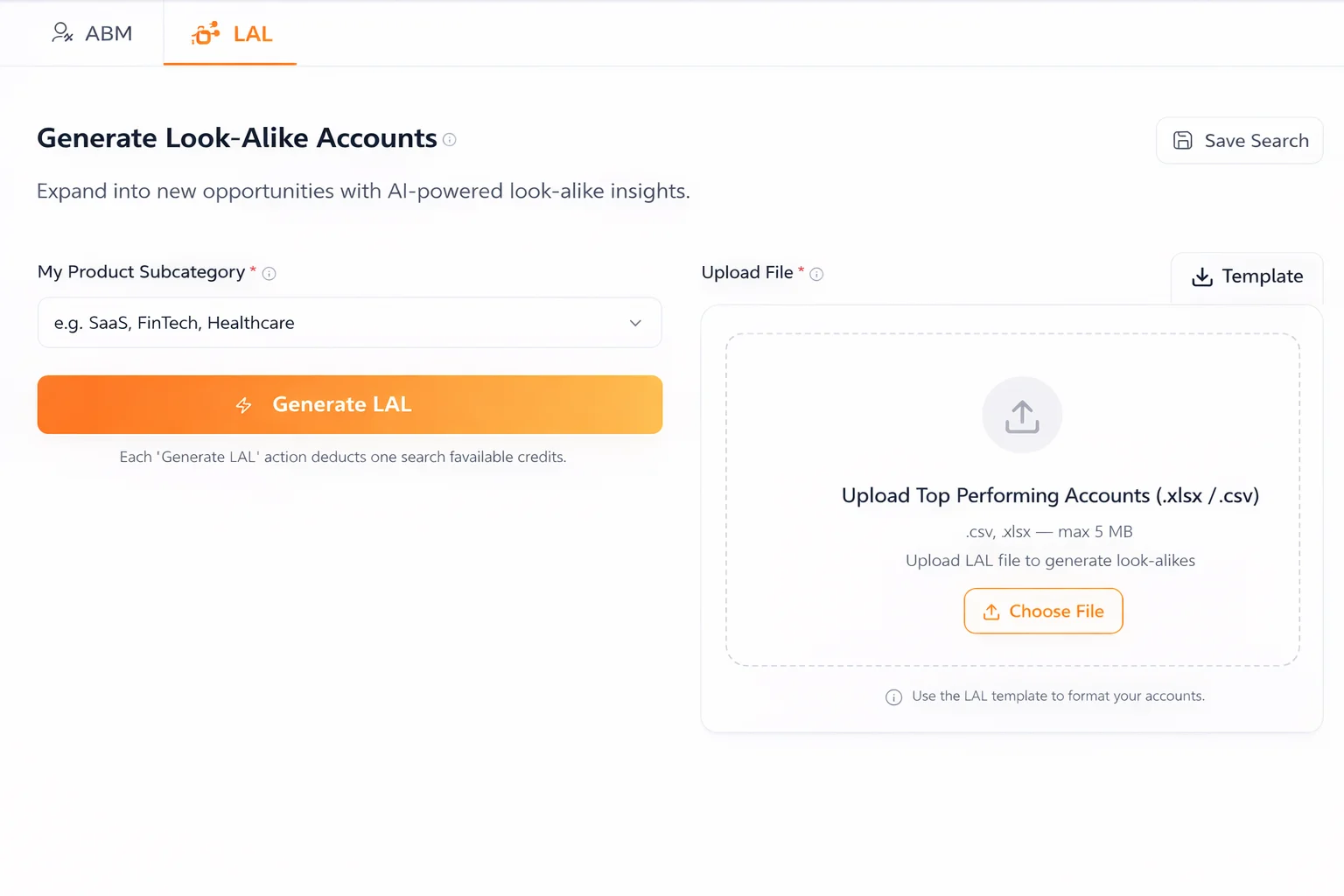
This anchors the model around the specific product alignment you want to target.

3. Upload Your Top Performing Domains
Upload a list of your best customers or high-engagement prospects. Even a heap of domains can generate meaningful recommendations.
4. VAIS Analyzes the Domains
Once the domains are uploaded, VAIS analyzes each company in relation to the selected product subcategory.
The system calculates the Valasys AI Score (VAIS), a product alignment score that shows how closely a company matches the buyer profile for that specific product category.
To generate this score, VAIS evaluates multiple signals, including:
- Firmographic data (industry, company size, operations)
- Technographic signals that indicate the company’s technology environment
- Market and product adoption trends
- Intent signals that show when companies are researching related solutions
Using machine learning and predictive analytics, these signals are processed to assign a numerical alignment score to each domain.
Once the score is calculated, VAIS maps the company to its sub-industry classification and then identifies other companies in its database that share similar scores and the same sub-industry profile.
Because the VAIS database spans millions of companies and hundreds of product subcategories, the model is highly scalable. Even a small set of seed domains can generate a large pool of highly relevant look-alike accounts.
This ensures the resulting accounts are not just similar in profile, but also strongly aligned with the product you are targeting.
5. Review Your Look-Alike Account List
VAIS returns a list of companies that match the score and sub-industry of your uploaded accounts.You can then export or activate these accounts in your campaigns.
Use Cases of Look-Alike Modelling in VAIS
Expanding Your Target Account List
Sometimes ABM campaigns start strong but eventually stop generating enough leads.
Look-Alike Modelling helps expand your Target Account List (TAL) with companies that resemble your best accounts. This allows you to scale your targeting without sacrificing precision.
Replicating Your Best Accounts
Every marketing team has accounts that convert faster and generate more revenue.
With LAL, you can systematically replicate these winning accounts. Instead of guessing which companies might behave similarly, the system identifies organizations that share the same alignment score and sub-industry profile.
In simple terms, you get more of what is already working.
Keeping Your Pipeline Healthy
A strong pipeline requires a constant flow of relevant accounts. Look-Alike Modelling ensures that marketers continuously discover new high-fit prospects, helping maintain a steady and healthy pipeline.
Discovering Unexpected Opportunities
One of the biggest advantages of LAL is discovery.
The recommendation algorithm can surface companies your team might never have manually shortlisted. These hidden opportunities often turn into valuable prospects because they match the same product alignment signals as your best customers.
Quick Recap
If you remember only three things about Look-Alike Modelling in VAIS, make it these:
- It removes guesswork from account discovery
Instead of manually searching for companies, LAL identifies accounts similar to your best-performing domains. - It uses real product alignment signals
Companies are matched using Valasys AI Score and sub-industry classification. - It helps expand your pipeline with precision
LAL allows marketers to replicate their best accounts and continuously grow their target account list.
Takeaway
Without the right tools, account discovery can feel like driving without a map. Look-Alike Modelling acts like a GPS for your pipeline, guiding you toward companies that already resemble your best customers.
Because in B2B marketing, the best customers always leave clues.
Look-Alike Modelling simply follows those clues to uncover the next set of companies ready to buy.
To find more clues try VAIS new feature here: VALASYS AI
Frequently Asked Questions (FAQ’s)
What is Look-Alike Modelling (LAL) in VAIS?
LAL in VAIS is a score-driven recommendation engine that takes your top-performing account domains, calculates their Valasys AI Score against a product subcategory, identifies their sub-industry, and returns a list of database-matched companies that share the same score profile and sub-industry. It is a data-backed way to expand your ABM without losing targeting precision.
How is Look-Alike Modelling in VAIS different from a standard account filter?
A standard filter matches on surface-level firmographics, industry, size, geography. VAIS LAL matches on product-specific AI alignment scores and granular sub-industry classification. That means the accounts it surfaces are not just similar in profile, they are aligned to your product in the same way your best accounts are.
How many domains do I need to upload for LAL to work?
Even a focused list of ten to fifteen high-quality domains is sufficient for the algorithm to generate meaningful recommendations. The model prioritizes quality of the seed list over sheer volume.
Can LAL in VAIS surface accounts from industries I have not previously targeted?
Yes and this is one of its most valuable outcomes. Because the algorithm is purely data-driven, it can surface accounts from sub-industries or company profiles your team would not have considered manually. These unexpected matches are sometimes the highest-converting discoveries from a LAL run.