Lead-Gen now on Auto-Pilot withBuild My Campaign
Valasys Media — Empowering marketers with powerful insights

SAP BTP: Empowering Business Growth and Innovation

Unlock business potential with SAP BTP, driving growth and innovation through integrated solutions and advanced technologies.

Guest Author
Guest Author
Last updated on: Jul 3, 2024
SAP BTP - Empowering Business Growth and Innovation

Companies are constantly navigating a dynamic environment characterized by emerging technologies, shifting customer demands, and ever-increasing competition. To thrive in this environment, agility and the ability to leverage data-driven insights are paramount. This is where SAP Business Technology Platform (SAP BTP) steps in as a powerful catalyst for growth and innovation.

The Need for Agility in a Dynamic Business Landscape

The modern business landscape is a canvas of constant change. New market opportunities emerge overnight, customer expectations morph and evolve, and disruptive technologies redefine entire industries. Companies that struggle to adapt to these dynamics often find themselves lagging behind. Here are some key trends highlighting the critical need for agility:

  • Rapid Growth: The rise of startups and a globalized marketplace create fierce competition. Businesses need to scale quickly and efficiently to capitalize on new opportunities.
  • Shifting Customer Demands: Today’s customers crave personalized experiences and seamless interactions across all channels. Businesses need to be agile to adapt to these changing customer demands.
  • Technological Disruption: Emerging technologies like Artificial Intelligence (AI), Internet of Things (IoT), and blockchain are rapidly transforming industries. Businesses that embrace these technologies and integrate them effectively gain a significant competitive edge.

SAP BTP: A Foundation for Unlocking Growth and Innovation

SAP BTP is a unified cloud platform designed to empower businesses with the agility and flexibility they need to thrive in today’s dynamic market. Here’s how SAP BTP can be a catalyst for growth and innovation:

  • Unified Platform for Innovation: SAP BTP provides a central platform for developing, deploying, and managing applications, both SAP and non-SAP. This eliminates the need for siloed systems and fosters a collaborative environment where innovation can flourish.
  • Cloud-Based Scalability: Built on a multi-cloud architecture, SAP BTP offers unparalleled scalability to accommodate business growth. Businesses can easily add new resources and capabilities as needed, without significant infrastructure investments.
  • Data-Driven Decision Making: SAP BTP integration with existing data sources, enabling real-time data visibility and advanced analytics is very seamless. Businesses can leverage this data to make informed decisions, optimize resource allocation, and streamline operations.
  • Streamlined Processes: SAP BTP offers tools for automating repetitive tasks and integrating disparate systems. This streamlines workflows, improves efficiency and frees up valuable resources for strategic initiatives.

Unveiling the Powerhouse Capabilities of SAP BTP

SAP BTP offers a comprehensive suite of capabilities that empower businesses to unlock their full potential. Here’s a closer look at some of the core pillars:

  • Database and Data Management: At the heart of SAP BTP lies SAP HANA Cloud, a robust and scalable cloud-based database solution. This enables efficient data storage, management, and access – critical for data-driven decision-making.
  • Analytics: SAP Analytics Cloud delivers powerful data visualization and analytics tools. Businesses can leverage these tools to gain valuable insights from their data, identify trends, predict future outcomes, and make informed business decisions.
  • Application Development and Integration: SAP BTP provides a flexible development environment with tools like Cloud Foundry and Neo. This allows businesses to develop custom applications, integrate existing systems, and extend SAP functionalities to meet their specific needs.
  • Intelligent Technologies: SAP BTP incorporates cutting-edge intelligent technologies like AI, Robotic Process Automation (RPA), and IoT. These technologies can automate tasks, improve operational efficiency, and enable the development of innovative new applications.

Partnering with Accely for a Successful SAP BTP Journey

At Accely, we are passionate about helping businesses unlock the transformative power of SAP BTP. Our team of experienced SAP consultants possesses in-depth knowledge of the platform and extensive industry expertise. We offer a comprehensive range of services to support your SAP BTP journey, including:

  • Strategic Roadmap Development: We work closely with you to understand your unique business goals and develop a customized SAP BTP implementation strategy that aligns with your long-term vision.
  • Implementation and Integration: Our team has extensive experience in implementing and integrating SAP BTP with your existing IT landscape. We ensure a smooth and efficient process to minimize disruption to your business operations.
  • Change Management and Training: We understand the importance of user adoption for a successful SAP BTP implementation. We offer comprehensive change management programs and user training to ensure your team is equipped to leverage the platform effectively.
  • Ongoing Support and Optimization: Our partnership extends beyond the initial implementation. We offer ongoing support and optimization services to ensure your SAP BTP continues to evolve alongside your business.

Embracing a Future of Growth and Innovation with SAP BTP

The future of business belongs to those who can embrace agility and innovation. SAP BTP is a powerful platform that empowers businesses to transform their operations, unlock new growth opportunities, and gain a competitive edge. By partnering with Accely, a leading SAP consulting firm, you can unlock the full potential of SAP BTP and propel your business toward a future of sustainable growth and innovation.

Contact Accely today to schedule a consultation and explore how we can help you leverage SAP BTP to achieve your business goals.

Related Posts

BANT for Buying Committees: Qualify Multi-Stakeholder Deals

BANT for Buying Committees: How to Qualify Multi-Stakeholder Deals

Mansi Hake

How Do You Apply BANT to a Buying Committee? BANT for buying committees means verifying Budget, Authority, Need, and Timeline across the stakeholders and approval dependency that affects the purchase. One contact’s answers can start the assessment, but they do not establish the full buying situation until the relevant people or authoritative sources confirm each condition. Key Takeaways Treat each answer as a claim with a source. What one contact says is contact-level information until the person responsible for that condition confirms it. Separate the budget owner from expenditure approval. Knowing who controls funds does not confirm that this purchase is funded. Treat authority as an approval path. Sponsorship, evaluation, funding approval, and contracting may sit with one person or several. Label each answer Confirmed, Reported, Inferred, Disputed, or Unknown. Record the source, date, and next review. Handle disagreement as a dependency to resolve. Unresolved conflict calls for investigation, not automatic abandonment. Use engagement and intent signals to decide where to investigate first. They do not prove budget, authority, need, or timing. Why Individual BANT Answers Fail in Committee-Led Deals A single contact can describe their own priorities accurately and still misstate the purchasing conditions of the wider group. Contact-level information is what one person says. Opportunity-level buying conditions are what must be true for the purchase to proceed. The difference matters most when a claim is secondhand or inferred, such as a sponsor reporting that finance has approved funding. Not every B2B purchase involves a large committee, but where one exists, disagreement is common. Gartner’s survey of 632 B2B buyers found unhealthy conflict in 74% of buyer teams, and groups that reached consensus were 2.5 times more likely to report a high-quality deal. That is an association from one survey, not proof that any process improves outcomes. It does show why one confident contact is a thin basis for a forecast. Traditional BANT questions remain useful, but modern BANT qualification requires evidence behind each answer rather than four unchecked assumptions. How Do Engagement and Intent Signals Help Prioritize Accounts? Engagement and intent signals help sales teams identify accounts showing potential buying interest. Insights from account intelligence platforms like Valasys help surface relevant account activity, including product research, website engagement, and interest across multiple employees. These signals help sales teams prioritize outreach and identify accounts worth investigating. However, they do not confirm an approved budget, purchasing authority, an established business need, or a buying timeline. These conditions still require verification through BANT qualification. How to Apply BANT Across a Buying Committee BANT stands for Budget, Authority, Need, and Timeline.In committee-led purchases, answering these four questions requires looking beyond the primary contact to understand who controls funding, who influences the decision, whose requirements shape the solution, and who determines the purchase timeline.  Budget: Verify Who Controls Funding Ask which kind of funding exists: allocated (money set aside for this purchase), proposed (requested, not approved), conditional (dependent on another decision, such as a headcount plan), or unconfirmed. Then separate the budget owner, who controls the money, from expenditure approval, the decision that releases it for this purchase. A useful question is: “What needs to happen before funding for this purchase can be approved?” A strong opportunity without an allocated budget is not an automatic disqualification. It has a funding path that still needs verification. Authority: Establish the Required Approval Path The authority check links four responsibilities: sponsoring the purchase, evaluating the solution, approving funding, and contracting. They do not require four separate people, so confirm the real path instead of assuming a structure. Ask who must approve, who can stop the purchase, and what each person needs to see.  MEDDICC, a methodology provider, treats the champion and the economic buyer as distinct roles. A champion actively supports the solution internally, helps build consensus, and influences other stakeholders. The economic buyer, on the other hand, controls the financial decision and has the authority to approve the investment. A contact may act as a champion without having the final say over the budget.  For a deeper explanation of approval responsibilities, verifying authority in BANT helps distinguish buying influence from the power to approve a purchase. Need: Confirm Cross-Functional Agreement One group can acknowledge a problem while another questions its priority, technical requirements, or business impact.  Ask each function to describe the problem, the cost of leaving it unsolved, and what a workable solution must do. Record agreement only where it was stated, and record disagreement exactly as it was stated. An operations lead who calls the issue urgent and an IT lead who calls it low priority have not produced a shared need, however enthusiastic the sponsor sounds. Timeline: Validate Decision and Procurement Dependencies Separate five items: desired project start, internal decision milestone, required reviews, procurement and contracting, and realistic purchase timing. A project deadline is not automatically a purchase deadline. A team that wants to launch in March may still need security review, legal terms, and vendor onboarding first. Ask what must happen between a verbal decision and a signed contract, and who owns each step. How to Build a Committee-Level BANT Evidence Matrix An evidence matrix records each buying condition, who can confirm it, and how strong the evidence is. One criterion can involve several roles, so list every relevant function instead of forcing one person per letter.  BANT criterion Relevant stakeholder or function What must be verified Evidence status Unresolved question Next owner/action Budget Department leader; Finance Funding source and approval for this purchase Reported Has finance approved the amount? AE asks finance for approval steps Authority Department leader; CFO; Legal Who approves, signs, and can block Inferred Is executive sign-off required? AE requests introduction to approver Need Operations; IT Shared problem definition and requirements Disputed Does IT agree on scope and priority? Solutions engineer joins IT call Timeline Sponsor; Procurement Decision date, review steps, contract timing Unknown How long is procurement review? AE asks procurement for process Use these evidence statuses: Confirmed: Verified with the responsible stakeholder or an

Corporate Website Design in 2026: Best Practices & Examples

What makes corporate website design effective in 2026? Insights from Halo Lab

Guest Author

Prospects, investors, job candidates, and journalists often check a company’s website before they ever speak to anyone there. Within a minute, they decide whether the business looks credible, understandable, and worth contacting. Effective corporate website design turns that first visit into confidence by combining clear positioning, easy navigation, and visible proof of expertise. The principles below draw on Halo Lab’s work on more than 500 projects since 2013, including corporate sites for fintech, HR tech, healthcare, insurance, marketing companies, and other industries. What makes a corporate website effective? Visual polish draws attention, yet a corporate website becomes effective through less visible work: wording, structure, evidence, and technical quality. The following principles cover these layers. Clear messaging and brand identity The homepage headline should state what the company does and for whom in one plain sentence. Visual identity then reinforces that message through consistent color, type, and imagery across every page. Sometimes the gap runs deeper than copy. When Halo Lab worked with Stay, a Munich-based insurance brokerage for expats, the company’s former name, MW Expat, no longer matched the credibility it had built. The rebrand introduced speech-bubble elements as a symbol of open dialogue, and the website carried that motif straight into its hero section. Afterward, visitors could find the right type of coverage faster, and the brand looked the same across the website, client portals, and other channels. A useful check: if the logo were removed, would visitors still recognize the business from its tone and visuals? Simple navigation and user experience Navigation works when the menu mirrors how visitors think about the company rather than how its departments are organized. Five to seven top-level items usually cover the essentials, such as solutions, industries, customers, resources, and company information. Structure comes before screens. Experienced teams draft the sitemap and test it before any page gets designed: a short tree test with people from the target audience shows whether they can find pricing, a relevant case study, or open positions by labels alone. When a page proves hard to find, the wording of its label is often the cause, so renaming usually fixes more than moving items around. It also pays to treat navigation as a system rather than a single menu. The same pattern for product, industry, and company pages keeps the site predictable when new sections appear years after launch. Trust signals and relevant content Corporate buyers look for proof before they request a call. Signals that answer their doubts include: Client logos and case studies with measurable outcomes. Specific figures about scale, such as transaction volume or the number of integrations. Certifications, security standards, and compliance details. Named leadership and clear contact information. Placement matters as much as the proof itself. Teams experienced in website design services tend to put each signal next to the claim it supports: an integration count beside the product overview, a security badge beside the contact form, a short case result beside the related service. Proof gathered on a single About page rarely reaches visitors at the moment their doubts appear. Mobile experience, speed, and accessibility Many first visits happen on a phone, often after a link in an email or a LinkedIn post. A layout that works on small screens, loads fast, and stays readable for people with visual or motor impairments keeps those visitors from leaving early. Several benchmarks, three of them from Core Web Vitals, make these goals measurable: Largest Contentful Paint within 2.5 seconds, so the main content appears quickly. Interaction to Next Paint under 200 milliseconds. Taps and clicks get a fast response. Cumulative Layout Shift below 0.1, so elements stay in place while the page loads. Compliance with WCAG 2.2, covering contrast, keyboard navigation, and alt text. Animation needs special care on mobile. A practical rule is to keep the motion that orients visitors, such as a page-load effect or a menu transition, and drop decorative effects that make small screens heavier. Testing on a mid-range Android phone over a throttled connection, rather than on the team’s latest devices, shows how the site behaves for a large share of real visitors. That balance is typical of thoughtful corporate web design. Corporate website design ideas and examples No single visual style suits every company, so the right direction depends on the audience, the market, and how competitors already look. The corporate website examples below show approaches and the situations where each pays off. Minimalist and clean design Minimalism relies on generous white space, a restrained palette, and few elements per screen. It suits enterprise software, consulting, and financial services, where buyers value clarity and calm over spectacle. The business benefit lies in focus: with less competition for attention, the value proposition and calls to action stand out. Minimalism also demands discipline in the details, because flaws that a busy layout hides become obvious on an empty screen. Consistent spacing, a strict type scale of three or four sizes, and high-quality photography carry the visual weight that decoration would otherwise provide. The main risk is sameness. When most competitors use similar airy templates, minimalism stops setting a company apart, and a stronger visual voice becomes worth considering. Bold typography and visual identity Large, expressive types and strong accent colors help a company stand out in a crowded category. This approach fits creative agencies, consumer-facing brands, and challengers entering a market dominated by look-alike sites. Stone, a brand strategy studio from Colorado, faced exactly that problem. Before designing anything, Halo Lab’s team spent two days analyzing four competitors and found that most relied on minimalist layouts built around case-study imagery. To break from that pattern, the designers replaced Stone’s black-and-white palette with red accents for calls to action and paired a tall condensed headline font with the Neue Plak grotesque for body text. They also built an unusual grid that highlights key data, introduced a stone-shaped graphic language, and added transitions in which media shrinks into the text on scroll. Within three months, Stone received a launch-ready site

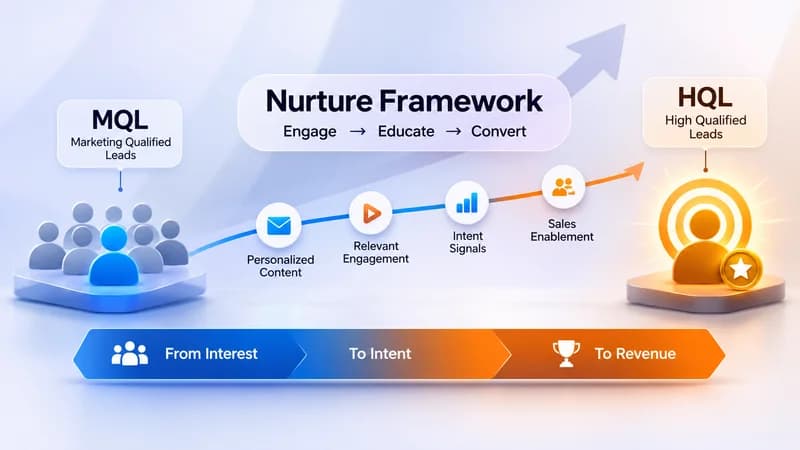
MQL-to-HQL Nurture Framework for B2B Leads

MQL-to-HQL Nurture Framework for B2B Leads

Pranali Shelar

Your MQLs are opening emails, downloading reports, and attending webinars. But are your nurture campaigns helping them move closer to becoming HQLs? An MQL shouldn’t reach sales with nothing more than a lead source and a trail of email clicks. Nurturing needs to do more than maintain engagement. It should help marketing understand what prospects are interested in, what business challenges they’re exploring, and what they need to move forward. Here’s how to structure that process. What Is an MQL-to-HQL Nurture Framework? An MQL-to-HQL nurture framework is a structured process that uses relevant content, behavioral signals, and timely follow-ups to develop the context needed to move a Marketing Qualified Lead (MQL) toward Highly Qualified Lead (HQL) validation. It connects prospect engagement with business needs and buying interests, helping marketing assess whether further qualification is justified. A MQL has engaged with marketing and shown potential interest but isn’t necessarily ready for a sales conversation. As the lead progresses, teams need to evaluate whether the available evidence meets their HQL qualification requirements. Since HQL criteria vary by organization, Marketing and Sales should agree on the evidence required before a lead progresses to that stage. Why Traditional MQL Nurturing Doesn’t Always Create Progress A prospect can download several reports and attend a webinar without getting any closer to a purchase decision. That’s because engagement alone doesn’t tell marketing what the prospect needs next or whether their interest connects to a business requirement. Three issues can get in the way: Calendar-led follow-ups: Prospects receive scheduled emails regardless of whether their interests or engagement have changed. Engagement mistaken for progress: Clicks and downloads are treated as buying signals without enough context. Disconnected communication: Automated sequences continue even when a prospect has replied or needs a human response. A structured MQL-to-SQL nurturing process can help teams connect these interactions through more consistent follow-ups and relevant content. The Four Stages of an MQL-to-HQL Nurture Framework Each stage should help marketing understand something new about the prospect. The objective is to make the next interaction more relevant than the previous one. Stage 1: Start With the Original MQL Interaction Begin with the action that qualified the prospect as an MQL. Someone who downloads a product comparison guide has shown a different interest from someone who registers for an introductory webinar. Review the information already available: Content consumed: Was it an introductory resource, a comparison, or a product-specific asset? Topic of interest: What challenge or business function does the interaction relate to? Conversion source: Did the prospect arrive through a campaign, organic search, or an event? Available lead information: What do you know about their role, company, and industry? Use this information to decide where the conversation should begin. Don’t restart every MQL with the same introductory sequence. Build on what the prospect has already shown you. Stage 2: Develop Business Context Through Relevant Content Once you understand the initial interest, use subsequent content to explore the business problem behind it. For example, a prospect who downloads a guide on marketing automation could receive an article about campaign execution challenges, followed by a resource on measuring automation performance. The content should build on the previous interaction rather than repeat it, with its relevance and timing aligned to the buyer’s needs and journey stage, as B2B content marketing research explains. Consider using: Educational articles to explain the problem and its implications. Industry reports to provide broader business context. Webinars to explore specific challenges and practical approaches. Case studies to show how similar organizations addressed those challenges. Product or solution resources when the prospect shows interest in evaluating potential approaches. Don’t send every asset simply because it belongs to the same topic category. Choose the next resource based on what the prospect has already explored and what they may need to understand next. Stage 3: Use Follow-Ups to Develop a Conversation Content engagement can indicate interest, but follow-ups help establish whether that interest connects to an actual business requirement. A useful follow-up acknowledges the prospect’s previous interaction and gives them a relevant reason to respond. Instead of sending another generic promotional email, ask a question connected to the challenge they explored. For example, after a prospect attends a webinar about lead qualification, a follow-up could ask whether their team currently struggles more with inconsistent MQL criteria or limited visibility into buying intent. A sample sequence might look like this: Timing Prospect interaction Suggested follow-up Day 0 Downloads an MQL qualification guide Send the resource and a related introductory article Day 3 Engages with the related article Share a practical resource on qualification challenges Day 7 Attends a qualification webinar Ask a relevant question about their current process Day 10 Visits a solution or service page Consider a more specific conversation or Sales follow-up The timing is illustrative, not a fixed rule. Adjust it based on the content, prospect behavior, and your audience’s engagement patterns. If a prospect replies with a specific question, pause the automated sequence and respond. If they request a conversation, route that request rather than making them complete the remaining nurture steps. For syndicated leads, follow-up timing and ownership may need to account for the original content interaction and lead source. Valasys’ 30-day content syndication follow-up plan provides a practical example. Stage 4: Transition From Nurturing to HQL Validation Nurturing should eventually give marketing enough context to determine whether a lead is ready for further qualification. Review the evidence gathered during the sequence: Does the prospect’s interest connect to a relevant business challenge? Has their engagement moved beyond general educational content? Have they responded, asked a specific question, or shown interest in evaluating a solution? Is there enough information to support the next qualification step? A content download alone may not justify an HQL transition. The objective is to pass forward the context gathered through nurturing, not simply report that a prospect completed a sequence. Marketing should share the original conversion, relevant content interactions, responses, and the reason for recommending further qualification as part of a clear