Your MQLs are opening emails, downloading reports, and attending webinars. But are your nurture campaigns helping them move closer to becoming HQLs?
An MQL shouldn’t reach sales with nothing more than a lead source and a trail of email clicks. Nurturing needs to do more than maintain engagement. It should help marketing understand what prospects are interested in, what business challenges they’re exploring, and what they need to move forward.
Here’s how to structure that process.
What Is an MQL-to-HQL Nurture Framework?
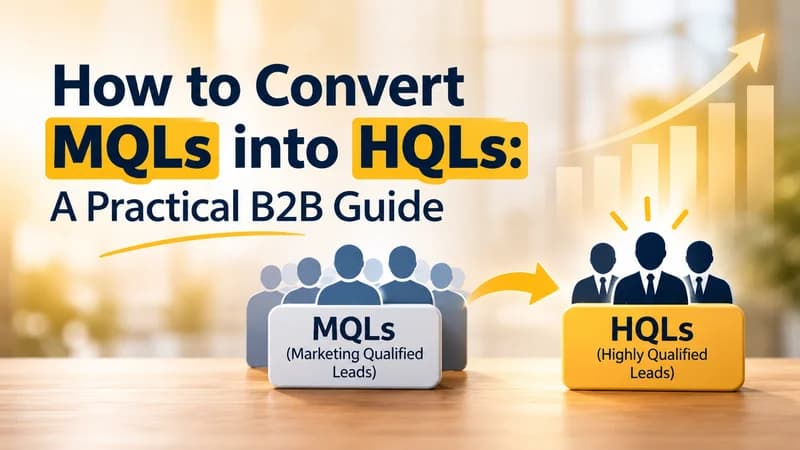
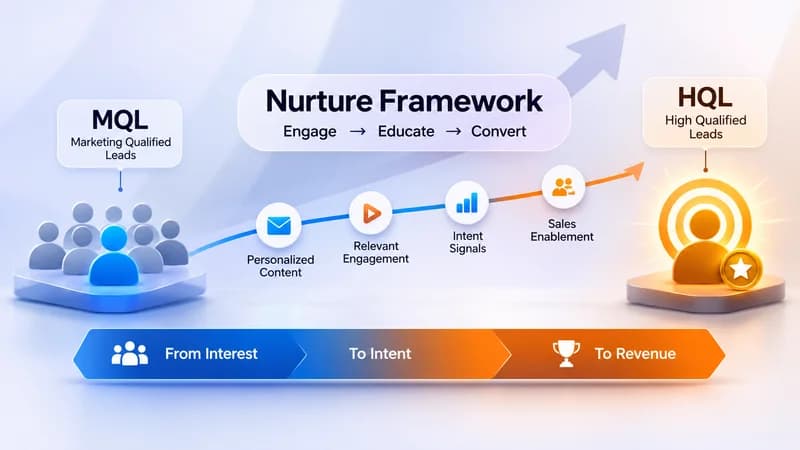
An MQL-to-HQL nurture framework is a structured process that uses relevant content, behavioral signals, and timely follow-ups to develop the context needed to move a Marketing Qualified Lead (MQL) toward Highly Qualified Lead (HQL) validation. It connects prospect engagement with business needs and buying interests, helping marketing assess whether further qualification is justified.
A MQL has engaged with marketing and shown potential interest but isn’t necessarily ready for a sales conversation. As the lead progresses, teams need to evaluate whether the available evidence meets their HQL qualification requirements. Since HQL criteria vary by organization, Marketing and Sales should agree on the evidence required before a lead progresses to that stage.
Why Traditional MQL Nurturing Doesn’t Always Create Progress
A prospect can download several reports and attend a webinar without getting any closer to a purchase decision. That’s because engagement alone doesn’t tell marketing what the prospect needs next or whether their interest connects to a business requirement.
Three issues can get in the way:
- Calendar-led follow-ups: Prospects receive scheduled emails regardless of whether their interests or engagement have changed.
- Engagement mistaken for progress: Clicks and downloads are treated as buying signals without enough context.
- Disconnected communication: Automated sequences continue even when a prospect has replied or needs a human response.
A structured MQL-to-SQL nurturing process can help teams connect these interactions through more consistent follow-ups and relevant content.
The Four Stages of an MQL-to-HQL Nurture Framework
Each stage should help marketing understand something new about the prospect. The objective is to make the next interaction more relevant than the previous one.
Stage 1: Start With the Original MQL Interaction
Begin with the action that qualified the prospect as an MQL. Someone who downloads a product comparison guide has shown a different interest from someone who registers for an introductory webinar.
Review the information already available:
- Content consumed: Was it an introductory resource, a comparison, or a product-specific asset?
- Topic of interest: What challenge or business function does the interaction relate to?
- Conversion source: Did the prospect arrive through a campaign, organic search, or an event?
- Available lead information: What do you know about their role, company, and industry?
Use this information to decide where the conversation should begin. Don’t restart every MQL with the same introductory sequence. Build on what the prospect has already shown you.
Stage 2: Develop Business Context Through Relevant Content
Once you understand the initial interest, use subsequent content to explore the business problem behind it.
For example, a prospect who downloads a guide on marketing automation could receive an article about campaign execution challenges, followed by a resource on measuring automation performance.
The content should build on the previous interaction rather than repeat it, with its relevance and timing aligned to the buyer’s needs and journey stage, as B2B content marketing research explains.
Consider using:
- Educational articles to explain the problem and its implications.
- Industry reports to provide broader business context.
- Webinars to explore specific challenges and practical approaches.
- Case studies to show how similar organizations addressed those challenges.
- Product or solution resources when the prospect shows interest in evaluating potential approaches.
Don’t send every asset simply because it belongs to the same topic category. Choose the next resource based on what the prospect has already explored and what they may need to understand next.
Stage 3: Use Follow-Ups to Develop a Conversation
Content engagement can indicate interest, but follow-ups help establish whether that interest connects to an actual business requirement.
A useful follow-up acknowledges the prospect’s previous interaction and gives them a relevant reason to respond. Instead of sending another generic promotional email, ask a question connected to the challenge they explored.
For example, after a prospect attends a webinar about lead qualification, a follow-up could ask whether their team currently struggles more with inconsistent MQL criteria or limited visibility into buying intent.
A sample sequence might look like this:
| Timing | Prospect interaction | Suggested follow-up |
| Day 0 | Downloads an MQL qualification guide | Send the resource and a related introductory article |
| Day 3 | Engages with the related article | Share a practical resource on qualification challenges |
| Day 7 | Attends a qualification webinar | Ask a relevant question about their current process |
| Day 10 | Visits a solution or service page | Consider a more specific conversation or Sales follow-up |
The timing is illustrative, not a fixed rule. Adjust it based on the content, prospect behavior, and your audience’s engagement patterns.
If a prospect replies with a specific question, pause the automated sequence and respond. If they request a conversation, route that request rather than making them complete the remaining nurture steps.

For syndicated leads, follow-up timing and ownership may need to account for the original content interaction and lead source. Valasys’ 30-day content syndication follow-up plan provides a practical example.
Stage 4: Transition From Nurturing to HQL Validation
Nurturing should eventually give marketing enough context to determine whether a lead is ready for further qualification.
Review the evidence gathered during the sequence:
- Does the prospect’s interest connect to a relevant business challenge?
- Has their engagement moved beyond general educational content?
- Have they responded, asked a specific question, or shown interest in evaluating a solution?
- Is there enough information to support the next qualification step?
A content download alone may not justify an HQL transition. The objective is to pass forward the context gathered through nurturing, not simply report that a prospect completed a sequence.
Marketing should share the original conversion, relevant content interactions, responses, and the reason for recommending further qualification as part of a clear Sales and Marketing handoff. Sales can then validate the business requirement and determine the appropriate next step.
How to Set Up Behavior-Based Nurture Automation
Once the four stages are defined, automation can help deliver the right follow-up based on what prospects actually do.
Start by mapping meaningful behaviors to specific actions. For example, a prospect who revisits a solution page could trigger an internal notification for review, while someone who replies to a nurture email should be removed from the automated sequence and routed to the appropriate team.
Your CRM and marketing automation platform should support these workflows through behavior-based triggers, segmentation, lead status updates, and routing rules. For example, automated customer journeys can use customer actions to determine what happens next. These workflows also connect to the broader lead-to-revenue process.
Set clear exit conditions too. A prospect who becomes an HQL, requests a conversation, unsubscribes, or no longer meets the campaign criteria shouldn’t continue receiving the same automated sequence.
How to Measure Your MQL-to-HQL Nurture Framework
Email clicks and replies can offer engagement signals, but they don’t establish whether nurturing is improving lead qualification.
Focus on outcomes that show whether prospects are progressing:
- MQL-to-HQL conversion rate: Whether nurtured MQLs progress to HQL validation.
- Time to HQL: How long leads take to reach the next qualification stage.
- Content engagement by topic: Which subjects attract meaningful prospect interest.
- Follow-up response rate: Whether nurture communication is generating conversations.
- Sales acceptance rate: Whether the leads passed to Sales meet its qualification expectations.
Review these metrics together rather than treating any single engagement metric as proof of success.
For instance, a campaign may generate plenty of clicks but few qualified conversations. That could indicate that the content attracts broad interest without addressing the business questions that influence qualification.
Compare performance across nurture sequences, original conversion sources, and content themes. Also review feedback from Sales. If leads repeatedly arrive without a clear business requirement or relevant context, the framework may need better content progression or follow-up questions.
Turn MQL Engagement Into Better-Qualified Leads
An effective MQL-to-HQL nurture framework doesn’t just keep leads engaged. It helps Marketing build a clearer picture of what prospects are researching, what business challenges they may be addressing, and whether their engagement signals genuine buying interest.
But individual lead activity is only part of the picture. Qualification also depends on understanding the account behind the lead: how well it fits your ICP, what intent signals it shows, and whether there is meaningful deal momentum. This requires clear HQL qualification criteria that give Marketing and Sales a shared standard for evaluating that evidence.
The Valasys AI Score (VAIS) adds another layer of context through its AI-powered account intelligence capabilities, helping teams assess account fit, intent, and buying signals alongside their existing lead nurturing and qualification efforts.
If your team wants to move beyond engagement-based lead scoring and build a stronger path from MQL to HQL, explore Valasys HQL Programs to see how Valasys can support your lead qualification strategy.
Frequently Asked Questions (FAQs)
Q1. How often should B2B leads receive nurture emails?
There isn’t one ideal frequency for every audience. It depends on the content, buying journey, and prospect engagement. Start with a manageable cadence, monitor unsubscribes and responses, and adjust based on whether the communication remains relevant.
Q2. Should MQL nurturing happen through email only?
No. Email can provide continuity, but B2B nurturing can also involve webinars, educational content, events, retargeting, and relevant Sales conversations. The channels should complement one another rather than repeat the same message.
Q3. What should Marketing do when an MQL replies to a nurture email?
Pause the automated sequence and review the response. If the prospect asks a question, respond with relevant information. If they express a specific business need or request a conversation, route the interaction to the appropriate team.
Q4. How can teams prevent nurture campaigns from sending repetitive content?
Use engagement history and content categories to control what prospects receive next. Exclude resources they’ve already consumed where possible, and make subsequent communication build on previous interactions instead of repeating the same introductory information.
Q5. When should Sales become involved in MQL nurturing?
Sales involvement makes sense when a prospect demonstrates a relevant business need, requests a conversation, or shows engagement that warrants direct qualification. Marketing should provide the interaction history and account context so Sales can continue the conversation without making the prospect repeat what they’ve already shared.