Sales Ready Lead Handoff Qualification Framework
Define clear signals for sales ready lead handoff
 Lead-Gen now on Auto-Pilot with
Build My Campaign
Lead-Gen now on Auto-Pilot with
Build My Campaign

Learn the signs a lead is truly sales-ready. Improve handoffs, boost conversions, and stop sending reps leads that won't buy.


Sales Ready Lead Handoff Qualification Framework
Define clear signals for sales ready lead handoff
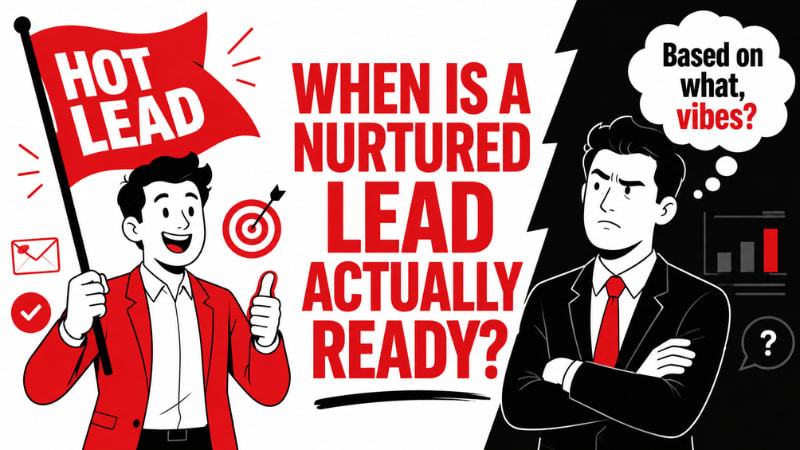
Somewhere right now, a sales rep is staring at a “hot lead” from marketing and quietly asking the void: based on what, exactly?
The lead downloaded one guide. Clicked one email. Attended half a webinar and disappeared before the Q&A. And now marketing has flagged them ready for a demo, assigned them to a rep, and expected magic.
That’s not a handoff. That’s a hand grenade with a HubSpot property attached.
Here’s the thing nobody puts in their “lead nurturing guide”: a nurtured lead is not ready because marketing says so. They’re ready when their behavior, fit, timing, and buying context all point the same direction.
That’s where Email Nurture and Lead Reactivation stops being “send more emails” and starts becoming revenue choreography.

A nurtured lead is ready for sales when they show clear intent, match your ideal customer profile, engage with decision-stage content, and give sales enough context to start a real conversation. Not a generic “just checking in.” A real one.
Sales Ready Lead Handoff Qualification Framework
Define clear signals for sales ready lead handoff
Think of readiness as four green lights:
| Readiness Factor | What It Means | Example Signal |
| Fit | The company matches your ICP | Right industry, size, geography, tech stack |
| Intent | They’re acting like a buyer, not a browser | Pricing page visit, demo click, comparison guide download |
| Engagement | They interact across multiple touches | Opens, clicks, repeat visits, webinar attendance |
| Context | Sales knows what they care about | Pain point, role, content history, objections |
One signal is a spark. Several signals in the right pattern? That’s a fire.
This is the oldest B2B argument, now with a shinier dashboard.
Marketing says: “The lead score is 87.”
Sales says: “Great. Do they have a problem we can actually solve this quarter?”
Both are right. Both are also mildly insufferable.
Marketing sees patterns. Sales needs a reason to call. The handoff fails when a score explains that something happened, but not why it matters.
A good handoff answers:
• Who is this person and what’s their role?
• What company are they from, and do they fit your ICP?
• What problem are they circling?
• What did they actually engage with?
• What stage are they likely in?
• What should sales say first? And what should they absolutely not say?
That last one matters more than people realize. Nothing kills momentum faster than a rep calling a CFO who read an ROI breakdown and opening with: “I saw you downloaded our beginner’s guide.” Warm intent, meet cold silence.
Lead nurturing is the process of building relationships with potential customers through relevant, timely content as they move through the funnel.
IBM defines lead nurturing as building relationships with potential customers by providing relevant resources and personalized content that guide them through the sales funnel.
Salesforce similarly frames lead nurturing as offering valuable resources that help prospects advance through the sales journey.
But here’s the version you’ll actually remember: lead nurturing is how you stay useful while the buyer is still figuring things out.
Because buyers are not following anyone’s funnel stages respectfully. They’re reading your blog at 11:47 PM. Forwarding it to procurement. Ignoring you for three weeks. Asking ChatGPT for alternatives. Clicking a case study from a Slack thread. Then legal enters the chat and ruins everyone’s week.
That’s the real funnel. It has snacks, delays, and six people named “stakeholder.”
Forrester research found that 73% of B2B purchases involve three or more departments, with an average of 13 people inside the buying organization involved. That’s from their B2B Nurture Metrics deep-dive worth bookmarking.
So no, your nurture flow can’t be “Email 1, Email 2, Email 3, book demo.” It needs to behave more like a GPS than a countdown timer.
A drip campaign says: Day 1, send this. Day 4, send this. Day 9, send this.
A nurture system asks: What did they do? What did they ignore? Who else is involved? What do they need next?
That difference is the whole game.
| Drip Campaign | Email Nurture |
| Time-based | Behavior-based |
| Same path for everyone | Different paths by role, stage, and intent |
| Good for welcome flows | Built for B2B buying journeys |
| Measures email activity | Measures movement toward revenue |
| “Send the next email” | “Send the right next move” |
Use drips when the journey is simple. Use nurture when the buyer is complex, slow, expensive, political, or all of the above. Want a deeper breakdown? Check out Behavior-Based Email vs Time-Based Drip.
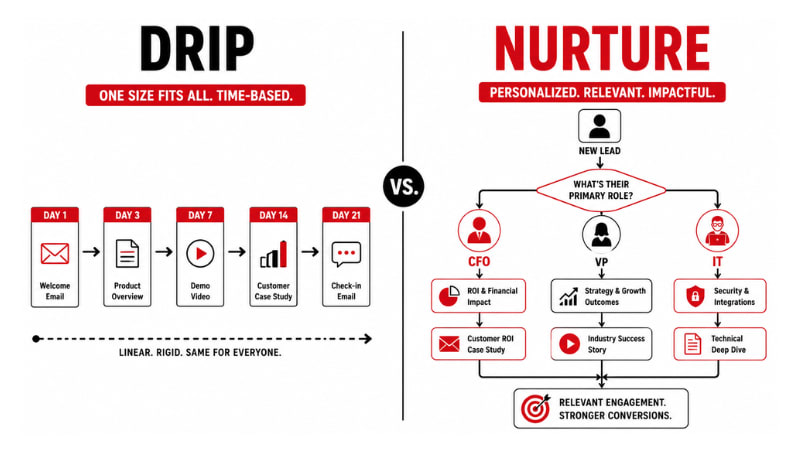
If your nurture flow still treats every buyer like they’re on the same timer, it’s time to upgrade the system. Explore Valasys Email Nurture and build journeys that respond to real buyer behavior, not calendar math.
This is the full buyer journey mapped for handoff clarity. Not funnel buzzwords. If you want the full MQL-to-SQL framework, check out this guide first.
Stage 1: The Stranger with a Problem
They don’t know you. They barely know the category. Don’t push demos here. Give them problem education, industry benchmarks, ungated thought leadership, simple explainers. Proposing on a first date because someone liked your Instagram story never ends well.
Stage 2: The Learner
They’re reading, clicking, comparing pain points. Give them how-to guides, checklists, role-based content, webinar invites. Nurture hard here.
Stage 3: The Comparer
Now they’re evaluating, not just learning. Give them comparison guides, ROI calculators, case studies, objection handling content. Sales should be watching, not pouncing.
Stage 4: The Committee Whisperer
One person loving you doesn’t mean the company’s ready.
Modern B2B deals are committee decisions, and committees create friction. Gartner reported that 74% of B2B buyer teams experience significant conflict during the purchasing process.
This is where you need CFO versions, IT versions, procurement versions, and champion enablement decks. See how to do this in our guide on personalizing nurture emails by buying committee role.
Stage 5: The Sales-Ready Lead
This is the moment. Not because they clicked once, but because the pattern says they’re ready. Sales gets the lead with: fit score, intent score, engagement history, content consumed, likely pain point, buying role, recommended opener, and suggested CTA.
That’s a handoff. Everything else is lead volleyball.
Here’s the simplest framework for deciding if a nurtured lead should move to sales:
Sales Readiness = Fit + Intent + Urgency + Context
If one’s missing, slow down.
Fit: Are They Worth Pursuing?
• Industry, company size, revenue range
• Geography and tech stack
• Job title and buying committee role
• Account tier
A student downloading your enterprise ABM guide is not an SQL. A VP Demand Gen at a 600-person SaaS company reading three blogs and visiting your pricing page twice? Completely different story.
Intent: Are They Acting Like They Care?
• Multiple visits in a short window
• Pricing or solution page visits
• Webinar attendance
• Reply to a nurture email
• ROI calculator usage
• “Book demo” page visit without submitting
• Multiple stakeholders from the same account engaging
Valasys AI Score uses predictive analytics, NLP, and buyer intent data to map the buyer journey and score accounts based on purchase readiness. Stop guessing which accounts are actually heating up. Try Valasys AI and prioritize buyers when their signal is at its peak.
Urgency: Is There a Reason to Act Now?
• New funding or hiring spike
• Product launch or compliance deadline
• Tool replacement or vendor research surge
• Repeated bottom-funnel engagement
No urgency? Keep nurturing. Urgency plus fit? Sales should move.
Context: Can Sales Start Smart?
This is the most ignored part of every handoff. Sales shouldn’t receive a name and email. They should receive a mini dossier. Not creepy. Useful.
Example: “Lead engaged with content on MQL-to-SQL conversion, behavior-based nurture, and lead scoring. Likely pain: poor sales handoff and wasted rep time. Suggested opener: ask how they currently define sales-ready leads and where handoff breaks down.”
That rep now has an angle. A good one.

Use a 100-point model, but don’t let the number become the strategy.
| Category | Points | Examples |
| ICP Fit | 30 | Industry, revenue, employee size, region |
| Role Fit | 15 | Decision-maker, influencer, evaluator |
| Engagement | 20 | Repeat clicks, webinar attendance, asset downloads |
| Intent | 25 | Pricing page, demo page, comparison content |
| Recency | 10 | Activity in last 7 to 14 days |
Suggested handoff rules:
• 0 to 39: Keep nurturing
• 40 to 59: Warm nurture, watch closely
• 60 to 74: MQL, add sales visibility
• 75 to 89: Sales-accepted lead candidate
• 90 to 100: Route to sales immediately

One important rule to add: a lead cannot become sales-ready on score alone. Marketing must include the story behind the score. Because “92 points” is not a sales strategy. “VP Marketing at an ICP account clicked the MQL-to-SQL article, visited the Email Nurture service page, and returned to pricing twice this week” is.
| Handoff Item | Required? | Why It Matters |
| ICP fit confirmed | Yes | Sales shouldn’t chase bad-fit leads |
| Engagement pattern visible | Yes | One click is not enough |
| Intent source identified | Yes | Sales needs to know what triggered the handoff |
| Buying stage estimated | Yes | Opener depends on stage |
| Role or persona tagged | Yes | CFO and Marketing Manager need different messages |
| Content history included | Yes | Prevents awkward, generic outreach |
| Recommended next action | Yes | Tells sales what to do now |
| SLA assigned | Yes | Speed matters once intent spikes |
| Recycle rule defined | Yes | Not every sales touch converts |
| CRM updated | Yes | If it’s not logged, it didn’t happen |
Print it. Paste it in Slack. Tattoo it on the CRM admin if they consent.
A sales handoff needs rules. Not “try to follow up soon.” Rules.
| Lead Type | Sales Action | Timing |
| High-intent SQL | Personalized outreach | Same business day |
| Demo request | Call plus email | Within 15 minutes during business hours |
| Reactivated lead | Contextual email | Within 24 hours |
| Committee activity | Account review | Within 24 hours |
| Warm MQL | Light-touch or social engagement | Within 48 hours |
| Low-intent MQL | Continue nurture | No direct sales yet |
Need the full capture-to-handoff engine, not just another lead list? See how Valasys Lead Management helps qualify, nurture, and route leads before opportunities slip away.
This is where good leads go to die.
Marketing does the work. The lead gets warm. The rep gets notified. Then sales sends: “Hi, just checking in.” No. Jail.
The first sales touch should match the nurture history.
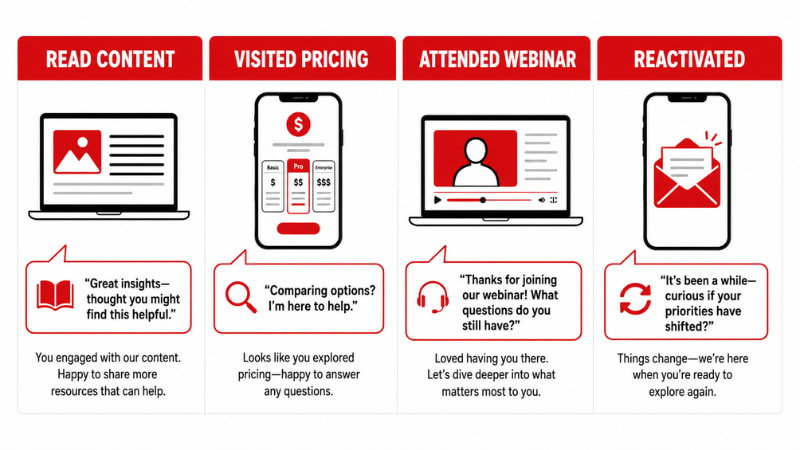
If they read educational content:
“Noticed your team has been looking into ways to improve nurture performance. Curious, are you trying to fix engagement, handoff quality, or lead reactivation right now?”
If they visited pricing:
“Saw some interest around our solution pages. Usually when teams get here, they’re comparing internal nurture setup vs managed execution. Is that the conversation on your side too?”
If they attended a webinar:
“You joined the session on nurture workflows. The part most teams ask about afterward is when to move a lead from nurture to sales. Is that where your team is stuck?”
If they reactivated after silence:
“Looks like this topic came back onto your radar. Has something changed internally, or are you revisiting pipeline priorities for next quarter?”
No fake familiarity. No “circling back.” No “bumping this to the top of your inbox,” which has never bumped anything except unsubscribe rates. Just relevant context and a useful question.
Cold leads aren’t always dead leads. Some went quiet because the budget froze. Some changed roles. Some needed six other stakeholders to stop arguing first. Lead reactivation is how you bring those contacts back without sounding like a desperate ex.
The first thing to get right: cold is not the same as dead. A cold lead showed interest but went quiet. A dead lead unsubscribed, bounced, changed companies, or said no clearly. Don’t waste energy on the dead. Focus on warming up the cold.
Reactivate leads when:
• They previously engaged with high-value content
• Their company still fits your ICP
• Their email is valid and they haven’t opted out
• There’s a new trigger, asset, or market reason to re-engage
Do not reactivate when:
• They unsubscribed or bounced repeatedly
• They said no clearly
• They left the company
• You have nothing new to say
Be brave enough to let bad leads go. Your CRM is not a cemetery.
A Simple 6-Email Reactivation Structure
| Purpose | Angle | |
| 1 | Re-open the loop | “Still solving this?” |
| 2 | Teach something useful | New insight, benchmark, or common mistake |
| 3 | Show proof | Case study or before/after story |
| 4 | Segment intent | “Which of these is your priority?” |
| 5 | Offer help | Audit, strategy session, or checklist |
| 6 | Clean break | “Should I close the loop?” |
The magic isn’t number six. It’s that every email earns its spot. No filler. No “hope you’re well.” No corporate oatmeal.
Want the complete framework? See how to move leads from MQL to revenue with nurture flows that convert.
Before marketing passes a nurtured lead to sales, fill this in.
Every field. No shortcuts. No “sales will figure it out.” That’s how warm leads become cold coffee.
| Field | Notes |
| Lead name | Full name |
| Company | Name and size |
| Role | Title and buying committee position |
| ICP fit | High / Medium / Low |
| Lifecycle stage | MQL / SAL / SQL candidate |
| Primary interest | Topic or problem area |
| Recent activity | What they did and when |
| Content consumed | Specific assets, blogs, webinars |
| Intent signals | Bottom-funnel behaviors |
| Likely pain point | Based on content pattern |
| Buying committee clues | Other contacts or stakeholders from the same company |
| Recommended sales opener | First question or angle |
| Suggested CTA | What sales should offer next |
| Do not mention | Content they haven’t seen or assumptions you can’t prove |
| Recycle rule | If no reply after X touches, return to the right nurture path |
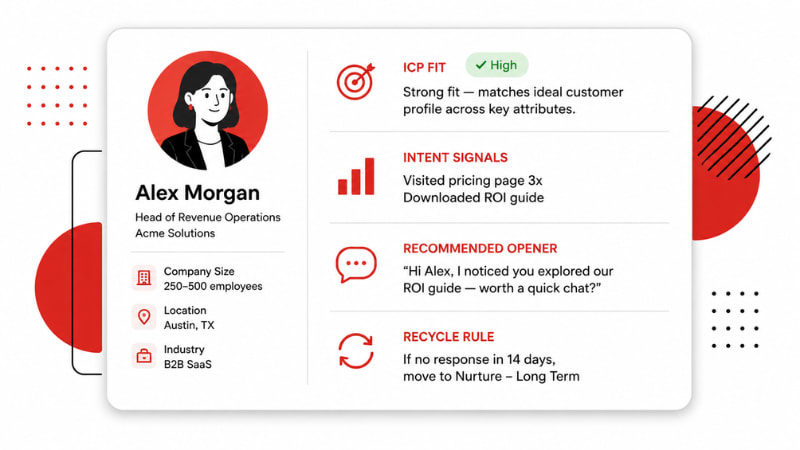
Example: Alex Morgan
| Field | Detail |
| Lead name | Alex Morgan |
| Company | Acme Solutions, 250–500 employees |
| Role | Head of Revenue Operations |
| ICP fit | High |
| Lifecycle stage | SQL candidate |
| Primary interest | Improving MQL-to-SQL conversion and handoff quality |
| Recent activity | Visited pricing page 3x, downloaded ROI guide, engaged with lead scoring content |
| Content consumed | ROI guide, lead scoring guide, MQL-to-SQL nurture content |
| Intent signals | Multiple bottom-funnel visits in 7 days |
| Likely pain point | Sales rejecting nurture leads as low quality |
| Buying committee clues | Revenue operations is involved, likely influencing both marketing and sales process |
| Recommended sales opener | “Hi Alex, I noticed you explored our ROI guide. Are you trying to fix lead quality, sales acceptance, or both?” |
| Suggested CTA | 20-minute nurture audit |
| Do not mention | Beginner nurture definitions |
| Recycle rule | If no reply after 3 touches, return to role-specific nurture |
That is how marketing earns sales trust.
Not with more leads.
With better clues.
Mistake 1: Passing leads too early
A download is interest. It’s not intent. Someone can download a guide while eating lunch, avoiding a meeting, or trying to understand what their boss said. Wait for patterns.
Mistake 2: Treating all engagement equally
A newsletter click is not a pricing visit. A blog view is not a demo page. A webinar registration is not the same as attending 42 minutes and asking a pricing question. Score accordingly.
Mistake 3: Ignoring the buying committee
If one person engages, nurture that person. If three people from the same account engage, alert sales. That’s not a lead anymore. That’s an account waking up.
Mistake 4: Making sales start from scratch
If sales has to research everything marketing already knows, the handoff is broken. The CRM should carry the story.
Mistake 5: Never recycling leads
Not ready today doesn’t mean bad. Recycle based on outcome:
| Sales Outcome | Next Move |
| No response | Return to nurture |
| Not a priority | Add to reactivation queue |
| Wrong contact | Find buying committee |
| Bad fit | Suppress or remove |
| Interested later | Set timed nurture |
| Active opportunity | Move to sales pipeline |
The recycle path is where a lot of revenue hides.
Here’s the whole system in one view.
1. Capture: Lead enters through content, webinar, syndication, ad, or inbound form
2. Segment: Sort by ICP, persona, stage, source, and problem
3. Nurture: Send behavior-based emails with educational, proof, comparison, and decision content
4. Score: Combine fit, role, engagement, intent, and recency
5. Qualify: Confirm the lead is not just active, but sales-relevant
6. Handoff: Give sales the context, opener, and next-best action
7. Follow up: Sales acts within the SLA
8. Recycle: Leads not ready return to the right nurture path
9. Reactivate: Cold but valid leads get a focused comeback sequence
10. Optimize: Measure SQL acceptance, meetings, opportunities, and revenue
That’s the machine. Not a drip. Not a blast. Not a quarterly database cleanup panic. A machine.
Open rates are not useless. They’re just over-promoted. An open means someone may have looked. A click means something caught their attention. A reply means you touched a nerve. A meeting means sales has oxygen.
| Metric | What It Tells You |
| Reply rate | Message relevance |
| Click-to-open rate | Content fit |
| Re-engagement rate | Reactivation quality |
| MQL-to-SQL conversion | Handoff strength |
| SQL acceptance rate | Sales trust in marketing |
| Meeting booked rate | Sales readiness accuracy |
| Opportunity creation | Pipeline impact |
| Sales cycle length | Nurture quality |
| Closed-won revenue | Actual business value |
| Recycle rate | Whether handoff timing is too early |
For a deeper dive into what to track and how, see B2B Nurture Metrics, Lead Scoring Email, and how AI helps lead prioritization.
If your nurture emails are getting opens but not meetings, it’s time to rebuild the journey. Explore Valasys Email Nurture and turn passive contacts into real pipeline.
1. What is a sales and marketing handoff?
A sales and marketing handoff is the process of transferring a qualified lead from marketing to sales with enough context for sales to take meaningful action. A strong handoff includes lead fit, engagement history, intent signals, content consumed, buying stage, and a recommended next step.
2. When is a nurtured lead ready for sales?
A nurtured lead is ready for sales when they match your ideal customer profile, show repeated engagement, demonstrate buying intent through bottom-funnel behavior, and give sales enough context to open a relevant conversation. One email click is not enough. Look for a pattern.
3. What is the difference between an MQL and an SQL?
An MQL, or marketing qualified lead, has shown enough interest to be worth continued attention. An SQL, or sales qualified lead, has enough fit, intent, urgency, and context for sales to pursue directly without nurturing further.
4. What signals show that a lead is sales-ready?
Sales-ready signals include pricing page visits, demo page visits, multiple content downloads, webinar attendance, repeat website visits, replies to nurture emails, ROI calculator usage, and multiple people from the same company engaging in a short window.
5. How does email nurture help the sales handoff?
Email nurture helps the handoff by educating leads, tracking their behavior, identifying intent signals, and warming them up before sales outreach. It gives sales better timing and better conversation starters, so the first touch isn’t cold.
6. What should marketing include in a lead handoff?
Marketing should include lead source, ICP fit, role, recent activity, content history, intent signals, lead score, likely pain point, recommended opener, and a suggested CTA. Sales should never receive just a name and email address.
7. Why do sales teams reject marketing leads?
Sales teams reject marketing leads when they’re passed too early, lack clear buying intent, don’t match the ICP, or arrive without useful context. Better scoring, qualification standards, and detailed handoff notes reduce rejection significantly.
8. What is lead reactivation and when should it be used?
Lead reactivation is the process of re-engaging previously interested leads who went quiet but still match your ICP and have valid contact information. It works best when there’s a new insight, offer, trigger, or market reason to reconnect. Don’t reactivate leads who unsubscribed or clearly said no.
9. How many emails should a lead nurture sequence have?
A nurture sequence can have anywhere from 4 to 12 emails depending on the buyer journey and sales cycle. For cold lead reactivation, six emails over three weeks is a practical structure when each email has a clear, distinct purpose. No filler.
10. What metrics matter most for measuring nurture and handoff quality?
The best metrics include reply rate, click-to-open rate, reactivation rate, MQL-to-SQL conversion rate, SQL acceptance rate, meetings booked, opportunities created, sales cycle length, and closed-won revenue. Opens are helpful context. They’re not the trophy.
Sales Ready Lead Handoff Qualification Framework
Define clear signals for sales ready lead handoff