AI Powered Lead Prioritization Framework For B2B
Use AI to rank and prioritize high intent leads
 Lead-Gen now on Auto-Pilot with
Build My Campaign
Lead-Gen now on Auto-Pilot with
Build My Campaign

Stop guessing and start scoring. Use AI to sort your leads so your team stops chasing noise and focuses on the people ready to buy.


AI Powered Lead Prioritization Framework For B2B
Use AI to rank and prioritize high intent leads
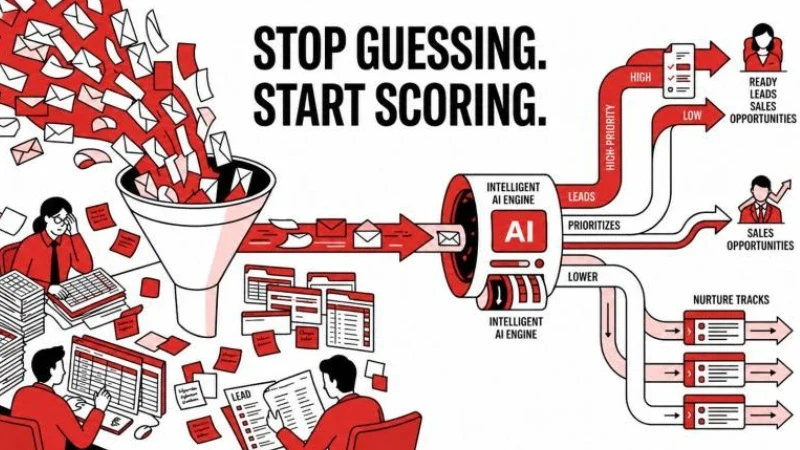
Stop guessing. Start scoring. Let the machine do the triage.
Here’s the scene.
Marketing runs a campaign. Leads come in. Everyone gets excited.
“Look at all these leads.”
Two hundred names. Email addresses. Company names. Job titles. Maybe a few form-fill details if you’re lucky.
The list goes to sales.
Sales works the first twenty. Maybe thirty. Usually the ones at the top of the spreadsheet. Or the companies they recognize. Or the titles that sound important.
AI Powered Lead Prioritization Framework For B2B
Use AI to rank and prioritize high intent leads
After a week.
Demos pile up. Deals need attention. Someone’s big opportunity catches fire. A manager asks for a forecast update. Another campaign launches.
And the remaining 170 leads?
They sit there. Aging like milk.
Not because sales is lazy. Not because marketing did anything wrong.
Because nobody told the team which leads actually mattered. That is the real lead nurture problem.
It is not a volume problem. It is a prioritization problem. And AI, when you use it correctly, is very good at solving that exact problem.
A Harvard Business Review study, “The Short Life of Online Sales Leads,” states that companies that contact leads within five minutes are dramatically more likely to connect and convert than companies that wait thirty minutes or longer.
But here’s the part people miss.
Speed only matters when you are fast with the right people.
Calling the wrong lead faster is not a strategy. It is just organized noise.

Most B2B marketing teams are pretty good at generating top-of-funnel interest.
Webinars. Whitepapers. Syndicated content. Gated guides. Event lists. Demo requests. Newsletter signups.
Leads come in → The handoff happens → A spreadsheet is shared in Slack → A CRM view is assigned → A list is exported.
And suddenly it is “everyone’s job,” which usually means it is nobody’s job.
Here is the problem. Not all leads are created equal.
We all know this. But most teams still behave like they are.
Humans are bad at sorting leads at scale. We over-index on recognizable company names. We chase pretty job titles. We assume a VP is always better than a manager. We call the first rows in the sheet because, well, they are there.
Meanwhile, the scrappy VP of Operations at a 200-person SaaS company downloaded three whitepapers, visited your pricing page twice, opened your last two nurture emails, and watched 70% of your product demo.
She is sitting in row 147. Untouched. That is the expensive part.
AI does not fix bad content. AI does not fix a weak offer. AI does not magically make every lead ready to buy. But it does fix this very specific, very expensive, very invisible problem:
Who should we contact first, what should we say, and when should we say it?
That is the game.

Let’s get practical.
Because most AI lead scoring content does one of two things.
It either floats at 30,000 feet and says things like “AI transforms revenue operations.”
Or it turns into vendor brochure soup.
Neither helps.
Here is what is actually happening.
Traditional lead scoring is rules-based.
Downloaded a whitepaper? Add 10 points. Job title includes “Director”? Add 15 points. Company size over 500 employees? Add 20 points.
This is better than nothing.
But let’s not pretend it is brilliant.
It is manual. It is rigid. It is usually outdated six months after someone builds it. And it only finds the patterns you already thought to look for.
AI-powered lead scoring looks at your historical lead and customer data, then finds patterns you never explicitly programmed.
It might learn that leads who watch more than 60% of a demo video and then visit the case studies page within 48 hours convert at 4x the base rate.
You would probably never write that rule. The model finds it. That is the difference.
Traditional scoring says, “We think this action matters.”
AI scoring says, “Your actual buyers are telling us this action matters.”
That is why your lead scoring model needs to reflect sales reality, not marketing convenience. For a deeper breakdown, read How to Nurture MQLs into SQLs: The Ultimate B2B Playbook.
Static lists are where relevance goes to die.
A lead who was cold last month might be active this week. A lead who ignored five emails might suddenly visit the pricing page three times. A lead who looked like a casual researcher might now be showing buying signals because their company just opened three job roles connected to your category.
People move. Accounts move. Buying committees move. Your nurture should move with them.
AI-powered segmentation does not keep leads trapped in fixed buckets forever.
It watches behavior and updates segments as the lead changes.
A lead engaging with ROI content should not get the same nurture sequence as someone downloading technical documentation.
Same product. Different buyer concerns. Different conversations. Different next step. That is the point.
For more on this, see Behavior-Based Email Nurture vs Time-Based Drip Campaigns.
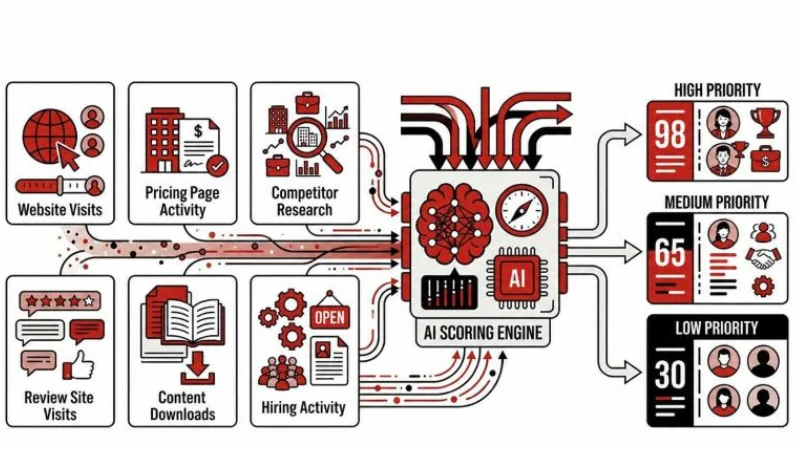
This is where AI gets genuinely useful.
Not because it is “smart.”
Because it is watching more than your team can.
Beyond your own website and email data, AI tools can monitor third-party intent signals: content consumption across the web, review site visits, competitor comparison searches, category research, and even hiring patterns that suggest a buying initiative.
When a company’s procurement team starts researching your category, that is a signal.
When multiple people from the same account start consuming content around the same topic, that is a signal.
When an account starts comparing you to a competitor, that is definitely a signal.
Humans miss this because the signals are scattered. AI pulls them together.
Then it turns scattered behavior into a priority score your team can actually use.
If you are building an intent-led program, also explore how VAIS helps score, prioritize, and convert B2B leads using AI and buyer intent data.
| Signal Type | What AI Tracks | Action Triggered |
| Behavioral | Page visits, email clicks, video completion, downloads | Move to high-intent nurture track |
| Firmographic | Company size, industry, tech stack, growth indicators | Match to ICP score and route to the right SDR |
| Intent – Third Party | Review site visits, competitor research, category searches | Trigger immediate outreach or sales alert |
| Conversational | Chatbot replies, WhatsApp answers, qualification responses | Score from AI agent and update CRM in real time |
| Engagement Decay | No activity over X days | Route to reactivation sequence or suppress |
Your email nurture is only as good as its scoring system. If your scores do not match sales reality, you are wasting effort. See how to bridge the gap between marketing tracking and sales requirements in our piece on nurturing MQLs into SQLs.
Here is what a real AI lead prioritization workflow looks like.
Not the fantasy version.
The version you can build with tools that exist right now.
A lead books a call or fills out a form. Immediately, enrichment kicks in.
The system pulls company information. It reviews the company website. It checks firmographic details. It may pull LinkedIn context. It creates a structured summary before your SDR has even opened the lead record.
Then qualification starts.
An AI agent reaches out through WhatsApp, email, chat, or whatever channel makes sense for that lead.
Not a clunky chatbot asking the same three questions no matter what.
A conversational agent.
It asks about the timeline. Budget. Pain points. Priorities. Current setup. Buying role. Then it summarizes the conversation.
Scores the lead. Updates the CRM. And gives your sales team the why behind the score.
Not just: “Lead score: 8.”
More like: “Lead score: 8/10. Strong ICP fit. Mid-market SaaS company. Recently engaged with pricing and ROI content. The timeline appears to be within 90 days. Budget not confirmed. Recommended next action: SDR follow-up with ROI case study and discovery call CTA.”
That is a totally different starting point.
Because now your rep is not staring at an email address.
They are looking at context.
And context is what makes outreach feel relevant.
The scoring agent should be trained on your specific offer and your actual ideal customer profile. It should not score generically. It should score relative to fit.[a]
Then the same agent can move into nurture mode.
It can answer questions. Share relevant case studies. Point leads toward product pages. Clarify use cases. Continue the conversation.
All tracked. All stored. All visible in the CRM.
Your sales rep opens the pipeline and sees a 9/10 lead with a company summary, LinkedIn-style overview, qualification transcript, engagement history, and an active AI conversation already in progress.
That is not “lead data.” That is a head start.

Here is the thing most nurture content gets wrong.
It talks about lead prioritization and lead nurture like they are two separate phases. They are not. They are a feedback loop.
A lead enters your funnel. AI assigns an initial score based on fit, behavior, source, and available intent signals. That lead gets nurture content based on the score and segment. Then the lead’s engagement with that nurture content updates the score. That updated score changes the next touch. That next touch creates new engagement data. And the loop keeps going.
This is how an average lead last week becomes a high-intent lead this week. Not because someone manually checked the dashboard. Because the system noticed what changed.
This is why behavior-based nurture beats calendar-based drip campaigns in complex B2B sales cycles.
Static sequences treat all leads the same.
Behavior-triggered sequences respond to what leads actually do.
A time-based drip says: “Send Email 3 on Day 7.”
A behavior-based nurture engine says: “She visited the pricing page after reading two case studies. Move her up. Change the message. Alert sales.”
That is a very different motion.
We cover the mechanics in depth here: Behavior-Based Email Nurture vs Time-Based Drip Campaigns.
AI makes this loop fast.

Without AI, someone has to check analytics, update a CRM field, move a lead into a new list, and tell sales what changed.
With AI, the lead who clicks three emails in 24 hours moves up the priority list before your morning standup.
That is the advantage. Not magic. Speed plus relevance.
Once AI sorts the leads, it still needs somewhere to send them. That is where the channel mix matters.
Because not every lead deserves the same channel. And not every channel deserves the same job.
Email remains the backbone.
It is scalable. Trackable. Easy to personalize. And still essential for education-heavy B2B nurture.
But the mistake is using email like a calendar.
Email should respond to behavior.
A pricing-page visitor should not get the same message as someone who downloaded an awareness-stage guide.
One is evaluating. The other is learning. Treat them differently.
If you want a service-level view, see Valasys Email Nurture Services.
SMS and WhatsApp are powerful for high-intent moments.
Not for spamming cold leads. Not for blasting generic promotions. For moments where speed matters.
Demo reminders. Qualification follow-ups. Post-event engagement. “You asked about this” conversations. Time-sensitive handoffs.
AI agents can qualify through these channels, summarize responses, and push updates into the CRM.
That means the sales team sees what happened before they step in.
Chatbots are no longer just website furniture.
Done correctly, conversational AI can qualify early-stage leads 24/7, route them based on intent, answer common questions, and keep the nurture process moving when no human is online.
The key is to connect the conversation back to CRM and scoring.
Otherwise, you just have a chat transcript floating in space. That helps nobody.
For enterprise deals, email alone is often not enough. Multiple stakeholders are involved. Different people care about different outcomes.
AI can help coordinate LinkedIn outreach alongside email nurture, especially when buying committee data is available.
The CFO does not need the same message as the RevOps lead.
The technical evaluator does not need the same message as the VP of Sales.
Buying committees need role-specific nurture. Read more here: How to Personalize Nurture Emails by Buying Committee Role.
For syndicated content leads specifically, the first touch matters even more because these leads are often warm to the topic, not necessarily warm to your brand.
That requires a different cadence.
Read: Email Nurture Flows for Content Syndication Leads.
Here is one of the most underrated parts of AI-powered lead prioritization:
Memory. Most CRMs store data.
AI-powered systems use data contextually.
That is a big difference.
A CRM might show that someone booked a call six weeks ago, ghosted, opened two emails, and then came back to read a case study.
Useful? Yes. Actionable? Maybe.
But an AI system with memory can connect those moments.
It knows what the person asked about before. It knows what objection came up. It knows which content they engaged with after going quiet. It can pick up the thread without pretending the conversation starts from zero.
That matters.
Because nobody likes being treated like a brand-new lead after they have already had three interactions with your company.
For sales, this is gold.
Your rep is not walking into a cold call. They are walking into a continued conversation with a complete history. That is how you make a first sales call feel like a second conversation.
And that is usually where a better pipeline starts.
Companies using AI-powered CRM nurture can shorten the gap between interest and sales readiness because leads arrive more educated, more qualified, and more contextualized.
Sales spends less time catching up. More time moving the deal forward.
This is also where marketing and sales alignment gets real.
Not theoretical alignment. Operational alignment.
Knowing when a nurtured lead is actually ready for sales is its own discipline. We break that down in B2B Email Nurture Strategy: How to Move Leads from MQL to Revenue.
Got cold leads sitting in your database? They are not dead. They are just waiting.
AI-powered reactivation sequences can revive leads that manual follow-up gave up on.
See the playbook here: How to Reactivate Cold B2B Leads Without Sounding Desperate
Let’s get concrete.
Because “AI-powered CRM” can mean almost anything.
Here is what a useful AI prioritization setup should surface for every scored lead.
| Field | What You See | Why It Matters |
| AI Score | 1–10 with confidence indicator | Gives reps a quick read on conversion likelihood |
| Score Rationale | Written reason from the model | Explains the “why” so reps can tailor outreach |
| Company Summary | Auto-generated from website and firmographic data | Saves pre-call research time |
| Lead Summary | Role context and professional background | Helps reps understand likely priorities |
| Qualification Transcript | Full conversation with AI agent | Answers budget, pain point, and timeline before first call |
| Engagement Timeline | Every email, click, visit, response, and form fill | Shows the relationship arc, not just the current moment |
| Nurture Stage | Current track and recommended next action | Keeps marketing and sales looking at the same picture |
| Sales Alert | Reason for immediate outreach | Prevents hot leads from aging in silence |
The score is not enough. That is important.
A naked score is just another number. The rationale is where the value is.
Sales does not just need to know “this lead is hot.”
They need to know why.
That context changes the outreach.
And better outreach changes the conversation.
Now, let’s talk about the ways teams mess this up.
Because AI does not remove bad processes. Sometimes it just makes bad processes faster.
If marketing says a score of 7 means “ready for sales” and sales says anything below 9 is a waste of time, you do not have an AI problem.
You have an alignment problem.
Fix that first.
Before you build the model, agree on what the scores mean.
AI can prioritize.
It cannot make your teams agree by itself.
AI models are only as good as the data underneath them.
If your CRM is full of duplicates, missing fields, inconsistent job titles, fake company names, and stale records, the model will reflect that mess.
Do not automate chaos. Clean the foundation first. Data hygiene is not exciting. But neither is watching a bad model confidently prioritize the wrong leads.
AI models drift. Markets change. Buyer behavior changes. Sales cycles change. Your best-fit customer may shift.
A scoring model trained on last year’s conversion data might not fully reflect this year’s buying reality.
Review the model. Quarterly is a good start. Look at false positives. Look at false negatives.
Ask sales which “high-score” leads were actually bad. Ask which “low-score” leads surprised everyone and converted.
Then feed that learning back into the system. Treat the model like a team member. Not a vending machine.
Prioritization without nurture is just a better-sorted mess. The score tells you who matters. The nurture sequence tells you what to say next.
You need both.
A high-intent lead needs one path. An early-stage learner needs another. A dormant lead needs another. A buying committee needs another.
AI can help route all of this, but you still need the content, logic, and handoff rules in place.
For the bigger nurture-and-reactivation framework, see Email Nurture and Lead Reactivation: The Cold-to-Closed Playbook.
This is another one.
Different source. Different intent. Different temperature. Different nurture path.
If webinars are part of your demand engine, read Post-Webinar Email Nurture Sequences That Convert.
Ready to build nurture flows that actually convert?
Valasys helps B2B marketing teams design and deploy AI-powered nurture systems that move leads from awareness to pipeline. From email sequences to full lead scoring infrastructure, we have seen what works. Explore Email Nurture Solutions at Valasys →
Lead prioritization is not glamorous.
Nobody puts “we sorted the list correctly” on a conference slide.
But this is where your pipeline quietly lives or dies.
You can have great content. You can run great campaigns. You can generate hundreds of leads. You can even have a strong sales team.
And still lose because your reps worked the wrong list in the wrong order with the wrong context.
That is the part AI fixes. Not the human relationship. Not the sales conversation. Not the trust.
AI does not replace that.
AI makes sure your humans spend their relationship capital on the right people, at the right moment, with enough context to make the first touch feel relevant.
That is not hype. That is just a better process. And better processes compound.
AI lead prioritization uses machine learning to rank leads by their conversion likelihood. Instead of treating every lead the same, the system analyzes behavior, firmographics, and historical patterns to identify who needs attention now. It stops sales from guessing and prevents marketing from dumping unvetted lists on the team.
Traditional scoring relies on manual, arbitrary rules like awarding points for page visits. AI scoring learns from actual outcomes. It identifies which actions historically led to deals and which were distractions. Traditional scoring reflects what teams think matters, while AI scoring reveals what actually drove past wins.
You need three data buckets: behavioral data like clicks and downloads, firmographic details like company size and industry, and outcome data showing which leads became customers. Richer data improves the model, but you should not wait for perfection. Start with the data you have, clean it, and refine the model over time.
Yes. While AI performs better with larger datasets, small teams can use pre-trained models, CRM tools, and automation to improve results. You do not need perfection to start. The primary goal is to stop treating every lead equally and focus your sales team on the highest-fit, highest-intent prospects.
AI calculates a score based on fit and intent, then compares it to your defined threshold. The real challenge is not the math, but the agreement. Marketing and sales must align on what sales-ready means. A lead should move to sales only when there is enough context for a high-quality conversation.
These channels are best for high-intent, time-sensitive interactions. They are not a replacement for email or an excuse to spam. AI agents use these platforms to confirm intent, answer specific questions, or update CRM data. Use them only when the timing is right and the message provides genuine value.
AI uses signal-based mapping to deliver the right content. If someone views ROI material, they receive business-case content next. If they study technical docs, they get integration guides. It is structural personalization, not just inserting a first name. It ensures different roles follow different paths with tailored timing and calls to action.
Expect to see improvements in rep efficiency within 30 to 60 days. Sales will spend less time on bad-fit leads. Measuring the full impact on conversion rates takes longer, so allow about 90 days. Treat the first quarter as a calibration period while the model and the team adjust to the new workflow.
Major platforms like Salesforce, HubSpot, and Marketo offer built-in predictive scoring. For custom needs, teams combine CRM tools with enrichment platforms, workflow automation, and AI agents. The right stack depends on your volume and control needs. Valasys teams can also look into VAIS for AI-powered buyer intent and lead scoring.
No. Modern, accessible tooling has leveled the field. Mid-market and growth-stage companies can easily build these systems using low-code tools and CRM integrations. If you have more leads than your team can manage by hand, you are ready for AI. The size of your company is no longer the limiting factor.
AI Powered Lead Prioritization Framework For B2B
Use AI to rank and prioritize high intent leads