Generate More B2B Leads With Webinars
Get proven strategies, templates, and tactics to generate qualified B2B leads through high-converting webinars.
 Lead-Gen now on Auto-Pilot with
Build My Campaign
Lead-Gen now on Auto-Pilot with
Build My Campaign

Learn how to create post-webinar email nurture sequences that boost engagement, build trust, & turn attendees into qualified leads customers.

Generate More B2B Leads With Webinars
Get proven strategies, templates, and tactics to generate qualified B2B leads through high-converting webinars.
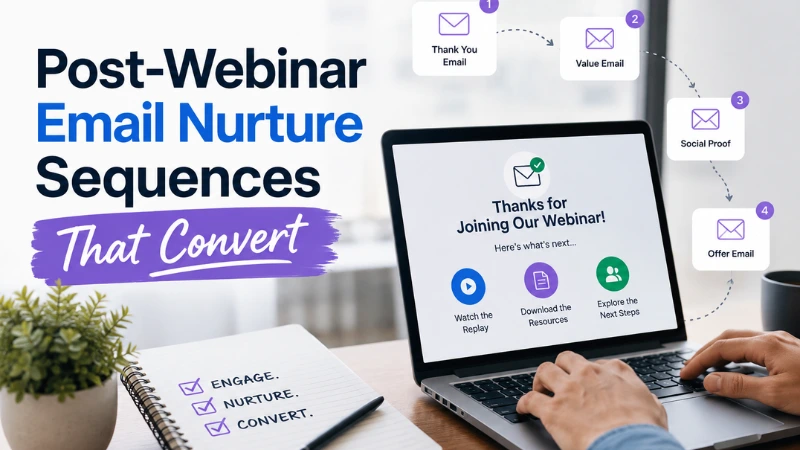
There may be no more expensive email in B2B marketing than the post-webinar on-demand webinar email.
Not because it costs money to send. Because it wastes intent.
Before that email reaches the inbox, something valuable has already happened. A prospect registered for your webinar. They shared first-party data. They invested time in a topic connected to a real business challenge.
Some attended live. Others asked questions during the session. Many clicked through to the shared resources. A portion of attendees even visited your pricing page.
Then they all receive the same message:
“Thanks for attending. Here’s the recording.”
That is where most webinar-generated pipeline begins to disappear.
Generate More B2B Leads With Webinars
Get proven strategies, templates, and tactics to generate qualified B2B leads through high-converting webinars.
The problem is not the On-Demand Webinar email itself. It is the assumption behind it: that every registrant is in the same place and ready for the same next step.
They are not.
The person who attended the full session and clicked a demo CTA is not the same lead as someone who registered six days ago and never showed up. Yet many organizations send both contacts identical follow-up.
That is not nurturing. It is broadcasting.
The organizations generating a consistent pipeline from webinars understand something different. The webinar is not the conversion event. The follow-up is.
This blog explains how to build post-webinar email nurture sequences that segment by behavior, align with buyer intent, and convert webinar engagement into meetings, opportunities, and revenue.
A post-webinar nurture sequence is a structured series of behavior-triggered emails sent to webinar registrants after the event. It segments contacts by engagement level and attendance status, routes each segment toward a different next step, and coordinates automated email touchpoints with CRM-visible sales actions. The goal is to move engaged registrants from first-party webinar data into qualified pipeline, not just replay views.
Valasys Media supports end-to-end Webinar Programs and Email Nurture designed for B2B demand generation teams. We can help you build the infrastructure that converts event engagement into a qualified pipeline.
Three patterns consistently explain weak post-webinar conversion: the replay-only send, generic segmentation, and delayed routing.
The On-Demand Webinar email gets treatedas a content delivery mechanism rather than a conversion trigger. A link to the recording is a passive offer. It asks nothing, creates no urgency, and gives the contact no reason to take a next step today rather than tomorrow or never.
Generic segmentation means every registrant gets the same message regardless of whether they attended live, watched on-demand, or never showed up. Those three groups have entirely different intent profiles. Treating them identically means every message is wrong for at least two thirds of your list.
Delayed routing is perhaps the most expensive mistake. Intent signal decay is real. A prospect who asked a sharp question during your live session and then clicked your demo CTA has shown you significant buying readiness. If your first meaningful follow-up arrives 72 hours later because it was buried in a weekly batch queue, that context is already cold.
There is a second structural problem that most post-webinar advice ignores entirely. According to Forrester’s Buyers’ Journey Survey, 73% of B2B purchases involve three or more departments, with an average of 13 internal and nine external stakeholders involved in a single purchasing decision. The person who attended your webinar is rarely the only person who needs to be convinced.
That means a recorded webinar link by itself is too weak for the job your email actually needs to do. The right follow-up asset helps the attendee summarize the session for a colleague, build an internal case, or forward a resource to a decision-maker who was not in the room. If your email cannot be forwarded with useful context intact, it is doing half the work it could be.
Understanding your conversion baseline starts with honest benchmark calibration. Here is what current research shows, and what it means for follow-up strategy.
According to Univid’s report, based on analysis of more than 2,000 webinars, the average live attendance rate is 49% of registrants, with total participation including replay reaching approximately 57%. That means for every 100 people who sign up, roughly 51 never attend live. They are not disengaged. They are a delayed-conversion segment that most teams abandon by sending a single follow-up email and moving on.
ON24’s Webinar Benchmarks Report found that 45% of attendees chose on-demand viewing, and that making webinars available on-demand by default can increase total views by up to 80%. It also reported that personalized nurture pages lifted average attendance from 208 to 275 and on-demand viewers from 89 to 151.
Mailchimp’s current data puts the average email open rate at approximately 35.63% across industries with an average click rate around 2.62%. Those numbers matter less than most teams think. Opens are increasingly distorted by Apple Mail Privacy Protection. The metrics that actually predict pipeline impact are reply rates, CTA clicks, asset downloads, meeting bookings, and movement into higher-intent lead-score tiers.
Gartner’s Future of Sales research found that 75% of B2B buyers prefer a largely rep-free experience, though Gartner also notes that fully self-service digital purchases are more likely to result in purchase regret. The practical implication for webinar follow-up is that your email sequence must serve self-directed buyers with content they can act on independently while also creating natural on-ramps to a human conversation when readiness signals are clear.
The RELAY Framework is a five-step operating model for post-webinar nurture that moves contacts from raw first-party engagement data into a sales-ready pipeline.
Within two to four hours of the event ending, your engagement data should be flowing into your MAP (Marketing Automation Platform) and CRM (Customer Relationship Management). Attendee duration, questions asked, poll responses, CTA clicks, and resource downloads are all routing inputs. High-intent contacts, those who attended the full session and clicked a pricing or demo CTA, should be flagged immediately for sales follow-up or moved into an accelerated sequence. Do not wait for the next business day.
The replay link alone is a passive offer. Extend its value by pairing it with a complementary asset: a one-page summary the attendee can share with a colleague, a relevant case study, a benchmark comparison, or a self-assessment tool. This packet serves two purposes: it gives the contact something actionable, and it gives the buying group something easy to forward internally.
Personalization in post-webinar emails is not about inserting a first name. It is about making the email feel like it was written for the specific role, account situation, or engagement behavior of the recipient. A VP of Marketing who attended the full session and asked about attribution modeling needs a different language than a Demand Gen Manager who registered but never showed up. Your MAP should make that segmentation automatic.
Every email in the sequence should have exactly one CTA calibrated to the contact’s current stage. High-intent attendees get a meeting request. Mid-intent contacts get a relevant content offer or self-assessment. Low-intent or no-show contacts get the replay with a soft invitation to return. Offering multiple CTAs in a single email diffuses action and makes the conversion event harder to measure.
Every touchpoint in the post-webinar sequence is a data event. Replay views, email clicks, asset downloads, and CTA interactions should all feed back into your lead scoring model and inform the next nurture program. A contact who did not convert this webinar cycle but engaged with two follow-up resources is telling you something important about their timing and topic interest. Capture it and act on it in the next cycle.
If you are working to connect webinar engagement to pipeline.

The most consequential segmentation decision you make after a webinar is not about subject lines. It is about which of the three primary groups each contact belongs to, and what that means for the next action you ask them to take.
First touch: Within two hours of the event. Email 1 should thank the attendee specifically for their time, reference something session-specific such as a question they asked or a poll result, and deliver the replay paired with a complementary resource. The CTA should match engagement level: demo booking for high engagers, content offer for moderate attendees.
Email 2 (Day 3 to 4): A value-add follow-up referencing a key takeaway from the session. This email should help the attendee brief an internal stakeholder. Include a shareable one-pager or a concise summary they can forward.
Email 3 (Day 7 to 8): A direct next-step ask, framed around a specific business problem the webinar addressed. High-intent contacts should receive a personalized outreach from sales rather than a third automated email.
No-shows are not cold leads. They registered, which means they had a reason to care about the topic at some point. Registration intent does not expire the moment the live window closes.
First touch (within 24 hours): A simple, low-pressure email that acknowledges they could not make it and offers the replay without any pressure to take additional action yet.
Email 2 (Day 4 to 5): A standalone value email built around one key insight from the webinar. This email should be able to stand alone without the recording. If the contact engages with this email, escalate their lead score.
Email 3 (Day 10 to 12): A resource offer tied to a pain point the webinar covered. Replay link included again for completeness. CTA should be a low-commitment offer such as a self-assessment or a relevant checklist.
On-demand viewers deserve their own branch, not a recycled no-show sequence with the first email swapped out. Someone who chose to watch the replay on their own schedule has demonstrated active intent. They sought out the content rather than letting it expire.
Trigger email (within 24 hours of replay view): Acknowledge the replay view, deliver the companion resource packet, and surface one relevant next step calibrated to what portion of the replay they watched if that data is available.
Email 2 (Day 3 to 5 after view): A persona-specific follow-up referencing the session topic with a direct CTA toward a conversation or a deeper content asset.
Structure every message around five elements.
One clear takeaway: Every email should open with or reference a single insight from the webinar. This grounds the message in the shared experience and demonstrates that your follow-up is connected to the event rather than templated.
The replay link with a purpose sentence: Do not just include the link. Tell the reader specifically what they will get from watching or rewatching. A timestamp reference to the most valuable segment is even better.
One intent-matched CTA: See the RELAY Framework above. The CTA should match where the contact is in their buying journey, not where you want them to be.
An internally shareable artifact: Given that most B2B purchases involve multiple departments, at least one email in the sequence should include an asset designed to be forwarded. A one-page summary, a benchmark comparison, or a short executive brief serves this function.
Deliverability-friendly formatting: Keep plain text as the dominant format. Avoid image-heavy designs that trigger spam filters. Use a recognizable sender name and address. Make the unsubscribe link visible and functional. Google and Yahoo now require SPF, DKIM, and DMARC authentication for bulk senders, and Yahoo requires spam complaint rates below 0.3%. Those are not optional technical housekeeping items. They are table stakes for inbox placement.
Open rate is not a useful primary metric for post-webinar nurture. Measure these instead:
One of the most overlooked webinar performance metrics is whether engagement data is actually reaching the systems used for pipeline reporting. Webinar registrations, attendance duration, poll responses, questions asked, asset downloads, and CTA clicks should sync automatically into both your MAP and CRM with consistent contact and account-level attribution.
Without proper CRM synchronization, marketing may report engagement while sales sees incomplete records, creating attribution gaps that make webinar ROI appear lower than it actually is. Regularly audit webinar-to-CRM workflows to ensure:
Opportunities can be tied back to webinar influence and sourced pipeline
Webinars do not generate pipelines on their own. What generates pipeline is what happens after the webinar ends.
The organizations seeing the highest webinar ROI are not sending better on-demand webinar email . They are building smarter nurture systems. They segment contacts by behavior, route intent signals quickly, align follow-up with buying-group dynamics, and create next steps that match buyer readiness.
A webinar attendee is not a lead. A replay viewer is not a lead. A registrant is not a lead.
They are signals.
The companies that consistently convert webinars into revenue are the ones that know how to capture, interpret, and act on those signals before they disappear.
If your current post-webinar strategy begins and ends with an on-demand webinar email , you are leaving a pipeline on the table. The opportunity is not to send more emails. The opportunity is to build a nurture sequence that turns webinar engagement into measurable business outcomes.
For live attendees, the first email should go out within two hours of the event closing, especially for high-engagement contacts who asked questions or clicked CTAs during the session. For no-shows, within 24 hours is the effective window. Intent context decays quickly, and a same-day or next-morning first touch consistently outperforms a batch send scheduled for the following week.
Most post-webinar sequences run three to four emails over ten to fourteen days per segment. High-intent attendees may accelerate into a shorter, sales-coordinated track of two emails before a human handoff. No-shows and on-demand viewers typically benefit from a slower, value-first sequence. Avoid sending more than four automated emails without a behavioral trigger that justifies the additional touch. Frequency without relevance creates unsubscribes.
Start with a simple, pressure-free email that acknowledges they missed the live session and offers the replay. Do not lead with a sales ask. The second email should deliver a standalone value asset, one key insight from the session that holds value without requiring them to watch the full recording. If they engage with either of those emails, escalate their lead score and introduce a more direct next-step offer in the third touch.
Prioritize meeting rate, demo request rate, reply rate, asset download rate, and influence pipeline over open rate. Open rates are increasingly unreliable due to Apple Mail Privacy Protection and similar inbox tools. Lead score progression across the sequence and the number of contacts who move from no-show or low-intent to mid-intent tiers are also strong indicators that your nurture logic is working.
Three things move the needle most. First, segment by behavior rather than sending a single email to all registrants. Personalized, behavior-triggered emails consistently outperform generic batch sends. Second, configure SPF, DKIM, and DMARC authentication for your sending domain. Google and Yahoo now enforce authentication requirements for bulk email senders, and missing authentication means your email may never reach the inbox regardless of content quality. Third, make unsubscribing easy. An accessible unsubscribe link reduces spam complaints, which protects your sender reputation and long-term deliverability.
Generate More B2B Leads With Webinars
Get proven strategies, templates, and tactics to generate qualified B2B leads through high-converting webinars.