Generate More B2B Leads With Webinars
Get proven strategies, templates, and tactics to generate qualified B2B leads through high-converting webinars.
 Lead-Gen now on Auto-Pilot with
Build My Campaign
Lead-Gen now on Auto-Pilot with
Build My Campaign

Learn how webinar attendance scoring helps identify real buyers vs casual browsers and improve lead qualification, targeting, and conversions.

Generate More B2B Leads With Webinars
Get proven strategies, templates, and tactics to generate qualified B2B leads through high-converting webinars.
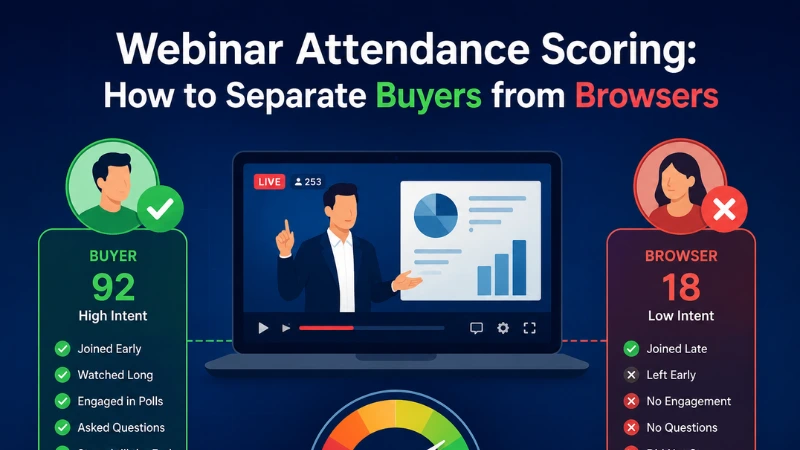
Picture your sales team receiving two leads from this week’s webinar.
Attendee A stayed for the full 60-minute session. They answered every poll, downloaded the slide deck, and submitted three detailed questions during Q&A. Your marketing automation platform scores them at 92 out of 100. Your SDR receives an alert and queues them for immediate outreach.
Attendee B dropped off after 20 minutes. With no poll participation, questions, or content downloads, their engagement remains low. Your system gives them a 24. They fall to the bottom of the follow-up queue.
What your scoring model didn’t know: Attendee A is a graduate student writing a thesis on B2B marketing automation. Attendee B is a VP of Operations at a 3,000-person enterprise whose CFO called them away from the webinar early to approve the budget for the exact solution you sell.
Your scoring model just deprioritized your most valuable prospect.
This is the fundamental problem with traditional webinar attendance scoring. Most models are built to measure activity. The best revenue teams score intent. That distinction sounds subtle. In practice, it costs organizations millions in misrouted follow-up, wasted SDR capacity, and missed pipeline.
Webinar attendance scoring without the right intelligence is like navigating with half a map. Marketers can see who registered and who attended, but they often lack visibility into what those engagement patterns mean at the account level and whether they reflect genuine purchase consideration or professional curiosity.
Generate More B2B Leads With Webinars
Get proven strategies, templates, and tactics to generate qualified B2B leads through high-converting webinars.
This is where platforms like Valasys Media Webinar Tracker add strategic value. By helping revenue teams monitor webinar participation patterns, identify account-level engagement trends, and surface potential buying signals across target organizations.
Why Most Webinar Attendance Scoring Models Fail
Traditional webinar lead scoring operates on a simple assumption: the more someone engages with your content, the more interested they are in buying. On the surface, this feels logical. In practice, it consistently creates more noise than signal.
The deeper problem is structural. When marketing teams build scoring models, they anchor on behaviors they can easily track: Did they register? How long did they stay? Did they answer the poll? These metrics are accessible, and they feel meaningful because engagement correlates with attention.
But attention is not the same as buying intent.
Consider the audiences routinely consuming your webinar content: industry analysts benchmarking competitive solutions; consultants researching content for client engagements; existing customers deepening product knowledge; academic researchers; competitors gathering market intelligence; and job seekers demonstrating industry expertise in interviews.
All of these audiences can score high on traditional webinar engagement metrics. None of them create pipelines.
When these segments are systematically over-scored, they crowd out genuinely high-intent prospects who may have exhibited quieter but far more commercially significant signals.
The B2B marketing industry has a persistent tendency to conflate enthusiasm with readiness. An attendee who stays for 55 minutes of a 60-minute session is clearly engaged. But engaged in what? In your content? In the topic? Or in evaluating your solution as a potential purchase?
The questions are too many but the answer lies in layers, there are three distinct layers of webinar engagement worth separating.
Behavioral engagement is the most visible layer. It includes attendance duration, poll interaction, Q&A submissions, and content downloads. This is what most scoring models measure exclusively.
Educational engagement reflects genuine interest in learning about a topic area, but not necessarily about buying a solution. A Director of Marketing attending a webinar on demand generation strategy may be deeply engaged educationally while having zero mandate or budget to purchase new technology this quarter.
Commercial intent is the layer that actually predicts the pipeline. It appears in question content (“How does pricing work at scale?” or “What does migration from our current platform look like?”), post-webinar behavior like pricing page visits or demo requests, and account-level patterns that suggest an organization is in active vendor evaluation.
The critical mistake most organizations make is treating behavioral engagement as a reliable proxy for commercial intent. It is not and building scoring models around that assumption reliably produces inaccurate pipeline forecasts.
To separate buyers from browsers at scale, revenue teams need a structured approach to evaluating what webinar engagement actually signals. The BUYER Signal Framework provides a repeatable model for scoring attendance data against commercially meaningful criteria.
The first question is not how engaged someone was, it is who they are. A CFO who attended your webinar for 15 minutes carries fundamentally different pipeline implications than a marketing coordinator who stayed for the entire session.
High-intent buyer roles include economic buyers with budget authority, technical decision-makers such as CIOs and IT Directors, operational leaders like VPs of Revenue Operations, and procurement stakeholders directly involved in vendor selection.
Practitioner roles analysts, coordinators, individual contributors often attend for professional development rather than vendor evaluation.
Scoring models that do not differentiate by seniority and decision-making authority will consistently over-weight practitioner attendance while missing executive signals buried lower in the queue.
Urgency manifests in the specific questions attendees ask. Questions about pricing structures, implementation timelines, migration complexity, integration requirements, and contract terms are commercially meaningful. They indicate a prospect thinking operationally about your solution which signals proximity to a decision.
When an attendee submits a question like “What does onboarding look like for a 200-person team migrating from a legacy system?”, that is not curiosity. That is a buying signal.
Your scoring model should treat it as such. Qualitative review of Q&A submissions, even a lightweight manual pass by an SDR or RevOps analyst can identify urgency signals that keyword-based automation misses entirely.
Not all engagement actions carry equal weight. Passive consumption such as watching, listening, and staying connected differs meaningfully from yielding engagement, which involves active investment in understanding your solution specifically.
Yielding engagement includes downloading implementation guides or ROI calculators. Rather than just slide decks, submitting questions about vendor-specific capabilities, engaging with post-webinar follow-up at a product or pricing level, and requesting additional conversations or live demonstrations.
Each of these actions represents a voluntary decision to invest further time in evaluating your solution, a meaningful indicator of forward movement in a buying process.
What an attendee does after your webinar ends is often more predictive than what they did during it. Post-webinar ecosystem activity like visiting your pricing page, exploring product documentation, spending time on customer case studies, or initiating a sales chat indicates that the webinar served as an entry point into a genuine evaluation cycle.
Marketers who isolate webinar engagement from post-event digital behavior miss the most commercially valuable signals in the data. The webinar is rarely the buying decision, it is the beginning of one.
Scoring models that fail to capture what happens after the session systematically undervalue a significant share of available intent data.
This is perhaps the most underutilized dimension in webinar attendance scoring. Single-attendee engagement from an account often signals individual curiosity. Multi-stakeholder attendance from the same account particularly when those stakeholders span different functions or seniority levels indicates that an organization is actively exploring a purchase.
When a Director of IT, a VP of Finance, and a Head of Operations from the same company all attend your webinar within the same quarter, that pattern is not coincidental. A buying committee is assembling. Your sales motion should reflect that reality.
In enterprise B2B environments, purchasing decisions are rarely made by individuals. Complex B2B purchases involve complex buying committees, often from different functions, with different evaluation criteria and different levels of authority.
Scoring models built around individual contacts are architecturally misaligned with how enterprise buying actually works.
Traditional webinar attendance scoring is contact-centric: it evaluates individuals without organizational context. Account-based scoring aggregates signals across all contacts within a target organization and interprets them collectively.
Identifying multi-stakeholder engagement patterns at scale is one of the hardest operational challenges in demand generation.

Attendance data often lives in event platforms disconnected from CRM systems, ABM tools, and marketing automation. When that data is fragmented, buying committee signals go undetected until it is too late to engage effectively.
Valasys Media Webinar Tracker helps revenue teams centralize webinar participation data and analyze engagement patterns at the account level, making it operationally possible to identify when multiple stakeholders within a target organization are simultaneously moving through your content. For teams running ABM programs, this kind of account-level visibility is foundational to accurate intent scoring and timely sales activation.
High engagement scores feel productive. They fill pipeline reports with leads that look qualified on paper. But false positive engagement creates a compounding operational problem: it crowds out genuine buyers, overloads SDRs with unqualified outreach, and over time it erodes the trust between marketing and sales that pipeline generation depends on.
Consider a realistic scenario. Your latest webinar on revenue operations attracted 400 attendees. By traditional engagement metrics, 85 scored above your qualification threshold. Your SDR team received 85 alerts and began outreach sequences.
A closer look reveals: 22 attendees work at consulting firms and attend for client research. 14 are existing customers who came for product education. Nine work at direct competitors monitoring your positioning. Eleven are academics or independent researchers. Seven are actively between jobs and building market knowledge for interviews.
That is 63 high-scoring attendees that were 74 percent of your qualified list, who will not generate pipeline regardless of how skillfully your SDRs execute.
Every hour spent following up with those contacts is an hour not spent on the 22 genuinely commercial leads in the remaining cohort.
False positives are not just an efficiency problem. They systematically train your sales team to distrust marketing-sourced leads, a credibility deficit that is difficult and slow to recover from.
A revenue-focused webinar scoring model starts by defining what it is actually trying to predict: not engagement, but pipeline probability. That reframing has immediate practical implications for model architecture.
The buyer role should carry the heaviest weighting. A confirmed economic buyer or technical decision-maker at a target account should score significantly higher than a practitioner from the same company and dramatically higher than any highly engaged attendee from an organization outside your addressable market.
Urgency signals in Q&A content should be scored qualitatively. A question about pricing or implementation timelines is not the same data point as a general conceptual question, and treating them identically inflates scores without improving signal quality.
Post-webinar ecosystem activity such as pricing page visits, demo requests, product content consumption should contribute substantially to the composite score. These behaviors represent voluntary forward movement in an evaluation process, which is among the strongest available indicators of commercial intent.
Account-level aggregation should be built into the model architecture, with threshold triggers that fire when multiple contacts from the same organization collectively cross a defined engagement threshold.
And negative scoring logic should be systematically applied to known false positive segments: existing customers, competitor employees, and contacts at organizations outside your total addressable market.
The metrics that matter to a VP of Sales or Chief Revenue Officer are not the ones most marketing dashboards surface by default. Registrations, attendance rates, and poll response percentages are operational metrics. They measure program execution. They do not measure revenue contribution.
Opportunity velocity is the rate at which an account moves from first engagement to closed-won. Accounts that engage multiple stakeholders with webinar content before entering a formal sales cycle frequently close faster and at higher contract values than accounts acquired through other channels. That insight changes how organizations invest in webinar content strategy, production, and promotion.
Intelligence without action is just data. The final element of an effective webinar attendance scoring system is the workflow layer that converts scored signals into coordinated sales motion.
SDR prioritization should be driven by account-level composite scores, not individual contact scores. Alerts should route to the appropriate account owner based on existing CRM territory assignments not to a generic inbound queue where context is lost.
Account routing logic should reflect pipeline status. When a webinar attendee comes from an account with an existing open opportunity, the engagement data should route directly to the owning rep with deal context attached, not be treated as a new inbound lead competing for SDR bandwidth.
Follow-up content in nurture sequences should reflect commercial intent, not just topical interest. A high-intent account should receive content that advances evaluation such as ROI frameworks, implementation guides, competitive comparison materials, customer case studies, not another educational webinar invitation that restarts the cycle.
For accounts showing multi-stakeholder engagement without a current opportunity, coordinated account-based outreach targeting multiple identified stakeholders with personalized, context-aware messaging will consistently outperform single-threaded SDR follow-up.
The future of webinar attendance scoring is not measuring who showed up. It is understanding who is moving closer to a buying decision.
Activity metrics tell you that your webinar was watched. Intent signals tell you that someone is evaluating whether to buy. The distance between those two data points is where the pipeline is created or quietly lost to a competitor who reads the signals better.
Revenue teams that design their scoring models around purchase readiness rather than engagement volume will consistently generate higher-quality pipeline, improve sales acceptance rates, and eliminate the false positive drain that erodes marketing credibility over time.
The webinar is a moment of access. The question every revenue marketer should be asking is not “How engaged were they?” but “What does this engagement tell us about where they are in a buying decision?”
Organizations that answer that question accurately will always know which buyers are in the room even when those buyers never ask a single question.
What is webinar attendance scoring?
Webinar attendance scoring is the process of assigning value to attendee behaviors such as registration, attendance duration, poll responses, Q&A participation, and content downloads to estimate a prospect’s level of interest or purchase readiness.
Modern scoring models go beyond activity metrics to incorporate buyer role, account-level signals, post-webinar behavior, and buying committee formation to more accurately identify commercial intent.
How do you score webinar attendees for sales qualification?
Effective webinar attendee scoring should weight buyer role and seniority most heavily, followed by urgency signals in Q&A content, post-webinar ecosystem activity such as pricing page visits or demo requests, and account-level engagement patterns including multi-stakeholder attendance. Negative scoring logic should be applied to existing customers, competitor employees, and contacts outside the target addressable market to reduce false positive rates.
Which webinar behaviors indicate genuine buying intent?
The strongest buying intent signals from webinar attendees include questions specifically about pricing, implementation timelines, migration complexity, and vendor evaluation criteria; post-event visits to pricing pages or product documentation; demo requests submitted after the webinar; and multi-stakeholder attendance from the same account, particularly when attendees span decision-making functions such as finance, IT, and operations.
How can sales teams identify high-intent prospects from webinar attendees?
Sales teams should receive account-level alerts that aggregate engagement across all contacts from the same organization, with contextual detail including attendee roles, questions submitted, and post-webinar digital behavior.
Prioritization should favor accounts where multiple stakeholders attended, where questions reflected operational evaluation criteria, and where post-event behavior indicated forward movement in a buying process, not individual contact scores in isolation.
What is the difference between webinar engagement scoring and intent scoring?
Engagement scoring measures behavioral interaction, how long someone attended, whether they responded to polls, whether they downloaded resources. Intent scoring measures purchase readiness, whether the attendee’s role, questions, account context, and post-event behavior suggest they are actively evaluating a vendor.
Engagement scoring predicts attention; intent scoring predicts pipeline. High-performing revenue teams use the former as an input to the latter, not as a proxy for it.
Generate More B2B Leads With Webinars
Get proven strategies, templates, and tactics to generate qualified B2B leads through high-converting webinars.