Generate More B2B Leads With Webinars
Get proven strategies, templates, and tactics to generate qualified B2B leads through high-converting webinars.
 Lead-Gen now on Auto-Pilot with
Build My Campaign
Lead-Gen now on Auto-Pilot with
Build My Campaign

Learn how to turn webinar registrants into qualified leads with proven strategies for engagement, nurturing, and pipeline growth.

Generate More B2B Leads With Webinars
Get proven strategies, templates, and tactics to generate qualified B2B leads through high-converting webinars.
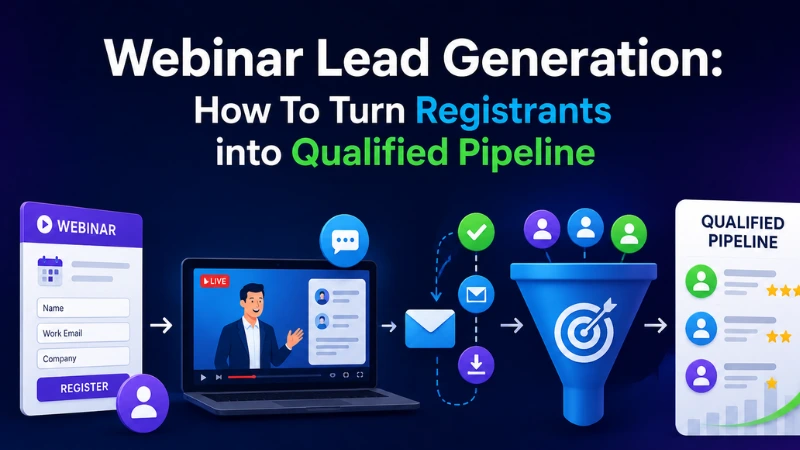
Great news, we got a whopping 3,000 webinar registrations.”
“That’s awesome. How many got into our pipeline?”
“…pipeline?”
That conversation happens in more B2B companies than anyone wants to admit. Somewhere between the registration form, reminder emails, and the “Thanks for joining” slide, webinar success became obsessed with vanity metrics instead of revenue impact.
Because registrations don’t pay revenue targets. Attendance screenshots alone don’t shorten sales cycles. And a packed webinar means nothing if sales teams are still asking: “Which of these leads actually wants to buy?”
Yet webinars continue to be one of the most effective B2B demand-generation channels when done correctly. The difference is that high-performing companies don’t treat webinars as content events.
They treat them as qualification engines.
Every click, question, poll response, chat interaction, and engagement signal becomes valuable intent data that helps identify who’s genuinely sales-ready and who simply showed up for the slides. The goal isn’t to collect more leads. It’s to identify better ones.
In this guide, you’ll learn how to turn webinar registrants into qualified pipeline by:
Generate More B2B Leads With Webinars
Get proven strategies, templates, and tactics to generate qualified B2B leads through high-converting webinars.
Because the most valuable part of a webinar isn’t the attendance count. It’s what happens after the webinar ends.
Every high-converting webinar starts with ruthless audience clarity. Before you pick a topic or open a registration page, define exactly who you want in the virtual room. Your Ideal Customer Profile (ICP) should drive every decision from the headline you write to the channel where you promote.
Use Account-Based Marketing (ABM) principles to build your invitation list. Rather than casting a wide net, identify the specific companies, titles, and verticals where your solution delivers the most value. Most demand-gen teams recommend a tiered content calendar:
Topic selection is equally critical. StackMatix’s analysis shows that intent-signaling topics consistently outperform generic trends content. A session titled “How to Evaluate ABM Platforms for Enterprise Sales Teams” will attract far more qualified buyers than “Top B2B Marketing Trends.” Frame your topic around a specific pain point or buying decision your ICP is actively wrestling with.
Key actions for audience targeting:
Your registration form is the first qualification gate and most marketers waste it by collecting only a name and email. A smartly designed form gathers the firmographic and intent data you need to segment leads before the event even starts, enabling personalized follow-up that speaks directly to each attendee’s situation.
Include three to five targeted fields beyond contact information: job title or seniority level, company size, primary pain point or challenge, and project timeline (e.g., “Are you evaluating solutions now, in 3 months, or just researching?”). This data feeds directly into your lead-scoring model and determines which nurture track each registrant enters post-webinar.
Balance qualification depth against friction. A longer form can deter casual browsers, which is not always a bad thing but it may also discourage genuinely interested prospects.
Consider a two-step registration: a short initial form to capture interest, followed by a deeper qualification survey sent by email 24 hours before the event in exchange for early access to slides or a bonus resource.
Gate the on-demand recording for 7 to 14 days after the live event. This creates urgency for live attendance while giving your team time to follow up with registrants who didn’t show before they access the content for free. It also helps you distinguish between committed prospects (who attended live) and casual researchers (who only watched the replay).
The content and format of your webinar determine both who attends and how engaged they become and two of the most important predictors of post-event conversion. Align your format to your funnel stage and your audience’s decision-making phase.
Top-of-funnel audiences benefit from broad educational content: industry trend panels, expert interviews, and how-to workshops that address common challenges without selling.
Mid-funnel audiences respond to deep-dive problem-solving sessions that compare approaches, share frameworks, or feature peer practitioners discussing real implementations.
Bottom-of-funnel audiences are ready for product demos, customer success stories, and ROI-focused case studies that directly support a buying decision.
Regardless of format, structure the live session for engagement. Intentsify recommends opening with a warm speaker introduction and a poll within the first three minutes, this activates attendees immediately and establishes a two-way dynamic.
Break up content every 8 to 10 minutes with a discussion prompt, chat question, or brief interactive exercise. Save the live Q&A for the final 15 minutes, after the core content has been delivered, and close with a clear next step (not a hard sell).
Keep slides visual and narrative-driven. ON24’s research shows that “toxic slides” i.e dense bullet-point decks that duplicate what the presenter is saying sharply reduce engagement time. Rather use images, data visualizations, and storytelling frameworks. Each slide should support the speaker’s narrative, not transcript it.
Webinar promotion is where most marketing teams underinvest. If you have spent three weeks preparing great content and only send two email blasts, you are leaving your registration potential on the table. Sirocco Group’s advice is blunt: promote your webinar like you are launching a product.
Start your promotional campaign at least three weeks out. StackMatix recommends the following multi-channel schedule:
During the live session, embed calls-to-action throughout. Post resource links in the chat at relevant moments, offer a downloadable summary or checklist midway through, and close with a specific next step, a free assessment, a 30-minute strategy call, or a product walkthrough that is available to attendees only.
These in-session CTAs capture intent data in real time and give your sales team immediate conversation starters.
The 72 hours after your webinar ends are the highest-leverage window you have for pipeline conversion. Most teams squander this window by sending a single “thanks for attending” email with the recording and moving on.
Top-performing teams use a segmented, multi-touch follow-up cadence that mirrors each lead’s level of engagement.
Start by scoring every attendee immediately after the event. Assign points for key behaviors:

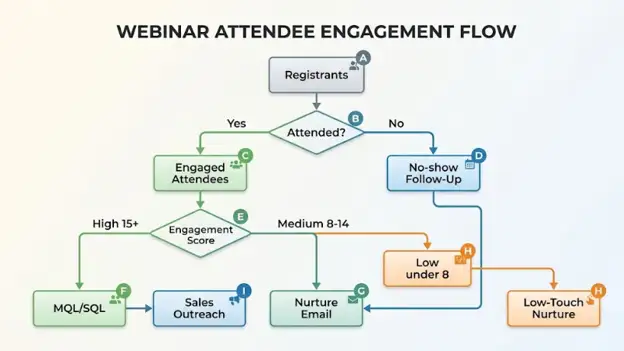
Leads scoring 15 or above qualify as Marketing Qualified Leads (MQLs) and should receive immediate sales outreach. Leads scoring 8-14 enter an accelerated nurture sequence. All others including no-shows receive the standard post-webinar drip.
Valasys Media recommends a structured 21-day follow-up cadence:
Do not ignore no-shows. These registrants expressed interest by signing up; they just had a conflict. Treat them as warm leads, send the recording with a brief personal note, and add them to the relevant nurture track based on their registration form data.
See how our expert team can automate your webinar follow-up. Book a Demo to explore Valasys Media’s end-to-end webinar nurture solutions.
The diagram below illustrates how registrants flow through qualification, engagement scoring, and follow-up to become sales-ready pipeline:
A webinar that generates 200 engaged attendees but never triggers a sales conversation has failed at its primary job. Bridging marketing and sales is the most critical and most frequently broken step in the webinar-to-pipeline process.
To set it right, first define your MQL and High-Quality Lead (HQL) criteria in advance, and agree on them with your sales team before the webinar goes live.
A BANT-qualified lead, one whose Budget, Authority, Need, and Timing have been at least partially confirmed through registration form data and webinar engagement should trigger immediate SDR outreach, not a drip sequence.
Integrate your webinar platform with your CRM and marketing automation tools so that engagement data flows into sales records in real time. Set up automated alerts that notify assigned SDRs when a prospect from their named accounts crosses the MQL threshold during a webinar.
Involve sales before the event as well. Notifying sales reps of upcoming webinars is very crucial, so they can invite prospects from their open opportunities and join the live Q&A. A rep who hears a prospect’s question during the session has an instant, personalized conversation starter for their follow-up call, something no automated email can replicate.
Stop measuring webinar success by registrant count. That metric tells you nothing about pipeline. Instead, track these KPIs after every event:
On the technology side, ensure your webinar platform integrates natively with your CRM and marketing automation tool. Fragmented tech stacks are the single biggest reason high-engagement leads fail to reach sales.
Tracking webinar performance requires more than attendance reports. Marketing teams need visibility into registrations, engagement scores, MQL conversion, follow-up activity, and pipeline creation. The Valasys Media Webinar-to-Pipeline Tracker helps teams consolidate these metrics in one place, making it easier to measure webinar ROI and identify optimization opportunities.
Webinars remain one of the most efficient lead-generation vehicles in B2B marketing but only when they are treated as full-fledged pipeline programs, not one-off content events. The difference between teams that convert 5% of registrants and teams that convert 30% comes down to four disciplines: precise audience targeting, pre-event qualification, deep live engagement, and a structured post-event follow-up cadence rooted in behavioral data.
By shifting from a broad-topic, mass-registration approach to an intent-driven topic selection and segmented follow-up, it increased webinar-to-pipeline conversion, a 10x improvement in pipeline value per event. Those results are replicable with the right strategy, tools, and execution partner.
A webinar-to-pipeline conversion rate measures the percentage of webinar attendees who eventually become qualified opportunities or pipeline. It helps marketing teams evaluate the actual revenue impact of a webinar instead of focusing solely on registrations or attendance.
Most B2B organizations run webinar follow-up campaigns for 14 to 30 days after the event. A structured cadence that includes thank-you emails, related content, case studies, and sales outreach helps maximize conversion opportunities.
Sales and marketing teams should agree on lead-scoring criteria before the webinar, share attendee engagement data through CRM integration, and establish clear handoff rules for qualified leads. This ensures high-intent prospects receive timely and relevant follow-up.
While attendance rates vary by industry, most B2B webinars achieve attendance rates between 35% and 50% of total registrants. More important than attendance rate, however, is the quality of attendee engagement and the number of qualified opportunities generated.
Yes. Webinars remain one of the most effective B2B demand generation channels because they combine educational content with real-time engagement. They help businesses identify buyer intent, nurture prospects, and accelerate pipeline creation more effectively than many other content formats.
What is a qualified lead in lead generation?
A qualified lead is a prospect who matches your Ideal Customer Profile (ICP) and has shown sufficient interest or intent to potentially become a customer. Qualified leads typically meet specific criteria such as company size, job role, business need, budget, authority, and engagement with your marketing activities. These leads are more likely to move through the sales funnel and convert into opportunities than general inquiries or unqualified contacts.
How do you generate qualified leads?
Generating qualified leads requires a combination of targeted outreach, valuable content, and effective lead qualification processes. Some proven strategies include:
The goal is not to generate the highest number of leads but to attract prospects who are most likely to become customers.
The five key factors commonly used to determine lead quality are:
In modern B2B sales, many teams also add a fifth factor:
So, when using BANT with an added ICP lens, the five important factors to consider for a qualified lead are:
Budget → Authority → Need → Timing → Fit
While BANT remains a widely used qualification framework, adding Fit helps ensure that even prospects with budget and urgency are also a strong long-term match for your solution.
Generate More B2B Leads With Webinars
Get proven strategies, templates, and tactics to generate qualified B2B leads through high-converting webinars.