Revenue Focused Lead Progression Strategy
Convert MQL leads into revenue through structured nurture
 Lead-Gen now on Auto-Pilot with
Build My Campaign
Lead-Gen now on Auto-Pilot with
Build My Campaign

Turn cold MQLs into pipeline with behavior-based nurture, smarter lead scoring, and email flows built for real B2B buying journeys.

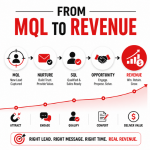
Revenue Focused Lead Progression Strategy
Convert MQL leads into revenue through structured nurture
Your marketing team worked really hard, and hit their MQL goal for the quarter. High-fives all around.
But in the sales wing? Silence.
The lead went cold, fell into a CRM abyss, and got blasted with a generic drip sequence about “synergizing your pipeline.”
That six-week drip campaign, it “synergized” them right into the unsubscribe folder.
In B2B, a 6-week nurture for a 12-month buying cycle often falls short of maintaining meaningful engagement throughout the full decision timeline. If you’re tired of watching your pipeline leak, it’s time to stop sending emails and start engineering revenue.
Here’s what this blog is going to do: walk you through what a real B2B email nurture strategy looks like, from the moment someone becomes an MQL to the moment sales finally has a conversation worth having.
Revenue Focused Lead Progression Strategy
Convert MQL leads into revenue through structured nurture
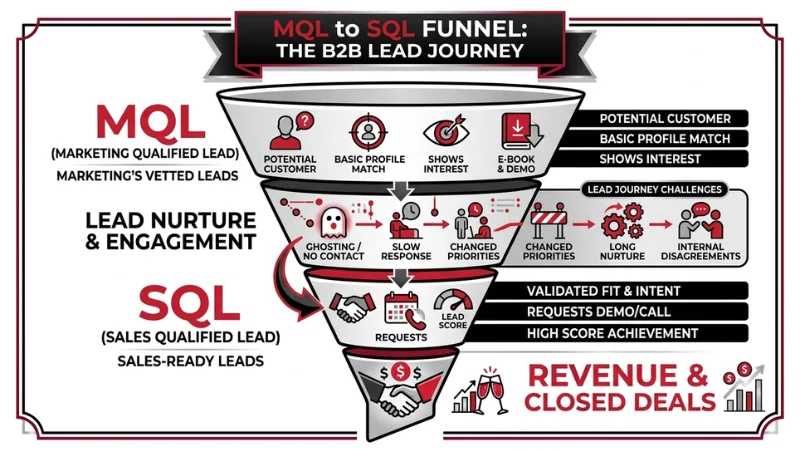
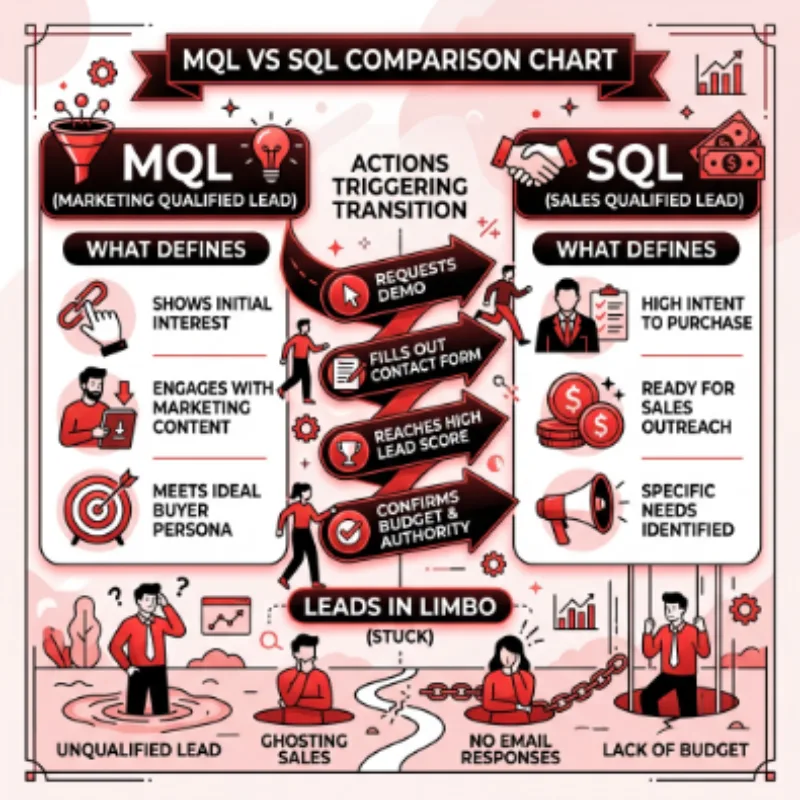
An MQL is someone who raised their hand, barely. They read a blog, attended a webinar, downloaded something. That’s interest, not intent. Treating an MQL like a warm lead is one of the fastest ways to burn a relationship before it starts, which is why we built VAIS to isolate the real buyers from the casual browsers.
The job of email nurture isn’t to close deals. It’s to qualify intent, build trust, and make the handoff to sales feel like a natural next step, not an ambush.
Don’t look at it like a sales funnel, it is more like a really well-paced conversation.
According to Forrester Research, companies that excel at lead nurturing generate 50% more sales-ready leads at 33% lower cost, making this one of the highest-ROI marketing investments a B2B company can make. The execution is where most B2B teams fumble.
Most nurture sequences are built around time. Email 1 goes out on Day 1. Email 2 on Day 4. Email 5 on Day 14. It’s predictable. It’s also largely ignored.
The better framework? Behavior-first. What someone does tells you far more than how long it’s been since they opted in.
The welcome email has a 4x higher open rate than anything you’ll send later. Use it. Don’t waste it on a generic “Thanks for downloading!” sequence.
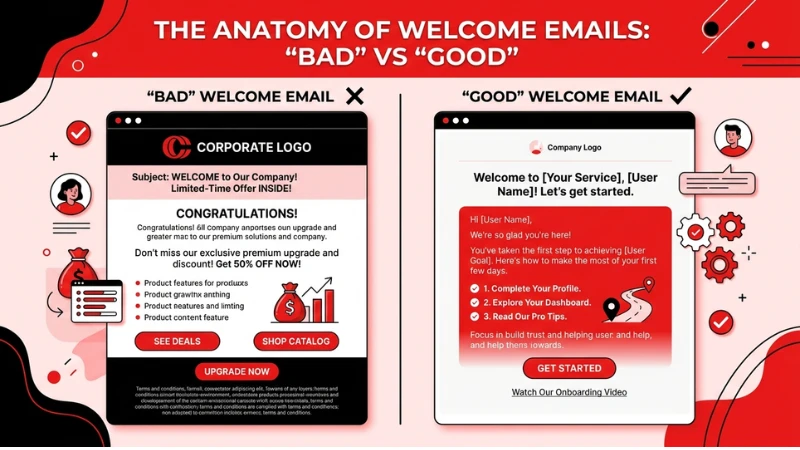
Your first email should do three things: acknowledge what they came for, deliver immediate value they didn’t expect, and set a clear expectation for what comes next. That’s it. Save the product pitch for when they’ve actually shown buying signals.
Stop making it all about you. Talk about them, their pain points, and what they actually care about instead of opening with a self-congratulatory pitch nobody asked for.
This is where most nurture programs get lazy. They recycle blog posts, add a “thought you’d find this interesting” intro, and call it personalization. It’s not.
A real education sequence is built around the problems your buyer is trying to solve, not the products you’re trying to sell. Map your content to pain points, not features. If you sell marketing automation, your Week 2 email shouldn’t be about your platform’s integrations. It should be about why their current reporting is making their CMO uncomfortable.
Problem-first content earns trust. Feature-first content gets ignored.
• Week 1: Problem identification. Help them name the pain they’re living with.
• Week 2: Social proof. Show them how peers in their industry solved that pain.
• Week 3: Framework. Give them a way to think about the problem structurally.
• Week 4: Soft product tie-in. Now, and only now, show how you fit into the solution.
The best email nurture programs all start with the same principle: map content to buyer stage, not to calendar dates. And if you’re wondering where your own flows might be fumbling the execution, you can grab a quick audit of your sequences right here.
Here’s the thing most teams miss: email nurture is not an email problem.
It’s a revenue architecture problem.
The emails are just the visible layer. Underneath them sits the machinery that decides who enters a flow, what they receive, when sales gets involved, what gets measured, and when a lead should be recycled instead of chased into oblivion.
A real nurture strategy connects six moving parts:
Lifecycle stages. Where is this person in the journey? New MQL? Recycled lead? Re-engaged account? Closed-lost opportunity? Different stages need different treatment.
CRM hygiene. If your job titles are messy, your source data is unclear, and your lifecycle stages are more folklore than system logic, your nurture will be messy too.
Routing logic. Who gets sent to sales, who stays in marketing nurture, who enters an ABM motion, and who gets suppressed completely?
Content mapping. Which assets actually help a buyer move forward, and which ones are just sitting in the library because someone worked hard on them in 2021?
Sales feedback. If sales says a lead was bad, why? Bad fit? Bad timing? No context? Wrong person? No buying intent? That feedback should improve the nurture system, not disappear into a Slack thread.
Reporting. Opens and clicks are not the strategy. Pipeline movement is.
This is why the best nurture programs don’t feel like campaigns. They feel like operating systems.
Every lead has a path. Every path has logic. Every signal has a response. Every handoff has context. And every quarter, the system gets smarter.
Before you write a single subject line, build the map.
Most teams do this backwards. They start with “What should Email 1 say?” when the better question is, “What decision is this buyer trying to make, and what do they need before they can make it?”
A nurture map keeps you from turning your automation platform into a very expensive email cannon.
Start with five questions.
1. Where did this lead come from?
A webinar attendee, a content syndication lead, a pricing page visitor, and a closed-lost opportunity are not standing in the same place. Don’t hand them the same brochure and hope for the best.
2. What stage are they actually in?
Are they learning, comparing, justifying, validating, or stalling? Each stage needs a different kind of message.
3. Who are they in the buying committee?
The CFO wants the business case. The technical evaluator wants to know what breaks. The end user wants to know whether their day gets easier. The champion wants ammunition to convince everyone else.
4. What behavior should change the path?
A pricing page visit should not trigger the same next email as a blog click. A webinar question should not be treated the same as a passive registration. Behavior is the buyer telling you what to do next.
5. When do they leave the flow?
This is the part teams forget. A nurture flow needs exit criteria. Demo request? Sales acceptance? Disqualification? No engagement after a defined period? Closed-lost recycle? If no one exits, you don’t have a nurture flow. You have a waiting room with newsletters.
A simple nurture map looks like this:
Source → Stage → Role → Signal → Next Best Action → Exit Criteria.
That’s the strategy. The emails are just how the strategy speaks.
Here’s where the marketing-sales blame game usually begins. Marketing says the lead was warm. Sales says it wasn’t. Both are partially right. The real issue? Nobody defined what “ready” looks like.
Enter lead scoring done properly. Not the kind where you assign 10 points for opening an email and 5 for clicking a link, resulting in a 45-point score that means nothing to anyone. The kind that’s built backwards from closed deals.
Ask your top sales reps what a great lead looks like before they get on a call. You’ll hear things like: they asked a specific question, they’ve been on the pricing page twice, they mentioned a competitor by name, they have budget authority. Those are your real scoring signals.
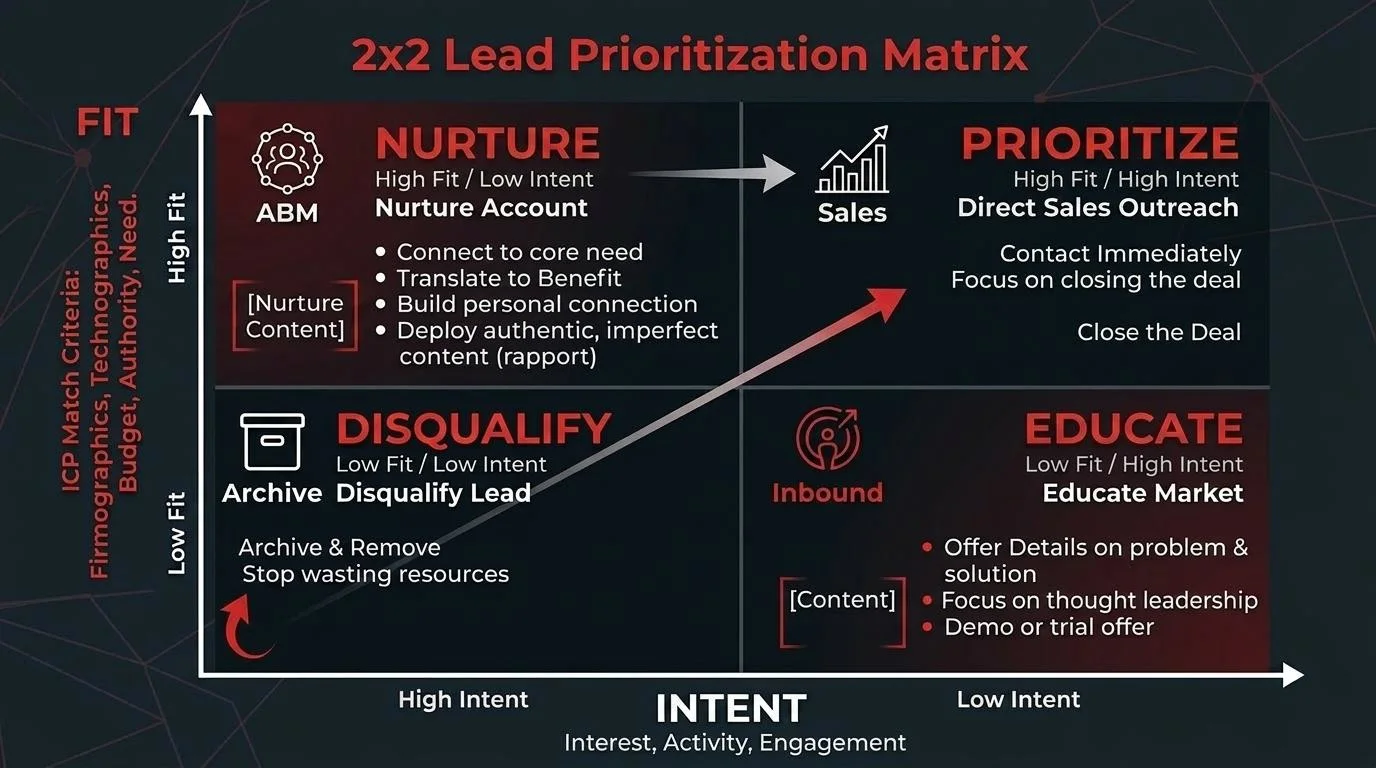
The handoff itself needs a documented SLA. Not a “marketing will email sales” policy. An actual agreement: how quickly sales follows up, what information marketing includes in the handoff note, and what happens if a lead isn’t contacted within 24 hours (because the data on lead response time degradation is brutal).
The first five minutes matter more than you think. Studies from Harvard Business Review found that leads contacted within an hour are 7x more likely to have a meaningful conversation. Your CRM automation should trigger sales alerts the moment an MQL crosses the SQL threshold, not in a daily digest.
Real personalization in B2B nurture isn’t about using someone’s name. It’s about understanding where they sit in the buying committee and sending them content that serves that specific role.
A CFO evaluating your platform needs different emails than the IT director who’ll implement it, or the marketing manager who’ll use it daily. Same product. Completely different buying concerns. Most nurture programs send everyone the same sequence and wonder why conversion rates are stuck.
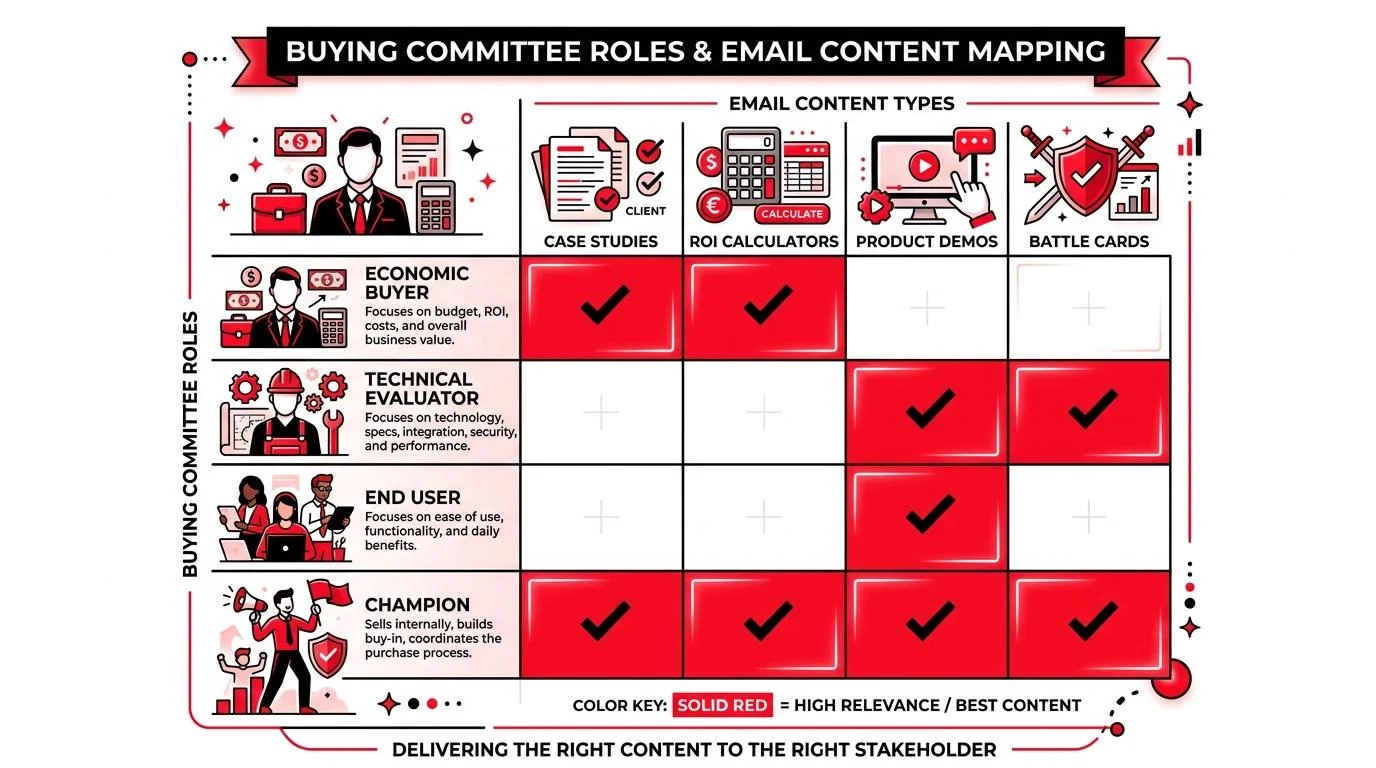
Getting this right requires knowing who you’re actually emailing, which means your lead capture forms and CRM data need to be doing real work. Job title fields matter. Company size matters. Segment early and segment properly.
You need to give sales the “why,” not just the “who.” Most platforms tell you a lead clicked; ours tells you what they’re looking for, showing you their intent topics. Automate your scoring, refine your handoff, and turn MQLs into revenue-ready conversations. Try VAIS for free.
Time-based drip campaigns are the comfort food of B2B marketing. Easy to set up, easy to explain to your CMO, and largely ineffective for leads who aren’t moving at your predefined pace. While time-based campaigns have their place for basic lead warming, they lack the sophistication needed for complex B2B buying cycles.
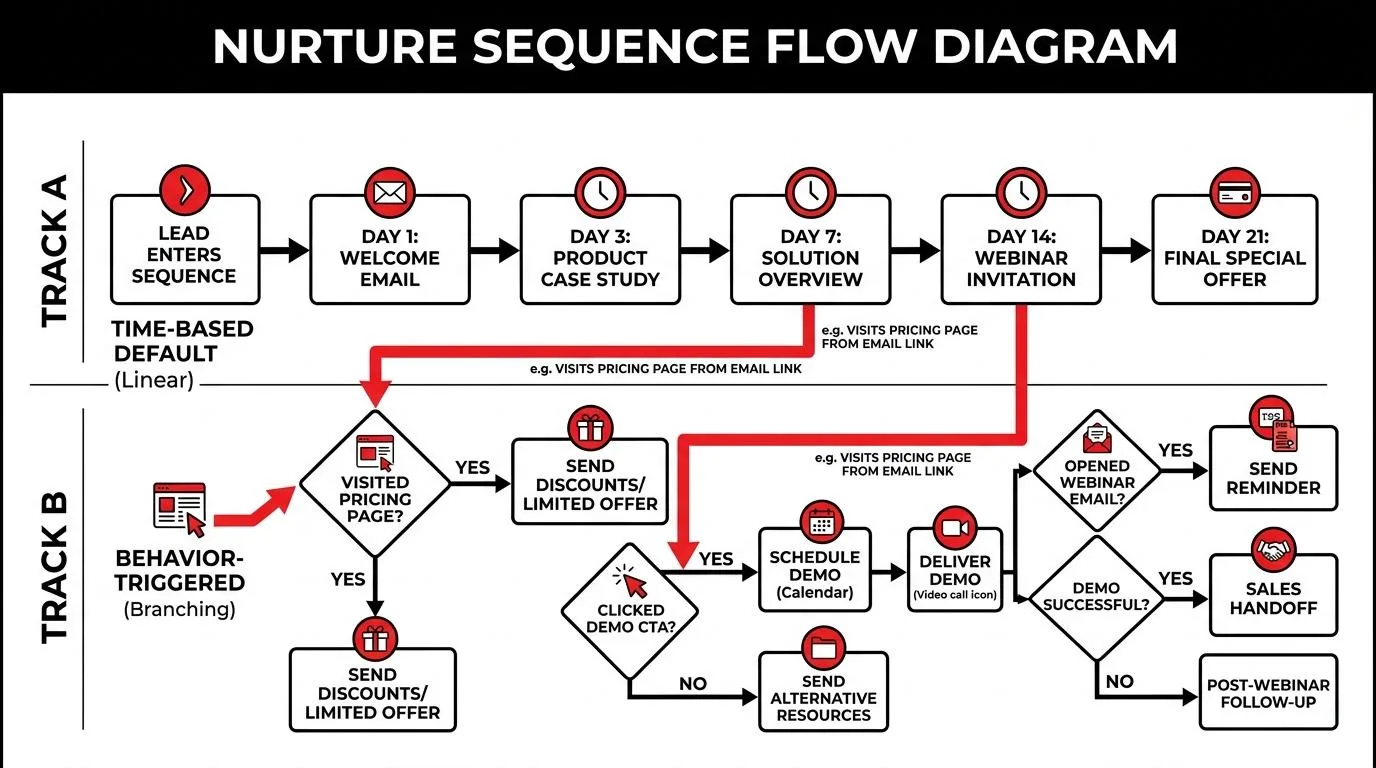 Behavior-based nurture takes more upfront work. You need triggers. You need branching logic. You need someone who actually understands marketing automation beyond “create a sequence and add contacts.” But the payoff is real.
Behavior-based and time-based aren’t mutually exclusive. The smartest programs use time-based as the default track and behavior-based triggers to accelerate, slow down, or redirect leads based on what they’re actually doing.

Your buyers do not live exclusively inside their inbox waiting for your nurture sequence to change their life. They are in meetings, on LinkedIn, reading analyst reports, comparing vendors, ignoring SDR calls, forwarding screenshots, and quietly judging your website.
So a real nurture strategy needs supporting channels.
Retargeting ads keep your message visible when the buyer is not ready to click another email.
LinkedIn engagement helps warm up high-value accounts without immediately forcing a sales conversation.
Webinars and virtual events give buyers a reason to spend time with your thinking, not just your pitch.
Website personalization can turn repeat visits into relevant next steps instead of generic homepage traffic.
Sales touches become more useful when they are triggered by behavior, not by someone’s desperate need to hit an activity target.
Direct mail can make sense for high-value accounts, especially when the buying committee is large and the deal size justifies a more thoughtful play.
This does not mean every lead needs every channel. That’s how marketing teams create chaos and call it orchestration.
The goal is not to surround the buyer from every angle like a low-budget spy movie. The goal is to create consistency.
If the email talks about ROI, the retargeting ad should not scream about features. If the webinar focused on implementation risk, the sales follow-up should not open with “just checking in.” If the buyer has been reading comparison content, the website CTA should not send them back to beginner education.
Email nurture works best when the entire journey agrees with itself.
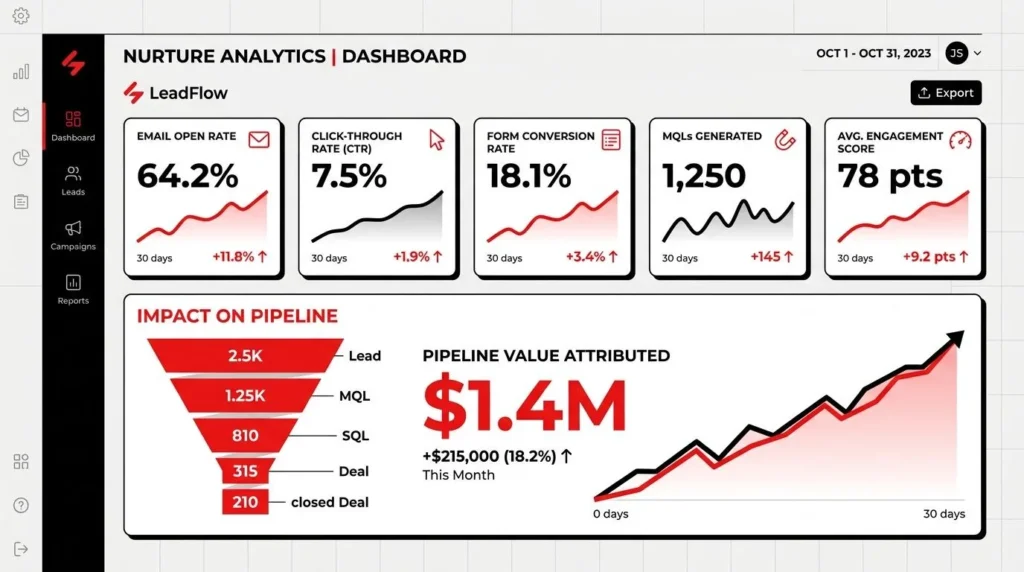
Open rates feel good. They’re easy to report. And since iOS 15 made them largely unreliable with mail privacy protection, they’re also increasingly meaningless. Clicks are better. Pipeline influence is what you actually want to be tracking.
Metrics That Connect Nurture to Revenue
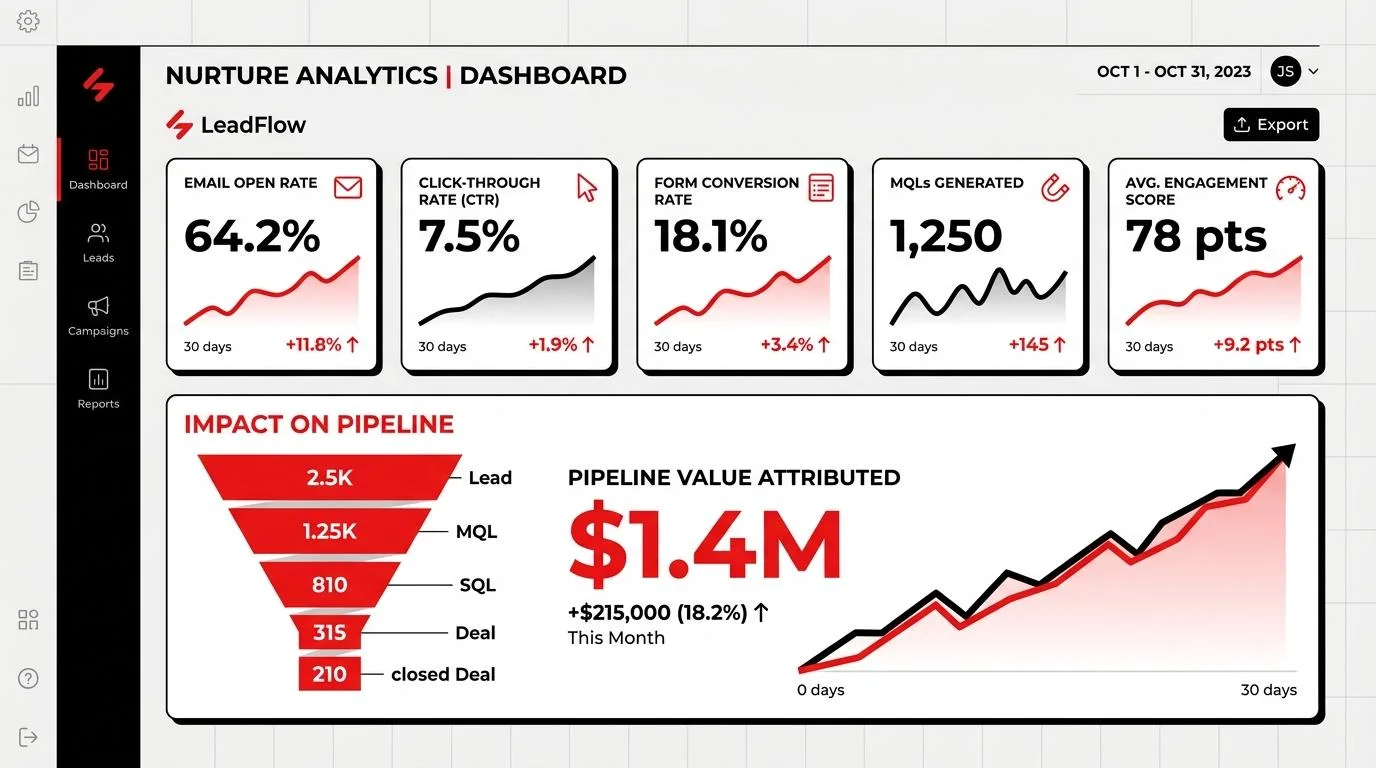 Build a monthly nurture report that shows these numbers alongside MQL volume and SQL rate. That’s the report that gets marketing a seat at the revenue table, not the one showing 42% open rates.
If your nurture dashboard is just open rate, click rate, and unsubscribe rate, you are measuring the wrapper, not the meal.
Those metrics matter. They tell you whether people are noticing and interacting. But they do not tell you whether nurture is doing its real job: moving leads toward revenue.
A revenue-ready dashboard should answer better questions.
Which sources create the best MQL-to-SQL conversion?
Not all MQLs are equal. A webinar attendee, a paid search lead, and a content syndication contact may all enter the same database, but they rarely produce the same pipeline quality.
Which nurture paths create accepted leads?
Sales acceptance matters because it tells you whether the handoff is trusted. If marketing celebrates conversions that sales immediately rejects, nobody wins.
Which content appears before real pipeline movement?
Some assets get clicks. Others create conviction. Know the difference.
Where do leads stall?
If leads keep engaging but never convert, the problem may be your CTA. If leads disappear after Email 2, the issue may be relevance. If sales rejects them after handoff, the issue may be qualification.
How long does it take to move from MQL to SQL?
Speed matters, but context matters more. A fast conversion from a bad-fit account is not a victory. A slower conversion from an enterprise account may be exactly how the buying cycle works.
How much pipeline is influenced by nurture?
This is where nurture earns its seat at the revenue table. Not by claiming every deal it touched, but by showing where it accelerated movement, revived dormant demand, or helped sales enter better conversations.
A good nurture dashboard does not just prove marketing activity. It shows where the revenue engine is gaining momentum, where it is leaking, and where it needs repair.
That is the difference between reporting and intelligence.
AI in B2B nurture is real and useful. It’s also wildly overhyped in most vendor decks. Here’s the honest version of what it actually does well and where human judgment still wins.
What AI Does Well in Nurture
Tone, timing on sensitive topics, recognizing when a relationship needs a human touch instead of another automated email. AI can optimize delivery. It can’t replace the instinct of a great marketer who knows when to break the sequence entirely and pick up the phone.
Marketo’s Engagement Programs certification, Salesforce Marketing Cloud’s Personalization module, and the emerging curriculum at demand gen-focused programs all dedicate significant time to how AI layers onto existing automation platforms, not replace them.
Let’s name the things most teams are doing wrong but nobody says out loud in the quarterly review.
Leads from content syndication are interest signals at best. Someone downloaded your gated report from a third-party publisher. They may not even know your brand name. Your nurture flow for these contacts should start with brand education before it gets anywhere near the product.
Email 1: Introduce the problem you solve (not your product).
Email 2: Give them the best free content your brand has produced.
Email 3: Light social proof from a recognizable customer name.
Only then does any product mention belong in the sequence.
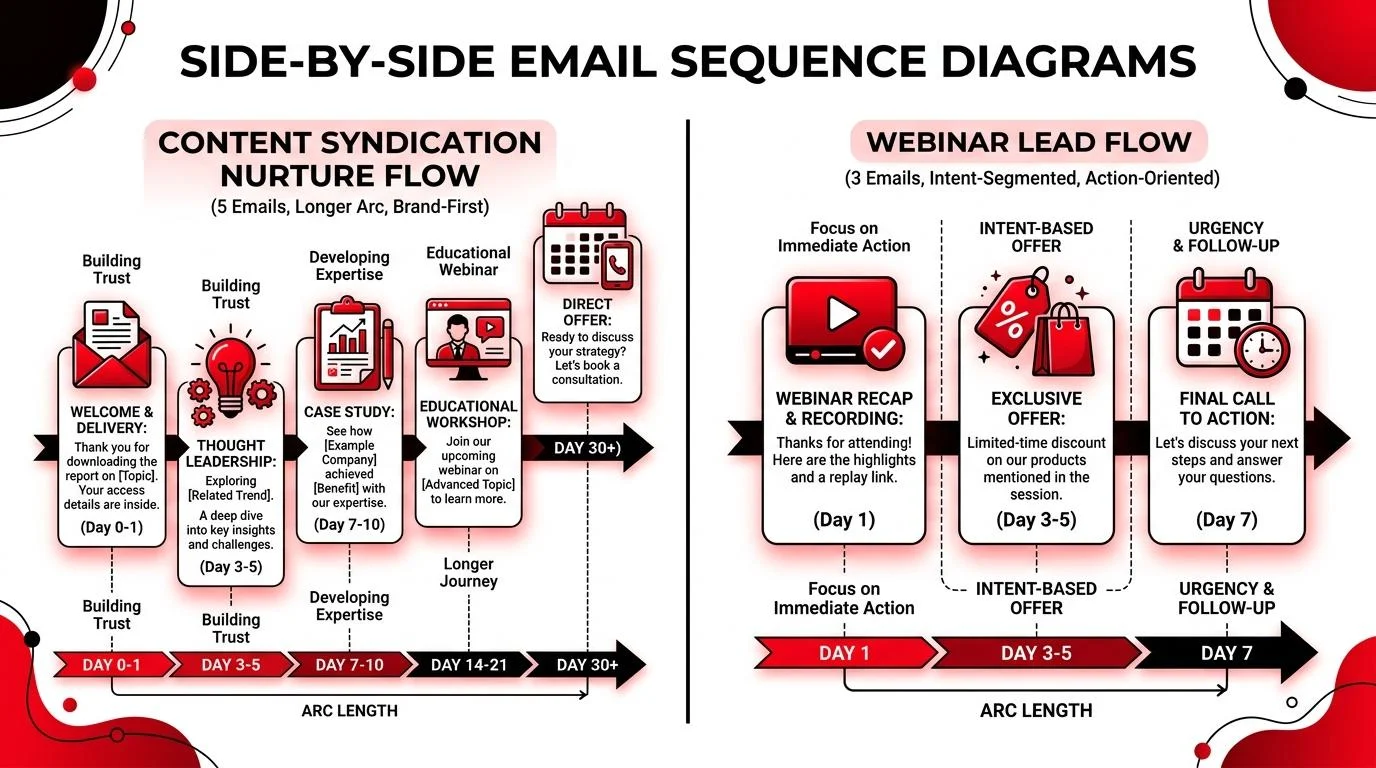
These are warmer than syndication leads, but the quality varies hugely based on whether they registered, attended, or attended and engaged. Segment accordingly.
A nurture strategy is not something you build once and then admire from a distance.
Buying behavior changes. Messaging changes. Product positioning changes. Sales priorities change. Your workflows should change too.
At least once a quarter, audit the system.
Start with the obvious questions.
Then ask the harder questions.
This is where good nurture programs separate from average ones.
Average teams build a workflow and move on.
Strong revenue teams inspect the machine. They look at the friction. They listen to sales. They study the leads that converted and the ones that vanished. Then they adjust the logic, the content, the scoring, and the handoff.
Because nurture is not a campaign.
It is a living revenue system. And living systems need maintenance.
MQL to revenue isn’t a straight line. It’s a conversation that needs to be managed, personalized, and measured against outcomes that actually matter to your business. The good news is that most of your competitors are still sending generic drip campaigns and calling it nurture.
That’s a gap. And gaps in B2B marketing are opportunities.
Build sequences that respond to behavior. Score leads on signals that sales actually uses. Measure your program by pipeline, not by opens. And when you can’t quite figure out where your leads are dropping off, find someone who can help you figure it out before the next quarter ends.
The leads are there. The question is whether your nurture program is ready for them.
An MQL (Marketing Qualified Lead) is a contact who has shown interest through engagement with marketing content, like a whitepaper download or webinar attendance. An SQL (Sales Qualified Lead) is one that sales has reviewed and confirmed meets the criteria for a direct sales conversation, typically based on budget, authority, need, and timeline (BANT). The nurture sequence exists to move leads from the first state to the second.
There’s no universal answer, but most B2B nurture sequences run between 8 and 12 emails over 60 to 90 days for the primary track. The more useful question is: does the sequence branch based on behavior? A lead who visits your pricing page on Day 14 shouldn’t get Email 5 in a generic drip. They should get a fast-track to a sales conversation.
It depends entirely on the buyer stage. Early stage: educational content, industry research, problem-framing. Mid stage: case studies, comparison guides, ROI calculators. Late stage: product-specific content, implementation timelines, customer references. The mistake most teams make is leading with late-stage content to early-stage leads and wondering why engagement drops.
The primary metric is MQL-to-SQL conversion rate. Secondary metrics include time-to-SQL, nurture-influenced pipeline value, email-to-meeting rate, and content engagement depth (which assets correlate with conversion). Open rates and click rates are directional at best and increasingly unreliable since Apple’s Mail Privacy Protection changes.
Drip campaigns send emails on a fixed schedule regardless of what the lead does. Behavior-based nurture sends emails triggered by specific actions, like visiting the pricing page, downloading a specific asset, or returning to the site after 60 days of inactivity. Behavior-based nurture is more complex to build but significantly more effective because it responds to actual buying signals rather than a calendar.
True personalization at scale requires good data segmentation first. Segment by persona (job function and seniority), by industry, by buying stage, and by lead source. Then build separate or branching sequences for your primary segments. Dynamic content blocks in email platforms can help surface different content to different segments within the same send, but only if the underlying data is clean.
When the lead has reached a threshold score based on both fit criteria (ICP match) and behavioral signals (intent actions like pricing page visits, demo requests, or competitive research). The exact threshold should be agreed upon by both marketing and sales in a documented SLA, revisited quarterly based on conversion data. The hand-off should include a context note, not just a CRM notification.
Content syndication leads typically have lower brand awareness and weaker intent signals. Your nurture sequence should start with brand-building and problem education rather than product pitches. Assume they barely know your company name. Earn their attention before you ask for their time. Sequences for syndication leads generally need more emails and a longer arc before any sales motion.
AI is genuinely useful for predictive lead scoring (identifying which MQLs are most likely to convert based on historical data), send-time optimization, content recommendation, and early identification of leads going cold. It doesn’t replace strategic content planning or the human judgment required for high-stakes account management, but it meaningfully improves the efficiency of programs that are already well-structured.
The biggest ones: treating all MQLs the same regardless of persona or buying stage, running outdated sequences that haven’t been refreshed in over a year, measuring success by email metrics instead of pipeline impact, not having a shared MQL-to-SQL definition between marketing and sales, and giving up on leads too early in a buying cycle that often spans six to twelve months.
Revenue Focused Lead Progression Strategy
Convert MQL leads into revenue through structured nurture