Generate More B2B Leads With Webinars
Get proven strategies, templates, and tactics to generate qualified B2B leads through high-converting webinars.
 Lead-Gen now on Auto-Pilot with
Build My Campaign
Lead-Gen now on Auto-Pilot with
Build My Campaign

Learn what webinar lead generation is, how it works in B2B marketing, and how webinars help attract, engage, and convert qualified leads.

Generate More B2B Leads With Webinars
Get proven strategies, templates, and tactics to generate qualified B2B leads through high-converting webinars.
Imagine a parallel universe where webinars were never treated as marketing events.
Nobody there obsessed over registration counts or celebrated attendance screenshots in Slack. Nobody ended quarterly reviews proudly reporting “2,000 sign-ups” while quietly avoiding the far more important question: how much pipeline did the webinar program actually generate?
Because in that universe, webinars were understood for what they truly are: buyer intelligence systems disguised as content.
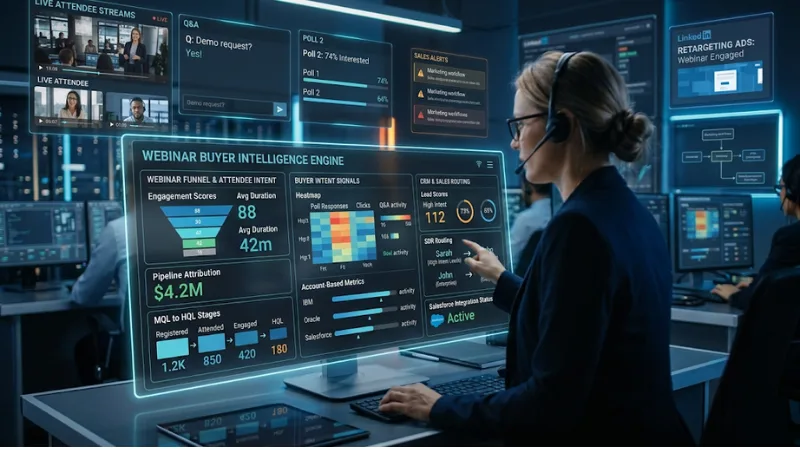
The webinar itself was never the real asset. The intelligence generated by the webinar was. Modern B2B marketing is slowly moving toward that reality.
For years, webinars were measured like digital events. Success meant registrations, attendance rates, and audience size. But as revenue accountability tightens and marketing teams face increasing pressure to prove commercial impact, those metrics are beginning to lose their persuasive power.
Generate More B2B Leads With Webinars
Get proven strategies, templates, and tactics to generate qualified B2B leads through high-converting webinars.
A webinar that attracts thousands of registrants but generates no meaningful sales conversation is no longer considered successful simply because it looked impressive in a dashboard.
That shift is forcing companies to rethink what webinar lead generation actually means.
Organizations like HubSpot and Gong are increasingly treating webinars not as awareness campaigns, but as qualification engines designed to identify buying intent, score engagement behavior, accelerate sales conversations, and influence pipeline creation.
Because there is a massive difference between attracting viewers and identifying buyers. And that distinction is where most webinar programs quietly fail.
This guide explores how modern B2B webinar lead generation actually works from registrations and engagement scoring to MQL qualification, BANT frameworks, nurture workflows, pipeline attribution, and revenue measurement.
More importantly, it explains why the future of webinar strategy belongs not to the companies capable of generating the largest audiences, but to the companies best equipped to recognize intent before their competitors do.
Webinar lead generation is the process of using live or on-demand webinars to attract, identify, engage, qualify, and convert prospective buyers into potential leads.
In the B2B context, it goes far beyond event registration. At its most effective, webinar lead generation is a multi-stage process; which captures not just contact information but behavioral signals, buying intent indicators, and qualification data that sales teams can act on with precision.
The concept has evolved significantly over the last decade. In the early 2010s, a webinar was essentially a broadcast event. A polished presentation, which can now be created more efficiently with an AI presentation maker, was delivered to an audience that signed a virtual attendance sheet. Success meant getting a lot of people into the virtual room.
Today, sophisticated B2B marketing teams think about webinars very differently. Platforms like ON24, Goldcast, and Demio now offer detailed engagement analytics tracking not just who attended, but how long they stayed, which poll questions they answered, which resources they downloaded, which questions they submitted, and how that behavior changed across the arc of the presentation.
Meanwhile, marketing automation platforms like HubSpot ingest that engagement data and use it to score leads, trigger nurture sequences, and route high-intent prospects directly to sales queues.
This shift, from attendance tracking to behavioral intelligence is what separates webinar programs that generate pipelines from those that generate spreadsheets.
B2B buying journeys have grown dramatically more complex. The average enterprise purchase now involves six to ten stakeholders, and those stakeholders spend a significant portion of their research time consuming content independently before ever engaging with a sales representative.
Webinars occupy a uniquely powerful position in that journey: they require a commitment of time and attention that a whitepaper download does not. That commitment is itself a signal.
When a VP of Marketing registers for a webinar titled ‘How to Attribute Revenue to Content Programs,’ they are telegraphing something meaningful about where they are in their evaluation.
When they attend live and submit three questions during the Q&A, they are shouting it. A lead downloading the associated playbook and visiting your pricing page within 72 hours sends an unmistakable signal.
Webinar lead generation, done correctly, is about capturing and acting on those signals before a competitor does.
One of the most persistent problems in webinar marketing is the absence of a clearly defined funnel. Teams treat every registrant as equivalent, every attendee as a lead, and every event as a standalone campaign.
In reality, webinar lead generation follows a predictable funnel and each stage has its own conversion logic, its own qualification criteria, and its own set of actions.
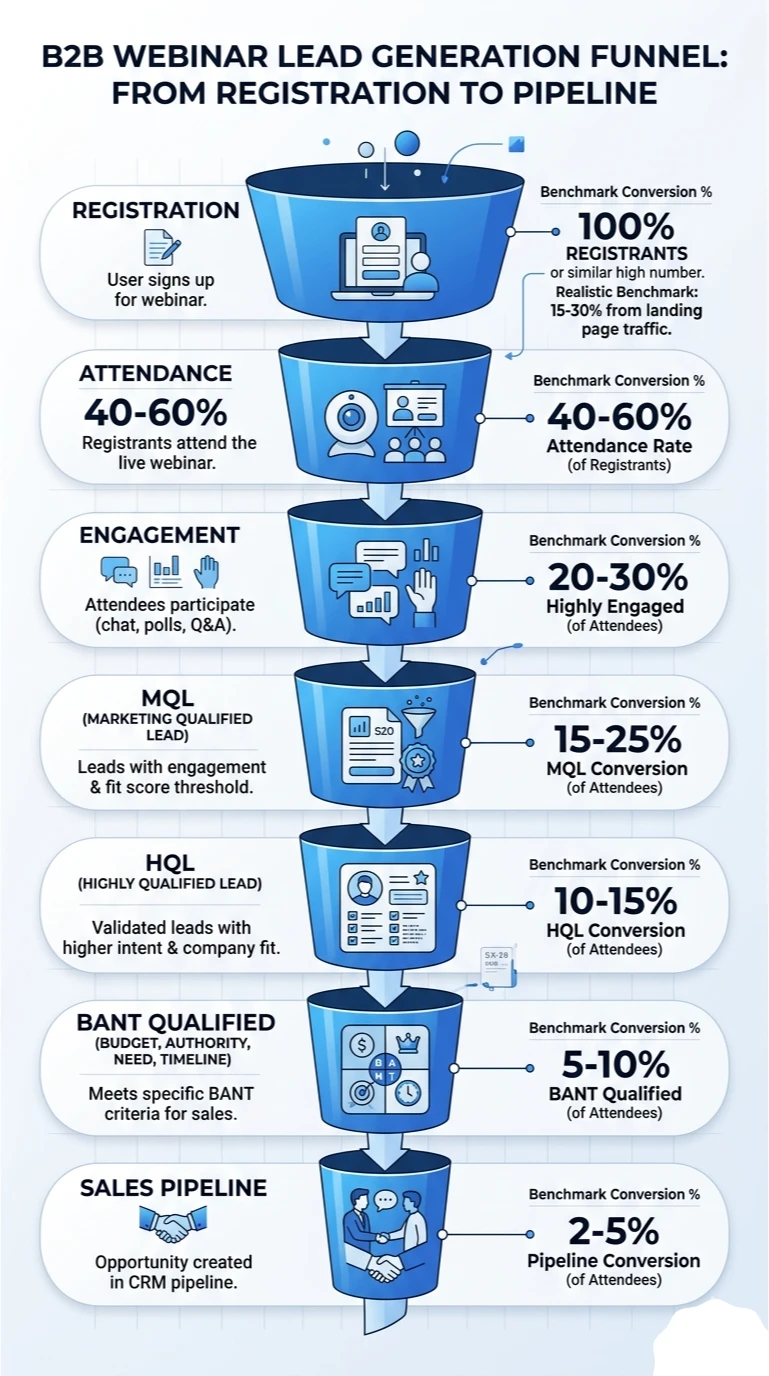
Understanding these stages is not academic. It is the operational foundation of every high-performing webinar program.
Registration represents the widest part of the funnel. Anyone who fills out the event form enters here, regardless of intent, budget, role, or fit. For most programs, this is also where measurement stops, which is the root cause of the pipeline problem.
What actually matters at the registration stage: the quality of the registration, not the quantity. A webinar on ‘AI in Revenue Operations‘ that pulls 200 VPs of Sales from target accounts is worth ten times more than one that generates 2,000 registrations from a broad, untargeted audience.
Audience acquisition strategy, who you invite, how you target, and what channels you promote through determines the ceiling of everything downstream.
Valasys’s webinar audience acquisition programs, for instance, are built on exactly this principle: filling registration lists with BANT-qualified prospects from target accounts, not just anyone who responds to a LinkedIn ad.
Industry data consistently shows that average webinar attendance rates hover between 35% and 45% of registered participants, with significant variation by industry, topic, and promotional strategy. That means more than half of your registrants will not show up.
This is where most programs make their first mistake: treating no-shows as lost opportunities. In reality, a no-show who registered for a highly relevant webinar is still a qualified prospect.
They raised their hands. They just did not attend. A targeted post-event nurture sequence for no-shows, personalized to the specific topic they registered for, can recover a meaningful percentage of that audience by sending webinar recordings.
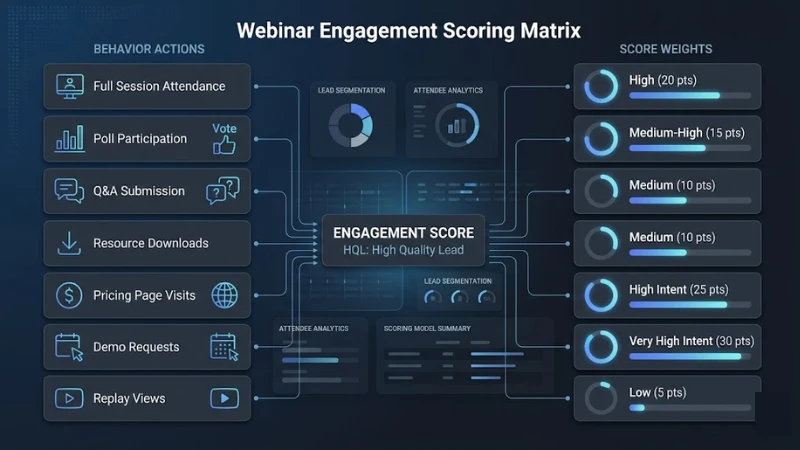
Engagement is where real intelligence lives. Not every attendee is equally valuable, the person who joined for seven minutes and dropped off is qualitatively different from the person who stayed for the full 60 minutes, answered every poll question, submitted two questions to the Q&A panel, and downloaded the supplementary research report.
Engagement scoring at this stage is the mechanism that separates buyers from browsers. (We cover this in detail in the next section.) The key insight is that time-in-session, interaction frequency, and specific interaction types all correlate with purchase intent and that correlation is measurable.
The MQL threshold is crossed when a registrant or attendee’s combined profile data and behavioral engagement meet a predefined scoring threshold.
In a webinar context, this typically means: the person attended for a meaningful duration, engaged with at least one interactive element, has a job title and company profile that matches your ICP, and has accumulated enough engagement points across their total interaction history to warrant marketing nurture activity.
Importantly, an MQL from a webinar program carries richer context than most inbound MQLs because you know exactly what topic they engaged with, which specific questions interested them, and how that engagement maps to the solutions you offer.
HQL status represents a higher-confidence qualification signal, typically requiring explicit BANT indicators in addition to behavioral engagement.
An attendee becomes an HQL when their engagement data is supplemented by qualification information: confirmed budget authority, an identified need that matches your solution, a relevant timeline, and a decision-making role that would include your product category.
This is where webinar programs that incorporate in-session qualification, polls with questions like ‘How are you currently handling [X]?’ or ‘What is your planned investment in [Y] over the next 12 months?’ gain a significant advantage. That explicit data, combined with behavioral signals, creates a qualification picture that is hard to replicate through any other content channel.
BANT qualification, which is Budget, Authority, Need, and Timeline, represents the highest level of qualification before a prospect enters an active sales opportunity.
In the webinar context, BANT qualification is achieved through a combination of explicit data (gathered through registration forms, in-session polls, and post-event surveys) and inferred signals (derived from behavioral engagement and firmographic data).
A BANT-qualified webinar lead is genuinely sales-ready: they have demonstrated need through their topic selection and engagement behavior, indicated budget awareness through direct or indirect signals, identified themselves as a decision-maker or influencer, and expressed or implied a near-term evaluation timeline.
Stage 7: Sales Pipeline
Pipeline entry happens when a BANT-qualified lead is accepted by sales and an opportunity is formally created in the CRM.
This is the moment the webinar program proves its commercial value. Every stage before this one exists to make this moment more likely and more efficient.
The discipline that makes this transition work is the quality of the handoff: how fast sales follow up, how much context they receive, and how well the follow-up conversation is aligned to the specific signals the prospect sent during the webinar. Poor handoffs destroy qualified leads at an alarming rate. More on this is available ahead.
Attendance numbers make for satisfying internal reports. They are concrete, visible, and easy to compare across events. But they are deeply incomplete as a measure of webinar program performance and in some cases, they actively mislead decision-making.
Here is the core problem: a 500-person attendance figure tells you almost nothing about the commercial value sitting in that audience. It does not tell you how many of those 500 people were genuinely evaluating a solution like yours.
It does not tell you which ones are in an active buying cycle, which ones are competitive researchers, and which ones are junior employees who registered because their manager told them to.
Modern webinar platforms have made it possible to move from attendance as a proxy to engagement as a direct signal. The behavioral patterns that consistently correlate with high purchase intent include:
The principle is the simple: behavior is a more honest signal than presence.
An effective webinar engagement scoring model assigns point values to specific behaviors, with higher-intent actions receiving proportionally higher scores. A simple framework might look like this:
| Engagement Behavior | Score Weight |
| Attended full session (>80%) | 25 points |
| Attended partial session (50–80%) | 15 points |
| Attended brief session (<50%) | 5 points |
| Submitted a Q&A question | 20 points |
| Responded to a poll question | 10 points per poll |
| Downloaded a resource during session | 15 points |
| Visited pricing page post-event | 30 points |
| Requested a demo post-event | 50 points |
| Watched on-demand replay within 48 hrs | 20 points |
| Opened post-event follow-up email | 5 points |
| Clicked post-event follow-up email | 10 points |
| Registered for a second webinar | 25 points |
The threshold at which a lead crosses from ‘engaged’ to ‘MQL’ to ‘HQL’ will vary by organization and average deal size. The important thing is that the model exists and is consistently applied because without it, every handoff to sales is a guess.
Qualification is where webinar programs earn their keep or fail. The difference between a webinar program that marketing loves and one that sales respects is almost entirely a function of how rigorously the team qualifies before passing leads downstream.
In most B2B organizations, a Marketing Qualified Lead (MQL) is defined by threshold-based engagement scoring combined with basic firmographic fit. The lead has demonstrated interest and matches your ideal customer profile but that interest has not been validated against explicit business criteria.
A High Quality Lead (HQL) goes further. It combines behavioral qualification (engagement scoring) with explicit qualification signals typically BANT indicators gathered through progressive profiling, registration form data, or post-event surveys. An HQL is not just interested; they are a credible prospective buyer.
BANT remains one of the most durable qualification frameworks in B2B sales, and webinar programs are uniquely positioned to gather BANT data without making the process feel like an interrogation.
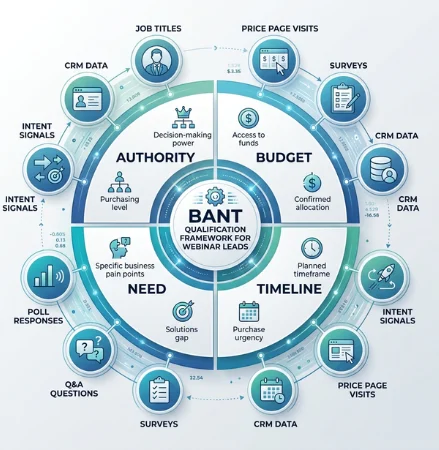

Budget signals can be gathered through registration form questions. The questions are not intrusive when framed around value, they feel like personalization, not qualification.
Authority is often derivable from job title and company data, supplemented by questions like ‘Are you the primary decision-maker for this type of investment?’ in post-event surveys. Seniority level and specific title patterns correlate reliably with purchasing authority in most B2B categories.
Need is the easiest signal to gather in a webinar context because the topic itself is a need signal.
Timeline is the hardest BANT element to gather passively, but a well-designed post-event survey can ask directly: ‘Are you actively evaluating solutions in this area?’ with response options that reveal urgency.
Behavioral signals like visiting a pricing page, requesting a demo also imply a near-term timeline.
Explicit BANT data is valuable, but behavioral qualification drawing inferences from engagement patterns is what makes webinar programs truly intelligent. The goal is to build a qualification picture without requiring the prospect to fill out a lengthy questionnaire.
A useful behavioral pattern to watch for: leads who engage heavily with problem-definition content (early webinar sections explaining the problem) and then disengage at the solution section are likely not yet at the evaluation stage. Leads who arrive late and engage most intensely with pricing, ROI, and implementation content are almost certainly in late-stage evaluation. These distinctions require no explicit data, they are readable from session timestamps alone.
Connecting webinar behavioral data with third-party platforms like Bombora, 6sense, and G2 adds a whole new dimension, allowing you to track exactly what your target accounts are researching across the web. When an account that is actively researching your category attends your webinar on that exact topic, the compounded signal is extremely reliable.
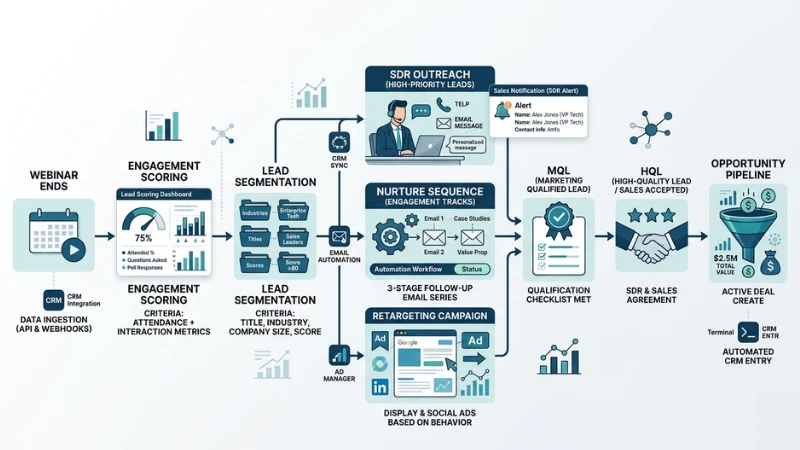
The live event is not the moment your webinar generates pipeline. The post-event execution is. What you do in the 24 to 72 hours after a webinar ends and over the following two to four weeks determines the vast majority of the commercial outcome.
Most programs get this wrong. The standard post-webinar workflow looks something like: send a recording link to all attendees, send a ‘sorry we missed you’ email to no-shows, and let the sales team do whatever they feel like. This approach guarantees mediocre results.
The first post-event action should be segmentation, breaking your attendee and registrant population into meaningful groups based on engagement scoring and qualification data. A minimum effective segmentation looks like this:
For high-priority leads, speed matters enormously. Research from Signalsprint consistently shows that lead response time has a dramatic impact on connect rates: responding within 5 minutes produces connection rates roughly 100 times higher than responding after 30 minutes.
That window is even more compressed for webinar leads, because the event itself creates a short moment of relevance, the prospect is thinking about your category now.
An effective SDR follow-up for a webinar lead includes:
Gong’s research into top-performing sales calls consistently shows that the SDRs who convert the most webinar leads are those who reference specifics not just ‘I saw you attended our webinar’ but ‘I noticed you asked about [specific topic] during the Q&A.’ That level of personalization requires the engagement data to be surfaced to the SDR in their CRM view, which requires an integration between the webinar platform and your sales tech stack.
For leads who are not yet ready for sales engagement, the post-event nurture sequence is the revenue engine. A well-designed 5-email sequence for webinar attendees typically follows this arc:
| Touchpoint | Content & Intent |
| Email 1 (Day 1) | Recording + 3 key insights + a single relevant CTA tied to their engagement behavior |
| Email 2 (Day 3) | Deep-dive resource on the specific sub-topic they engaged most with |
| Email 3 (Day 7) | Case study or customer story relevant to their industry/use case |
| Email 4 (Day 14) | A contrarian perspective or ‘what most teams get wrong’ insight |
| Email 5 (Day 21) | Direct offer: webinar replay + SDR outreach offer / demo invitation |
The critical design principle here: every email in the sequence should feel like a continuation of the webinar conversation, not a generic marketing email. Using dynamic content to personalize based on engagement behavior, which poll they answered, which resource they downloaded is not optional for high-performing programs. It is the mechanism.
Paid retargeting for webinar audiences is dramatically underutilized. Most programs that invest in pre-event promotion simply turn off their paid campaigns after the event.
High-performing programs do the opposite: they use post-event retargeting to stay in front of high-intent audiences with content that moves them down the funnel.
LinkedIn retargeting audiences built from webinar attendees, especially those who visited your website post-event can be served case study content, ROI calculators, and comparison guides that directly address evaluation-stage questions.
The fact that these prospects have already engaged with your content in a high-commitment format (a live webinar) makes them uniquely receptive to follow-up.
Revenue attribution for webinars is one of the most contested topics in B2B marketing and one of the most important. Without a credible attribution model, webinar programs are always vulnerable to budget cuts, because their commercial contribution is invisible.
B2B marketing teams typically use one of two primary attribution models for webinars: first-touch and multi-touch.
First-touch attribution assigns full revenue credit to the first marketing interaction that introduced a prospect to your brand. If a webinar was the first touchpoint, it gets full credit for any resulting revenue.
Multi-touch attribution distributes credit across multiple interactions in the buyer journey. The most sophisticated version often called ‘position-based’ or ‘W-shaped’ attribution weights the first touch, the lead conversion touch, and the opportunity creation touch more heavily, with remaining credit distributed across other interactions.
A crucial distinction that often gets muddied: pipeline influenced is not the same as pipeline generated. Pipeline generated means a webinar was the primary driver of a net-new opportunity. Pipeline influence means a webinar had a meaningful impact on an opportunity that would have happened anyway by accelerating the deal, expanding it, or defending it against a competitor.
Both matter. But they should be reported separately, because conflating them produces misleading numbers that eventually erode CFO trust.
For a webinar program to justify its budget, it needs to demonstrate a cost per qualified lead that competes favorably with alternative demand generation channels.
A useful benchmark: well-executed B2B webinar programs with proper audience acquisition strategies typically produce BANT-qualified leads at a cost between $150 and $400 per lead — significantly below the $500–$900 range that many paid content syndication programs cost, and comparable to or better than high-quality field events.
Ultimately, webinar ROI is a revenue conversation. The KPIs that matter to a CMO or CRO are not attendance rates or MQL counts; they are influenced pipeline, opportunity conversion rates, and average deal size from webinar-sourced accounts.
The Future of Webinar Lead Generation
The webinar as a format is not going away but the webinar as we have known it for the last decade is already changing. The programs that will dominate the next three to five years share a set of characteristics that are distinct from current practice.
Platforms are beginning to use AI to personalize the webinar experience in real time, serving different content tracks to different attendee segments within the same live event. They dynamically adjust polls and Q&A prompts based on viewer engagement data, and generate personalized follow-up content immediately after the session ends.
The most sophisticated demand generation teams in 2025 are no longer choosing webinar topics based on what their subject matter experts want to talk about. They are choosing topics based on what their target accounts are already researching, derived from intent data platforms like VAIS that track content consumption patterns across the B2B web.
Predictive Engagement Scoring
Machine learning models trained on historical webinar data can now predict which registrants are most likely to attend, which attendees are most likely to convert to pipeline, and which leads will be most responsive to specific follow-up approaches.
Live webinars are increasingly the beginning of a content asset’s life, not the end. The same session that attracts 300 live attendees can, through content syndication and on-demand distribution, generate hundreds of additional qualified leads over the following 6 to 12 months.
On-demand webinar content performs particularly well in SEO contexts, recording pages with full transcripts, chapter markers, and accompanying written content can capture significant organic search traffic for competitive keywords.
The future of webinar lead generation is not webinar-centric. It is integrated. The highest-performing programs will use webinar engagement data as one signal among many combined with email behavior, website activity, content consumption patterns, social engagement, and third-party intent signals to create a unified buyer intelligence picture that both marketing and sales can act on in a coordinated way.
The webinar is the event. The data it generates is the asset.
There is nothing wrong with being proud of a 1,000-registrant webinar. Registration success means your topic resonated, your targeting worked, and your promotional strategy delivered. Those are real achievements worth acknowledging.
But they are table stakes. The question that separates average webinar programs from exceptional ones is not ‘How many registered?’ It is: what happened next?
The organizations generating meaningful pipeline from webinars share a common philosophy: they treat the event as the beginning of a qualification conversation, not the conclusion of a marketing campaign.
Every data point that comes out of that event is who attended, for how long, what they asked, what they downloaded, where they went on your website afterward is a piece of intelligence that informs a more precise, more relevant, more effective commercial engagement.
Building that program requires four things: a structured funnel with defined qualification criteria at each stage, an engagement scoring model that distinguishes buyers from browsers, a post-event execution system that routes high-intent leads to sales with the speed and context they need to convert, and a reporting framework that speaks the language of revenue, not activity.
None of this is especially complicated. But all of it requires discipline, intentionality, and a willingness to measure the right things instead of the easy things.
The B2B webinar programs that will generate the most pipeline in the coming years are not necessarily the ones with the best speakers, the most production polish, or the largest promotional budgets. They are the ones that treat qualification as a science, follow-up as an urgency, and revenue as the only outcome that counts.
Get the complete implementation toolkit: Webinar Funnel Checklist · Attendance Scoring Framework · MQL/HQL Qualification Sheet · BANT Qualification Template · Post-Webinar Follow-Up Workflow · Webinar KPI Tracker · ROI Worksheet Visit valasys.com to download your free copy.
Webinar lead generation is the process of using live or on-demand webinars to attract, identify, engage, qualify, and convert prospective buyers into sales-ready leads. In B2B marketing, it goes beyond registration tracking to capture behavioral signals and qualification data that sales teams can act on.
B2B webinars generate pipeline by collecting engagement data (who attended, for how long, what questions they asked, what resources they downloaded), using that data to qualify leads against MQL and HQL thresholds, and routing high-intent prospects to sales with the context and speed needed to convert. The webinar itself is a qualification engine, not just an event.
Industry benchmarks typically show 35 – 45% of registered participants attend the live event. Rates above 50% are achievable with strong audience targeting, relevant topics, and effective pre-event promotional sequences. Attendance rate matters less than engagement quality among those who do attend.
Webinar ROI is calculated as: (Revenue Influenced – Total Event Cost) ÷ Total Event Cost × 100.
Key supporting metrics include cost per BANT-qualified lead, pipeline generated, pipeline influenced, and closed-won revenue from webinar-sourced accounts. Effective measurement requires multi-touch attribution tracking and CRM integration with webinar engagement data.
Research consistently shows that lead response time has a dramatic impact on connect rates. Top-performing webinar programs route high-engagement leads to SDRs within 24 hours of the event, with the highest-priority BANT-qualified leads receiving outreach within the same business day. Delayed follow-up allows the relevance window created by the webinar to close.
Webinar engagement scoring is a framework that assigns point values to specific attendee behaviors, including session duration, poll participation, Q&A submissions, resource downloads, and post-event actions like website visits to produce a numerical score that reflects purchase intent. Teams escalate leads that cross predefined score thresholds to MQL, HQL, or BANT-qualified status for the right follow-up action.
BANT qualification in webinars combines explicit data (gathered through registration forms, in-session polls, and post-event surveys) with inferred signals (derived from behavioral engagement and firmographic data). Form fields and polls assess Budget. Job titles and seniority data reveal Authority. Topic selection and engagement depth indicate Need. Post-event surveys and demo request behavior help determine Timeline.
An effective post-webinar follow-up sequence includes: segmentation by engagement level before any outreach; personalized recording delivery on Day 1 with a behavior-specific CTA; a relevant deep-dive resource on Day 3; a case study on Day 7; a thought leadership insight on Day 14; and a direct offer or SDR outreach on Day 21. High-engagement leads should receive direct SDR contact within 24 hours regardless of the email sequence.
Webinar audience acquisition is the process of attracting qualified registrants through targeted outreach, partner networks, content syndication, and paid promotion. It goes beyond organic promotion alone.
In B2B marketing, high-quality audience acquisition focuses on ICP-matched prospects from target accounts. Many companies also include BANT pre-qualification during the acquisition process.
Generate More B2B Leads With Webinars
Get proven strategies, templates, and tactics to generate qualified B2B leads through high-converting webinars.