Know What Actually Drives Revenue
Identify the channels and touchpoints that truly influence your pipeline and optimize your B2B attribution strategy for better ROI.
 Lead-Gen now on Auto-Pilot with
Build My Campaign
Lead-Gen now on Auto-Pilot with
Build My Campaign

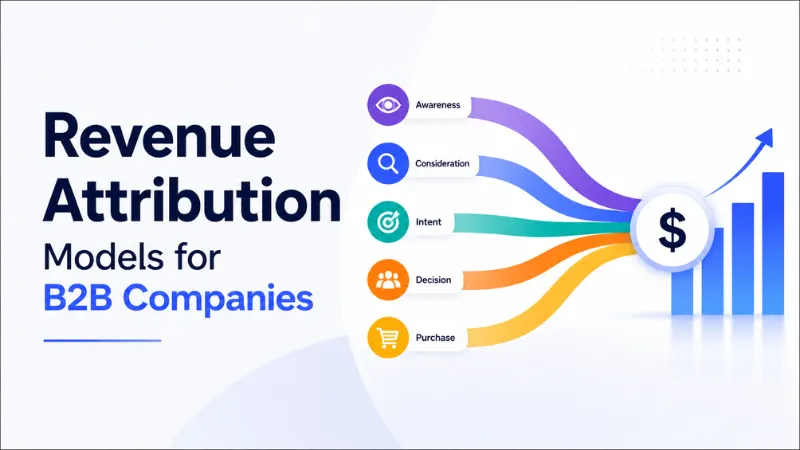
Explore B2B revenue attribution models to understand which channels drive pipeline, optimize spend, and improve marketing & sales performance.

Know What Actually Drives Revenue
Identify the channels and touchpoints that truly influence your pipeline and optimize your B2B attribution strategy for better ROI.
Most B2B companies are making six-figure marketing decisions based on data that’s about as reliable as a horoscope. They look at their last-touch attribution report, see that Google Ads “caused” 60% of their deals, and double the PPC budget. Meanwhile, the LinkedIn thought leadership series that warmed up every single one of those leads gets quietly defunded.
This is how good marketing dies. Not from bad ideas. From bad measurements.
Revenue attribution, done right, is the difference between a marketing team that grows a company and one that just spends its way through a budget. So let’s talk about what it actually is, which models are worth using in 2026, and how connecting attribution to your lead management system turns it from an interesting report into a genuine competitive weapon.
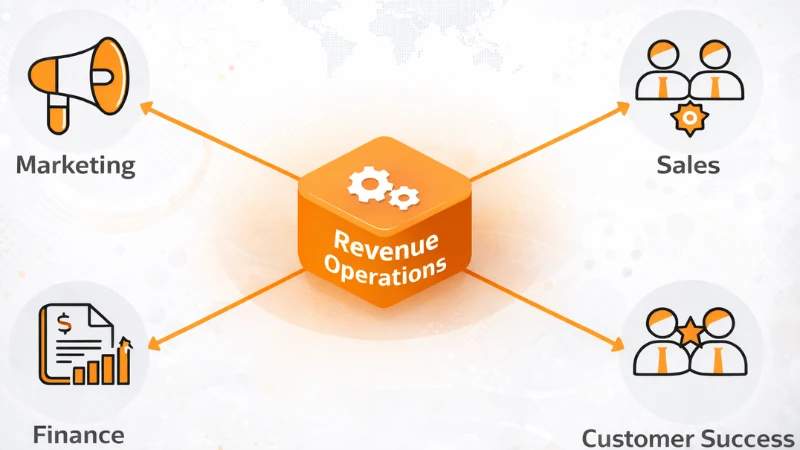
To truly understand how these systems scale, check out our Complete Guide to B2B Revenue Operations.
Revenue attribution is the practice of figuring out which marketing and sales touchpoints contributed to a closed deal, and how much credit each one deserves.
That sounds simple. It isn’t.
A B2B buyer in 2026 doesn’t just click one ad, fill out one form, and buy. They see your CEO’s LinkedIn post. They Google your category. They read a competitor comparison on G2. They attend a webinar. They get a cold email from your SDR. Six months later, they book a demo. Who gets credit?
Know What Actually Drives Revenue
Identify the channels and touchpoints that truly influence your pipeline and optimize your B2B attribution strategy for better ROI.
That question, annoying as it is, determines where your budget goes next quarter.
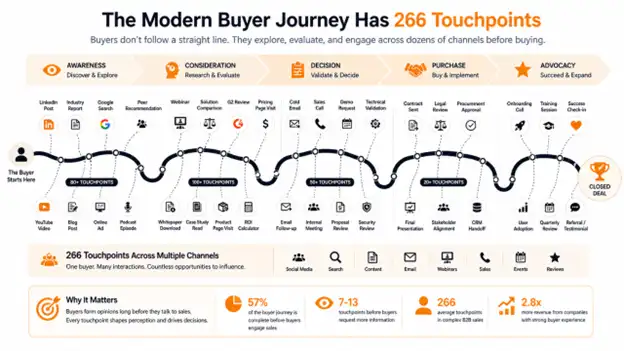
The stakes are real. HockeyStack’s research found that B2B SaaS deals require an average of 266 touchpoints to close. If you’re running a last-click model, you’re giving 100% of the credit to touchpoint number 266 and completely ignoring the other 265 that built the relationship. That’s not attribution. That’s just measuring who delivered the invoice.
For a deeper dive into how attribution fits into your overall growth strategy, check out our essential guide to getting started with Revenue Operations.
First-Touch Attribution gives all the credit to the first interaction. Great for understanding what’s generating awareness. Terrible for anything else. It’s like crediting the person who introduced you at a party for your ten-year marriage.
Last-Touch Attribution gives all the credit to the final interaction before conversion. This is what most companies default to, and it systematically undervalues everything that happened before the prospect raised their hand. Demand gen teams get ruined by this constantly. Their content warms up thousands of leads and gets zero credit because the SDR sequence technically “closed” the meeting.
Use single-touch models when you need a quick, directional answer. Don’t use them to make budget decisions.
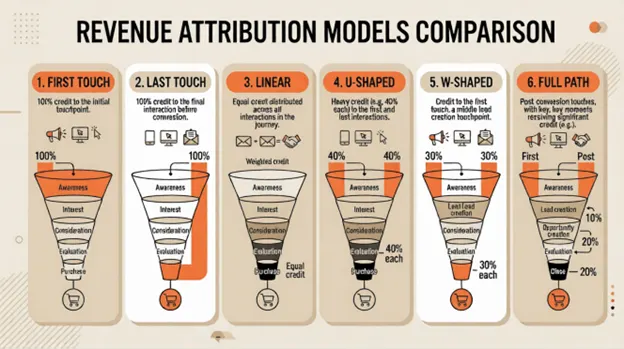
Linear Attribution splits credit equally across every touchpoint. Better than single-touch, but still imperfect. Treating a brand awareness blog post and a product demo as equally important to the close is its own kind of fiction.
Time-Decay Attribution weights recent touchpoints more heavily. This makes intuitive sense for long sales cycles. The demo that happened last week probably mattered more than the newsletter someone read fourteen months ago. Good fit for enterprise deals with 6-12 month cycles.
U-Shaped (Position-Based) Attribution gives 40% to the first touch, 40% to the lead creation moment, and splits the remaining 20% across everything in between. This is the model that finally starts to respect both the top of the funnel and the moment someone becomes a real lead. Solid starting point for most B2B teams.
W-Shaped Attribution takes the U-shape and adds another spike at opportunity creation. So you’re crediting first touch, lead creation, and the moment the deal enters the pipeline. For teams running structured sales processes, this is one of the most honest models available.
Full-Path Attribution assigns weight to every significant milestone across the entire journey. It’s comprehensive and complex. You need clean data infrastructure to make this work, but when it works, it’s the clearest picture you’ll get.
To manage these complex models, you need a robust B2B Revenue Tech Stack that can track data across the entire lifecycle.
Data-driven models use machine learning to figure out which touchpoints actually correlate with closed revenue. No predetermined rules. Just pattern recognition on your historical data.
The catch: you need volume. Hundreds of closed deals across multiple channels before the algorithm has enough signal to find meaningful patterns. If you’re closing 30 deals a month, you’re probably not there yet. If you’re closing 300, this should be on your roadmap.
Getting there usually means investing in the best marketing attribution software , which uses automatic event tracking and multi-touch models to tie every touchpoint to revenue without manual tagging.
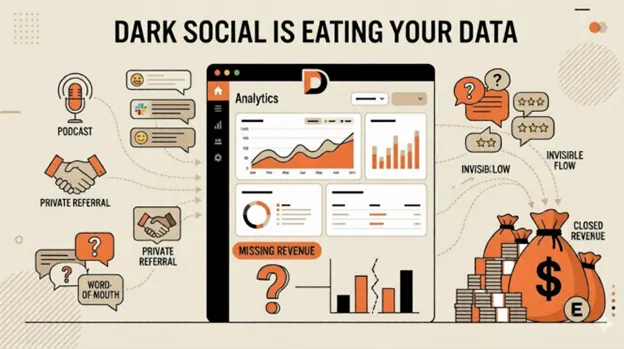
Here’s what every attribution guide quietly avoids: a massive chunk of B2B influence is completely untrackable.
Your prospect heard your founder on a podcast. Their colleague Slack-messaged them a link to your case study. They saw your ad twelve times on LinkedIn but never clicked. Someone in their network mentioned you positively in a private conversation. None of that shows up in your attribution dashboard.

This is called “dark social,” and it’s not a niche problem. For B2B companies with any kind of content or thought leadership presence, it can account for a significant portion of why deals close.
The solution isn’t to pretend it doesn’t exist. Add a “How did you first hear about us?” field to your demo request form. Ask during onboarding calls. Cross-reference that qualitative data with your quantitative attribution model. You won’t get a perfect picture, but you’ll get a truer one.
This is the part most attribution guides skip, and it’s arguably the most important.
Attribution data without a lead management system is just a report. A lead management system without attribution data is just a list. Together, they become something that actually changes how you work.
Here’s what that integration looks like in practice:
Prioritizing leads by attributed influence, not just form fills. Not every lead that fills out a demo form is equal. A lead that found you through organic search, downloaded two whitepapers, attended a webinar, and then filled out the form has a completely different quality profile than someone who clicked a retargeting ad on their way to somewhere else. Your lead management system should surface that context immediately, so sales knows what they’re walking into.
Routing leads based on channel behavior. Someone who came in through a high-intent keyword and went straight to your pricing page needs a different response than someone who came in through a top-of-funnel blog post. Attribution tells you the path. Lead management determines who picks them up and how fast.
Closing the feedback loop between sales and marketing. This is where Sales and Marketing Alignment becomes critical. When sales marks a deal as closed-won or closed-lost in the CRM, that outcome needs to flow back into your attribution model. Otherwise you’re optimizing for lead generation, not revenue. These systems need to talk to each other. CRM is the foundation. Marketing automation, ad platforms, and analytics all need to sync into it, not alongside it.
If you are just starting to build this infrastructure, understanding Sales Ops vs. Marketing Ops vs. RevOps will help you define who owns these data sets.
Identifying your highest-value lead sources. Over time, attribution data inside your lead management system shows you patterns. Maybe leads from LinkedIn ads have a lower volume but a 40% higher average contract value. Maybe webinar leads close in half the time of inbound blog leads. You can’t see that without attribution data living inside the same system where you manage the leads.
Strategic Insight: Building these connections is much easier when you define Revenue Operations as the glue between your departments.
Start simpler than you think you need to. Pick one model, implement it consistently, and live with it for a quarter before you layer in complexity. Most attribution breakdowns aren’t caused by using the wrong model. They’re caused by inconsistent tracking, broken integrations, and dirty data.
Step one is UTM discipline. Every link your team shares, across every channel, needs consistent UTM parameters. Source, medium, campaign, content. Document the convention. Train the team. Enforce it. This sounds tedious because it is, but without it your attribution data is noise.
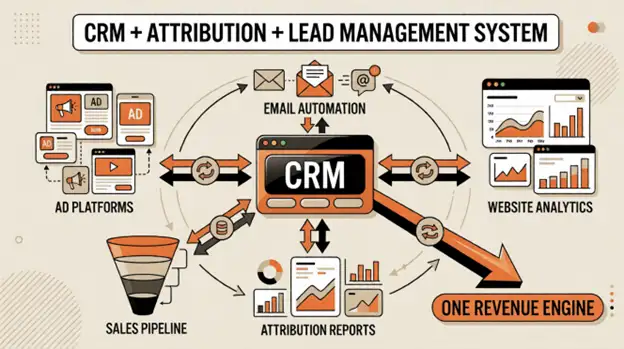
Step two is CRM as the single source of truth. Your CRM is where marketing data meets sales data meets actual revenue. Every touchpoint needs to write to contact and opportunity records in your CRM. If information lives in a disconnected dashboard, it will be ignored when decisions get made.
Step three is account-level thinking. B2B deals involve multiple people. If three people from the same company engaged with your content over 90 days, that’s one account’s journey, not three separate leads. Your attribution model needs to roll up individual contact touchpoints to the parent account. Otherwise you’re missing the buying committee dynamic that defines almost every enterprise deal.
Step four is connecting closed revenue back to campaigns. This is the step most marketing teams never actually complete. They track leads. They don’t track which leads became revenue. Closed-won data from sales needs to flow back to marketing. That’s what turns attribution from a marketing metric into a revenue metric.
If you’re finding the technical setup overwhelming, it might be time to hire your first RevOps leader to own the data integrity and RevOps strategy.
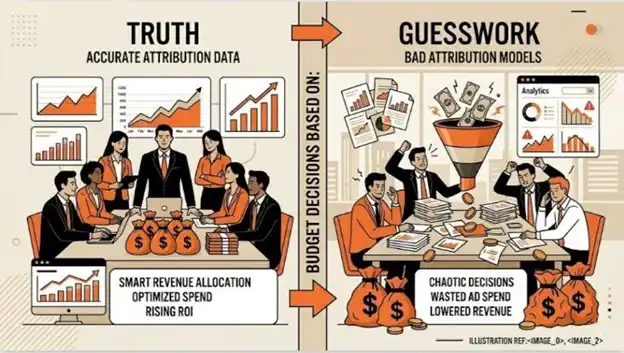
Revenue attribution isn’t a reporting exercise. It’s how you decide where the money goes.
Companies that do this well stop funding channels that generate noise and double down on the ones that generate revenue. They have marketing and sales teams that look at the same data and agree on what it means. They make budget decisions in November based on actual revenue patterns instead of gut feelings.
Companies that do it badly keep boosting the PPC spend because last-click told them to, while the content team that built half the pipeline gets cut in the next round of layoffs.
The model you pick matters less than the discipline you build around it. Start with a model that makes sense for your sales cycle length. Get your CRM connected to everything. Make sure dark social gets captured qualitatively. And for the love of everything, align with your sales team on what counts before you run a single attribution report.
The data is trying to tell you something useful. You just have to set it up to tell the truth.
If you are ready to stop guessing and start measuring, begin with this essential guide to Revenue Operations to build your foundation.
Know What Actually Drives Revenue
Identify the channels and touchpoints that truly influence your pipeline and optimize your B2B attribution strategy for better ROI.