Fix Your Revenue Leaks with RevOps
Align sales and marketing with a unified RevOps strategy that improves handoffs, boosts conversion rates, and drives predictable growth.
 Lead-Gen now on Auto-Pilot with
Build My Campaign
Lead-Gen now on Auto-Pilot with
Build My Campaign

Learn how RevOps aligns sales and marketing to improve collaboration, streamline processes, and drive predictable revenue growth.


Fix Your Revenue Leaks with RevOps
Align sales and marketing with a unified RevOps strategy that improves handoffs, boosts conversion rates, and drives predictable growth.
Monday morning. Conference room, half-drunk coffee cups, tense faces. Sales is frustrated because another batch of leads “went nowhere.” Marketing is equally annoyed because reps never followed up on last month’s campaign responses. Across the room, someone pulls up the CRM and notices a prospect who requested a demo three weeks ago is still stuck in an automated nurture flow, untouched by sales. At the same time, a rep is dialing cold contacts who have never even heard of your brand. Everyone thinks the problem is the other team. It isn’t.
This is what revenue leakage looks like in real life. Sales and marketing misalignment costs companies an estimated 10% of annual revenue, yet only 30% of organisations say their teams truly work well together. Most are operating like a relay race where both runners are sprinting in opposite directions. The answer is not another awkward alignment meeting or a trendy job title nobody asked for. The real fix is Revenue Operations. When RevOps connects your teams, systems, and lead management process under one strategy, handoffs improve, accountability becomes clear, and growth stops slipping through the cracks.
Learn how high-growth teams use
Before we talk solutions, let’s be honest about why this keeps happening. There are four root causes, and most organisations are dealing with all four simultaneously.
Marketing is rewarded for website traffic, MQL volume, and campaign engagement. Sales is rewarded for closed revenue, this quarter. These aren’t just different metrics. They create fundamentally different incentives that pull people in opposite directions.
Marketing runs a top-of-funnel awareness campaign because leadership asked for brand building. Sales expects it to generate bottom-of-funnel buyers ready to sign contracts next week. Nobody wins. Both teams feel let down. The leads disappear into a void.
60 to 70% of B2B content is never used by sales teams. Not because the content is bad, but because sales doesn’t know it exists, or worse, it doesn’t address the questions prospects are actually asking. Meanwhile, marketing has no visibility into what happens after a lead is handed over. They’re optimising for volume with no feedback on quality.
Fix Your Revenue Leaks with RevOps
Align sales and marketing with a unified RevOps strategy that improves handoffs, boosts conversion rates, and drives predictable growth.
When your CRM, your marketing automation platform, and your sales tools aren’t talking to each other, you don’t have data. You have competing stories.
What’s an MQL? Sounds simple. But ask your marketing team and your sales team to define it independently, then compare answers. You’ll often find they’re using the same word to mean completely different things. Without shared definitions, even a perfectly designed handoff process breaks down.
Marketing owns awareness. Sales owns the close. Nobody owns the middle. That handoff zone, where a marketing-qualified lead becomes a sales conversation, is where most revenue is lost. It falls through the gap because accountability stops at the departmental boundary.
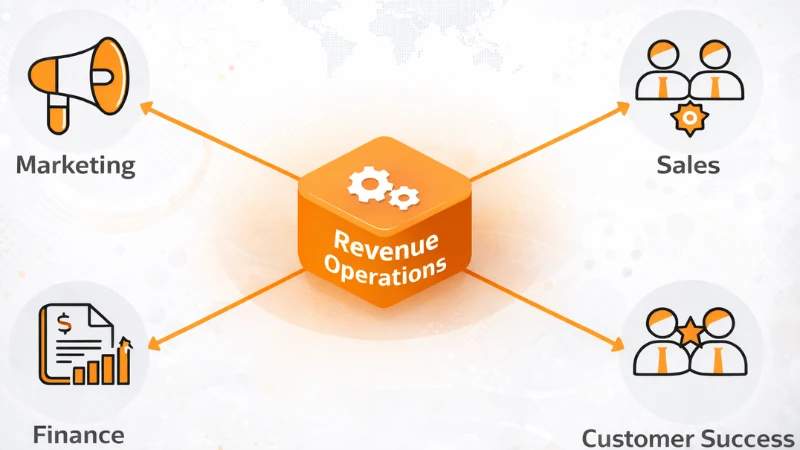
Revenue Operations is a strategic function that aligns marketing, sales, and customer success around a single goal: predictable revenue growth. It’s not a rebrand of the ops team. It’s not about giving sales control of marketing budgets. Instead, it’s a structural shift that removes the root causes of misalignment.
RevOps works because it removes the departmental boundaries that make alignment so hard. When everyone reports to a shared revenue strategy, turf wars become irrelevant.
In practice, RevOps does four things well: it unifies data across teams, standardises processes, aligns incentives, and creates a single accountability structure for revenue outcomes. Companies that have implemented RevOps properly see measurable results: nearly 3x more likely to exceed customer acquisition targets, 39% higher revenue growth, and lead conversion rates up to 67% better.
Those aren’t marketing statistics. That’s the compounding effect of two teams finally pulling in the same direction.
Here’s where theory meets practice. The most tangible place RevOps creates value is in lead management, specifically the end-to-end journey from first touch to closed deal.
Right now, in most organisations, this process is fractured. Marketing generates leads using one definition of ‘qualified.’ Sales receives them, disagrees with the assessment, ignores most of them, and goes back to sourcing their own pipeline. Marketing, seeing that leads aren’t being worked, pushes harder on volume. The cycle repeats.
A RevOps approach to lead management fixes this at every stage.
Instead of marketing deciding unilaterally what makes a good lead, RevOps brings both teams to the table to build a shared scoring model.
Which firmographic signals actually matter? How do you identify behavioural indicators that reflect genuine buying intent? And at what point should a contact move from MQL to SQL?
This isn’t just a semantics exercise. When sales trusts the scoring model because they helped build it, follow-up rates improve dramatically. When marketing gets feedback from sales on which leads actually convert, they can refine targeting. The model gets smarter over time because both teams are contributing to it.
One of the most practical outputs of RevOps is a clear, documented Service Level Agreement between marketing and sales. Marketing commits to delivering leads that meet agreed criteria. Sales commits to following up within a defined window, every single time, no exceptions.
This removes ambiguity. It removes the ‘those leads were rubbish’ excuse. It removes the passive-aggressive inter-departmental email threads that drain energy and erode culture. Both teams know exactly what they owe each other.
In a properly structured RevOps system, data flows in both directions. Marketing can see what happened to every lead they passed to sales. Sales can flag leads that weren’t ready and push them back for further nurturing. Customer success can signal when a customer churned, triggering a review of the signals that should have predicted it.
This closed loop is the difference between optimising for inputs (leads generated, calls made) and optimising for outcomes (revenue created, customers retained).

When marketing and sales look at the same dashboard, in real time, conversations change. Instead of ‘your leads are bad,’ you get ‘our conversion rate at this stage dropped this week, let’s figure out why.’ The language shifts from blame to diagnosis. That’s not a cultural aspiration, it’s a structural outcome of shared visibility.
Here’s the honest version of implementation, without the consultant-speak.
Step 1: Run a gap analysis. Before anything else, understand where the friction actually lives. Survey both teams separately. Look at your CRM data. Map the lead lifecycle and find where leads are disappearing. This isn’t about blame; it’s about building a baseline so you can measure progress.
Step 2: Build shared definitions. Get marketing and sales in a room and agree on what an MQL is. Define what an SQL really is. Clarify what a “good fit” company looks like. Establish clear expectations for follow-up timelines. Write it down. Make it official. This document is the foundation everything else is built on.
Step 3: Audit and consolidate your tech stack. Sales teams are drowning in tools. Marketing automation platforms, CRMs, sales engagement tools, analytics dashboards, each with its own data model. RevOps brings these into alignment. At minimum, your CRM should be the single source of truth for both teams, with marketing data flowing in and sales activity flowing back out.
Step 4: Create an SLA and hold both sides accountable. The SLA isn’t bureaucracy. It’s trust in writing. It tells both teams exactly what they can expect from each other, and it gives leadership a framework for having honest conversations when things go wrong.
Step 5: Establish a regular joint review cadence. Weekly or biweekly lead reviews where both teams look at the pipeline together. Not to assign blame but to spot patterns: which lead sources are converting, which campaigns generated SQLs, which industries are responding. This meeting is where alignment becomes a habit.
Process and technology get most of the attention in RevOps conversations. Culture gets treated as a footnote. That’s a mistake.
87% of the words sales and marketing teams use to describe each other are negative. That’s not a statistic you fix with a new CRM implementation. It requires deliberate effort: shared meetings, cross-functional shadowing, leaders from both sides attending each other’s kick-offs, and, crucially, celebrating wins together when the system works.
The research is clear on one thing: 32% of companies identify creating a liaison role that spans both functions as the single most effective alignment tactic. A revenue operations director, a RevOps specialist, someone who understands both worlds and has authority in neither silo. That person becomes the translator, the referee, and eventually the creator of a culture where the question isn’t ‘whose fault is it?’ but ‘what do we need to fix?’
If you’re still weighing whether this is worth the investment, here’s what the data says about aligned organisations:
These aren’t theoretical projections. They’re outcomes from companies that did the work. HubSpot saw a 20% increase in lead conversion after implementing RevOps. Adobe improved marketing campaign success by 25%. Salesforce cut sales cycle length and saw a 15% revenue increase.
The ROI case for RevOps isn’t hard to make. The harder part is getting leadership aligned on the structural changes required to make it real.
Misalignment has a price. It’s just distributed across the P&L in ways that are easy to overlook.
You’re paying for marketing content that sales never uses. The leads you generate often get followed up four days too late. There’s also money lost on duplicate tools purchased independently by each team due to a lack of trust in shared systems. Over time, this disconnect adds up to cultural damage, as both teams spend years blaming each other instead of solving problems together.
And you’re paying in lost deals. 44% of businesses say lead generation is negatively impacted by the sales-marketing relationship. 37% say sales cycles are longer because of it. The more fragmented the experience, the more likely the buyer is to choose a competitor who has their act together.
Misalignment compounds over time, just like alignment does. The difference is which direction you’re compounding in.
Sales and marketing alignment isn’t a cultural initiative. It’s a revenue strategy. When you treat it that way, and back it with the processes, technology, and shared accountability that RevOps provides, the results aren’t incremental. They’re transformational.
The organisations getting this right aren’t doing anything magical. They’ve just decided that operating in silos is more expensive than doing the work to tear them down. They’ve built shared definitions, shared dashboards, shared goals, and an SLA that holds everyone accountable.
Your lead management process is the most visible place to start. Every lead that falls through the gap between marketing and sales is a signal. Most organisations treat those signals as noise. RevOps teaches you to read them.
The relay race only works when both runners are going the same direction. RevOps is how you make sure of it.
Ready to fix sales and marketing alignment? Download
Fix Your Revenue Leaks with RevOps
Align sales and marketing with a unified RevOps strategy that improves handoffs, boosts conversion rates, and drives predictable growth.