Understand Ops Functions That Accelerate Your Revenue Growth
Discover how these functions drive revenue, where they break, and how alignment fuels growth.
 Lead-Gen now on Auto-Pilot with
Build My Campaign
Lead-Gen now on Auto-Pilot with
Build My Campaign

Every quarter, marketing celebrates rising MQLs and strong campaign metrics—while sales questions whether those leads actually convert.


Understand Ops Functions That Accelerate Your Revenue Growth
Discover how these functions drive revenue, where they break, and how alignment fuels growth.
A reality we know all too well about every quarter is when marketing pulls up the dashboard, MQLs are up 40%, the campaign performance looks great; but sales differs to agree. Sales is in another meeting complaining that leads are tire kickers with zero budget and no authority. And leadership? Well they are staring at the revenue number which did not move even though everyone was working hard.
No one is slacking here, everyone is trying to optimize, that becomes a problem.
The issue here is that three different functions are pulling in three different directions, and all of them are measuring their version of success, with literally no one owning the full revenue cycle. Before you go about reorganizing your team or buying another software, you have to understand what Sales Operations, Marketing Operations, and Revenue Operations actually do, and more importantly, where each one hits a wall.
This blog breaks that down clearly so you can see exactly what each function does, where things fall apart, and how to fix the gaps before they hamper your revenue.
What Are We Actually Comparing?
Let’s look at it this way:
RevOps cannot replace the other two, it is like an evolution. It is a response to what happens when Sales Ops and Marketing Ops both do their jobs well in isolation but the company still can’t scale. For a strategic context, Valasys has a complete guide to B2B Revenue Operations worth reading alongside this.
Understand Ops Functions That Accelerate Your Revenue Growth
Discover how these functions drive revenue, where they break, and how alignment fuels growth.
If your sales rep is cribbing about spending more time updating Salesforce than selling, then you have a Sales Ops problem. Sales Operations exists to remove that friction. It owns:
A classic example of Sales Ops done right would be when IBM restructured its sales force in the 1990s after Lou Gerstner took over, one of the first moves was brutal process standardization. Sales reps had been operating with wildly different approaches across regions. Installing unified CRM processes and quota structures didn’t just improve efficiency – it made revenue forecasting possible for the first time in years. That’s Sales Ops.
The core dysfunction Sales Ops fixes is inconsistency. When 20 reps work a pipeline 20 different ways, it becomes impossible to predict what next quarter looks like. Forecasting becomes a guessing game. Managers spend their time chasing status updates instead of coaching.
Sales Ops gives you a single operating system for your sales team.
Something a Sales Ops cannot fix is lead quality. A Sales Ops function can optimize conversion rates between stages, but it has no control over what walks in the door. If marketing sends over 500 MQLs and 450 of them are researchers with zero buying authority, the most efficient CRM in the world won’t save you. Sales Ops also has limited visibility into what happens before a lead is handed over, the pre-sales journey, the content someone consumed, the intent signals they showed. That data lives elsewhere.
Marketing Operations acts like a backbone behind every campaign. When marketers create the content and campaigns, Marketing Ops builds and runs the systems that make those campaigns measurable. It owns:
Insights from Valasys on B2B engagement data shows how first-party intent signals, when captured and used correctly at the Marketing Ops level, can fundamentally change how accurately teams qualify and engage prospects.
Marketing Ops exists because “spray and pray” doesn’t scale. The function answers the three questions every CMO asks eventually:
In 2013, a Forrester study found that most B2B companies relied on single-touch attribution models, either first touch (whoever gets credit for the first click) or last touch (whoever closed the deal). Both are dangerously misleading. A prospect might read a whitepaper in January, attend a webinar in March, and click an email in June before buying. First-touch attribution gives all the credit to content syndication. Last-touch gives it all to email. Neither picture is accurate. Marketing Ops exists to build multi-touch attribution models that show the full truth, and marketing attribution software makes this practical by crediting every touch point in that journey rather than just one.
The honest failure mode of Marketing Ops is over-optimization for MQL volume instead of revenue quality. When the KPI is “number of MQLs generated,” the system produces MQLs. Some indicate real buying intent. Many reflect early-stage engagement rather than immediate sales readiness.
The challenge begins when those leads move into qualification workflows, whether through SDR review, sales acceptance, or nurture tracks. At that point, Marketing Ops often loses visibility. What happens next? Does the lead progress? Does it stall? Does it get recycled?
Marketing Ops rarely has a complete picture, because downstream pipeline data often sits inside systems managed by sales or revenue operations teams.
RevOps doesn’t own a team. It owns a system, more specifically, it owns:
RevOps is like an operating system underneath every go-to-market function. It doesn’t replace Sales Ops or Marketing Ops any more than macOS replaces your actual applications. It’s the layer that makes the applications work together.
In the early 2000s, Cisco famously had to write down $2.2 billion in inventory, largely because each business unit was forecasting independently, using different data, with no unified view. Siloed operational functions each “worked” in isolation. The system did not. That’s not a technology company problem. That’s what happens when operations functions are optimized locally but not globally. RevOps is the structural answer to that kind of risk.
Four problems that Sales Ops and Marketing Ops cannot solve alone:
| Dimension | Sales Ops | Marketing Ops | RevOps |
| Scope | Sales team only | Marketing team only | Entire revenue lifecycle |
| Primary Goal | Close deals faster | Generate better pipeline | Make revenue predictable |
| Data Ownership | Pipeline + deals | Leads + campaigns | Unified revenue data |
| Tech Stack Role | CRM administrator | Automation platform owner | Integration layer across all tools |
| Impact Level | Execution efficiency | Demand performance | Growth + predictability |
| Failure Mode | Over-optimizes pipeline stages | Over-optimizes MQL volume | Fails when treated as a job title |
Most of the companies are not asking these questions early enough, they add the headcount, change their CRM, run more campaigns, and the problem remains the same.
Here are the signals that you’ve outgrown siloed operations:
Your pipeline looks healthy but revenue doesn’t follow. This is the most common symptom. It usually means there’s leakage at the sales-marketing handoff, or that your pipeline stages don’t reflect actual buyer behavior.
Sales and marketing are in constant friction. Not personality friction. Process friction. “Your leads are bad.” “Your follow-up is slow.” Both teams are usually right about the symptoms and wrong about the cause.
Forecasting is a monthly debate, not a data exercise. If your forecast accuracy is below 75%, you don’t have a sales problem. You have a data problem.
You have too many tools and too little visibility. The average B2B company with 100–500 employees runs 40+ sales and marketing tools, according to Gartner research. Tools rarely fail. Integration fails.

Leads disappear between stages. You can see them enter. You can see (some of) them close. What happened in the middle is a mystery.
If these symptoms sound like your current reality, you need a more robust framework to align your functions. Download our guide.
This is what a well-aligned revenue system looks like:
Marketing Ops generates and qualifies demand. It builds the infrastructure to attract the right buyers, score them based on real behavior (not just demographics), and route them intelligently.
Sales Ops converts and closes. It gives reps a clear, consistent process. It maintains CRM accuracy so the pipeline is trustworthy. It ensures that every opportunity is followed up with the right next action.
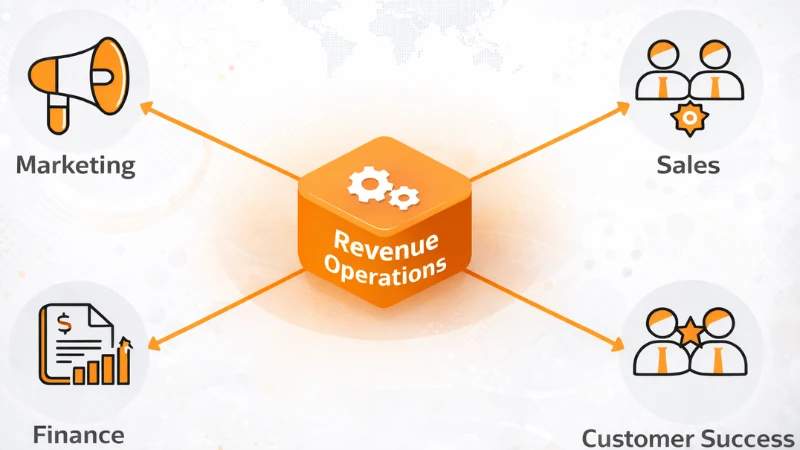
RevOps connects and optimizes the entire flow. It sets the shared KPIs both teams are measured against. It owns the handoff processes. It builds the reporting that shows the full picture from first touch to closed revenue to expansion.
When these three operate in sync:
Moving from the theory of alignment to actual execution is the hard part. We’ve outlined the specific strategies for building this cohesive system in our latest asset: The Rise of Revenue Ops: Why Marketing & Sales Operations Make Growth Possible[b]
Renaming Sales Ops as RevOps. This is the most common mistake. Companies take their existing Sales Ops function, give it a new title, and expect alignment to appear. Alignment requires structural change, not a rebrand.
Hiring one “RevOps person” and expecting magic. RevOps is an operating model. One person can build the foundation, but the model requires buy-in from leadership and coordination across functions. A single hire cannot manufacture that alignment.
Keeping siloed tools but wanting unified insights. If your CRM doesn’t talk to your marketing automation platform, and your CS platform doesn’t feed into your BI tool, RevOps cannot function. The data infrastructure has to actually connect. This is where Valasys’s intelligence solutions become practically relevant – creating the unified data layer that makes RevOps work rather than just sound good in a deck.
No shared revenue metrics. If marketing is measured on MQLs and sales is measured on closed revenue, you have structurally guaranteed their misalignment. RevOps starts with aligning the scorecard.
Sales Ops is execution efficiency. Marketing Ops is demand efficiency. RevOps is system efficiency.
You can have it all, all three functions, optimizing each one independently, and still fail to scale – because you’re not optimizing parts. Scaling requires aligning the system.
The companies that crack revenue predictability aren’t the ones with the best reps or the most sophisticated campaigns. They’re the ones who figured out that the handoff between functions is where revenue is won or lost and built operations to own that handoff deliberately.
Ready to stop optimizing in silos? You don’t have to navigate this transition alone. Download our guide on the rise of Revenue Ops to see how modern organizations are making predictable growth a reality [c]
That’s the real difference between Sales Ops, Marketing Ops, and RevOps. And it’s why the question isn’t which one you need. It’s whether your three functions are working as one.
1. What is the main difference between Sales Ops, Marketing Ops, and RevOps?
Sales Ops improves sales execution, Marketing Ops improves campaign performance and lead management, while RevOps aligns both functions across the full revenue lifecycle.
2. Is RevOps just a new name for Sales Operations?
No. RevOps is broader than Sales Ops. Sales Ops focuses on the sales team, while RevOps connects sales, marketing, customer success, systems, and reporting into one revenue engine.
3. Can a company have Sales Ops and Marketing Ops without RevOps?
Yes, many companies do. But without RevOps, those teams often work in silos, causing handoff issues, inconsistent data, and unreliable forecasting.
4. When should a business invest in RevOps?
Usually when growth becomes harder to predict, teams blame each other for missed targets, pipeline quality drops, or reporting turns into monthly chaos.
5. Does RevOps replace Sales Ops and Marketing Ops teams?
Not necessarily. In many companies, RevOps becomes the umbrella function that aligns Sales Ops and Marketing Ops rather than replacing them.
6. Which function owns CRM and marketing automation tools?
Typically, Sales Ops manages CRM systems like Salesforce, while Marketing Ops handles automation tools like HubSpot or Marketo. RevOps ensures all tools work together.
7. Why do companies struggle with forecasting accuracy?
Because sales, marketing, and customer data often live in separate systems with different definitions. RevOps solves this by creating one source of truth.
8. Is RevOps only for large enterprises?
No. Mid-sized and scaling B2B companies often benefit the most because operational gaps become expensive once growth speeds up.
9. What metrics matter most in a RevOps model?
Pipeline conversion rates, CAC payback, revenue velocity, forecast accuracy, win rates, retention, and expansion revenue usually matter more than vanity metrics like raw MQL volume.
10. Which is more important: Sales Ops, Marketing Ops, or RevOps?
It’s not about choosing one. Strong companies need all three working together. Sales Ops drives efficiency, Marketing Ops drives demand, and RevOps makes the system scalable.
Understand Ops Functions That Accelerate Your Revenue Growth
Discover how these functions drive revenue, where they break, and how alignment fuels growth.