Build RevOps the Right Way
See how high-growth teams build the right RevOps foundation before scaling automation.
 Lead-Gen now on Auto-Pilot with
Build My Campaign
Lead-Gen now on Auto-Pilot with
Build My Campaign

Guide to hiring your first RevOps leader with non-negotiable skills, interview process, 90-day plan, and common hiring mistakes to avoid.


Build RevOps the Right Way
See how high-growth teams build the right RevOps foundation before scaling automation.
Conference room. Monday morning. Coffee is almost cold. Screen glowing with a half-open CRM dashboard nobody fully trusts.
The CEO leans back, arms crossed. Calm voice. “So… what’s our actual pipeline number?”
Silence.
Marketing speaks first. Confident. “We’re at a $2.8 million influenced pipeline.”
Sales jumped in immediately. “No chance. The real pipeline is closer to $1.9 million.”
Finance slowly turns a laptop around like it contains classified evidence. “I have $2.3 million, and that’s being generous.”
Everyone looks at everyone. No one is lying. No one is guessing either. They’re all pulling from different reports, different definitions, different realities. The room gets quieter.
Build RevOps the Right Way
See how high-growth teams build the right RevOps foundation before scaling automation.
Because bad numbers are a problem. But three believable numbers?
That’s a system failure while wearing business casual. And a moment of realisation: We need a RevOps Leader.
Truth is you needed him six months before this meeting.
Revenue Operations is one of the most misunderstood functions in modern B2B. Companies know they need it. They’ve heard the stat (RevOps teams grow 36% faster, more profitable, all of that). But when it comes time to actually hire for it, most of them fumble it badly. They hire too junior, or too technical, or they write a job description that describes four different roles wrapped in one unrealistic human being. Then they wonder why nothing changes.
In this blog, we are going to fix that problem by addressing a question enough people need to act before starting the hiring process: How to hire your first RevOps Leader?
Did you know? VP of Revenue Operations titles increased by 300% in 18 months. This is not a trend everyone is hoping for today and will change tomorrow but it is something that is going to change the tomorrow for your organization. But do it wrong and the script flips completely.
Let me show you how that nightmare looks like:
You hired someone and everyone felt productive again.
New title. Fresh LinkedIn post. The internal announcement went out. “Excited to welcome our new Head of RevOps.”
Except the person was really a Salesforce admin with an impressive title.
They know fields, workflows, permissions, duplicate cleanup. They can make the system cleaner. Faster. Tidier. And they do.
Six months later, the CRM looks beautiful.
Dashboards polished. Lead statuses standardized. Picklists under control. The pipeline is still a mess. The forecast is still shaky. Sales are still blaming lead quality. Marketing is still asking why follow-up is slow.
Because the problem was never the software. It was the revenue motion hiding underneath it.
Your competitor went the opposite way.
They hired someone sharp. Strategic. This person sees the actual issues in week one. Broken handoffs. Conflicting KPIs. No ownership. Bad incentives. Then reality enters the room.
Sales won’t change the process. Marketing disputes attribution. Leadership wants fixes, but not friction.
Nobody gave this person real authority. So they spend a year in back-to-back meetings fighting wars they were never armed for.
Eventually they burn out. Then they leave.
Both stories end the same way.
Money spent. Time spent. Problems remained unresolved.
And it keeps happening for one simple reason.
Most hiring managers know RevOps as a buzzword. They know the category.
They don’t know the job. So before talking titles, comp, or org charts, let’s fix the foundation, shall we?
RevOps is not simply CRM administration. That’s a component of it, not the definition.
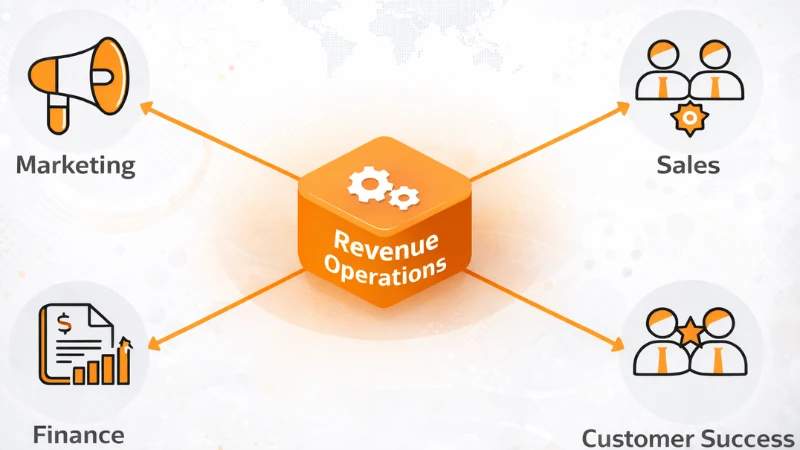
RevOps is the function that connects your sales, marketing, and customer success teams into something that behaves like a single revenue engine rather than three departments pointing fingers at each other. It owns the data, the processes, the tech stack, and the reporting. More importantly, it owns the truth. When your CRO needs to know if you’re going to hit the quarter, RevOps is the function that can actually answer that question with confidence.
Know that, it’s not a catch-all for every operational problem nobody else wants to own. This is a trap. Companies load the first RevOps hire with tech support tickets, random reporting requests, and whatever process mess has been accumulating for two years. Then they measure them on those outputs instead of on revenue impact. The hire burns out. The function never matures.
Also, and this matters: RevOps is not the same as a GTM Engineer. A GTM Engineer is a technical accelerator, someone who builds automation and tooling on top of a strategic foundation. RevOps creates that foundation. You need the strategy before you need the automation. Confusing these two roles is a fast way to spend money on sophisticated automation of a broken process.
See how high-growth teams build the right RevOps foundation before automation. Download The Rise of Revenue Ops.
The timing matters more than more people expect it too; you’re ready for your first RevOps hire when at least three of these are true:
You have 10 to 15 sales reps. Below 10, the CEO or VP of Sales can manage operations themselves without significant opportunity cost. Above 15, doing it yourself is genuinely expensive, because you’re paying executive salary for admin work.
You’re at $5M ARR or above. Before this threshold, the complexity of your revenue motion usually doesn’t justify a dedicated ops function. After it, you have enough pipeline and enough process debt to make the hire pay for itself quickly.
Leadership is spending 10-plus hours weekly on ops work. If your VP of Sales is building reports and fixing routing rules instead of coaching reps and closing deals, that’s a red flag. The math on that is brutal. At $300K total comp, that’s $150 an hour disappearing into spreadsheet maintenance.
You have no single source of truth. When sales, marketing, and finance all report different revenue numbers, you have a data trust problem. That problem compounds every quarter you leave it unfixed.
You’re scaling headcount fast. If you plan to grow the sales team by 50% in the next 12 months, the systems need to be ready before the new reps arrive. Building the plane while flying it is possible. Building it while adding 10 new passengers mid-flight is chaos.
If you’re not at this point yet, fractional RevOps is worth serious consideration. Companies report 30 to 50% cost savings versus full-time hires for specific projects, and a sharp fractional operator can lay the foundation in months. There’s no shame in the fractional route when the timing isn’t right for a full-time hire.
Job descriptions are very important but a common mistake is most of them list 14 requirements that contradict one another and end with a salary range that suggests they want a senior executive at manager pay. Then they’re surprised by the quality of applicants.
The first RevOps hire is a specific archetype. Industry shorthand calls it a “player-coach.” Someone who can own strategy and execute it without a team underneath them, at least for the first 6 to 12 months. This is not a junior analyst. It’s also not a VP who’s used to managing a department and delegating the hands-on work. It’s someone in between, and finding them requires knowing what you’re actually looking for.
Standard interviews are a poor fit for RevOps roles. You’re not trying to assess general competence. You’re trying to assess a specific combination of analytical, strategic, and interpersonal skills in someone who will operate across every revenue-generating function in your company. That requires a different approach.

An AI interview can help streamline the initial assessment process while giving hiring teams more time to focus on the deeper strategic and interpersonal qualities required for the role.
Round one: This can be like a discovery call itself. Your goal is to qualify the candidate against minimum requirements and get them genuinely interested in the opportunity. Ask enough to determine if they’re worth a deep evaluation. Sell the role authentically. Understand what they’re actually looking for. If you spend the whole first call interrogating them without making the opportunity sound compelling, you’ll lose the best candidates, who have options.
Round two: Go situational. Ask how they prioritize their work in a week with five competing fires. Ask about a time they had to push back on a senior stakeholder and how that went, and how do their process looks like when they inherit a messy CRM. You’re not looking for the “right” answer. You’re looking for evidence that they actually do this work and think carefully about it.
The practical exercise: Give them something real. A broken dataset to analyze and return with insights. A fictional lead routing problem to solve. A description of an actual systems challenge you’re facing and ask how they’d approach it. The candidates who ask the most follow-up questions before they start, who want to understand the business context before they build anything, are almost always the stronger performers.
The panel interview: Bring in your key cross-functional stakeholders, your marketing lead, your CS lead, your CRO or COO. Have the candidate present their exercise. Ask them how they arrived at their conclusion, why they chose that approach, and how they’d handle a different variation. The ones who can go deep into the weeds while keeping the business context in view are the ones worth hiring.
This is a useful interview question in itself: “What does your first 90 days look like in a new RevOps role?” A strong candidate will have a version of this framework already in their head.
Days 1 to 30 are for audit and listening. Map the current lead-to-revenue process end to end. Audit CRM data quality across every critical field. Talk to the sales reps, the marketing team, the CS team. Identify the top three process failures that are costing the most revenue. Don’t build anything yet.
Days 31 to 60 are for fixing the foundation. Data enrichment at point of entry so new records are clean from day one. Lead routing that ensures every lead is assigned within five minutes. A pipeline dashboard that leadership actually trusts and agrees to use as the single source of truth.
Days 61 to 90 are for scaling what’s working. Lead and account scoring built on clean data. A weekly pipeline review process with standardized deal inspection criteria. Process documentation and team training so the systems actually get used.
The mistake is trying to build scoring models before the data is clean, or chasing strategic initiatives before the foundation is solid. Good RevOps leaders know the sequence. That instinct is worth testing for.
You can hire the right person and still fail. It happens constantly.
The single biggest predictor of first RevOps hire success is executive sponsorship. RevOps changes processes across sales, marketing, and CS. When you change processes that cross departmental lines, someone always pushes back. Salespeople resist new CRM requirements. Marketing disputes attribution models. CS has opinions about handoff processes. None of that is irrational. It’s just how organizations work.
Without a VP or C-level sponsor who will back the RevOps leader when change is unpopular, every improvement becomes a negotiation. A negotiation the RevOps person will usually lose, because they’re fighting on political terrain while trying to do analytical work.
Before you make the hire, get alignment from your revenue leadership that this person has the mandate to change processes, not just recommend them. Announce the hire to the full revenue team. Make it clear what they own. Give them a direct line to the CRO or CEO for the first six months. Budget for tooling from day one.
The companies that get RevOps right treat it as a strategic function with real authority. The companies that get it wrong treat it as a cleanup crew and then complain that it didn’t transform their revenue motion.
For a senior individual contributor at the right level for a first hire, expect $120,000 to $180,000 base salary in most US markets. In major metros, strong candidates regularly command $150,000 to $200,000. Director-level total comp, including bonus and equity, runs $146,000 to $273,000 depending on company stage and geography.
This is not a place to save money. A strong first RevOps hire typically pays for themselves within two quarters through improved pipeline conversion, reduced rep time waste, and better forecast accuracy. A weak hire or a wrong-level hire costs you the salary and 12 months of opportunity cost while the problems compound.
Hire for the level the role actually requires. The player-coach who can own strategy and execution simultaneously. That person is worth paying for.
Your pipeline number is probably wrong right now. Someone in your company knows it and isn’t saying it out loud. You have too many people who should be focused on revenue instead spending hours keeping the lights on in your CRM. Your marketing and sales teams probably have a version of the same argument about lead quality every quarter.
A great RevOps hire fixes all of that systematically, with data, and with the kind of clarity that makes the rest of your revenue team significantly more effective.
The key is knowing what you’re hiring for, hiring at the right level, giving them real authority, and backing them when it matters.
Do that, and the hire pays for itself. Skip any of those steps, and you’ll be back at square one in 18 months, wondering why RevOps didn’t work for you.
It worked. You just didn’t let it.
Ready to build RevOps the right way? Download The Rise of Revenue Ops and turn alignment into growth.
A RevOps Leader aligns sales, marketing, and customer success so they operate like one revenue engine. They usually own data quality, funnel reporting, forecasting systems, handoff processes, and overall revenue efficiency.
Usually when growth starts creating operational chaos. Common signals include:
If three or more of these are true, it’s likely time.
No. Sales Ops focuses mainly on the sales team. RevOps looks across the full customer journey: marketing, sales, and customer success.
Sales Ops improves one department. RevOps improves the whole revenue system.
No. CRM management is one part of the role, not the whole role.
If someone only cleans fields, fixes workflows, and builds dashboards but can’t improve pipeline performance, you hired an admin, not a RevOps leader.
Usually mid-to-senior.
Your first hire should be a builder who can think strategically and execute hands-on. Too junior and they get overwhelmed. Too senior and they may expect a team before doing the work.
Look for:
The big ones:
Don’t just ask generic questions. Use real scenarios.
Ask things like:
Practical exercises usually reveal the best candidates.
Typically:
Days 1–30: Audit systems, data, funnel flow, stakeholder interviews
Days 31–60: Fix routing, clean data, create trusted reporting
Days 61–90: Improve forecasting, process cadence, scalable systems
Usually because leadership doesn’t support change.
RevOps often requires new rules, new accountability, and process shifts. Without executive backing, every improvement becomes a debate.
It depends on market, stage, and experience, but strong candidates are not cheap. The bigger cost is hiring the wrong person and losing a year of momentum.
Cheap hire + wrong level = expensive mistake.
Fractional RevOps can be smart if you’re earlier stage or need short-term cleanup. Full-time usually makes sense once scaling complexity becomes constant.
Build RevOps the Right Way
See how high-growth teams build the right RevOps foundation before scaling automation.