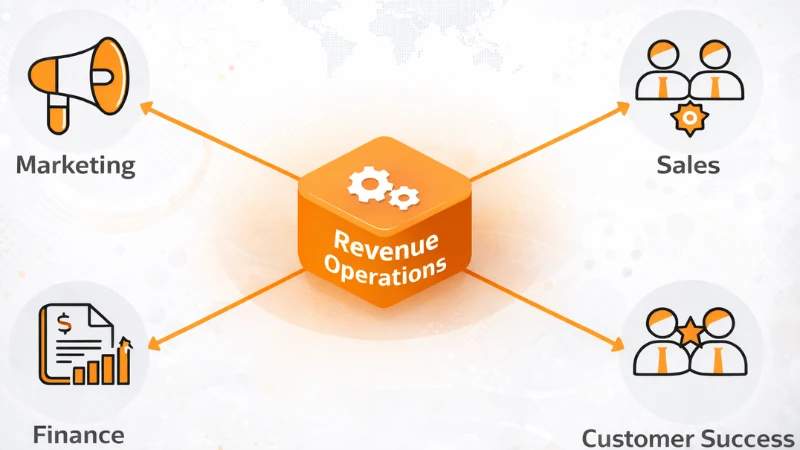
Integrate Your RevOps Stack Smarter
Connect your tools, unify your data, and eliminate silos to build a seamless revenue engine that drives growth.
 Lead-Gen now on Auto-Pilot with
Build My Campaign
Lead-Gen now on Auto-Pilot with
Build My Campaign

Learn best practices for integrating your RevOps tech stack to unify data, streamline workflows, and drive better revenue performance.

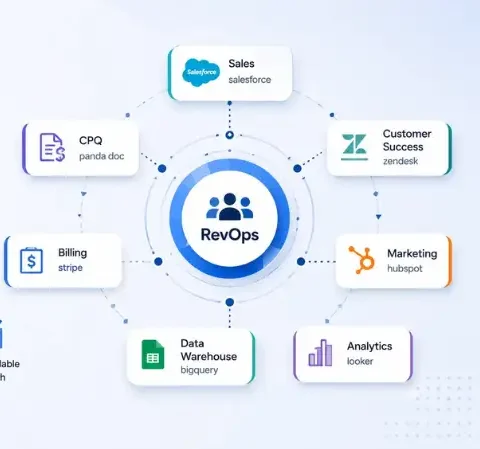
Integrate Your RevOps Stack Smarter
Connect your tools, unify your data, and eliminate silos to build a seamless revenue engine that drives growth.
Your sales team has a CRM they barely update. Marketing runs three separate automation platforms. Customer success tracks renewals in a spreadsheet that lives on someone’s laptop. And leadership wants a forecast by Friday.
This is not a technology problem. It is a systems problem. And throwing more software at it will not help.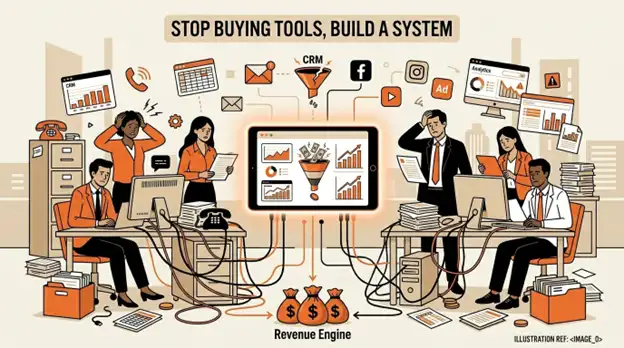
Revenue operations exists precisely because the old way of doing things, where marketing, sales, and customer success each build their own data kingdoms and call it “alignment,” produces exactly the kind of fragmented, leaky revenue engine that kills growth.
To fix this, you need a complete guide to B2B revenue operations that treats your tech stack as a single, unified organism.
The average company today runs 175 different SaaS tools. Most teams only use 42% of their software’s capabilities. That is not a tech stack. That is organized chaos with a monthly invoice.
So before you open another vendor demo, let’s talk about what actually works.
Every RevOps best practice article will tell you to “make the CRM your source of truth.” Great advice. Genuinely. The problem is nobody tells you what breaks that truth, which is usually one of three things: inconsistent data entry, poor field governance, or tools that write to the CRM but never read from it.
Integrate Your RevOps Stack Smarter
Connect your tools, unify your data, and eliminate silos to build a seamless revenue engine that drives growth.
Your CRM should be the heartbeat of your entire stack. Whether you are using HubSpot or Salesforce, the goal is the same: ensuring your sales and marketing alignment is backed by data, not just “good vibes.”
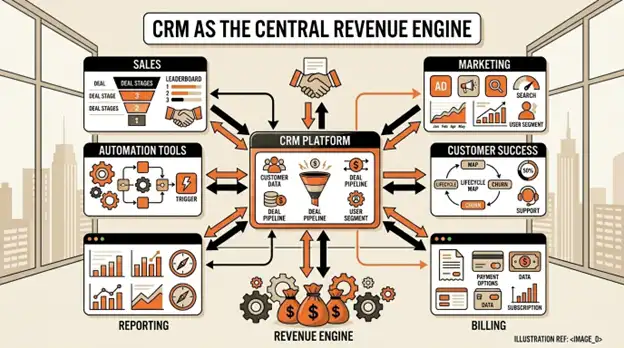
Every touchpoint, every deal stage, every customer interaction should flow through or back into it. Not because some consultant told you to centralize data, but because when it works, your entire revenue team operates off the same reality. No more “marketing says we have 500 MQLs” while sales is muttering about lead quality in the Slack channel.
The fix is less about which CRM you pick and more about governance from day one. Define your fields. Assign data owners. Document what gets recorded, when, and by whom. A HubSpot with clear governance will outperform a Salesforce implementation that no one bothered to configure properly.
Here is something vendors will not always tell you: the integration that looks easy in the demo is often a maintenance nightmare in production. Third-party middleware like Zapier works brilliantly for simple automations and becomes a liability the moment your data volume scales or your business logic gets complex.
This is where understanding the difference between Sales Ops vs. Marketing Ops vs. RevOps becomes vital. The goal is bidirectional sync, meaning data flows cleanly in both directions between your systems, not just from marketing automation into CRM, but back again. When a sales rep updates an account status, marketing needs to know. When customer success flags a churn risk, sales should see it. When billing processes a renewal, CS should get that confirmation automatically. When evaluating new software, prioritize native connectors that have documented, maintained integrations with your existing B2B revenue tech stack.
This is where service-data solutions and iPaaS (Integration Platform as a Service) tools earn their keep. Platforms built specifically to connect disparate enterprise systems handle complex data transformations, error logging, and scalability in ways that basic webhook automations simply cannot. If your stack has more than five tools actively exchanging data, a proper iPaaS layer is not optional. It is infrastructure.
Native connectors, when they exist, will almost always be more stable, better supported, and easier to troubleshoot than custom API builds. Prioritize tools that have documented, maintained integrations with your existing stack. And when evaluating new software, ask vendors one simple question: “What happens to my data if I cancel?” The answer tells you everything.
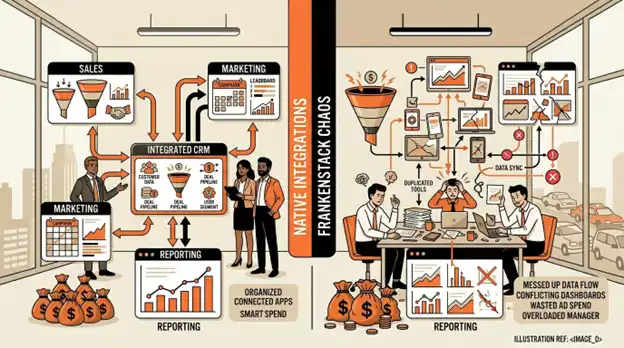
The Frankenstack is what happens when every quarter, someone buys a point solution for a specific problem without auditing whether the existing stack already does that thing. Over time, you have eleven tools with overlapping features, three different places where customer data lives, and a RevOps team spending more time managing integrations than enabling revenue.
Signs you are living in a Frankenstack:
The audit process is straightforward: List every tool, map the integrations, map out what it integrates with and what it does not, and check usage rates. The tools that score low on impact and high on cost are the ones you sunset, regardless of how enthusiastic the vendor’s account manager is about your renewal.
Do this quarterly. Not because your stack changes that dramatically, but because teams change, priorities shift, and what made sense eighteen months ago might be technical debt today.
If you find your stack is becoming unmanageable, it might be time to hire your first RevOps leader to trim the fat and enforce a RevOps strategy.
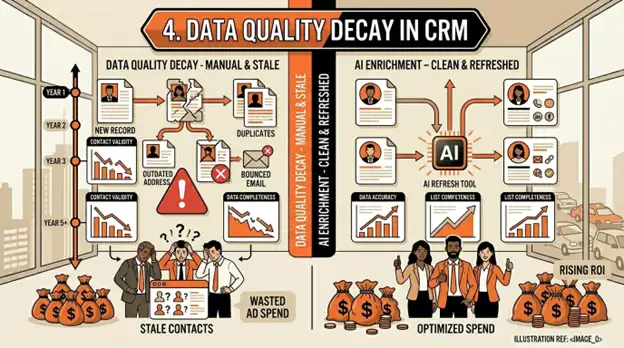
Bad data does not just produce bad reports. It causes bad routing, wasted outreach, broken automations, and sales reps chasing contacts who changed companies six months ago. Data decays at roughly 22% per year. Which means if you last cleaned your CRM eighteen months ago, nearly a third of it is already stale.
The companies getting this right have stopped treating data hygiene as a one-time remediation project and started treating it as infrastructure maintenance. Continuous enrichment tools keep contact and company records fresh automatically. For vendor evaluation, this breakdown of Zoominfo alternatives helps RevOps teams choose the right B2B data and GTM platform based on coverage, accuracy, compliance, integrations, and ROI. Lead-to-account matching ensures that when a new contact comes in from a key target account, it routes to the right owner rather than sitting in a queue. Normalization rules standardize how data is entered so your reporting actually reflects reality.
To turn this clean data into actual growth, you need RevOps reporting and dashboards that drive real-time decisions.
AI is genuinely useful here in ways that are concrete rather than buzzword-y. Data normalization, call summary extraction, deduplication logic, these are tasks where machine learning removes enormous amounts of manual effort. Start there before you try to use AI for anything more ambitious. The exotic use cases collapse when the underlying data is dirty.

You can’t build a skyscraper on a swamp. Use our defining Revenue Operations guide to ensure your data foundation is solid before layering on advanced AI tools.
The most expensive mistake in RevOps is buying software before defining the process it is supposed to support. This happens because software demos are designed to make you believe the tool will solve your problem, and sometimes you have not even clearly defined what the problem is.
Before any new tool conversation, answer these questions:
If you cannot answer those questions clearly, you are not ready to evaluate vendors. You are ready to do process mapping, which is less exciting but considerably more valuable.
The teams that get this right define their revenue process end to end, identify the gaps, and then find tools that fill those specific gaps. The teams that get it wrong do it backwards and spend twelve months rationalizing a software purchase that solved a problem they did not actually have.
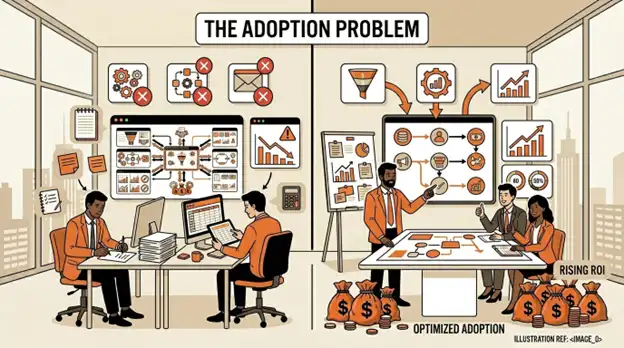
You can build the most architecturally elegant RevOps stack in the industry. If your reps are logging calls in a notes app and updating deals in spreadsheets because the CRM workflow “takes too long,” you have a tool, not a system.
Adoption is a design problem before it is a training problem. If a tool adds friction to a rep’s day, they will route around it. The solution is not more mandatory training sessions. It is configuring the tool to fit how people actually work, not how the implementation team assumed they would.
Assign system owners. Not tool administrators, but people who are accountable for adoption rates, who can identify friction points, who have the authority to make changes. Track active usage the same way you track pipeline. And build a communication cadence around new feature releases or process changes so changes do not arrive as surprises.
“What is your week-over-week adoption communication strategy?” is the question every RevOps leader should be asking after every rollout. Releasing something and hoping it works is not a strategy.
The architecture varies by company size and complexity, but the principles are consistent. A high-performing integrated RevOps stack typically has:
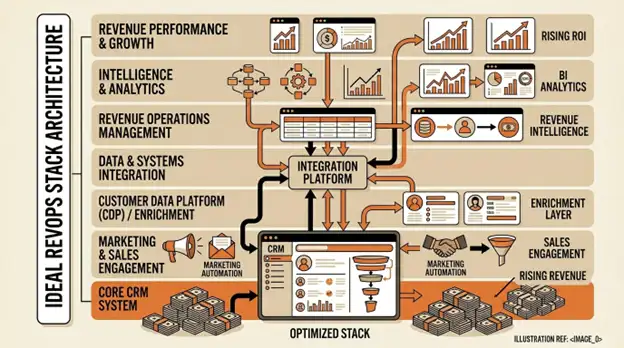
A CRM at the center handling contact management, pipeline, and the full customer lifecycle. Everything else feeds into and out of it.
A marketing automation platform that syncs cleanly with the CRM and handles lead nurturing, email, and campaign tracking without creating a parallel customer database.
A sales engagement platform that tracks outreach activity and writes that activity back to the CRM automatically. Not because someone clicked “log call,” but because the integration handles it.
A data enrichment layer that keeps records clean and surfaces intent signals so teams are working with current, accurate information.
Revenue intelligence tools that analyze pipeline and conversation data to surface deal risk and coaching opportunities. This category has advanced rapidly, and the AI-driven insights from platforms in this space are genuinely changing how sales leaders run forecasts.
A BI layer for reporting that sits above the CRM and handles the trend analysis, cohort modeling, and revenue attribution that CRM native reporting was never built to do.
An integration layer or iPaaS that connects the above without requiring an engineering team to maintain bespoke API connections.
That is not a comprehensive tool list. It is a functional architecture. The tools you choose to fill each layer should be decided based on your specific data flows, team size, and business model.
Technology governance in RevOps sounds bureaucratic. In practice, it is the difference between a stack that compounds in value over time and one that quietly becomes a liability.
Governance means establishing a formal review process for new tool purchases. It means having a single accountable owner for each major system. It means documenting integration dependencies before you decommission anything. And it means building a long-term roadmap tied to contract renewals rather than reacting to vendor pressure or internal requests.
Companies that skip this end up with the opposite of governance: a new tool sneaking into the stack every quarter because someone in the org found it useful, until six months later nobody knows why they have three tools that all do variations of the same thing and no one has the authority to kill any of them.
The smartest RevOps teams treat their stack like a product. It has a roadmap, an owner, a set of metrics it is accountable to, and a process for managing changes. That discipline, more than any specific tool choice, is what separates stacks that scale from ones that collapse under their own weight.
The companies winning on revenue right now are not the ones with the most tools. They are the ones that built a system, governed it deliberately, and made it genuinely usable by the people who depend on it every day. That is the actual best practice. Everything else is just picking which tools to put inside it.
Integrate Your RevOps Stack Smarter
Connect your tools, unify your data, and eliminate silos to build a seamless revenue engine that drives growth.