Generate More B2B Leads With Webinars
Get proven strategies, templates, and tactics to generate qualified B2B leads through high-converting webinars.
 Lead-Gen now on Auto-Pilot with
Build My Campaign
Lead-Gen now on Auto-Pilot with
Build My Campaign

Learn the webinar funnel stages, from registration and engagement to BANT qualification, to convert attendees into sales-ready leads.

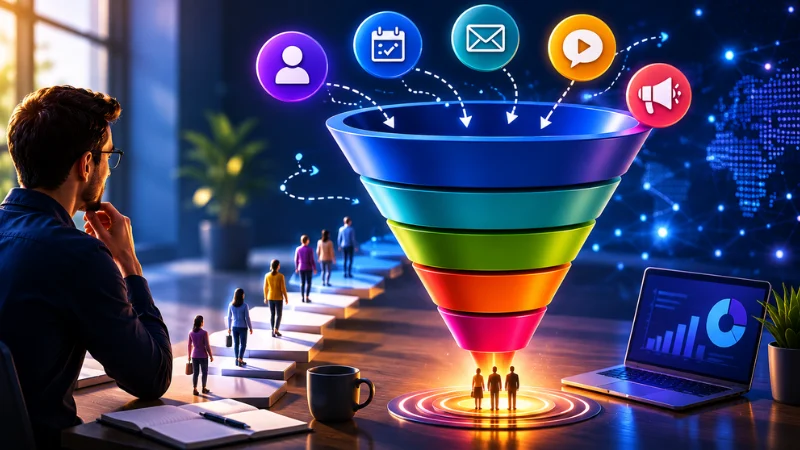
Generate More B2B Leads With Webinars
Get proven strategies, templates, and tactics to generate qualified B2B leads through high-converting webinars.
A Revenue-Focused Framework for B2B Demand Generation and Pipeline Creation
Every demand generation team runs webinars. Very few run webinar programs that generate a solid pipeline.
The difference is not production quality, speaker lineup, or topic selection. The difference is whether your team understands the webinar funnel as a buyer identification system rather than an audience delivery mechanism.
Most webinar teams stop at registrations. They report attendance rates. They send a follow-up email. They hand a list to SDRs and call it a campaign. Then they keep wondering, “why is the webinar-influenced pipeline so thin?”
The reason is structural. When funnel stages are undefined, qualification logic is absent, and sales teams receive undifferentiated contact lists, the webinar machine produces chaotic activity, not a revenue generating workflow.
The webinar funnel, when built correctly, is one of the most efficient pipeline qualification systems available to B2B marketing teams. It generates behavioral intelligence, surfaces buying intent, qualifies prospects without a sales call, and builds purchase momentum across the buying committee.
“The webinar funnel exists to identify buyers, not viewers. Every stage should filter and qualify, not just count.”
Generate More B2B Leads With Webinars
Get proven strategies, templates, and tactics to generate qualified B2B leads through high-converting webinars.
Webinar programs fail predictably, and almost always for the same reasons:
Registration count. Attendance number. Replay views. These are visibility metrics, not revenue metrics. When a marketing team celebrates 800 registrations, the CFO wants to know how many became opportunities. Usually, no one can answer that.
Without distinct funnel stages with defined thresholds, everyone who attended a webinar gets treated identically. The executive who asked three questions during Q&A and clicked the pricing page CTA receives the same follow-up as the student who joined for five minutes and dropped off.
Webinars promoted to broad audiences generate registrations from people who will never buy. High registration volume often reduces lead quality. A webinar with 600 registrations from outside your ICP will underperform a tightly targeted event with 80 registrations from decision-makers in your exact segment.
Webinar programs fail when marketing and sales define qualification differently. If marketing counts all attendees as MQLs and sales only acts on prospects showing strong buying signals, the pipeline handoff breaks down at every event.
Every hour after a webinar, buyer intent starts cooling. Research from Harvard Business Review and multiple B2B lead-response studies shows that companies responding within the first hour are significantly more likely to qualify and convert leads than teams waiting 24-72 hours. Yet most webinar follow-ups still happen days later, long after intent has faded.
Session duration is tracked. Almost nothing else is.
All of the above carry very distinct intent signals. When these signals are not scored, high-intent prospects are invisible.
When a webinar pipeline cannot be attributed to specific events, stages, or audience segments the budget justification fails. Without attribution, webinar programs are cut in the next planning cycle.
A webinar funnel is a structured buyer qualification system that moves a prospect through defined stages from initial awareness to sales-ready pipeline.
Each stage in the funnel contains three elements:
For example, a webinar registration signals topic interest, qualification depends on ICP fit, and the operational action is segmenting and preparing the prospect for attendance. The same structure applies throughout the funnel, ensuring every stage drives a measurable next step rather than simply capturing activity.
Registration is the entry point of your webinar funnel. It is also where most teams make their most expensive mistake: optimizing for volume over quality.
A registration from someone who matches your ICP is worth 20 registrations from people outside your target segment. Yet most webinar acquisition strategies prioritize reach over fit.
What Registration Actually Tells You
Registration tells you that someone found your topic compelling enough to give you their contact information. That is the signal, topic resonance with a named individual at a defined company. Nothing more or nothing less. The quality of that signal depends entirely on how well your topic attracts buyers, not browsers.
Operational Action
Segment registrants by ICP fit, role, company size, and industry before the event. High-fit registrants should enter targeted reminder and engagement sequences, while low-fit contacts can remain in broader nurture programs.
Attendance is the metric most webinar teams over-value. Someone attended your webinar. That tells you they showed up. It tells you nothing about whether they are evaluating a solution, have a budget, are a decision-maker, or whether they even intend to buy anything.
Attendance Benchmarks
Industry benchmarks for live attendance rates in B2B webinars typically run between 35% and 45% of registrants. These numbers are consistent but contextually meaningless without engagement data layered on top.
Registration Operational Alignment
Use attendance as a filtering mechanism, not a qualification mechanism. Attendees should move into engagement scoring workflows, while non-attendees should be routed to replay campaigns and on-demand nurturing.
Engagement is the most information-dense stage of the webinar funnel. It is where buyer behavior separates active evaluators from passive viewers. It is also the most underused source of pipeline intelligence in B2B marketing.
Engagement-Driven Next Steps
Aggregate engagement scores automatically inside your marketing automation platform or CRM. Prospects crossing predefined thresholds should be routed to MQL review, while lower-scoring contacts continue receiving educational content.
| Engagement Behavior | Intent Signal | Buying Stage Indicator | Score |
| Full session attendance (85%+) | High interest in topic | Awareness to Consideration | +10 |
| Poll response: ‘Planning for next quarter’ | Near-term intent | Late Consideration | +20 |
| Poll response: ‘Evaluating solutions now’ | Active buying cycle | Active Evaluation | +25 |
| Q&A question about implementation | Evaluation in progress | Active Evaluation | +25 |
| Q&A question about pricing or ROI | Commercial intent | Decision Stage | +30 |
| Resource download during session | Research behavior | Consideration | +12 |
| CTA click: ‘Download Case Study’ | Research behavior | Consideration | +15 |
| CTA click: ‘Book a Demo’ | High commercial intent | Decision Stage | +35 |
| Post-webinar survey completion | Engaged and cooperative | Consideration to Evaluation | +15 |
| Survey: ‘Planning to implement in 90 days’ | Near-term buyer | Decision Stage | +30 |
| Replay view: 80%+ consumption | Strong topic resonance | Consideration to Evaluation | +18 |
| Session drop-off under 30% | Low engagement | Awareness only | +2 |
Consider a prospect who attends 90% of the webinar (+10), selects “Evaluating solutions now” in a poll (+25), and clicks the “Book a Demo” CTA (+35).
Their total engagement score reaches 70 points, well above a typical HQL threshold of 50. Combined with strong ICP alignment, this prospect should be prioritized for immediate SDR follow-up rather than a standard nurture sequence.
The webinar MQL is one of the most misused classifications in B2B marketing. Many teams apply MQL status to any attendee from a company that vaguely resembles their target market. This produces MQL volume with no corresponding pipeline impact.

A webinar MQL requires two simultaneous conditions: firmographic fit and behavioral threshold. Without both, the lead is not an MQL, it is an unused part of a long contact list.
| Qualification Dimension | Minimum Threshold | Example Criteria |
| Firmographic Fit | Must meet ICP definition | Company size 50-5000 employees, target industry, relevant geography |
| Behavioral Score | Score above defined threshold | Engagement score 25+ based on session behavior |
| Persona Match | Role aligns to buyer persona | Director level and above, in marketing, sales, RevOps, or IT |
| Recency | Activity within qualification window | Attended or watched replay within 14 days |
Once a lead meets both firmographic and behavioral requirements, enroll them into targeted nurture tracks or SDR review queues. The objective is to validate buying intent before advancing them to HQL status.
The Highly Qualified Lead (HQL) is the stage where pipeline potential becomes tangible. HQLs combine strong engagement signals with verified qualification criteria. They represent a small percentage of webinar leads but an outsized percentage of webinar-influenced pipeline.
If MQL volume is your success metric, you will optimize for the wrong outcomes. HQL conversion rate is the metric that predicts revenue.
| Dimension | MQL | HQL |
| Firmographic fit | Meets ICP definition | Confirmed ICP with verified data |
| Behavioral threshold | Moderate engagement score | High engagement score (50+) |
| Buying signals | Topic interest | Commercial intent behavior (demo CTA, pricing question) |
| Sales readiness | Needs nurturing | Ready for SDR conversation |
| Typical conversion to pipeline | 3% to 8% | 15% to 35% |
| Follow-up model | Marketing nurture sequence | SDR direct outreach within 2 hours |
HQLs are generated by combining firmographic qualification with behavioral evidence of buying intent. A VP of Revenue Operations from a 500-person SaaS company who attended 90% of your pipeline attribution webinar, responded to a poll indicating they are currently evaluating tools, and clicked the book-a-demo CTA is an HQL. They do not need nurturing. They need a phone call within two hours.
Route HQLs directly to SDRs for personalized outreach. Every hour of delay reduces the value of the behavioral intelligence collected during the webinar.
BANT (Budget, Authority, Need, Timeline) is the qualification framework that separates prospects from pipeline. Most teams think of BANT as something that happens on a discovery call. In reality, well-designed webinars surface BANT signals throughout the event without a single sales conversation.
Direct budget questions rarely appear in webinar polls but proxy signals do. Poll questions such as ‘What is your primary challenge with your current solution?’ reveal dissatisfaction and therefore implicit budget pressure.
For example high-intent budget signals: An attendee asks during Q&A, ‘How do your customers typically justify the investment to the CFO?’ This question can only come from someone who is already thinking about approval.
Registration data captures title and seniority. But behavioral data adds nuance. Decision-makers ask different questions than researchers. A VP asks about outcomes, ROI, and implementation scope. An analyst asks about features and integrations. Both are valuable but they require different follow-up paths.
Poll designs can explicitly surface authority. A poll asking ‘What is your role in evaluating this type of solution?’ with options like ‘Final decision-maker,’ ‘Key influencer,’ ‘Research and recommendation,’ and ‘End user’ generates direct qualification data that flows straight to CRM.
The webinar topic itself pre-qualifies need. Someone who registers for ‘How Enterprise Sales Teams Reduce CAC by 30%’ has self-identified a need before the session begins. What happens inside the session deepens that signal.
A poll question like ‘Which of the following best describes your current situation?’ with options mapping to pain points at different buying stages generates needed data at scale.
Timeline is the most valuable BANT signal and the most frequently absent from webinar data. A single poll question like ‘What best describes your evaluation timeline?’ with options like ‘Actively evaluating now,’ ‘Planning for next quarter,’ ‘Exploring for the future,’ and ‘Not currently in evaluation’ converts an abstract interest signal into a time-bound buying signal.
| BANT Element | Webinar Signal Source | Example Intelligence Gathered |
| Budget | Poll, Q&A questions, survey | ROI questions, CFO justification questions, budget cycle references |
| Authority | Registration title, poll, Q&A tone | Decision-maker role selection, outcome-focused questions |
| Need | Topic self-selection, poll response, Q&A | Pain point confirmation, solution evaluation signals |
| Timeline | Poll, post-event survey | Active evaluation, next-quarter planning, long-term exploration |
Use webinar-generated BANT data to prioritize follow-up. Prospects showing strong authority, clear need, and near-term timelines should be routed immediately to sales conversations, while lower-priority leads continue in nurture programs.
Pipeline creation is the terminal stage of the webinar funnel. It is also where the majority of webinar ROI is abandoned.
Most webinar-generated pipeline is lost after the event not because the leads were poor, but because the operational infrastructure for pipeline creation is absent.
The handoff from marketing to SDR must happen within two hours of the event’s conclusion. Engagement scores, BANT signals from polls, and firmographic data should be consolidated into a prioritized outreach list before the event replay is published.
SDR follow-up personalization matters. An SDR who references a specific question the prospect asked during the webinar demonstrates attentiveness and converts at significantly higher rates than generic follow-up templates.
HQLs and BANT-qualified leads should route directly to opportunity creation, not to the top of a standard nurture sequence. The behavioral intelligence collected during the webinar should populate CRM contact records with engagement score, BANT signals, attendance duration, and CTA interaction data.
Without this data flowing into the CRM, pipeline attribution becomes impossible. Without attribution, webinar programs cannot be defended in budget cycles.
Webinar programs should track both pipeline influenced (deals in the pipeline where a webinar touchpoint occurred) and pipeline generated (deals where the webinar was the first meaningful engagement). Both metrics matter; the distinction shapes how webinar investment is justified to leadership.
Create opportunities, not contact records. HQLs and BANT-qualified leads should be routed directly into sales workflows, with webinar engagement data attached to each record. The objective of the final stage is clear: transform buyer intelligence into attributable pipeline and revenue.
Attendance rate is the weakest KPI in your webinar measurement stack. It tells you nothing about revenue potential. The metrics that matter are conversion rates between funnel stages and their downstream impact on pipeline.
| Metric | What It Measures | Benchmark Target |
| Registration-to-Attendance Rate | Audience activation quality | 35% to 50% |
| Engagement Rate | Behavioral participation depth | 20% to 35% of attendees |
| MQL Conversion Rate | ICP fit from webinar audience | 15% to 30% of attendees |
| HQL Conversion Rate | High-intent buyer identification | 5% to 12% of attendees |
| BANT Qualification Rate | Sales-ready lead generation | 2% to 6% of registrants |
| Opportunity Conversion Rate | Pipeline creation from HQLs | 15% to 35% of HQLs |
| Pipeline Influenced | Multi-touch revenue attribution | Varies by deal size |
| Pipeline Generated | First-touch webinar attribution | Track per event |
| Cost Per Qualified Lead | Efficiency of demand generation | Compare against other channels |
The ratio between registration count and BANT-qualified leads is your webinar funnel efficiency ratio.
The webinar itself, the slides, the speakers, the production is not the asset. The buyer intelligence generated by the webinar is the asset.
Every registration is a data point about topic-driven intent. Every attendance behavior is a signal about buying stage. Every poll response is qualification data. Every Q&A question from a decision-maker is a sales intelligence input. Every CTA click is a commercial intent marker.
When teams build webinar funnels with defined stages, threshold-based qualification, and operational rigor at each stage, webinars stop being events and start functioning as the pipeline qualification systems they are capable of being.
Registrations are not pipeline. Attendance is not intent. Engagement is not a qualification.
But structured webinar funnels, built for buyer identification, are one of the most powerful pipeline generation systems available to modern B2B marketing teams.
The seven stages of a B2B webinar funnel are: Registration, Attendance, Engagement, MQL (Marketing Qualified Lead), HQL (Highly Qualified Lead), BANT Qualification, and Pipeline Creation. Each stage has distinct intent signals, qualification thresholds, and required operational actions.
An MQL meets basic firmographic ICP criteria and a minimum engagement threshold. An HQL combines strong engagement signals (typically a score above 50) with verified commercial intent behaviors such as demo CTA clicks, pricing questions, or timeline-positive poll responses.
Webinars gather BANT signals naturally through poll design, Q&A behavior, form fields, and post-event surveys. Budget signals emerge from ROI and CFO-justification questions. Authority is captured through registration title data and poll-based role qualification. Need is confirmed through topic self-selection and pain-point polls. Timeline is surfaced through a single poll question asking about evaluation stage.
Most webinar funnels fail because they lack defined qualification stages, have weak ICP targeting at the registration stage, do not use engagement scoring, delay SDR follow-up beyond 24 hours, and treat all attendees identically regardless of behavioral signals. The root cause is treating webinars as events rather than as buyer qualification systems.
The strongest buyer intent signals in a webinar are: clicking a book-a-demo or pricing CTA, asking questions about ROI, implementation, or contract terms during Q&A, selecting ‘actively evaluating’ in a timeline poll, completing a post-event survey with near-term purchase indicators, and watching 80% or more of an on-demand replay.
Generate More B2B Leads With Webinars
Get proven strategies, templates, and tactics to generate qualified B2B leads through high-converting webinars.