Beyond Vanity Metrics: Modeling Real Revenue with a B2B Marketing ROI Calculator
Move beyond vanity metrics with a B2B marketing ROI calculator that helps model real revenue impact, pipeline value, & campaign performance.

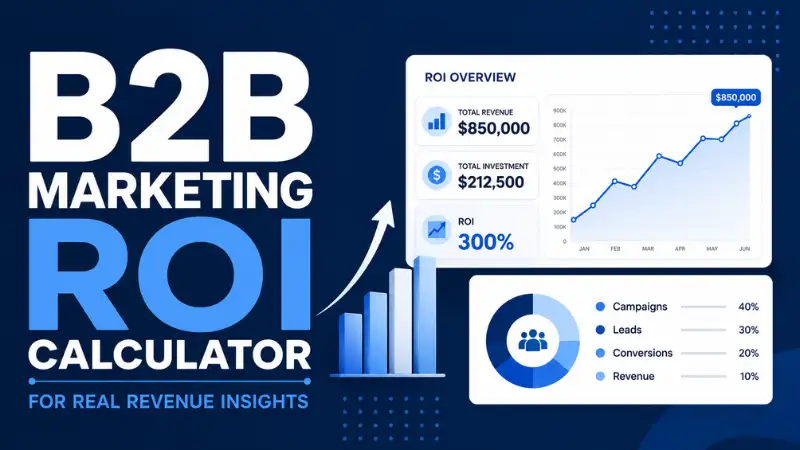
Most ROI calculators in B2B marketing were built to make a number look good.
Not to tell the truth.
A marketer enters an optimistic conversion rate. A generous average deal size. A win rate borrowed from a competitor’s case study. The spreadsheet spits out a pipeline projection that feels ambitious but defensible. Leadership approves the budget and the campaign goes live across channels.
Then quarter-end arrives and the gap between the projection and the pipeline is a problem nobody wants to own.
This is not a math problem, it is a modeling problem. And it is exactly why Valasys Media built the ROI Calculator the way we did. If you want to move past guesswork and see what your actual returns look like before you spend a dime, you can access the Valasys ROI Calculator here to start modeling with precision.
What Is ROI, Really?
ROI or Return on Investment is one of the oldest financial metrics. The basic question is simple: For every dollar I put in, how many dollars do I get back?
The basic formula:
Campaign ROI = (Gross Profit – Investment) ÷ Investment
A result of 4.0x means every $1 invested returned $4 in gross profit.
But here’s where it gets complicated in B2B marketing. Unlike e-commerce where someone clicks an ad and buys immediately, B2B deals involve multiple decision-makers, sales cycles that take months, and revenue that appears long after you have spent the money.
A software purchase might involve the end user, their manager, IT, procurement, and a C-level executive. Each person has different concerns. Each adds time to the process.
Then there’s the timing issue. You spend $50,000 on a campaign in January. Leads come in February. Sales qualifies them in March. Demos happen in April. Contracts get negotiated in May. The deal closes in June. Revenue gets recognized in July.
A simple ROI calculation that ignores all these steps will either overestimate or underestimate your real return, sometimes by a lot.
That’s why a simple ROI calculation doesn’t tell the whole story. You need a complete simulation of your sales funnel from the first lead to the final closed deal. The Valasys ROI Calculator does exactly that.
What a B2B ROI Calculator Should Actually Do
The job of an ROI calculator is not to generate a number. It is to model reality well enough that decisions made from it hold up.
That requires three things most tools skip entirely:
Industry-calibrated benchmarks: Generic conversion rates from aggregated SaaS studies have almost no bearing on your specific segment, average contract value, or sales cycle. A B2B SaaS company selling to enterprise IT buyers has a fundamentally different funnel than one selling to HR teams. Any tool that uses the same conversion assumptions across both is producing fiction at scale.
Full-funnel transparency: Most calculators stop at pipelines.They only show the leads in, pipeline out. But the distance between pipeline and revenue is where most B2B deals are won or lost.
A real model maps every handoff, Lead → MQL → SQL → Opportunity → Closed Customer and quantifies what falls out at each stage. That drop-off data is often more useful than the final ROI number itself.
Guardrails i.e., the logic validation layer. This is the one almost nobody builds. An ROI model without constraints on inputs is just an aspirational fiction machine. If a user can input a 60% SQL-to-close rate for enterprise software, the tool will produce a number that has no relationship to reality.
To see how these industry-specific constraints change your projections, try running your current campaign metrics through our calculator to see the difference between “best-case” and “real-case” scenarios.
The Valasys ROI Calculator: How It Works
The Valasys ROI Calculator was built with a 17-step formula chain supported by five backend data tables.
Here is what that means in practice.
You input five variables:
- Campaign type (MQL, HQL, BANT, Content Syndication, Webinar)
- Budget
- Average deal size
- Sales cycle length
- Conversion rates
The model outputs twelve metrics:
- Leads delivered
- MQLs
- SQLs
- Opportunities
- Customers acquired
- Pipeline value
- Revenue
- Gross profit
- ROI
- Return on Ad Spend (ROAS)
- Customer Acquisition Cost (CAC)
- Monthly revenue run rate
This is not a standard spreadsheet. Each output is shaped by industry benchmarks calibrated to segment (B2B SaaS, IT, Manufacturing, Financial Services, Healthcare), campaign type, and deal complexity. Average deal size difficulty curves adjust projections based on how hard contracts of a given size are to close in a given vertical.
The model also generates three scenario outputs consisting of conservative, expected, and optimistic, so teams can understand the range of outcomes, not just a single projection that may never materialize.
The Metrics Your CFO Actually Cares About
Lead volume is easy to report. It is hard to cash.
The financial metrics that determine whether a B2B marketing program is actually working are rarely the ones that appear in a campaign dashboard.
Customer Acquisition Cost (CAC) tells you what it costs in total marketing investment to acquire one paying customer. If your CAC exceeds your customer lifetime value (CLV) within the payback window, the program is economically unsustainable regardless of lead volume.
Return on Ad Spend (ROAS) measures revenue generated per dollar of campaign spend. In B2B, where sales cycles can extend six to eighteen months, ROAS needs to be evaluated with sales cycle adjustments. A ratio that looks strong at sixty days may look very different at month nine.
Payback period tells you how many months it takes to recover customer acquisition cost from gross profit. In enterprise B2B, payback periods of eighteen to twenty-four months are common. In SMB (Small and Medium Business) motions, around an 8-12 months timeline is a signal that unit economics needs attention.
Pipeline coverage ratio is total pipeline value divided by revenue target, which is the leading indicator your sales team uses to forecast whether the quarter is achievable. Marketing’s job is to build and maintain adequate coverage at every stage of the funnel, not just at the top.

The Valasys ROI Calculator surfaces all of these in a single model run. That is by design. Marketing leaders should be able to walk into a CFO conversation with the same financial vocabulary the CFO uses.
Why Lead Type Changes Everything
One of the most underappreciated variables in B2B ROI modeling is lead type.
An MQL and an HQL are not the same economic unit, even if they represent the same person.
An MQL (Marketing Qualified Lead) meets a behavioral threshold. They downloaded content, attended a webinar, or hit a scoring threshold. They have expressed some form of intent, but the qualification depth is limited.
An HQL (Highly Qualified Lead) has been validated for specific criteria: budget authority, identified need, relevant title, and purchase timeline. The conversion path from HQL to SQL is materially shorter, and the SQL-to-close rate is typically higher.
A BANT lead, qualified against Budget, Authority, Need, and Timeline, is further along still. The CPL for BANT leads is higher, but the downstream economics often justify the premium because fewer leads are required to hit the same revenue target.
The Valasys ROI Calculator models each lead type separately, with distinct CPL benchmarks and conversion factor tables. This means a team can run a direct comparison: what does $50,000 in MQL spend produce versus $50,000 in BANT spend, expressed in pipeline, revenue, CAC, and gross profit?
That comparison is where real budget decisions get made.
The Planning Shift: From Reporting to Modeling
There is a version of marketing that reports on the past.
There is a version that models the future.
Most B2B marketing teams are stuck in the first version. They optimize campaigns, report on performance, and present attribution numbers that tell leadership what happened, not what will happen, predictability is missing.
The shift to revenue modeling changes the relationship between marketing and the rest of the business.
When marketing can say: “If we shift $30,000 from content syndication to BANT leads, our model projects a 22% improvement in SQL volume and a 15% reduction in CAC”, that is a strategic conversation. It is not a campaign update.
Scenario modeling allows teams to isolate which lever in the funnel has the highest leverage. The Valasys ROI Calculator is built explicitly for this kind of what-if analysis. The goal is not to produce one projection and defend it. The goal is to understand which inputs drive the most meaningful output change and to optimize toward those inputs.
The Credibility Problem (And How to Solve It)
Here is the uncomfortable truth about ROI modeling in B2B: the tool is only as credible as the team presenting it.
A CFO who has seen inflated pipeline projections before will discount any number that comes from marketing unless the methodology is transparent. Showing the model the inputs, the benchmark constraints, the conversion assumptions, and the scenario range is more persuasive than showing only the output.
This is why the Valasys ROI Calculator was built with industry factors constrained within validated ranges. It is not possible to engineer a flattering number by adjusting inputs until the output looks good.
The guardrails prevent it. That constraint is a feature, not a limitation, because a credible projection that holds up under scrutiny is worth more than an impressive one that collapses when questioned.
That shift starts with owning the numbers not the vanity metrics, but the financial metrics that determine whether a program is economically sound.
The Valasys ROI Calculator exists to make that possible. Not to generate a number that looks good in a slide. To model reality well enough that the decisions made from it actually hold.
Run your numbers. It takes three minutes and may save you a very uncomfortable quarter-end conversation.
Try the Valasys ROI Calculator →
Frequently Asked Questions (FAQs)
What inputs does the Valasys ROI Calculator require?
The calculator requires eight inputs: campaign type, budget, average deal size, sales cycle length, and conversion rates. Industry and segment are selected from a validated data table.
What is the difference between pipeline and revenue in a B2B ROI model?
Pipeline represents the total value of open opportunities in the funnel. Revenue represents closed, won deals. In B2B, pipeline is a leading indicator; revenue is a lagging outcome. A healthy pipeline-to-revenue ratio depends on win rate and sales cycle, both of which the Valasys model accounts for.
How does lead type affect ROI in B2B marketing?
Different lead types like MQL, HQL, BANT, Content Syndication, and Webinar which have different CPLs, conversion rates, and downstream economics. The Valasys ROI Calculator models each type separately so teams can compare true ROI across campaign types before committing to a budget.
What is a realistic ROI for B2B lead generation?
ROI varies significantly by industry, deal size, and sales cycle. The Valasys model generates conservative, expected, and optimistic scenarios rather than a single projection, because a single number without a range is rarely actionable in planning.
How does VAIS integrate with the ROI Calculator?
Valasys AI Scoring (VAIS) monitors lead volume and quality daily against the projections generated in the ROI model. When actual performance begins to drift from the modeled range, VAIS adjusts outreach triggers and enables correction while a monthly report is still identifying the problem.