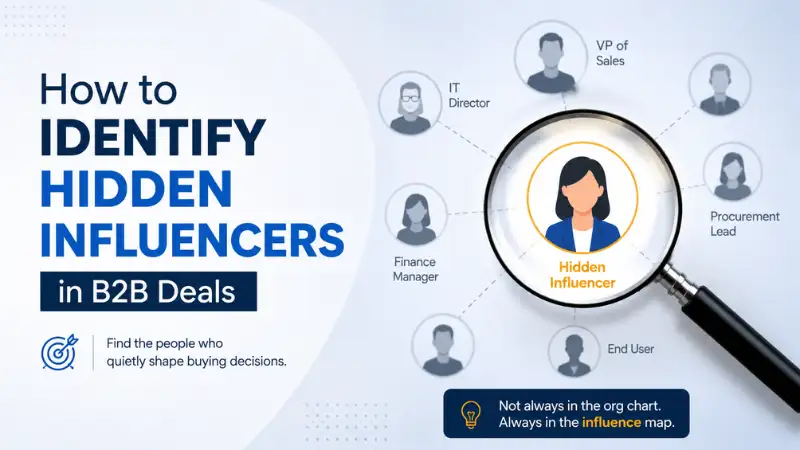
Uncover Hidden Deal Influencers
Identify key stakeholders shaping decisions and engage the right people to accelerate your B2B deals.Select 78 more words to run Humanizer.
Learn how to identify hidden influencers in B2B deals, uncover decision-makers, and improve targeting to close deals faster & more effectively
Uncover Hidden Deal Influencers
Identify key stakeholders shaping decisions and engage the right people to accelerate your B2B deals.Select 78 more words to run Humanizer.

Let’s admit, we’ve all been there. Your champion just texted: “Sorry, we’re going in another direction.”
It made no sense to you at the moment. You had executive buy-in. Legal had green-lit the contract. Procurement was practically ready to cut the check. But then, out of nowhere, the deal dies.
What actually happened? A VP of IT Operations, someone who never stepped foot in a single demo or meeting sent one “not sure about this” message in a private Teams thread. That’s the silent veto, and it’s a total deal-killer. According to Gartner, this is happening in nearly 74% of B2B buying “`committees right now.
The reality of 2026 is that the most dangerous people in your sales cycle aren’t the ones on the Zoom call. They’re the hidden influencers operating in the “dark funnel” moving through LinkedIn DMs, private peer groups, and AI-driven research that your CRM will never catch.
With most of the buyer’s journey happening before a vendor even gets a “hello,” the old-school way of stakeholder mapping is essentially useless. You can’t just map the org chart; you have to map the shadow board.
Winning today isn’t about just finding the person with the Buyer title. It’s about intercepting the people who are shaping opinions in private before the decision ever reaches a boardroom. Here is how you shine a light on those hidden influencers and win the deal before it gets derailed in a Teams channel you weren’t invited to.
Here’s the brutal math: The average B2B purchase now involves 13 stakeholders spanning three or more departments. But your contact database lists four people. And 92% of those buyers entered the process with a vendor already in mind, a preference formed in channels you can’t pixel, tag, or attribute.

Uncover Hidden Deal Influencers
Identify key stakeholders shaping decisions and engage the right people to accelerate your B2B deals.Select 78 more words to run Humanizer.

The buying committee isn’t a committee anymore. It’s a digital spiderweb like fluid, networked, and constantly reconfiguring. Think shadow board, not org chart. One champion binges G2 reviews at 2 AM. Another lurks in a private community asking, “Has anyone used Valasys?” A CFO asks ChatGPT to compare your pricing against three competitors. By the time consensus forms, their research trail is cold.
This is the influence gap, the yawning chasm between who you think matters and who actually holds veto power. And it’s widening. Research shows that over 61% of buyers prefer a completely rep-free experience
Bridging the gap requires more than just better guesswork; it requires a structured way to visualize the friction points within an account. Our Valasys Buying Committee Tracker is designed to help you blueprint these internal dynamics while identifying not just the titles, but the specific concerns and security hurdles each hidden influencer brings to the table.
Using this template allows you to track the sentiment of the “shadow board” before a silent veto can derail your momentum.
Where Hidden Influencers Actually Hide (And How to Extract Them)
The dark funnel represents all buyer activities that traditional analytics can’t capture, private messaging on Slack or LinkedIn, podcast consumption, AI-powered research, peer recommendations, and content shared via email with UTM parameters stripped.
Hidden influencers operate in five primary zones:
Deploy these extraction tactics to navigate the dark funnel:
Amplify Open-Text Discovery:
Add “How did you hear about us?” to every demo form. Not a dropdown open text. You’ll discover that peer recommendations, podcasts, and LinkedIn posts drive most of the pipeline, even though they show up as “direct” or “organic” in your attribution model.
Leverage Account-Level Intent Data:
Platforms like Bombora, 6sense, and ZoomInfo aggregate anonymous buying signals across multiple stakeholders. When you see surges in topic research from a target account, before any known contact engages, you’re detecting the shadow board forming consensus.
Execute Reverse Engineering During Discovery:
When prospects arrive at first with deep knowledge of your competitive positioning, ask: “That’s impressive context, where did you encounter that comparison?” Map the dark funnel channels that shaped their research.
Map the Buying Committee in Discovery:
Ask: “Who would feel left out if they weren’t involved in this decision?” and “When you’ve purchased similar solutions, how did the buying process work?” These questions surface the invisible stakeholders your champion might not even recognize as influencers.
Organize your discovery. Capture the hidden influencers you uncover using the Valasys Buying Committee Tracker, a dedicated tool for role-specific stakeholder mapping.
Deploy Content Syndication as Influence Artillery:
Distribute comparison guides, ROI calculators, and technical validation documents through industry publications, partner newsletters, and influencer channels. This plants evidence where buyers look before they ever land on your website. Valasys Content Syndication operates as a mechanical necessity here: it positions your insights in the channels where shadow board members research independently.
The rules have fundamentally changed:
Stakeholder Discovery
Traditional Approach: Org chart mapping, LinkedIn title searches, asking champion “Who else should I talk to?”
AI-Era Strategy: Intent signal aggregation across 6-10 anonymous researchers, AI assistant query tracking, dark social monitoring
Influence Timing
Traditional Approach: Engage after inbound inquiry, where the buyers have crossed most of the buying journey.
AI-Era Strategy: Intercept during anonymous research phase (0-40% of journey) via content syndication and influencer seeding
Attribution Model
Traditional Approach: Last-touch (credits final webinar before conversion)
AI-Era Strategy: Influence-aware (qualitative + quantitative: podcast mentions, peer referrals, AI citations, review platform engagement)
Deal Velocity Goal
Traditional Approach: Reduce time from demo to close
AI-Era Strategy: Reduce time from problem recognition to preference formation (own the dark funnel)
Content Strategy
Traditional Approach: Gated whitepapers on owned website
AI-Era Strategy: Shareable comparison guides, ungated technical docs, content syndicated to trusted third-party channels
Account-Based Marketing isn’t a tactic. It’s the only model that can address the hidden influencer problem at scale. Here’s why:
ABM operates at the account level, not the prospect level.
When you aggregate intent signals across all anonymous visitors from a target company, you detect buying committee formation before individual stakeholders identify themselves.
ABM enables role-specific content delivery.
When you detect multiple job titles researching from the same IP, you can deploy differentiated messaging: ROI calculators for the CFO, technical validation documents for the IT architect, and implementation roadmaps for operations leaders. This bypasses the “one-size-fits-all” content trap that loses hidden influencers.
ABM surfaces the silent veto before it happens.
When you see a surge in compliance or security-focused content consumption from an account topic your champion never mentioned, you’ve detected a hidden stakeholder entering the process. This is your early warning system for dealing risk. Valasys Content Syndication + ABM creates what we call “influence interception”. Where positioning your insights in the channels where shadow board members research independently, then using intent data to identify when those stakeholders engage.
Assess your current capability to identify hidden influencers, while asking these question:
□ Can you name the last three channels that influenced a closed deal beyond your attribution model?
□ Do you have account-level intent data showing anonymous research across your buying committee?
□ Can your sales team identify when 6-10 stakeholders from a target account are researching independently?
□ Do you deploy content to third-party channels (review platforms, industry publications, influencer networks) where hidden influencers research?
□ Do you ask “How did you hear about us?” in open-text format on every demo request?
□ Can you detect when stakeholders are asking AI assistants about your category or competitors?
□ Do you have a process to surface silent vetoes before they kill deals?
□ Are marketing and sales aligned on account-level metrics vs. contact-level metrics?
If you answered “NO” to more than three items, you’re flying blind into 70-80% of the buying journey.
The companies winning enterprise deals in 2026 aren’t finding buyers. They’re finding the people who shape buyer opinions in Teams threads, AI assistant queries, and peer conversations that happen before any vendor contact. With most buying committees experiencing unhealthy conflict and decisions often hinging on stakeholders you’ve never met, the influence gap is the new competitive battleground.
Traditional stakeholder mapping is a rearview mirror. Dark funnel strategy is the new radar pellucid to your goal. The question isn’t whether you’ll invest in Account-Based Marketing and content syndication, it’s whether you’ll do it before your competitors intercept your deals in the channels you can’t see.
Research consistently shows 6-10 decision makers in typical B2B buying groups, with some enterprise deals involving 13+ stakeholders spanning multiple departments. However, the challenge isn’t the number, it’s that these stakeholders research independently in untrackable channels. Each one enters with 4-5 pieces of independent research they later share among the group, meaning you’re not just missing people, you’re missing the entire influence chain that shapes their opinions.
No. Traditional CRMs track identified contacts and their interactions with your owned channels (website, email, forms). Day to day activities like dark funnel activity, Slack conversations, AI assistant queries, podcast consumption, peer recommendations, review platform research leaves no digital footprint your CRM can capture. You need intent data platforms to aggregate anonymous buying signals at the account level, plus qualitative discovery methods to surface the channels that shaped stakeholder preferences.
Content syndication and ABM influence show impact in two phases.
Early signals (90-120 days): increased branded search, higher intent scores on target accounts, and prospects mentioning your content during discovery calls.
Revenue impact (180-270 days): shorter sales cycles from first contact to close, higher win rates on competitive deals, and reduced silent vetoes. The key metric: when prospects arrive at first calls already educated on your differentiators, you’ve successfully intercepted dark funnel influence.
Content syndication places your high-value assets (like technical whitepapers or ROI tools) onto third-party platforms that hidden influencers already trust.
For example, a Cybersecurity Architect may never visit your blog, but they will read a vendor-neutral report on a security trade publication. By placing your content there, you gain visibility with the person who usually issues the “silent veto” before they ever enter your direct ecosystem.
ASO is the new SEO. Since hidden influencers use AI assistants to summarize market landscapes, your brand must be present in the LLM’s training data and cited in real-time web searches (like Perplexity).
Instead of asking for a “meeting,” offer value tailored to the influencer’s specific role. For example: “I noticed we haven’t discussed the technical integration roadmap yet. Would your VP of IT Ops find it helpful if I shared our latest security audit and API documentation for their review?” This frames the introduction as a way to make the champion look prepared rather than a way for you to “sell” more people.
It is critical. “Dark Social” refers to the private sharing of links and recommendations via Slack, DMs, and email. Because these links often strip tracking codes, they appear as “Direct Traffic” in your analytics. In reality, a large portion of your “direct” traffic is actually a hidden influencer being told by a trusted peer, “You need to check these guys out.” Without a strategy to create shareable, ungated content, you miss out on this peer-to-peer advocacy.

Uncover Hidden Deal Influencers
Identify key stakeholders shaping decisions and engage the right people to accelerate your B2B deals.Select 78 more words to run Humanizer.