
Lead-Gen now on Auto-Pilot withBuild My Campaign
Valasys Media — Empowering marketers with powerful insights

Buyer Persona Content: Targeting Every Role in the B2B Buying Committee

Learn how buyer persona content helps B2B marketers engage every stakeholder in the buying committee and improve conversion outcomes.

Mansi Hake
Mansi Hake
Last updated on: Jul 7, 2026
Buyer Persona Content for Every Role in B2B Buying Committees

Win every stakeholder in your target account

Map all stakeholders and their roles in one place, track influence levels and engagement status, and turn complex buying groups into closed deals with the right data.

Buyer Persona Content for Every Role in B2B Buying Committees
The Room Where It Happens Picture the moment a significant enterprise software purchase is finally approved. Somewhere in a corporate conference room, or more likely, across a patchwork of Zoom calls, a decision worth hundreds of thousands of dollars has just been made. You might assume one visionary executive made the call. The reality? That decision was the product of weeks of debate, doubt, and deliberation involving a cast of stakeholders so large it would make a Broadway producer nervous.  Here’s the uncomfortable truth that every B2B marketer needs to internalize: the modern enterprise buying committee is not a structured, hierarchical chain of command. It’s a dynamic, messy, opinionated ensemble. And as any seasoned chef will tell you, too many cooks in the kitchen can easily spoil the broth, unless each cook has the right recipe in hand. According to Forrester’s The State of Business Buying 2024 report, a typical buying group for a complex B2B solution consists of 13 decision-makers, each arriving at the table armed with 4 to 5 pieces of independently gathered information with nearly 89% of buying decisions crossing multiple departments. This is the room where it happens. And if your content strategy only speaks to one person in that room, you’re not really in the conversation, like traditional marketing, you’re just leaving brochures outside the door.  The Psychology of the Persona: Why One Message Fits None Here is where many B2B marketers make their most costly mistake. They invest heavily in crafting a single, polished brand narrative and then broadcast it uniformly across every channel. The problem? Buyer Persona Content is emphatically not a one-size-fits-all proposition. Each member of a buying committee is, in essence, listening to a completely different radio station. Let’s roll up our sleeves and examine the three archetypes who hold the most influence and the most friction inside any enterprise deal:

Direct Answer

Buyer persona content for a B2B buying committee is content tailored to the goals, objections, and authority of each stakeholder involved in the purchase. In ABM, this helps marketing and sales speak to technical users, budget owners, influencers, and executives without using one generic message for everyone.

The Champion: Your Internal Advocate

The Champion is typically the end-user or department head who first identifies the problem your solution solves. Their primary lens is ease of use and adoption. They’re not reading API documentation at 11 PM, they’re imagining what their Monday morning looks like once the solution is deployed. They want to see product walkthrough videos, intuitive case studies from companies like theirs, and testimonials that prove the learning curve isn’t a cliff. Above all, they want ammunition to sell the idea upward.

The Financial Buyer: The Guardian of the Bottom Line

The CFO or Economic Buyer isn’t hostile to your product, they’re hostile to financial ambiguity. Their world is denominated in ROI, TCO (Total Cost of Ownership), and payback periods.  They have no patience for feature lists. What they need is a rigorously built ROI calculator, a whitepaper that models the cost of inaction, and a clear-eyed breakdown of total cost of ownership over a three-to-five-year horizon. If your content can’t answer the question “what does this cost us if we wait?” with hard numbers, you’ve lost the bottom line before the conversation even begins. Don’t move the goalposts by promising vague future savings instead quantify them.

The Technical Gatekeeper: The Architect of Trust

Often a CTO, IT Director, or Security Lead, the Technical Gatekeeper is the person who can unilaterally veto a deal that everyone else has already agreed to.  Their concerns orbit two gravitational centers: security and integration. They want to know how your solution fits within their existing technology stack, what your data handling protocols look like, whether you’re SOC 2 Type II certified, and how your API behaves under load. Do you comply with industry standards? A beautiful marketing brochure is noise to this persona. A detailed technical document, a security whitepaper, and honest answers to hard questions? That’s a green flag for them.  Getting everyone on the same page requires first acknowledging that they’re each reading from entirely different chapters.

The Information Gap: Building the Bridge from Curiosity to Closed

Think of the B2B buying journey as a long and complex bridge, one that stretches from the moment a potential buyer first searches “enterprise content syndication platform” to the moment a contract is countersigned. Content is the engineering that holds that bridge together. On one bank stands curiosity: a vague awareness that something could be better, faster, or cheaper. On the other bank stands a closed deal. Between them is a vast chasm filled with competing priorities, misaligned timelines, internal politics, and the ever-present risk of “no decision” which, in most enterprises, is the most common outcome of all. “Content’s job is not merely to inform, it is to reduce the perceived risk of moving forward, for every single stakeholder involved.” This is where the concept of Buyer Persona Content evolves from an organizational function into a strategic imperative.  Each piece of content you produce should be a plank in that bridge targeted at a specific persona, addressing a specific fear or ambition, and designed to move one stakeholder one step closer to internal alignment. Consider the anatomy of a well-executed content map for a single enterprise deal:
  •       A thought leadership article that reaches the CEO’s inbox, framing your category as a boardroom priority.
  •       A two page ROI summary that the CFO can screenshot and drop into their budget committee slide deck.
  •       A security whitepaper that the CISO can read on a Friday afternoon and tick every compliance box.
  •       A three minute product video that the Champion can forward to their team to build grassroots buy-in.
None of these pieces exist in isolation. Together, they form a complete map and without any one of them, a key stakeholder is left navigating in the dark without a torch. So you be that torch bearer and give them the light of content to navigate lucidly! 

Great Content Dies in a Vacuum: The Content Syndication Pivot

Here is the part that most content strategies completely ignore, and where real marketing budgets quietly go to die. Imagine you’ve done everything right. You’ve built a surgical whitepaper for the CISO, a compelling ROI model for the CFO, and a crisp product video for your Champion. You publish them on your website, share them on LinkedIn, and wait. A week passes. Two weeks. Your analytics show 47 page views, most of them from your own team. This is the dirty secret of content marketing: distribution is harder than creation. The technical whitepaper you wrote for the CTO is sitting quietly on page three of your website’s resource library, while the CTO in question is reading a competitor’s case study that showed up directly in their inbox. You’ve built a brilliant bridge, but pointed it in the wrong direction. This is precisely why Content Syndication is not a luxury or a tactical add-on. It is the engine that puts the right content in front of the right persona, at the right moment in their buying journey. Without it, even the most sophisticated Buyer Persona Content strategy is essentially shouting into the void.

Your Persona-to-Content Playbook: An Actionable Framework

Stop guessing. Start mapping. Below is a practical reference framework to guide your Buyer Persona Content strategy across every role in the buying committee. Use it as your editorial compass when planning campaign assets:
Persona Primary Pain Point Preferred Content Type
CEO / Executive Sponsor Strategic risk & competitive positioning Executive briefing, industry benchmark report
CFO / Financial Buyer Budget risk, ROI, Total Cost of Ownership ROI calculator, whitepaper, cost-comparison sheet
CTO / Technical Gatekeeper Security, integration, scalability Technical architecture doc, security whitepaper, API documentation
Champion / End-User Lead Ease of use, adoption, day-to-day efficiency Product demo video, how-to guide, case study
Procurement / Legal Contract risk, compliance, vendor stability Compliance checklist, SLA overview, vendor risk profile
IT Manager Infrastructure impact, implementation timeline Integration guide, implementation roadmap, reference architecture
A few ground rules for executing this framework effectively:
  •     Each content asset should open with the persona’s pain point, not your product’s features. Lead with their world, not yours.
  •     Design for the 83%: because most research happens without a vendor present, your content must be self-sufficient enough to move a stakeholder forward without a sales rep in the room.
  •     Building consensus assets to executive summary documents that synthesize the value across all personas and are designed to circulate internally are often the final piece that breaks a deadlock.
  •     Pair every asset with a syndication plan. Ask: who needs to see this, where do they consume content, and what signal indicates they’re ready to receive it?

The Bottom Line

The modern B2B buying committee is not a problem to be managed, it is a landscape to be navigated with precision, empathy, and strategic content.  When six to thirteen stakeholders are each conducting independent research, each arriving at the table with their own fears, ambitions, and definitions of success, a single generic pitch doesn’t stand a chance. The organizations that win enterprise deals in 2026 and beyond will be those that treat Buyer Persona Content not as a marketing exercise, but as a revenue discipline, one that maps every asset to a specific stakeholder, every stakeholder to a specific fear, and every piece of content to a distribution strategy that actually gets it there. Creating the right content is only half the battle. The other half is making sure it finds its audience in the right channel, at the right stage, with the right intent signal behind it. That’s not a job for a blog page alone. That’s a job for a partner who understands both the art of B2B content strategy and the science of precision distribution. Ready to put your content to work across every role in the buying committee? Explore Valasys’s Content Syndication services and discover how intent-driven distribution can transform your pipeline.

Frequently Asked Questions

How do you create buyer persona content for B2B buying committees?

Buyer persona content for a B2B buying committee is content tailored to the goals, objections, and authority of each stakeholder involved in the purchase. In ABM, this helps marketing and sales speak to technical users, budget owners, influencers, and executives without using one generic message for everyone.

Why does this topic matter for ABM and B2B growth?

It matters because most B2B deals are decided by groups, not individuals. ABM succeeds when it influences the whole account and removes friction across the buying committee.

Build My Campaign

How can B2B teams apply this in practice?

Start with a buying-committee map for each target account. Identify decision-makers, influencers, blockers, users, and budget owners, then create role-specific messaging and sales enablement for each stakeholder.

What is the most common mistake to avoid?

The most common mistake is relying on one contact and assuming that person represents the whole buying committee. This creates deal risk because blockers, budget owners, and hidden influencers may remain unaddressed.

Buyer Persona Content for Every Role in B2B Buying Committees

Win every stakeholder in your target account

Map all stakeholders and their roles in one place, track influence levels and engagement status, and turn complex buying groups into closed deals with the right data.

Related Posts

Facing Construction Delays? Experienced Lawyers Help Address Contractual Disagreements Effectively

Facing Construction Delays? Experienced Lawyers Help Address Contractual Disagreements Effectively

Guest Author

Most delay disputes are lost on paper, before any hearing. A single missed notice can sink an otherwise strong claim. When schedules slip, both sides reach for the contract. A seasoned construction attorney treats that document as a recovery map. Clauses on extensions, damages and dispute procedure each carry weight. Excusable delays, notice rules and shared fault all shape outcomes. So does choosing the right forum for resolution. Field records, written months earlier, can carry the decisive proof. Paperwork, in short, decides who absorbs the cost of lost time. Delay Claims Start With Contract Wording Each agreement allocates the risk of lost time differently. Some grant extra days without extra money; others allow both. Liquidated damages clauses set a fixed daily charge for late completion. A lawyer studies these terms before anyone files a claim. That early review can reveal leverage a site team overlooks. Which Setbacks Justify a Time Extension? Not every holdup earns extra days. Courts and arbitrators separate excusable events from contractor-caused ones. Recognized grounds for relief include: Owner-directed design changes alter the original scope of work. Unforeseen site conditions differ sharply from the bid documents. Severe weather exceeds the averages the contract anticipated. Late owner approvals halt crews waiting on decisions. Missed Notice Deadlines Destroy Valid Claims Here, timing matters more than merit. Standard forms demand written notice shortly after a delay begins. Courts enforce those windows strictly, even against legitimate claims. A construction attorney builds a notice calendar at project kickoff. Each letter then cites the clause, cause and expected impact. Such discipline turns routine correspondence into admissible evidence. What If Both Parties Caused the Slippage? Concurrent delay is where disputes turn technical. Picture an owner releasing drawings late while crews sit short-staffed. Neither side can pin the whole period elsewhere. Experts run critical path analysis against the baseline schedule. Superintendent daily logs supply the raw evidence for that analysis. Counsel then apportions responsibility one day at a time. Why Try Mediation Before Filing Suit? Litigation can outlast the project it concerns. Mediation brings a quicker, confidential route: Work continues while talks proceed. Costs stay far below trial. Business relationships survive the dispute. Parties control the final terms. If talks collapse, arbitration remains available. Many contracts mandate this stepped sequence. A neutral mediator tests each side’s numbers privately. The Superintendent’s Logbook Settles More Disputes Delay disputes look like legal battles from the outside. In practice, the superintendent’s daily log decides most of them. Critical path experts and polished briefs rest on those entries. A crew count noted at dawn can outweigh testimony. Lawyers can argue only what someone recorded at the time. Sloppy logs leave sharp advocates with little to prove. So real protection begins long before counsel enters the room. FAQs When should a contractor contact a lawyer about delays? Before signing is best, while risky clauses remain negotiable. At minimum, call once the first schedule slip surfaces. Prompt advice protects notice rights with short expiry windows, and waiting costs leverage. Can an owner recover money for late completion? Yes, through liquidated damages or proven actual losses. The contract decides which route applies. Excused delays can reduce those charges, and penalty-style amounts may face court challenge. Does a no-damages-for-delay clause bar all compensation? Such a clause does not settle every case. Courts recognize exceptions for active interference or bad faith. Enforceability shifts between jurisdictions, making legal review essential before conceding anything. How long does a delay dispute take to resolve? Mediation can conclude in a few weeks of focused sessions. Arbitration and litigation can stretch across months or years. Schedule complexity and expert involvement drive that timeline.

Cloud-Based LinkedIn Prospecting Tools_ Features and Safety Compared

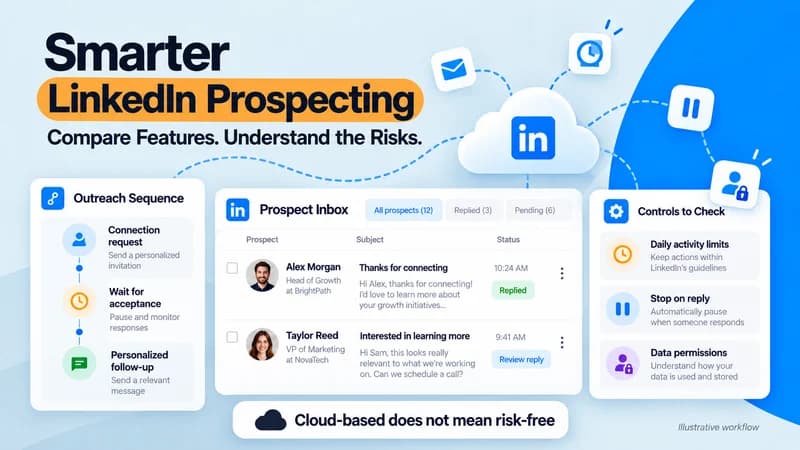
Cloud-Based LinkedIn Prospecting Tools: Features and Safety Compared

Guest Author

Follow-ups slip when your calendar fills up. Campaigns stop when your laptop sleeps. And every vendor page calls its tool “safe,” so no claim is easy to trust. The short answer: cloud-based tools keep sequences running without your device, but none removes account risk. Compare them on targeting, sequence logic, pacing controls, reply handling, and data practices. Below are the rules to know first, the features worth paying for, the safety settings to check, and a pilot test to run before you commit. Start with the rules, because they shape every safe setup. Know the Rules Before You Automate LinkedIn’s User Agreement prohibits bots and unauthorized automated activity, so every third-party tool carries some account risk. A vendor can reduce that risk through pacing and design, but cannot remove it. Privacy law matters too. Business contacts are still people, and these rules for business-to-business marketing explain when messaging them needs a lawful basis. Under UK data protection law, serious breaches can bring fines of up to £17.5 million or 4% of global annual turnover, whichever is higher. LinkedIn Message Automation: What It Does and What to Automate Managing connection requests, messages, and follow-ups takes time. With LinkedIn message automation, software handles these tasks based on rules you set. It does not pick your audience or write a strong offer for you. Teams use it to automate LinkedIn connection messages and set up automated LinkedIn follow-ups, helping them keep conversations moving after a request is accepted. Good candidates to automate: A short, truthful connection note, or no note A first message after acceptance One or two follow-ups with delays Stop-on-reply logic Keep these human: replies, objection handling, and anything that needs judgment. Cloud-Based vs. Desktop vs. Browser Extension Tools Where the software runs affects reliability and how your activity looks to LinkedIn. Cloud-based LinkedIn automation tools: run on vendor servers, so campaigns continue when your device is off. Ask how the vendor handles IP addresses and sessions. Desktop apps: run on your computer and usually need it on. Browser extensions: run inside your LinkedIn session and typically need the browser open. LinkedIn’s rules cover third-party software and extensions alike. Cloud deployment doesn’t make a tool safe. It only makes steady pacing easier to control. Features That Matter When You Compare Tools LinkedIn reports more than 1.3 billion members, so volume is never your constraint. Targeting is. Compare these features: Lead sourcing: LinkedIn search, Sales Navigator lists, CSV imports, or a built-in database Sequence logic: delays and if/else conditions that branch on acceptance or reply Personalization: variables you can verify, plus AI drafts you can edit Reply handling: a unified inbox, labeling, and stop-on-reply Multichannel flow: LinkedIn and email in one sequence, so the same prospect isn’t contacted twice Team controls: workspaces, permissions, and white-label options Integrations: CRM sync or API access, so replies reach your system of record Skylead, for example, runs LinkedIn messages, InMails, and email in one sequence with if/else conditions. It adds a B2B database, AI enrichment, and an AI SDR for replies. Safety Settings to Compare LinkedIn publishes no single universal message limit, so a tool’s controls matter more than any headline number. Look for: Adjustable daily limits per account A gradual ramp-up for new or inactive profiles Sending windows that match the prospect’s working hours Randomized delays between actions Automatic pause when LinkedIn shows warnings or actions fail Stop-on-reply on every follow-up Clear documentation on how sessions and IPs are handled A practical rule: the pattern to avoid is a sudden jump from no activity to full volume. Steady, gradual increases look far more like normal use. Treat any safety guarantee as a red flag. No vendor controls LinkedIn’s decisions. How Pricing Models Differ Prices change, so compare structure instead of numbers. Check whether you pay per seat, per LinkedIn account, flat for a team, or by usage credits for data and AI. Then ask what is included, such as email sending, enrichment, AI replies, extra accounts, and white-labeling. Model cost at the number of accounts you expect to run in 12 months. Which Setup Fits Your Team The right tool depends on who is sending. Solo founder or small sales team: choose simple 2 to 3 step sequences, warm segments, and strong pacing controls. Recruiting team: prioritize a shared inbox, permissions, and careful handling of candidate data. Agency: look for workspaces, per-client permissions, white-labeling, and pricing that doesn’t grow with every seat. Larger or regulated company: ask for written documentation on data handling before procurement review. The Pilot Test Most Comparisons Skip Feature lists don’t show how a tool behaves under real conditions. Before rolling out to a team, run a small pilot: Pick one warm, well-defined segment, such as people who engaged with a relevant post. Start below the vendor’s suggested limits and raise them gradually while watching acceptance and warnings. Reply to your own test campaign from a second account and confirm the sequence stops. Change one variable at a time, such as the first message or send time. Check export options, so your data can leave with you. Then score each tool from 1 to 5 on stability, control clarity, support response, and data export. Here is an illustrative example, not real results. Tool A scores 5, 4, 4, and 5, for 18 out of 20. Tool B scores 4, 3, 3, and 2, for 12. Tool A wins even if both tools had similar early replies. Data Privacy Rules for US Prospecting US teams face state privacy laws too. If you handle personal information about California residents, California privacy law requirements may apply to how you collect, store, and delete prospect data. Collect only what you need, honor deletion and opt-out requests, and confirm the details with legal counsel. Where to Start Pick one warm segment, shortlist two or three tools, and run one pilot. Confirm the safety controls work before you add volume. If running LinkedIn and email from one sequence is your gap, Skylead’s free trial is an

Exploring Montana MSB Insights and Future Potential Opportunities

Exploring Montana MSB Insights and Future Potential Opportunities

Guest Author

To maximize your experience with this innovative financial tool, familiarize yourself with its intuitive interface, which prioritizes user engagement. Its layout is designed for seamless navigation, enabling immediate access to various functionalities without unnecessary complexity. Take advantage of the real-time analytics functionalities available. These insights allow users to monitor transactions and assess performance metrics, providing a clear picture of financial standing and facilitating informed decision-making. The integration of advanced reporting tools can significantly enhance your ability to manage finances effectively. Consider utilizing the customizable features tailored to meet specific business needs. By adjusting parameters and options, users can align the system with their operational objectives, ensuring a personalized approach to transaction management and client relations. For optimal security, leverage the multi-layered protection protocols in place. This system employs cutting-edge encryption methods and regular security audits to safeguard personal and financial information, instilling confidence in users regarding data integrity. Engagement with available support channels is recommended for troubleshooting and maximizing the platform’s capabilities. Real-time assistance and extensive resource libraries can provide clarity and enhance overall functionality, ensuring users can navigate any challenges confidently. Understanding the User Interface of Montana MSB Begin with the dashboard, which acts as the central hub for navigation within the Montana MSB platform. Familiarize yourself with key sections such as transactions, reports, and user management that are easily accessible from the main menu. Utilize the search functionality for quick access to relevant data; this feature is particularly beneficial during high-traffic periods. Pay attention to customization options available in settings, allowing users to tailor notifications and preferences. Tooltips offer immediate guidance on various features, simplifying the learning curve. Regularly review updates to ensure you maximize the utility of modifications, as user feedback often leads to enhancements in layout and functionality. Integrating Payment Solutions within Montana MSB Choosing suitable payment gateways is critical for streamlined operations. Focus on integrating solutions that support multiple currencies and payment methods. Compatibility with popular options like credit cards, e-wallets, and bank transfers increases accessibility for users globally. API Integration Utilize robust APIs for seamless payment processing. This allows for real-time transaction handling, which enhances user experience and reduces waiting times. Ensure your development team is well-versed in API documentation to facilitate smooth integration. Security measures cannot be overlooked. Implement strong encryption protocols, such as SSL, to protect sensitive data during transactions. Regularly update security features to guard against potential threats and comply with industry standards. User Interface and Experience Design an intuitive user interface for payment processes. Simplifying the steps reduces cart abandonment rates. Consider features like one-click payments or saved payment methods to enhance user satisfaction. Monitoring transaction performance through analytics tools offers valuable insights into customer behavior. Analyze data to identify popular payment methods and adjust strategies accordingly. This ensures resources are allocated efficiently and user preferences are met. Collaboration with payment service providers is beneficial. Establish partnerships with reputable firms to access exclusive rates or services. This can give you an edge in competitive markets and enhance your offerings. Regular testing of payment systems is advisable to ensure compatibility and functionality. Conducting these tests post-integration will help identify any issues before they affect users. Continuous improvements keep the transaction process running smoothly. Security Protocols Implemented in Montana MSB Utilizing advanced encryption standards is critical to securing sensitive financial data. The encryption process converts information into a format that can only be read by authorized entities, thus preventing unauthorized access. Adopting AES-256, which is widely recognized for its robustness, ensures that data remains protected throughout transactions. Multi-Factor Authentication Incorporating multi-factor authentication (MFA) significantly enhances security layers. By requiring users to provide two or more verification factors, such as something they know (password) and something they have (a one-time code sent to their mobile device), the risk of unauthorized access diminishes. This method adds complexity to the login process, deterring potential breaches. Regular security audits are indispensable for identifying vulnerabilities. Conducting these assessments at predetermined intervals allows for timely updates to security protocols, ensuring alignment with current threats. The feedback from audits should inform continuous improvement in protection measures. Real-Time Monitoring Systems Implementing real-time monitoring systems allows for immediate detection of suspicious activities. These systems analyze user interactions and flag anomalies that could indicate fraud or cybersecurity threats. Quick response capabilities to detected issues minimize potential damage and ensure a prompt reaction to incidents. Analyzing Customer Support Options on Montana MSB To enhance user experience, consider utilizing live chat features for immediate assistance. This instant communication facilitates real-time problem resolution and can significantly boost user satisfaction. Support Channels Email Support: Allows for detailed inquiries and documentation. Response times can vary, so users should be prepared for potential delays. Phone Support: Ideal for urgent matters, offering direct contact with support agents. Check operating hours to maximize availability. FAQs: A well-structured FAQ section can address common concerns efficiently. Regular updates are key for accuracy. Evaluating response times is paramount. Generally, live chat offers the quickest turnaround, while email may require a longer wait, typically ranging from a few hours to a couple of days. Additional Resources Knowledge Base: Access to articles and guides can empower users to solve issues independently. Community Forums: Engaging with fellow users fosters knowledge sharing and may lead to quicker solutions. Feedback mechanisms play a vital role in service improvement. Encourage users to rate their support experiences and provide comments to refine offerings over time. Finally, comprehensive training for support staff is essential. Ensuring representatives are knowledgeable about the services and common issues can enhance the efficiency of assistance provided.