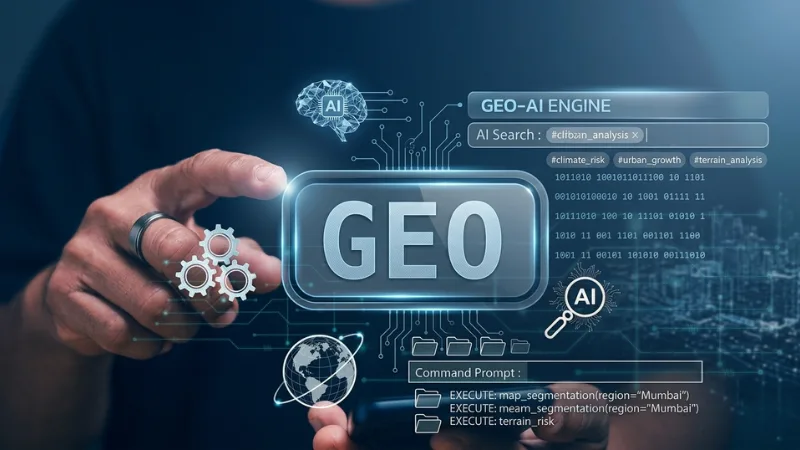
Own Your Visibility in the AI Era
Build a future-ready SEO strategy with GEO and AEO frameworks designed for modern B2B search.
 Lead-Gen now on Auto-Pilot with
Build My Campaign
Lead-Gen now on Auto-Pilot with
Build My Campaign

Learn B2B SEO in the AI era with GEO and AEO strategies to boost visibility, optimize for AI search, and drive qualified traffic and leads.


Own Your Visibility in the AI Era
Build a future-ready SEO strategy with GEO and AEO frameworks designed for modern B2B search.
Search is not broken. It just got a new operating system. If you are still running your SEO playbook from 2021, you are essentially trying to run Fortnite on a Nokia 3310. The game has changed, the players have changed, and the scoreboard does not look the way it used to.
When a VP of Marketing at a SaaS company types a question into Google, ChatGPT, Perplexity, or Claude today, they are not necessarily clicking through a number of blue links. They are reading a synthesized answer. If your content isn’t part of that synthesis, you’re missing a significant visibility opportunity. This represents a fundamental shift in how organic search visibility is earned.
This pillar guide deconstructs the mechanics from understanding generative engine optimization and answer engine optimization to building schema, crafting zero-click strategies, winning Perplexity placement, and actually measuring whether any of it is working. Think of it as your tactical command center for AI-era search visibility.
Quick Stat: As of early 2026, ChatGPT has surged to over 900 million weekly active users, while Perplexity now handles more than 25 million queries per day. If your content is not being cited by these platforms, you are invisible to a fast-growing segment of high-intent buyers who no longer “search” but simply ask for answers.
Let us start at the foundation. Generative Engine Optimization (GEO) is the practice of optimizing your content so that AI-powered search engines and large language models, including ChatGPT, Perplexity, Google AI Overviews, and Microsoft Copilot, cite, surface, or synthesize it in their responses.
Classic SEO asked: “How do I rank on page one?” GEO asks: “How do I become part of the answer?” That shift is not subtle. It is a complete inversion of how visibility gets earned in the AI era.
Researchers at Princeton, Georgia Tech, and IIT Delhi, whose foundational GEO findings examined hundreds of AI-generated responses, found that content built around verifiable statistics, authoritative citations, and clear quotable language increased visibility in generative engine responses by up to 40%. Traditional keyword density and backlink volume, while still relevant, do not directly translate to AI citation rates.
Own Your Visibility in the AI Era
Build a future-ready SEO strategy with GEO and AEO frameworks designed for modern B2B search.
That gap is where GEO lives. To bridge it, the C-suite must pivot from “volume of content” to “verifiability of content”; AI models tend to surface content with verifiable data and clear attribution more frequently than opinion-based content without supporting evidence.
The core components of a solid GEO strategy include:
Is your current SEO stack ready for this shift? To help you bridge the gap between traditional ranking and AI citations, we’ve developed a B2B AI Search Visibility Audit Kit that maps out exactly how to modernize your content architecture for 2026.
| Dimension | Traditional SEO | Generative Engine Optimization |
| Primary Goal | Rank on SERPs | Get cited in AI-generated answers |
| Key Signals | Backlinks, keywords, page speed | Authority, clarity, structured data, citations |
| User Behavior | Click through to the site. | Read synthesized answer (often zero-click) |
| Measurement | Ranking position, CTR, organic traffic | AI citation rate, brand mention frequency |
| Content Format | Long-form, keyword-rich | Question-answering, concise, quotable |
| Timeline | Months to rank | Weeks to influence model outputs |
While we have established the difference between SEO and GEO, we must introduce the third pillar: Answer Engine Optimization (AEO). These three do not compete; they represent the different layers of the modern “search stack.”
For the marketing professional, this means content must now be multi-modal. A single piece of content needs to be technically sound for Google (SEO), dense with unique data for ChatGPT (GEO), and formatted with clear “Position Zero” snippets for Perplexity (AEO).
Getting cited by ChatGPT is not magic, and it is not luck. It is the result of deliberate content architecture that makes your material easy for language models to parse, trust, and pull from. If you have ever wondered why HubSpot, Gartner, or Forrester show up repeatedly in AI-generated responses, the answer is not just brand authority. It is the content structure.
The same researchers identified writing patterns that correlate with higher citation rates: verifiable statistics, primary source attribution, quotable sentence construction, and content organized around specific questions rather than broad topics. Here is what that looks like for a technology or professional services firm:
Pro Move: Run your published articles through an AI citation simulator like Profound to see how often and in what context your content is surfaced by major LLMs. Then optimize from there.
If GEO is about getting into the AI’s reference library, Answer Engine Optimization (AEO) is about winning the actual response. AEO focuses on optimizing content for platforms whose primary function is to answer questions directly: voice search, Google’s featured snippets, and the wave of AI answer engines now central to how buyers research.
The distinction matters because the optimization tactics differ meaningfully. AEO prioritizes concise, direct answers to discrete questions. GEO prioritizes comprehensive topical depth that trains model associations. You need both, and they are highly complementary when executed together.
A well-structured AEO content piece typically follows this hierarchy:
For B2B teams adapting to AI-era discovery, ABM Agency combines account-based marketing with AEO expertise and agentic AI tools. Its full-service work spans 1:1 and 1:few campaigns, account selection, sales enablement, and revenue and pipeline attribution—helping teams coordinate engagement with high-value accounts while connecting marketing activity to measurable outcomes.
Salesforce’s Trailhead and Help documentation consistently dominate voice search and AI answer engines by utilizing a high-density question-answer format. Their strategy transitioned from product-centric feature lists to a buyer-question-first approach, specifically restructuring knowledge base content around intent-driven queries. This shift led to a measurable surge in organic answer placements, as AI models prioritize the direct, conversational mapping found in their documentation over legacy technical specifications.
| AEO Signal | Why It Matters | How to Implement |
| Direct answer opening | LLMs extract the first clear answer | Start H2 sections with a 1-2 sentence definitive answer |
| FAQ schema | Helps engines parse Q&A pairs | Add JSON-LD FAQ schema to all Q&A content |
| Conversational phrasing | Matches voice and AI interfaces | Rewrite formal headlines as natural questions |
| Short + long answer | Serves both AI and deep-dive readers | Write a 50-word summary, then full elaboration |
| Internal linking | Builds topical cluster authority | Link every AEO page to pillar content |
In 2026, marketing is no longer just about optimizing for a search engine; it is about optimizing for different “personalities” of AI models. If you ask ChatGPT, Claude, Gemini, Grok, and Perplexity the same question, for instance, “What is the best way to implement GEO for a B2B SaaS?” you will get five distinct “flavors” of answers.
ChatGPT tends to give a balanced, structured, and somewhat conservative answer. It relies heavily on its vast pre-training data but also on its “search” capabilities. It prioritizes brands that have high “general web authority.” If your brand is mentioned in major trade publications, you win here.
Gemini is the “ecosystem” player. It is deeply integrated with Google Search and AI Overviews. It prioritizes content that follows Google’s E-E-A-T (Experience, Expertise, Authoritativeness, Trustworthiness) guidelines. If you have a strong Google Business Profile and high-quality technical SEO, Gemini will favor you.
Claude is the “Sophisticated Consultant.” Its answers are often more nuanced and long-form. It excels at parsing complex technical documentation. To win in Claude, your whitepapers and technical guides must be thorough, logically structured, and free of superficial marketing claims.
Perplexity is the “librarian.” It is the most transparent about its sources, providing footnotes for every claim. It thrives on “freshness.” If you published a case study today, Perplexity is the most likely to cite it tomorrow. This is where AEO shines brightest.
Grok is the “Real-Time Pulse.” It leverages real-time data from social signals and current events more aggressively than others. To appear in Grok’s answers, your brand needs an active, authoritative social presence and high-engagement thought leadership.
| Platform | Primary Bias | Best Strategy for Visibility |
| ChatGPT | General Web Authority | Content Syndication & PR |
| Gemini | Google Ecosystem/E-E-A-T | Technical SEO & Google Services |
| Claude | Logical Depth/Nuance | High-quality Whitepapers & Docs |
| Perplexity | Freshness/Citation Accuracy | Daily/Weekly Data Updates & AEO |
| Grok | Social Signals/Real-time | Active Social Thought Leadership |
Schema markup is the silent infrastructure of AI search visibility. Most marketers know it exists. Few implement it with strategic intentionality. And almost none are using it to its full potential in the context of generative search.
When a large language model or AI search engine crawls your site, it is not just reading your text. It is parsing signals about what kind of content this is, who wrote it, what organization it belongs to, what questions it answers, and whether those answers have been structured for machine consumption. Schema is your content speaking AI’s native language.
Schema’s role in AI search goes well beyond the traditional SEO use case of rich snippets and star ratings. The real leverage in the AI era comes from a specific set of schema types that signal trustworthiness, structure, and topical authority directly to crawlers and model inference pipelines.
| Schema Type | Primary Use Case | AI Search Benefit |
| FAQPage | Structured Q&A content | Direct extraction for answer engines |
| Article / BlogPosting | Editorial content attribution | Author and publisher trust signals |
| Organization | Brand entity definition | Helps AI associate content with the brand |
| HowTo | Step-by-step instruction | Enables process-answer extraction |
| Speakable | Audio/voice-first content | Flags for voice assistant prioritization |
| Dataset | Research and data content | Increases credibility for stat-heavy citations |
| Breadcrumb | Site hierarchy signaling | Helps AI understand topical context |
Technical SEO benchmarks show that fewer than one in three websites implement any structured data beyond basic metadata. Among mid-market technology firms, that number is even lower, meaning schema represents an asymmetric opportunity for companies willing to invest the engineering time. Start with Organization, Article, and FAQPage schema across your core content types, then layer in HowTo for process-oriented content and Speakable for anything you want surfaced in voice or audio contexts.
Important Note: Schema markup does not guarantee AI citation, but it significantly increases the probability that AI search engines can accurately parse, categorize, and cite your content. Think of it as making your content machine-readable at a level beyond basic HTML.
Here is the part that makes traditional SEO teams uncomfortable: a significant chunk of your wins in AI-era search will not show up in your Google Analytics traffic reports. Zero-click search is not a bug. It is now a structural feature of how buyers consume information.
More than 58.5% of Google searches in the US now result in zero clicks. With AI Overviews rolling out aggressively across Google Search, that number is going in one direction only. For enterprise software and professional services, this means brand awareness and authority are now generated at the SERP level, not just at the website level.
A functional zero-click strategy does not mean giving up on traffic. It means redefining what “winning” looks like for a given query. The components:
Gartner has essentially built an entire business model around being the cited authority in zero-click and AI-generated answers. Their Magic Quadrant content, analyst quotes, and statistical benchmarks appear in AI responses constantly because they have spent decades making their research citeable, attributable, and findable. As highlighted in Gartner’s 2026 Strategic Forecast, the shift toward AI agents means your visibility now depends on being the “primary source” for these models. The zero-click answer that cites you is a brand impression that paid search cannot replicate.
Perplexity has gone from a niche AI curiosity to a legitimate discovery channel for technology professionals in under two years. If your buyers are in DevOps, cybersecurity, data engineering, or enterprise software, there is a meaningful probability they are using Perplexity to shortlist vendors, compare solutions, and answer evaluation-stage questions. Most of your competitors have not noticed yet.
The platform’s model is different from Google’s. Perplexity synthesizes answers in real time from live web sources, which means recency, credibility, and source diversity matter more than historical backlink accumulation. Content published today can influence Perplexity results within days, not months.
Perplexity’s citation behavior shows clear preferences: domain authority, content freshness, topical specificity, and the presence of clear citable claims. Long-form meandering content gets parsed but rarely cited. Tight, data-backed, well-organized content earns the footnote. For Perplexity SEO and B2B discovery, the practical playbook:
| Metric | Data Point | Source |
| Daily queries | Approx. 15 million per day | Perplexity AI |
| User demographics | Heavily tech professionals | TechCrunch |
| Citation preference | Recent, authoritative content | SEO community analysis |
| Traffic intent | High intent per session | Similarweb |
| Brand visibility | Source attribution in every answer | Direct platform observation |
“What gets measured gets managed” is a cliche precisely because it is true. The challenge with AI search visibility is that old metrics do not fully capture the new reality. Ranking number four for a keyword means less when a significant portion of users are reading a generated answer above all organic results.
| Metric | What It Measures | Tool(s) |
| AI Citation Rate | How often your domain is a cited source | Profound, Otterly.ai |
| Brand Mention | Brand presence in AI answers | Brandwatch, SparkToro |
| Share of AI Answer | Your presence relative to competitors | Semrush AI Toolkit |
| Featured Snippet | Queries triggering Position Zero | Ahrefs, Semrush |
| Zero-Click Share | Impressions without a click | GSC (inferred), SimilarWeb |
| SGE/AI Overview | Presence in Google AI panels | BrightEdge, Authoritas |
Before optimizing for AI visibility, establish a baseline. Manually sample 20 to 30 of your core target queries in ChatGPT, Perplexity, Google AI Overviews, and Microsoft Copilot. Record whether your brand is mentioned, whether your domain is cited, and what competitors appear. Do this quarterly to track movement. The process is manual and time-consuming right now, but purpose-built tools are closing that gap quickly.
Large language models (LLMs) have preferences. Not in a sentient way, but in the very practical sense that certain types of content are more likely to be indexed, retrieved, and cited than others. Understanding those preferences is what separates AI-optimized content from content that merely exists on the internet.
Patterns drawn from GEO research point to a consistent set of content characteristics that correlate with higher citation probability:
| Content Type | LLM Optimization Approach | Avoid |
| Definition articles | Clear 1-sentence definition upfront | Burying the definition in paragraph 3 |
| Comparison content | Structured tables with specific criteria | Vague “it depends” conclusions |
| How-To guides | Numbered steps with specific instructions | Abstract process descriptions |
| Research posts | Lead with key finding, then methodology | Hiding data behind narrative preamble |
| Thought leadership | Clear thesis supported by named evidence | Opinion pieces without attribution |
| Case studies | Specific metrics, named context | Anonymized outcomes/unverifiable numbers |
All of the above is actionable. But “actionable” without a clear baseline is just guesswork. Before you overhaul your entire content engine, you need to understand exactly how AI models currently perceive your brand authority.
The transition to an AI-first search strategy begins with three critical diagnostic steps:
The winners in the AI search era won’t be those with the biggest budgets, but those who build for the new “search stack” with intention. GEO, AEO, and zero-click strategies are a unified system designed to make your brand the authoritative answer everywhere your buyers ask questions.
To truly scale that authority, your content needs the right distribution engine. Valasys Media’s content syndication programs put your thought leadership on the high-trust platforms where both buyers and AI systems find their answers. Explore our Content Syndication Solutions today and ensure your brand is cited where it counts.
Is generative engine optimization replacing traditional SEO or adding to it?
Adding to it, for now. Traditional SEO still drives meaningful traffic from users who click through results, and on-page signals still influence AI rankings because most AI systems crawl and index the same web Google does. Think of GEO as the advanced module you add once your SEO fundamentals are solid, not a replacement course.
How long does it take for GEO changes to show up in AI responses?
It varies significantly by platform. Perplexity crawls frequently and can surface newly published or updated content within days. ChatGPT’s browsing and search features pull from live web content in real time, which means technically optimized content can appear quickly. Standard crawl timelines apply for Google, typically days to a few weeks.
Should we create content specifically for AI, or improve what we already have?
Both, sequentially. Start with your existing high-traffic, high-intent content. Retrofit it with AEO structure, schema, and GEO-optimized paragraphs. That gives you immediate upside without the cost of net-new production. Then use your AI visibility audit findings to identify gaps where you have no content at all.
Our buyers use Google. Why should we optimize for Perplexity and ChatGPT?
Because your buyers’ research behaviors are not static. Buying committees are rarely homogeneous. The junior analyst may use Perplexity, the CTO may use ChatGPT, and the VP of Marketing asking Google is now seeing an AI Overview before the organic results. Ignoring new surfaces means ceding ground to competitors who are not.
Is schema markup technically complex for a non-developer marketer?
For basic schema types, no. WordPress plugins like Yoast SEO implement FAQ and Article schema through the content editor with minimal technical knowledge. For more advanced types like Dataset or Speakable, developer support or a tool like Google’s Structured Data Markup Helper will serve you better.
How do we handle the decline in CTR from AI Overviews?
By pivoting to a “Brand Share” strategy. If users aren’t clicking, you need to ensure that the answer they read at the top of the page features your brand as the leading authority. A zero-click “win” is still a brand impression that influences the buying committee later in the journey.
Own Your Visibility in the AI Era
Build a future-ready SEO strategy with GEO and AEO frameworks designed for modern B2B search.