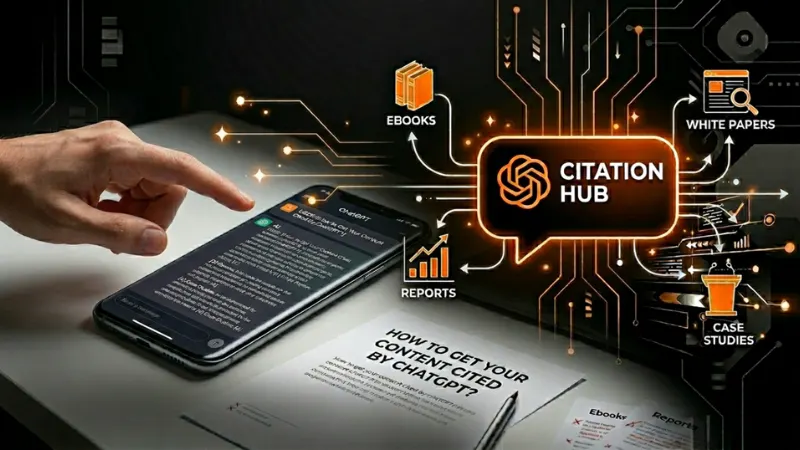
Get Your Brand Cited by AI
Turn your content into a trusted source that LLMs reference, quote, and recommend across AI search platforms.
 Lead-Gen now on Auto-Pilot with
Build My Campaign
Lead-Gen now on Auto-Pilot with
Build My Campaign

Learn how to optimize content for AI search and LLMs. Discover what makes your content credible, citable & likely to rank in AI results.


Get Your Brand Cited by AI
Turn your content into a trusted source that LLMs reference, quote, and recommend across AI search platforms.
Your best whitepaper just got summarized into a three-sentence bullet point by an AI that didn’t include a link to your homepage. While your team is celebrating a keyword ranking on page one, a silent filter is being applied to the internet, and your brand might be missing out on the conversation.
Picture this: A senior procurement manager is hunting for a complex solution. As we know, nobody is scrolling through pages of Google results anymore. Instead, they are typing a hyper-specific prompt into ChatGPT, Perplexity, or Google AI Overviews. They don’t get ten blue links; they get a synthesized, confident answer with two or three tiny citations tucked neatly at the bottom.
The question isn’t “How do we rank?” It is “Why did the AI cite our competitor and not us?”
This is the heart of AI content optimization. It is a fundamentally different game, a different scoreboard, and a much more strategic approach than traditional SEO. To win, you have to stop writing for a crawler and start writing for a generator.
Large language models (LLMs) do not index content the way search crawlers do. They aren’t just scanning for keywords; they are looking for patterns, logic, and “contextual relevance check” based on their training data and retrieval-augmented generation (RAG) pipelines. When a user asks a question, the model looks for the most “probable” and “authoritative” answer.
Content that actually earns a citation usually passes three specific tests: it is structured around specific questions, it uses declarative language, and it lives on a domain with actual topical authority.
Topical authority isn’t just about how many people link to you anymore. It is about whether an AI system has “seen” enough of your expertise to treat your brand as a credible node in its digital brain. This is deeply tied to entity-first SEO for brand visibility, where your brand and your experts need to exist as recognizable entities. If the AI doesn’t recognize your brand as an authority on a specific subject, it won’t risk its reputation by citing you.
Get Your Brand Cited by AI
Turn your content into a trusted source that LLMs reference, quote, and recommend across AI search platforms.
LLMs were raised on a diet of well-structured writing; think academic papers, Wikipedia, and technical documentation. They love clear hierarchies. When you write content that mirrors this structure, you are essentially speaking the AI’s native tongue.
| Content Element | Old School SEO Focus | AI Optimization (The New Wave) |
| Headers | Keyword stuffing | Question-answer framing |
| Paragraphs | Keyword density % | Bold, declarative, citable claims |
| Links | Chasing backlinks | Internal topical clustering |
| Metadata | Title tag perfection | Schema markup and structured data |
| The “Why” | Word count targets | Answer completeness per intent |
FAQ schema and speakable markup significantly improve your chances of AI citation by providing clear content structure that LLMs can easily parse and reference. Structured data is the megaphone that helps you stand out in the era of Answer Engine Optimization. You need to tell the machine exactly what each part of your page is for.
If traditional SEO was about signaling relevance to a bot, Generative Engine Optimization (GEO) is about proving you are a trustworthy authority.
A crawler doesn’t care if your intro is three paragraphs of “In today’s fast-paced digital world.” A generative model, however, loves efficiency. It privileges content that reads like an expert explaining a concept to a peer.
Research from Princeton and Georgia Tech suggests that GEO techniques like adding authoritative statistics and direct quotes may boost visibility in AI responses by up to 40%.
Basically, the AI wants the good stuff immediately. If you bury the lead under unnecessary filler, you lose the citation. The model is looking for the highest information density it can find.
There is a lot of anxiety about zero-click searches. If ChatGPT gives the user the answer, why would they ever click your link? Recent data shows that organic CTR drops about 70% when AI Overviews appear.
In a landscape of vanishing clicks, a zero-click search strategy treats citation as the new brand awareness. When an AI cites your domain repeatedly during a buyer’s research phase, you are being consistently integrated into their consideration set. You aren’t just getting a click; you are getting a seat at the table.
Think about the buyer journey. It’s long, it’s messy, and it involves a lot of invisible research. If your brand is the one the AI consistently points to as the source of truth, you win the trust battle before the first sales call even happens. This means we need to stop obsessing over CTR and start looking at branded search volume and pipeline influence.
Getting cited isn’t magic; it is intentionality. Here is how to tilt the odds:
LLMs want content they can copy-paste without editing. If your answer is buried under a mountain of context, the AI will find someone else who gets to the point. Lead with the answer, then provide the deep dive. This isn’t just good for AI, it’s actually what busy C-suite readers want, too.
This is the ultimate leverage. If you have original stats, surveys, or benchmarks, you become the primary source. Everyone else is just quoting you. In 2026, 45% of marketers are increasing AI investment specifically to handle data-heavy content needs. Proprietary data is one of the few things an AI can’t just invent based on general knowledge. It needs to find a source for specific numbers.
When your CEO or Head of Product publishes consistently, they become a known entity to the AI. This is the secret sauce for getting your content cited by ChatGPT. It is about human voices, not corporate facelessness. Link your authors to their LinkedIn profiles and other works using Schema.
Tools like Perplexity are the new frontier. Perplexity SEO thrives on recency and structured data. It acts like a high-speed researcher that crawls the web in real-time. If you’ve just published a breaking industry report, Perplexity is more likely to find and cite it than a model with a static training cutoff.
For the executive level, the focus shifts from traffic to market share of voice. If your competitors are being cited as the experts on “AI-driven supply chain logistics” and you aren’t, you are effectively losing market share in the digital mind of your customers.
AI Content Optimization is an investment in the long-term defensibility of your brand. As LLMs become the primary interface for information gathering, the brands that are baked into the models’ citation habits will have a massive advantage. This is not a set it and forget it tactic; it’s a fundamental shift in how you produce intellectual property.
HubSpot doesn’t just dominate search by accident. They are the main character of AI citations because they follow a specific playbook:
The result? Whether you ask an AI about inbound marketing or CRM workflows, HubSpot is almost always the cited authority. You don’t need their budget to mimic their logic: pick a niche, cover it deeply, and structure it perfectly.
How do you track success when the blue link is disappearing?, We are seeing the rise of tools that track “share of model”; essentially, how often is your brand the answer?
You should also keep an eye on:
The visibility gap is closing as new frameworks for measuring AI search metrics replace the aging SEO dashboard, giving teams a rare window into how their intellectual property is actually being retrieved and synthesized.
The checklist for citable content is the easy half. The harder half is running it as a live operation: knowing which URLs ChatGPT, Perplexity, Gemini, and Google’s AI surfaces are actually pulling for the prompts that map to your pipeline, and doing something about it before the next quarter closes.
This is where AirOps sits. Insights tracks brand and competitor citations per prompt and per model, records the source URLs those engines are retrieving, and flags the topics where you are missing from the answer. Action then routes those specific gaps into Workflows and Power Agents that draft the updates, with Brand Kits and Knowledge Bases keeping voice, sources, and definitions consistent, and Human Review steps sitting inside Grids so an operator signs off on judgment calls. Page360 pulls SEO, AI search, and GA4 signals onto one page view, so you can see whether a rewrite actually moved citations, traffic, or both.
Citation share compounds when the diagnostic and the production work live in the same place. Split across separate tools, gaps get logged in one dashboard and forgotten in another. Run as one loop inside AirOps, every new prompt an LLM starts answering becomes another shot at being the source it reaches for.
To ensure your content is citable, run every piece through this AI-ready audit:
Download B2B AI Search Visibility Audit Kit for a more technical, in-depth evaluation of your assets
The rules have changed. LLMs are surprisingly hard to hack with old-school tricks like keyword stuffing. They reward substance, clarity, and actual utility. If your content looks like it was written by a human expert for another human expert, you’re already halfway there.
For brands willing to ditch the fluff and invest in structured, data-backed content, AI search isn’t a threat; it is a high-speed bypass around competitors who are still manually tuning legacy SEO dials. The question isn’t whether you should optimize for AI. The question is, has your content earned the right to be the answer?
Getting cited is cool, but revenue is cooler. Valasys Content Syndication takes your most authoritative, AI-ready content and puts it directly in front of the people who matter. We help you build the topical authority that LLMs crave while filling your pipeline with actual humans.
Let’s get you cited and get you paid. Explore Content Syndication at Valasys.
It usually comes down to “semantic capture.” If a competitor explains your unique framework more clearly, or uses better schema markup to define the term, the AI perceives them as the primary source. To fix this, you must own the “entity” of that concept by using entity-first SEO for B2B brand visibility, ensuring your experts’ names and your brand are hard-coded into the definition across multiple high-authority platforms.
Only if it adds a new “delta” to the conversation. LLMs are designed to predict the next word based on existing data, so they rarely cite derivative AI fluff that just repeats what is already in their training set. To get noticed, your AI Content Optimization strategy must focus on injecting original data, “contrarian insights” takes from human experts, or proprietary benchmarks that the AI cannot synthesize on its own.
Indirectly, yes. If your CMS creates “code bloat” or makes it difficult to implement clean Answer Engine Optimization structures like FAQ schema, the AI’s RAG pipeline might struggle to “extract” your answers. The cleaner the HTML and the more precise the structured data, the easier it is for a generative engine to pull your claim into a response.
Recency is a major factor, especially for tools like Perplexity SEO. Newer players often “leapfrog” established brands by publishing real-time reactions to industry shifts. You defend your territory by maintaining a “live” content strategy, updating your core pillars with the latest 2026 data so the AI sees your domain as both authoritative and current.
Quite the opposite. While humans might skim over dense technical whitepapers, LLMs thrive on them. They were trained in high-quality academic corpora, so they view “sophisticated” language as a signal of authority. The trick is to pair that depth with a clear, extractable summary at the top so the model can cite the “simple” answer while having the “complex” evidence to back it up.
Get Your Brand Cited by AI
Turn your content into a trusted source that LLMs reference, quote, and recommend across AI search platforms.