Win every stakeholder in your target account
Map all stakeholders and their roles in one place, track influence levels and engagement status, and turn complex buying groups into closed deals with the right data.
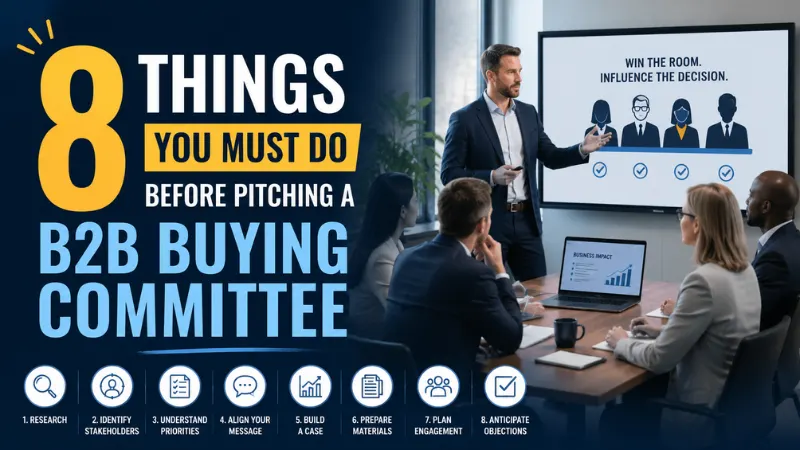
Learn 8 essential steps to prepare before pitching a B2B buying committee and improve your chances of winning complex deals.
Win every stakeholder in your target account

Map all stakeholders and their roles in one place, track influence levels and engagement status, and turn complex buying groups into closed deals with the right data.

In 2011, Hewlett-Packard (HP) acquired Autonomy for $11.1 billion in what was supposed to be a transformational enterprise software deal. Just over a year later, HP admitted the acquisition had massively failed and reduced Autonomy’s value by $8.8 billion, turning it into one of the biggest failed business deals in tech history.
The collapse sparked years of lawsuits, investigations, and finger-pointing over due diligence, financial oversight, and internal decision-making failures.
For modern B2B sellers, the lesson goes far beyond one disastrous acquisition: nobody inside a large organization wants to be responsible for approving the wrong decision.
That fear now shapes almost every enterprise buying committee.
In 2026, B2B deals are rarely won because one person loves your product. They’re won when an entire group of stakeholders feels confident enough to defend the decision internally.
Finance teams worry about budget exposure. IT leaders worry about security and implementation risk. Operations teams worry about disruption. Executives worry about making a decision that backfires publicly or internally. And if even one influential stakeholder feels uncertain, the deal can quietly stall after what looked like a successful pitch.
That’s why so many promising opportunities disappear into “we’re still evaluating our options.” The biggest threat to your deal usually isn’t a competitor. It’s an internal misalignment inside the buying committee itself.

Win every stakeholder in your target account
Map all stakeholders and their roles in one place, track influence levels and engagement status, and turn complex buying groups into closed deals with the right data.

The sellers who consistently win enterprise deals understand this. They don’t just prepare for the presentation; they prepare for the company dynamics, objections, fears, and power dynamics inside the room long before the meeting starts.
This checklist is designed for exactly that. Before your next buying committee pitch, here are eight things you need to pressure-test if you want the deal to survive beyond the demo.
If you can’t name every person in that room and explain what keeps them up at night, you’re not ready to present. A CFO’s fear is budget overrun. A CSO’s (Chief Compliance Officer) fear is a compliance gap. An operations lead is terrified of implementation disruption. These aren’t abstract personas; they’re real human beings whose careers are partially on the line every time they approve a vendor.
Before any pitch, build a proper stakeholder map: who influences the decision, who blocks it, who quietly holds veto power, and who is simply attending because they were CC’d on the calendar invite. For a detailed breakdown of how to do this systematically, the B2B Buying Committee Mapping: A complete guide is the best place to start. It will change how you read a room.
Pre-pitch check: Can you name every attendee, their role in the decision, and their primary fear about this purchase?
Having a champion feels great. Having a credible champion is what actually moves deals. Before you pitch, ask yourself honestly: does this person have genuine organizational influence, or do they just like your product?
There’s a meaningful difference between someone who will fight for you in a closed-door budget meeting and someone who enthusiastically attends your webinars.
A real champion can tell you who is likely to object and why. They can coach you on how the committee actually makes decisions, as opposed to how the org chart says they should. If your champion can’t answer those questions, you don’t have a champion yet; you have an enthusiast. Nurture the relationship further before you commit to a committee pitch.
Pre-pitch check: Has your champion explicitly prepared you for likely objections from other stakeholders?
Every company has a political climate that’s completely invisible on the surface. There might be a turf war between the IT director and the Head of Operations. The VP of Sales might be in a budget fight with the CFO.
A recent reorg may have shuffled priorities in ways that your contact hasn’t mentioned because they’re still processing it themselves.
This is not mundane gossip, it’s intelligence. Ask your champion open-ended questions in the weeks before your pitch: “Has anything changed internally that might affect how this decision gets made?” or “Is there anyone who might push back who I should be aware of?” The answers will be more valuable than any slide you could build.
Pre-pitch check: Do you have a clear read on the internal dynamics that have nothing to do with your product?
Here’s a common mistake: sellers define success in their own terms mostly in terms of contract value, renewal rate, and usage metrics. The committee doesn’t care about any of that. They care about their version of success, which is deeply personal and often unspoken.
Before the pitch, work with your champion to define what a winning outcome looks like for each key stakeholder. For the CFO, it might be a predictable cost structure and a clear break-even point. For an end-user team lead, it might be a 90-day onboarding that doesn’t blow up their workflow. For the CEO, it might be a solution they can mention in a board meeting without blushing.
When you walk into that room, you should be able to speak directly to each person’s version of “this went well.”
Pre-pitch check: Can you articulate a distinct success outcome for each decision-maker in the room?
Committees don’t kill deals because they hate your product. They kill deals because they’re afraid. Afraid of implementation failure, hidden costs, vendor lock-in, low adoption, or the career risk of sponsoring a project that doesn’t deliver.
Your job before you pitch is to anticipate every one of those fears and have a credible response ready.
This is not only about memorizing rebuttals. It’s about genuinely de-risking the purchase from the committee’s perspective.
Think about offering a phased rollout, a pilot period, performance guarantees, or detailed case studies from comparable companies. If you can make the cost of saying yes feel lower than the cost of saying no, you’ve shifted the conversation entirely.
Pre-pitch check: For each stakeholder’s likely objection, do you have a concrete, credible risk reversal ready?
Most pitch decks are built around the seller’s story: company history, product features, awards, and a pricing table at the end. Buying committees aren’t there to learn about you. They’re there to answer one question: “Is this decision safe to make?”
Restructure your deck to mirror the committee’s decision journey. Lead with the business problem they’re trying to solve, not your product.
Then walk through how your solution addresses the specific risks each stakeholder cares about. Save your differentiation points for the middle, not the beginning, you haven’t earned the right to talk about features until you’ve proven you understand their problem.
Pre-pitch check: If you removed your company name and logo from your deck, would the content still speak directly to this specific committee?
This is the single highest-leverage thing most sellers don’t do. “Pre-wiring” means having individual conversations with key stakeholders before the group meeting, not to sell but to genuinely listen.
Find out their specific concerns, share relevant information, and begin building personal rapport before you’re standing at the front of a conference room with fifteen minutes on the clock.
Even one 20-minute conversation with a skeptical stakeholder before the pitch can be the difference between a “we need more time” and a green light. People are far more likely to support a direction in a group setting when they feel they’ve already been heard individually. Pre-wiring is how you turn a presentation into a confirmation, rather than a deliberation.
Pre-pitch check: Have you had individual conversations with at least the top three decision-makers before the group pitch?
The most dangerous words at the end of a committee pitch are “We’ll be in touch.” Vague next steps are where deals go to slowly die. Before the meeting ends, you need to secure a specific, agreed-upon next action with a named owner and a date attached to it.
This doesn’t mean pressuring anyone. It means coming in prepared with a proposed path forward, whether that’s a technical deep-dive with the IT team, a reference call with a current customer, or a pilot scope session.
Give the committee something concrete to say yes to, so the meeting ends with momentum rather than a polite non-commitment. The goal isn’t to close in the room, it’s to ensure the deal doesn’t stall the moment you walk out.
Pre-pitch check: Do you have a specific next step proposal ready, with a suggested owner and timeline?
B2B buying committees aren’t an obstacle race that you have to clear. They’re the reality of how large organizations protect themselves from bad decisions. The sellers who consistently win aren’t the ones with the best product or the slickest deck. They’re the ones who do the unglamorous work of understanding the room before they walk into it.
This checklist isn’t a silver bullet that will fetch you a deal. But if you can confidently answer “yes” to each of these eight questions before your next committee pitch, you’ll walk in with more confidence, more credibility, and a substantially higher chance of walking out with a deal.
What is the most common mistake when pitching to a B2B buying committee?
The biggest mistake is presenting a generic, “one-size-fits-all” pitch deck that only speaks to one person in the room. Most sellers focus on the end-user’s features while ignoring the CFO’s financial risk or the IT Director’s security concerns. To win, your presentation must address the specific ‘success definitions’ of every stakeholder present.
How do you identify hidden influencers in a complex B2B deal?
You can identify hidden influencers by asking your internal champion, “Whose budget does this touch?” or “Who is responsible for the long-term implementation?”. Often, stakeholders in Legal, Procurement, or Security have silent veto power and can stall a deal at the 11th hour if they aren’t included in the early mapping process. For a deeper dive into finding these roles, see our on B2B Buying Committee Mapping: Step-by-Step Guide
What should I do if my champion lacks organizational influence?
If your champion is an enthusiast but lacks the power to move the deal, you must multi-thread the account. Use your current contact as a navigator to get introduced to senior leadership with an intention of aligning with high-level business goals. This ensures your deal survives even if your original contact leaves or loses internal standing.
How do you handle a skeptical or hostile stakeholder during a pitch?
The best way to handle a skeptical stakeholder is through Risk Reversal. Hostility usually stems from a fear of implementation failure or career risk. Acknowledge their concern directly and offer concrete proof such as a phased rollout, performance guarantees, or a pilot period to make the cost of saying yes feel lower than the risk of saying no.
Why is Pre-wiring the meeting room essential for enterprise sales?
Pre-wiring is essential because it turns a high-stakes presentation into a confirmation of agreement rather than a deliberation. By having 15-minute 1-on-1 conversations with key decision-makers before the group pitch, you can address individual fears privately. This builds rapport and ensures that when the committee meets, the most influential voices are already on your side.
How do I prevent a B2B deal from stalling after a successful presentation?
To prevent a deal from stalling, you must define a specific next step with a named owner and a firm date before you leave the room. Avoid vague follow-ups like “we’ll be in touch”. Instead, secure a commitment for a technical deep-dive, a reference call, or a pilot scope session to maintain momentum.

Win every stakeholder in your target account
Map all stakeholders and their roles in one place, track influence levels and engagement status, and turn complex buying groups into closed deals with the right data.