Intent Driven Nurture Vs Drip Campaign Strategy
Compare behavior triggered nurture against fixed drip campaigns
 Lead-Gen now on Auto-Pilot with
Build My Campaign
Lead-Gen now on Auto-Pilot with
Build My Campaign

I built one drip campaign in 2 days that kept making sales for months. Here’s why behavior-based emails outperform basic drips.

Intent Driven Nurture Vs Drip Campaign Strategy
Compare behavior triggered nurture against fixed drip campaigns
In August 2025, I spent almost two days building a single email drip campaign. That short time investment ended up generating returns far beyond what I ever anticipated. Here’s the exact breakdown of how I did it, and how you can replicate the results.
Let’s start with what exactly is a drip campaign?
First, we have the word “drip” and “campaign.”
It is almost like watering a plant. You don’t dump a whole bucket of water on a seed all at once and expect it to grow, that just drowns it. Instead, you feed it a measured cup of water every few days. That’s exactly how this email sequence works: it delivers steady, timed nourishment to your leads so they grow into ready buyers.
That’s how the emails work too. One email goes out at a time.
A “campaign” means it’s not just one email. It’s a bunch of emails. So a drip campaign is an email sequence that sends one email at a time over a period of time.
Who benefits from this strategy?
Intent Driven Nurture Vs Drip Campaign Strategy
Compare behavior triggered nurture against fixed drip campaigns
Simply put: any business looking to build lasting traction. Whether you run a service-based agency, digital courses, or a local storefront, it fits your model. If you are looking to increase website engagement, boost physical foot traffic, or predictably drive more sales, this structured approach is designed for you.
How do they work?
Inside your email service provider, there’s usually something called a campaign or sequence. You write one email, schedule it, then add a delay before the next email sends.
Like, if you want one email per week, you schedule the email and add a 7-day delay. Or If you want two emails per week, you might schedule the next one 3 days later.
This way when someone joins your list, the emails are sent automatically.
So you only write these emails once and you don’t have to keep rewriting them over and over again. That’s why people (me) love drip campaigns. It’s a one-time setup instead of an ongoing task.
And the sequence I use which has made us money since last august is an evergreen sequence.
I only wrote it once, and now it sends automatically every week without me having to think about it. My audience still gets valuable, relevant information today. I keep updating them as needed, but overall the content still works.
These emails nurture my list so that when I launch something, my audience is much more likely to buy from me.I also included offers in the sequence that I think will genuinely help them.
But there are two ways to approach this: Do you just pour water on your schedule regardless of the weather, or do you check the soil first?
In other words, are you sending emails based solely on what you want to say, or are you responding to what your lead just did?
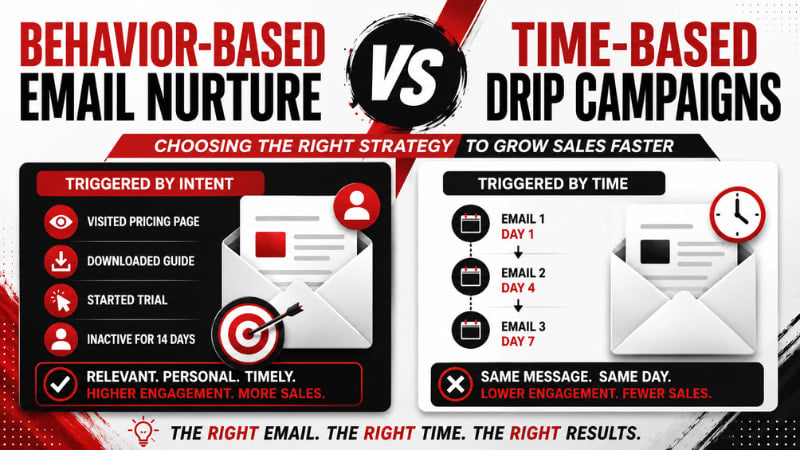
The answer to that question is the difference between behavior-based email nurture and time-based drip campaigns. And in a B2B sales cycle where buyers are 70% through their decision before they talk to sales, getting this wrong isn’t just a missed opportunity. It’s how you end up with a “warm” pipeline that’s actually been sitting in the fridge.
Let’s fix that.
See they are not the same thing, get that very clear before you start.
Here’s the simplest way to think about it:
| Time-Based Drip | Behavior-Based Nurture | |
| Primary trigger | Days since sign-up | User action (or inaction) |
| Personalization level | Low | High |
| Setup complexity | Simple | Moderate to complex |
| Ideal for | Awareness, onboarding basics, event countdowns | B2B sales cycles, re-engagement, upsells |
| Open rates | Average | Significantly higher |
| Conversion impact | Moderate | Measurable pipeline acceleration |
| Content library needed | Small | Larger, segmented |
| Maintenance | Minimal | Ongoing optimization |
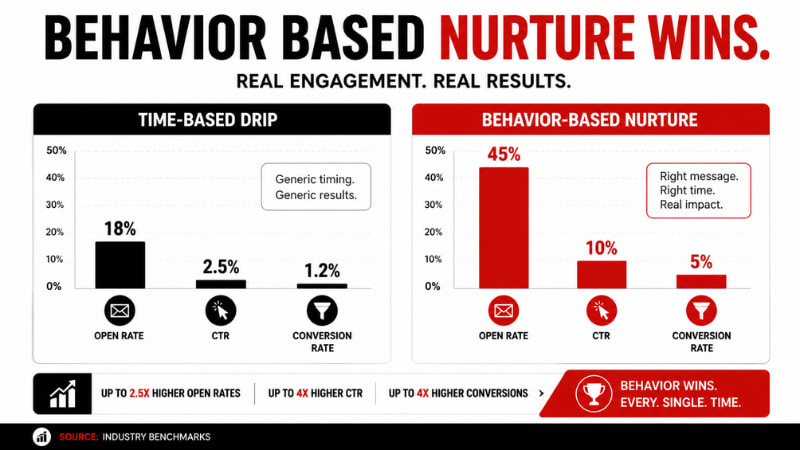
The numbers back this up. Behavior-triggered emails generate 3x higher open rates and up to 4x higher click-through rates than standard batch-and-blast sequences. Because they arrive when someone is already in motion, already thinking about your product. That timing? It’s everything.
See drip campaigns are genuinely useful, they’re predictable, scalable, and require little to no work once they’re live.
For a content creator, a course seller, or a B2C brand running a welcome sequence, a well-crafted drip campaign does the job. You write the emails once, schedule the delays, and let it run. Done. That’s exactly why my evergreen drip sequence quietly generates revenue without even touching it.
Drip campaigns get a bad rap simply because you try to force a linear sequence onto a complex buyer who requires a dynamic journey.
In a complex B2B sales cycle, your leads aren’t on the same journey. One came in through a webinar cold, still figuring out if they have the problem you solve. Another downloaded your ROI calculator and visited the pricing page twice this week. Sending both of them the same “Did you know we help companies like yours?” email on Day 7 is, to put it charitably, a missed shot.
For the nuances of moving leads from MQL to SQL territory, this framework breaks down exactly where the journey gets complicated.
Now, let’s see what this looks like in the wild. Think of it less like a rigid script and more like a choose-your-own-adventure story, where your lead is the one holding the pen (or typing).
Here’s a simple SaaS example:
Trigger: Lead visits pricing page twice in 5 days Send: “Here’s what our most popular plan includes” + case study from a similar company size
Trigger: Lead downloads competitive comparison guide Send: “Here’s how customers made their final decision” + offer a 15-minute call
Trigger: Lead hasn’t logged in after 14 days post-signup Send: Nudge email that highlights one key feature they haven’t used yet, with a direct link to try it
Trigger: Lead clicks “upgrade” but doesn’t complete Send: Objection-handling email with a limited-time assist offer
Each of these emails lands in an inbox at exactly the moment it’s most relevant. That’s not spray-and-pray. That’s context-aware communication. The kind that actually sounds like a business that pays attention.
The formula itself is deceptively simple: one email, one goal, one call to action. That’s it. Not a newsletter, not a hub of five helpful links. One problem. One solution. One click.
Here’s why time-based drip campaigns specifically struggle in B2B:
1. B2B buying isn’t linear. Leads don’t move on your schedule. They go dark for three weeks, then suddenly download everything on your site in an afternoon. A drip doesn’t catch that moment. Behavioral triggers do.
2. The committee problem. In B2B, you’re often nurturing multiple stakeholders simultaneously. A VP of Marketing and a Director of IT at the same company have completely different pain points. Sending them the same drip sequence is the content equivalent of giving everyone at a dinner table the same meal without asking about allergies.
3. Dead databases are a drip casualty. Cold leads in a drip sequence just churn. They ignore. They unsubscribe. They mark you as spam. Behavior-based re-engagement sequences, triggered by the absence of action rather than a fixed date, are far more effective at reviving those relationships. For a deeper playbook on exactly this problem, this reactivation strategy guide is worth bookmarking.
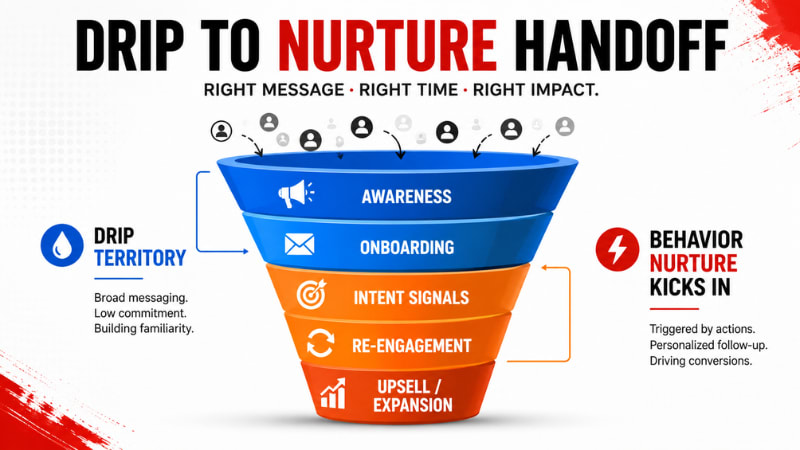
Smart B2B marketing teams aren’t choosing one over the other. They’re running both, and being deliberate about the handoff.
Here’s the model that works:
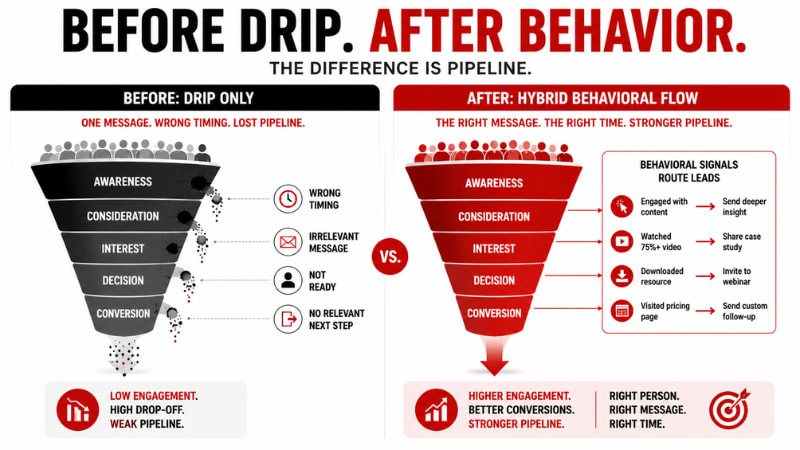
Top of funnel: Drip campaigns handle awareness and basic onboarding. New subscribers get a welcome sequence, an intro to your content, and a few foundational emails. Low friction, automated, consistent.
Mid-funnel: As soon as a lead shows intent, they graduate out of the drip and into a behavioral flow. Pricing page visit, asset download, webinar attendance. These signals tell you they’re ready for a more targeted conversation.

Bottom of funnel: Pure behavior. Cart abandonment, trial expiration, demo no-shows, upgrade prompts. Every email here is triggered by something specific the lead just did or stopped doing.
The leads coming in through content syndication programs are a particularly interesting case here. They often need a carefully designed behavioral onramp because they arrived cold and with varying levels of intent. This breakdown of email nurture flows for syndication leads covers how to handle that transition well.
And if you want to understand what a fully mapped MQL-to-revenue email journey looks like end-to-end, this guide lays out the full arc.
Before you start building behavior-based sequences, be real with yourself about the prerequisites:
If you’re not sure whether to use a linear sequence or a dynamic flow, let’s map out your current setup. We’ll identify the exact drop-off points where behavior-based triggers should take over to salvage cold leads. Claim Your Pipeline Audit.
Here’s something that gets lost when teams start building complex behavioral workflows: complexity in the automation doesn’t mean complexity in the email.
The most effective behavior-triggered emails are almost aggressively simple:
The welcome email that tries to explain your entire product in 800 words? Fails. The five-sentence nudge that says “Hey, you created your first project. Here’s how to make it 10x more useful” with one link? That one works.
We all have a list we have written off. Let’s talk about it.
That database of 12,000 contacts that stopped engaging six months ago is not dead. It’s waiting for the right signal.
A time-based drip has likely already annoyed them. A behavior-based reactivation sequence, triggered by any flicker of activity like a single email open, a website visit from an old link, a webinar registration, can pull a surprising number of them back into an active consideration phase.
The key is not sounding like you’ve been counting down the days. Re-engagement emails work when they acknowledge the gap honestly and lead with something genuinely useful or new. Not “We miss you!” Not a discount code with no context. Something that proves you understand where they are right now.
Here’s a plot twist most marketers miss: You run a live demo, the champion goes quiet, and the story stalls out in your CRM. For the next year, they keep getting your standard newsletter which gives you absolutely nothing. On paper, this chapter is over. But remember: your lead is writing their own adventure, and right now, they’re just stuck in a loop. By expanding the narrative into a multi-threaded plot line that loops in the rest of the buying committee with hyper-targeted messaging, you completely change the ending. You don’t just revive a contact, you rewrite the future of the whole account.
Pro tip: Don’t ghost behind a corporate email alias. Sending these messages from a generic company account instantly exposes the automation. Instead, route the sequence through the specific person who hosted the live demo. It replaces the ‘marketing campaign’ vibe with a human touch that buyers actually reply to.
Don’t let your warmest past opportunities end on a cliffhanger. Our B2B behavioral workflows read the room, pick up on hidden signals, and bring dormant accounts back to life.
Use time-based drip when:
Use behavior-based nurture when:
Run both when:
AI this, AI that, let’s see how to actually build these sequences using AI.
As a copywriter, I used to map this out manually for clients using a framework called the Cash Map Strategy. We would painstakingly isolate who the audience was, what they needed to know, and, most importantly, what they needed to believe and think to transition from cold discovery to repeat buyers.
Today, you don’t have to do that heavy lifting alone. You can partner with AI to build a scalable content engine in six systematic steps.
Before writing a single word, you need a blueprint. Feed your AI assistant everything you know about your ideal customer profile (ICP), their friction points, hidden motivations, and late-night anxieties.
Then, introduce your core offer and prompt the model:
“What does my audience need to know, believe, and think to confidently say yes to this offer?”
Once you define the scope of your campaign, whether it’s a tight 5-part welcome flow or a continuous 52-week nurture ecosystem, ask the AI to map out the exact topical trajectory for every single touchpoint.
Never ask AI to write an entire email from scratch without structure. Instead, take your freshly generated topic list and have ChatGPT outline the first asset. If your topic is “Leveraging AI for Workflow Automation,” command the model to build a logical, high-impact outline tailored specifically to your audience’s unique business goals.
Authenticity cannot be synthetic. To keep your unique voice intact, review the AI-generated outline and speak your thoughts out loud. Record a quick, casual voice memo expanding on each section naturally, just as if you were explaining it to a peer. If you aren’t a verbal processor, brain-dump your unfiltered thoughts into a scratchpad instead.
Take that raw, unedited voice transcript or your rough scratchpad notes and drop them back into ChatGPT. This step is critical: it ensures the underlying data, personal anecdotes, and core philosophies belong entirely to you, not a generic web-scraped database.
With your perspective fully loaded into the AI, you can now command it to turn that single transcript into a multi-channel asset portfolio. Ask it to output:
One localized burst of strategic thought instantly transforms into a month’s worth of multi-threaded marketing assets.
Here’s where most marketers fail: they treat AI like a magic wand rather than a collaborative partner. A first draft from ChatGPT is exactly that, a first draft. It will require refinement.
Review the output and feed explicit, directional feedback back into the system. Tell it exactly what lines felt too corporate, what metaphors hit the mark, and where it needs to adjust the pacing. Treat it like a junior copywriter; the more precise your guardrails, the sharper the next iteration becomes.
The choice between behavior-based nurture and time-based drips isn’t binary, it’s strategic. Start with drips for top-of-funnel consistency, then graduate high-intent leads into behavioral flows that respond to their actual buying signals. The result? Email sequences that feel less like marketing automation and more like helpful sales conversations that happen to scale.
Drip emails follow a fixed time schedule regardless of user behavior. Nurture emails are triggered by specific actions (or inactions) the lead takes, making them more relevant and timely.
Use drips for predictable, top-of-funnel sequences like onboarding or welcome flows. Switch to behavioral nurture when you have intent signals to act on, complex sales cycles, or re-engagement goals.
B2B buyers move on non-linear timelines and involve multiple stakeholders. Time-based sequences can’t adapt to the actual pace and behavior of a buying committee, so they send the wrong message at the wrong moment.
Behavioral triggers are specific user actions (visiting a pricing page, downloading a guide, clicking a specific link) or inactions (not logging in after X days) that automatically fire a targeted email.
Start by identifying the key actions in your user journey that indicate intent. Connect your CRM or app to an email platform that supports conditional logic. Map triggers to specific emails with one goal each. Then test and optimize based on conversion data, not just open rates.
Yes. Behavior-triggered emails consistently outperform time-based sequences because they arrive when the lead is already engaged with a relevant topic. Industry benchmarks show 2x to 3x higher open rates.
Absolutely. The most effective strategy is a hybrid: drip campaigns handle top-of-funnel awareness and onboarding, while behavioral flows take over as soon as intent signals appear.
A re-engagement strategy that targets cold or inactive leads using behavioral triggers. Instead of sending emails on a fixed schedule, these campaigns fire when any signal of renewed interest appears, such as a website visit or a link click from an old email.
There’s no fixed number. Each trigger should have its own targeted response (often a single email or a short 2 to 3 email arc). The flow ends when the lead takes the desired action or exits the segment.
Platforms like HubSpot, ActiveCampaign, Marketo, Klaviyo, and Endcharge support behavioral triggers and conditional workflow logic. The right tool depends on your CRM setup, team size, and the complexity of your automation needs.
Intent Driven Nurture Vs Drip Campaign Strategy
Compare behavior triggered nurture against fixed drip campaigns