Cold Lead Re-Engagement Framework For B2B Growth
Reengage inactive leads using value driven email messaging
 Lead-Gen now on Auto-Pilot with
Build My Campaign
Lead-Gen now on Auto-Pilot with
Build My Campaign

Stop "just checking in" spam. Learn how to decode database silence, spot intent signals, and run a high-converting reactivation sequence.


Cold Lead Re-Engagement Framework For B2B Growth
Reengage inactive leads using value driven email messaging
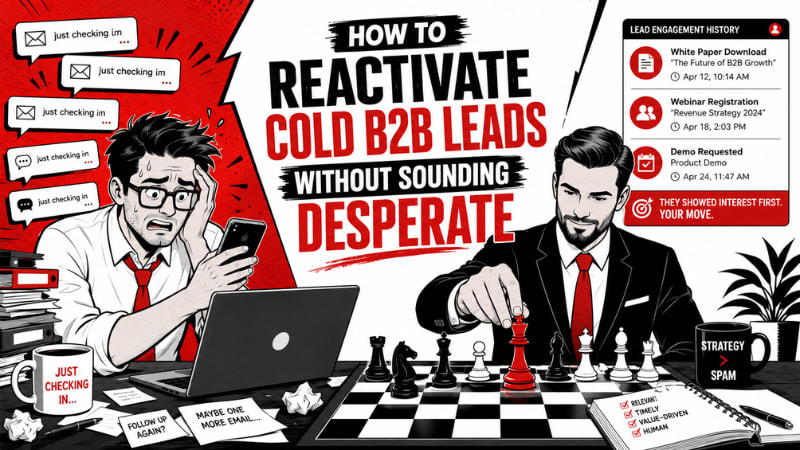
Here’s something most marketers refuse to admit: that cold lead ghosting you right now? They texted first.
Not literally, obviously. But they downloaded your white paper. They registered for your webinar. They filled out that demo request form at 2am on a Tuesday. Somewhere in your CRM, there’s a timestamp proving they wanted something from you before you ever wanted something from them. And yet here you are, crafting your fifth “just checking in” email like you’re sliding into their DMs after being left on read.
Stop it. You have the upper hand, and it’s time you remembered how to use it.
Let’s get one thing straight. A cold lead isn’t a dead lead. It’s a relationship that almost bloomed but didn’t quite make it past the first date. Maybe the timing was wrong. Maybe their budget got slashed. Maybe your sales rep called them seventeen times in three days and they panicked.
The point is: something changed between “hell yes” and radio silence. Your job isn’t to spam them back to life. It’s to figure out what shifted and whether you can shift it back.
According to research, 80% of sales require five follow-up calls after the initial meeting, but 44% of salespeople give up after one follow-up. The gap between persistence and desperation? Strategy.
Here’s what most B2B marketers get wrong: They treat reactivation like CPR. Chest compressions. Mouth to mouth. Frantic energy. What you actually need is more like physical therapy. Gentle, intentional, designed to rebuild strength over time.
Cold Lead Re-Engagement Framework For B2B Growth
Reengage inactive leads using value driven email messaging
Think about it. You wouldn’t propose marriage to someone who stopped returning your texts. So why are you hitting cold leads with “Ready to buy?” emails when they haven’t even agreed to get coffee again?
This isn’t semantic wordplay. The moment you stop thinking about leads as pipeline metrics and start thinking about them as actual humans who woke up this morning with problems you might solve, everything changes.
When someone goes cold, there’s always a reason. Not always a good reason, but always a reason:
You can’t fix what you don’t understand. Before you write a single reactivation email, you need to audit your cold list and segment by why they went cold, not just when.
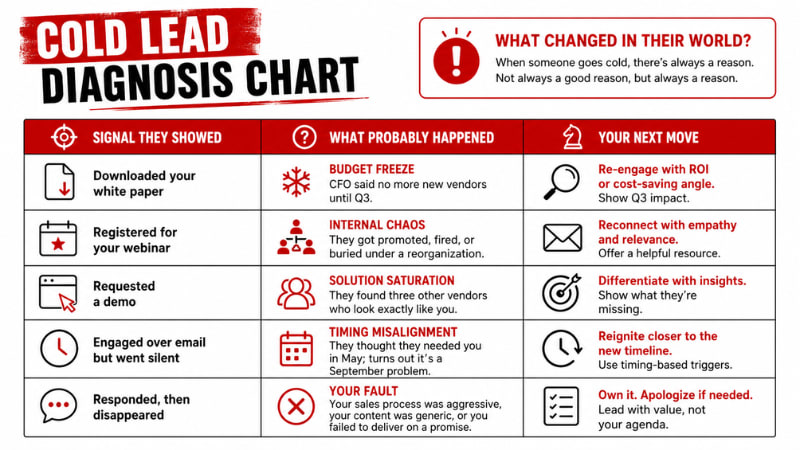
The Golden Rule of Reactivation: If you don’t know why they stopped talking to you, your first email shouldn’t be a pitch, it should be a diagnostic tool to find out which of the five buckets they fall into.
Which of these profiles seems to be dominating your current cold list?
When you’re trying to reactivate a cold lead, every visual element screams “CAMPAIGN.” Your fancy header. Your color-coded CTA button. Your footer with twelve social media icons nobody clicks.
Strip it all away.
A reactivation email should look like your colleague sent it from their iPhone while waiting for coffee. Plain text. One clear point. A signature that’s just a name.
Why? Because people don’t ghost campaigns. They ghost relationships. And nothing says “I remember you as a human” like an email that looks like you actually typed it yourself.
Pro move: Send it from the person they last interacted with. If they spoke to Sarah in sales, Sarah’s name should be in the “from” field. Consistency builds trust. Musical chairs build confusion.
The fastest way to sound desperate is to lead with what you want.
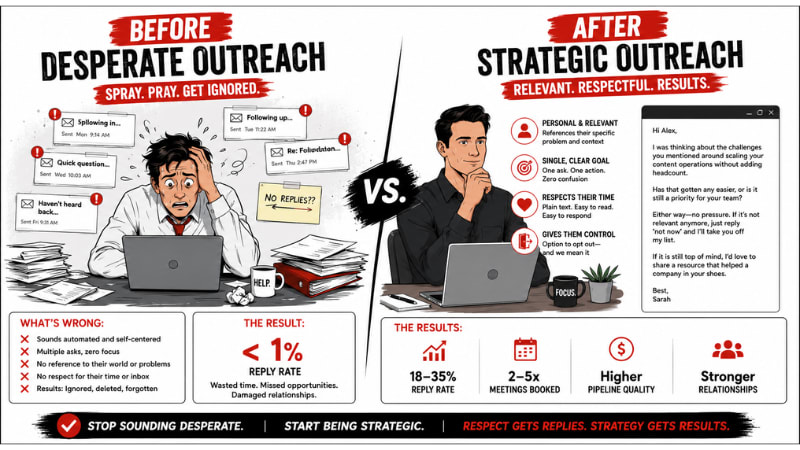
Desperate: “Hi [Name], I noticed you haven’t responded to our last few emails. We’d love to reconnect and discuss how [Product] can transform your workflow!”
Strategic: “Hi [Name], I was just thinking about the challenges you mentioned around scaling your content operations without hiring three more people. Has that gotten any easier, or is it still the nightmare you described?”
See the difference? The first email is about you closing a deal. The second email is about them solving a problem.
When someone goes cold, they don’t need another pitch. They need proof you were listening the first time. Reference the specific pain point they told you about. Ask if it’s still relevant. Give them an out if it’s not.
A cold lead doesn’t need another pitch. They need proof you were actually listening the first time.
You know what kills reactivation emails? Options.
“Want to schedule a call? Or download our new case study? Or watch this webinar replay? Or check out our blog?”
Congratulations. You just gave them four reasons to do nothing.
Every reactivation email needs exactly one goal. Book a call. Download a resource. Reply with a yes or no. That’s it. If you need multiple links in your email, they should all point to the same destination.
Think of your CTA like a doorway. If you offer someone six doors, they’ll stand in the hallway forever. Offer them one door, and they’ll either walk through it or tell you they’re not interested. Both outcomes are better than limbo.
This might sound counterintuitive, but hear me out: some of your best reactivation results will come from people who tell you to buzz off.
Why? Because they’re no longer polluting your metrics, distracting your team, or giving you false hope. And occasionally, the permission to opt out is what makes someone realize they do actually want to stay in.
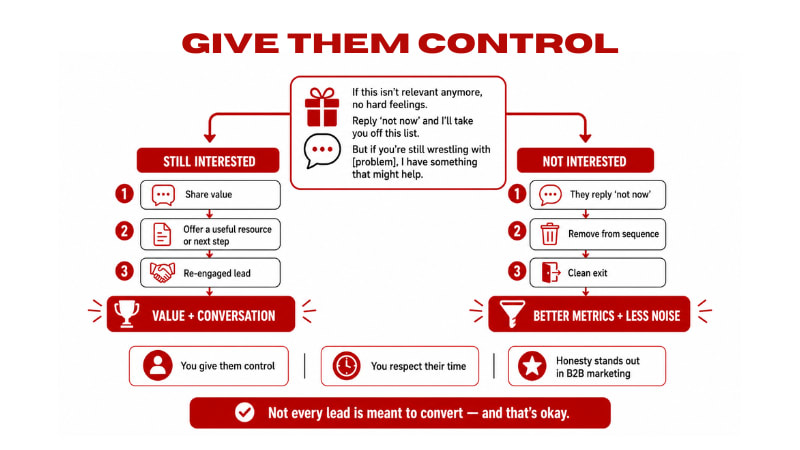
Try this language: “If this isn’t relevant anymore, no hard feelings. Just hit reply and say ‘not now,’ and I’ll take you off this list. But if you’re still wrestling with [problem], I have something that might help.”
You’re giving them control. You’re respecting their time. You’re acknowledging that not every lead is meant to convert, and that’s okay. That level of honesty is rare enough in B2B marketing that it stands out.
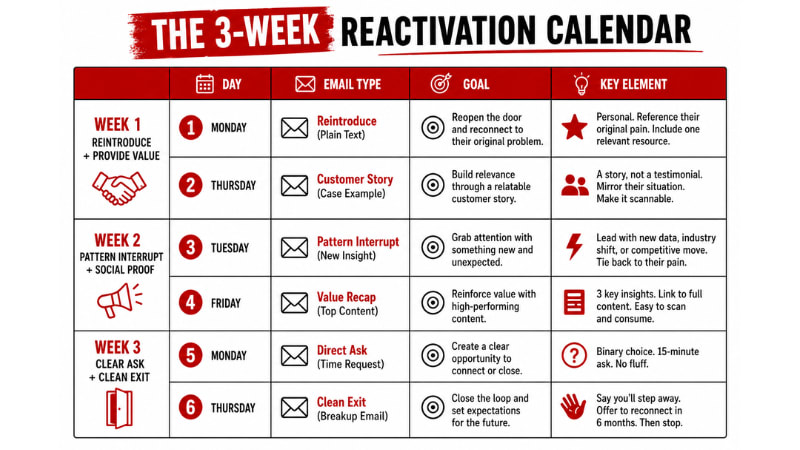
Here’s your tactical playbook. Two emails per week for three weeks. That’s it. Six touches maximum. If they don’t bite, you move on.
Email 1 (Monday): Plain text. Personal. Remind them of the specific problem they were trying to solve. Ask if it’s still a priority. Include one relevant resource (blog post, case study, tool) that helps even if they never buy from you.
Email 2 (Thursday): Share a customer story that mirrors their situation. Not a testimonial. A story. “A company like yours was dealing with X. Here’s what they tried. Here’s what actually worked.” Make it scannable. Use short paragraphs and bullet points.
Email 3 (Tuesday): Lead with something unexpected. New data. Industry shift. Competitive move. Something that makes them think “wait, I should pay attention to this.” Then tie it back to their original pain point.
Email 4 (Friday): This is your “in case you missed it” email, but don’t say that. Repurpose your best-performing content from the last month. Break it into three digestible insights. Link to the full piece. Keep it skimmable.
Email 5 (Monday): Direct ask. “I’ve got 15 minutes on Tuesday or Wednesday. Want to talk through whether there’s a fit here, or should I stop bothering you?” Binary choice. No fluff.
Email 6 (Thursday): This is your breakup email. “Last one, I promise. If I don’t hear from you, I’ll assume this isn’t the right time. I’ll check back in six months unless you tell me not to.” Then actually stop.

If they don’t respond after six attempts, they’re not cold. They’re not interested. And that’s valuable data. Tag them for a future campaign, remove them from active nurture, and move on to leads who actually want what you’re selling.
AI-generated emails have a tell. They’re too smooth. Too grammatically perfect. Too polite. Real humans stumble. They use sentence fragments. They throw in a “honestly” or “look” or “here’s the thing.”
Your reactivation emails should sound like you. Not like a brand style guide. Not like a template. Like the version of you that explains something to a friend over lunch.
Read your email out loud. If you wouldn’t say it in a conversation, don’t write it in an email.
Generic: “We’re excited to reconnect and discuss how our platform can optimize your workflow efficiency.”
Human: “Hey, it’s been a minute. Still drowning in manual processes, or did you find a way to automate your way out of that mess?”
Notice the difference? The second one has personality. It takes a stance. It acknowledges time passing without being weird about it. It sounds like someone who actually remembers the conversation.
Let’s be honest: most nurture programs are just slow-motion spam. A drip campaign that sends the same generic content to everyone on the same schedule, regardless of behavior, interest, or buying stage.
That’s not nurture. That’s noise.
Real nurture is contextual. It’s based on what someone did (or didn’t do), what they care about, and where they are in their buying journey. It’s the difference between sending everyone “10 Tips for Better Marketing” and sending someone who downloaded your ABM guide a case study about how a similar company built an account-based strategy.
If you want to see what strategic nurture looks like in practice, check out our full framework for nurturing MQLs into SQLs. It walks through how to segment by behavior, personalize by pain point, and time your outreach so it actually lands.
Opens are dead (initially promising, but that’s not how you should measure success). Everyone knows this by now. Apple’s Mail Privacy Protection killed open rates as a reliable signal. So what should you track instead?
For reactivation campaigns, focus on:
Don’t chase vanity metrics. Chase signal. A 10% reply rate where half say “not now” is infinitely more valuable than a 40% open rate with zero engagement.
People don’t reactivate because you sent the right email. They reactivate because the circumstances that made them go cold have changed.
Common reactivation triggers:
Your job isn’t to manufacture urgency. It’s to be present and helpful when their urgency returns naturally. That’s why consistency matters more than intensity.
One email a month for six months typically outperforms six emails in one week, as it maintains presence without triggering spam fatigue.
Some leads are never coming back. And that’s okay.
If someone has ignored six emails, opted out of your list, or explicitly said they’re not interested, respect it. Continuing to email them doesn’t make you persistent. It makes you that person who can’t take a hint.
The best thing you can do for your reactivation program is to ruthlessly prune the dead weight. Focus your energy on the leads who are actually in play, not the ones you wish were in play.
Red flags to stop trying:
If you want to build a lead reactivation strategy that actually works, you need to pair smart outreach with smart segmentation. Our B2B email nurture strategy guide breaks down how to identify which leads are worth re-engaging and which ones you should let go.
Before you hit send on your next reactivation campaign, run through this:
✓ Is this email coming from a real person’s inbox?
✓ Does it reference a specific interaction or pain point?
✓ Is it plain text, not HTML?
✓ Does it have exactly one CTA?
✓ Would I say these exact words out loud to a colleague?
✓ Have I given them an easy way to opt out?
✓ Am I providing value, not just asking for a meeting?
✓ Is the subject line specific and relevant?
If you can’t check every box, don’t send the email. Seriously. One great reactivation email beats five mediocre ones every time.
Cold leads aren’t lost causes. They’re just people who got distracted, deprioritized, or decided it wasn’t the right time. Your job isn’t to convince them they were wrong. It’s to be helpful enough, human enough, and strategically persistent enough that when the time is right, you’re the obvious choice.
Remember: they reached out first. That means something. Use it.
Stop sending “just checking in” emails. Start sending emails that prove you remember who they are and what they care about. Be direct. Be valuable. Be willing to walk away. That’s how you reactivate leads without sounding desperate.
That’s how you win.
Wait at least 30 days after their last engagement before starting a reactivation sequence. If they went cold after a sales conversation, wait 60-90 days. The gap gives them breathing room and makes your outreach feel less aggressive. For leads who have been cold for 6+ months, segment them into a separate long-term nurture track with lighter touchpoints.
The best subject lines reference the specific problem the lead was trying to solve, not your product. Try “Still dealing with [pain point]?” or “Quick question about [their project].” Avoid generic lines like “Following up” or “Checking in.” Personalization matters, but don’t fake it. If you don’t remember their specific situation, lead with value instead: “3 ways [companies like theirs] solved [problem].”
Send reactivation emails from the last person who had a meaningful interaction with the lead. If they spoke with a sales rep, use that rep’s email. If they only engaged with marketing content, send it from a marketing team member. Never send from a “no reply” address or generic “info@” email. People respond to people, not departments.
Six emails over three weeks is the optimal cadence. Two per week gives you presence without being overwhelming. After six attempts with no response, move them to a quarterly check-in nurture or remove them from active campaigns. More emails don’t equal better results; they equal unsubscribes.
A cold lead showed initial interest but hasn’t engaged recently. They’re in your database, their email is valid, and they haven’t opted out. A dead lead is someone who has unsubscribed, explicitly said “no thanks,” bounced repeatedly, or left their company. Focus on reactivating cold leads. Let dead leads go.
Only if you already have a promotional calendar and the lead went cold over pricing concerns. Don’t train your audience that ignoring you leads to discounts. Instead, offer value: exclusive content, early access to features, custom analysis, or a lightweight consultation. Make them feel special without making them feel bought.
The best CTA is low-friction and relevant to their buying stage. Early-stage leads should get content (“Read this case study”). Mid-stage leads can handle a direct ask (“15-minute call to see if there’s a fit?”). Never ask for an hour-long demo in a reactivation email. Start small and earn the bigger commitment.
Use dynamic fields for company-specific pain points, industry, and previous behavior (what they downloaded, which webinar they attended). But don’t over-automate. Write 2-3 template variations based on why they went cold, then manually customize the first line for your highest-value leads. A semi-personalized email from a real person beats a fully automated campaign.
Yes, but carefully. Automate the timing and segmentation, but make the emails feel manual. Use plain text, personal signatures, and contextual content. Never automate follow-ups to someone who has replied (even if they said no). Once a lead responds, they should get human attention, not another automated email.
Thank them and remove them from the sequence immediately. Ask if they’d like to stay on your general content newsletter or be removed entirely. Their clarity is a gift as it cleans up your list and lets you focus on real opportunities. Occasionally, someone who opts out now will come back in six months when their situation changes. Make it easy for them to do that.
Cold Lead Re-Engagement Framework For B2B Growth
Reengage inactive leads using value driven email messaging