MQL To SQL Conversion Optimization System
Turn marketing qualified leads into sales qualified opportunities
 Lead-Gen now on Auto-Pilot with
Build My Campaign
Lead-Gen now on Auto-Pilot with
Build My Campaign

Learn the three-phase nurture framework that converts MQLs to SQLs with behavior-based sequences, intent scoring, and proven handoff strategies.


MQL To SQL Conversion Optimization System
Turn marketing qualified leads into sales qualified opportunities
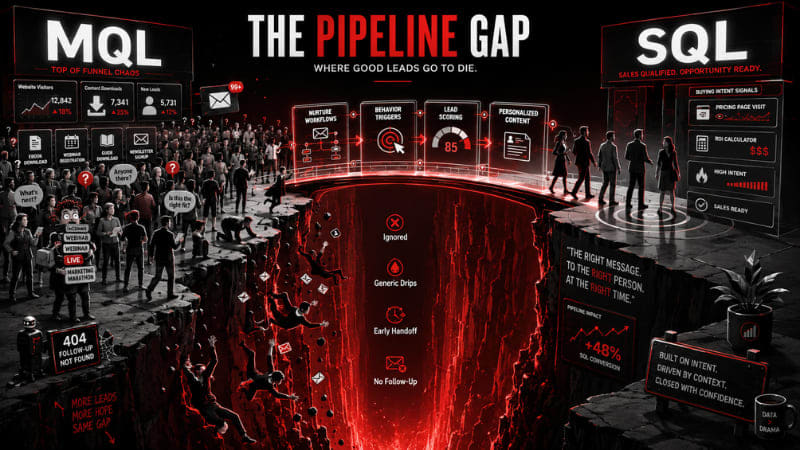
Be honest for a minute. Will you?
Most leads don’t go cold because they’re bad. They go cold because we treat them like a line item. A number instead of an actual person.
Somewhere between “downloaded our ebook” and “ready to talk to sales,” most leads quietly ghost you.
They didn’t stop having the problem your product solves. They just stopped believing you were the one to solve it.
That gap, that painful, expensive, preventable gap, is exactly what this guide is about.
MQL (Marketing Qualified Lead): Someone who has raised their hand. They clicked, downloaded, attended, or engaged. They’re not ready to buy yet, but they’re interested enough for marketing to say, “hey, this one’s worth a closer look.”
SQL (Sales Qualified Lead): Someone who has crossed the line from curious to qualified. They have real intent, a real-fit signal, a visible need, and sales has agreed they’re worth pursuing.
MQL To SQL Conversion Optimization System
Turn marketing qualified leads into sales qualified opportunities
The gap between those two? That’s nurture territory.
And most companies treat it like a waiting room when it should be treated like a relationship-building operation.
Only 27% of B2B leads sent to sales are actually qualified. Which means 73% of what’s handed over isn’t ready.
Nurture isn’t optional. It’s the whole game.
Before you hand off another MQL, ask yourself one uncomfortable question:
Is this lead ready for a sales conversation, or are we just tired of nurturing them?
Those are not the same thing.
An SQL-ready lead usually has seven things going for it:
ICP fit is confirmed. They match the kind of company you can actually help.
Role relevance is clear. The person engaging is part of the buying committee or close enough to influence it.
Recent intent exists. Old engagement is not the current intent.
The problem is identifiable. You know what pain they are likely trying to solve.
The buying stage is visible. They are researching, comparing, validating, or preparing to talk.
A blocker is likely. Price, implementation, internal buy-in, technical risk, or budget timing.
Sales has context for the opener. The first touch should feel relevant, not random.
That is the standard.
Not “they clicked three emails.” Not “they hit 75 points.” Not “we need more SQLs this month.”
An MQL becomes an SQL when fit, intent, timing, and context are strong enough for sales to enter the conversation without sounding like they just found the lead in a spreadsheet.
Now, tracking all of that manually? Connecting those dots across data silos? It’s nearly impossible. That is exactly why we built VAIS. It does the heavy lifting for you, calculating true buyer intent and score accuracy in real-time, so your team actually has the deep context they need to close the deal.
Because when you have that level of visibility, you stop guessing. But sadly, most teams are still flying blind. Which brings us to the real problem: why most nurture programs fail and why yours might be next.
Before we get into what works, let’s get real about what doesn’t.
The spray-and-pray drip. Seven emails in seven days, same message to everyone, zero personalization. This isn’t nurture. This is spam with a logo.
While basic drip campaigns may serve as a starting point for resource-constrained teams, they quickly become ineffective as lead volume and complexity increase.
The “check-in” email. “Hi [First Name], just wanted to touch base…” Nobody wants to touch base.
Handing off too early. Marketing sees some engagement and throws the lead to sales before they’re warm. Sales calls, gets voicemail, marks it as dead. Repeat forever.
Handing off too late. The lead is practically begging to talk to someone and marketing is still sending them blog newsletters.
Treating everyone the same. The CFO at a 500-person company should not get the same nurturing as the solo founder still figuring out the budget.
Most nurture programs fail because they are built around the company’s schedule, not the buyer’s reality.
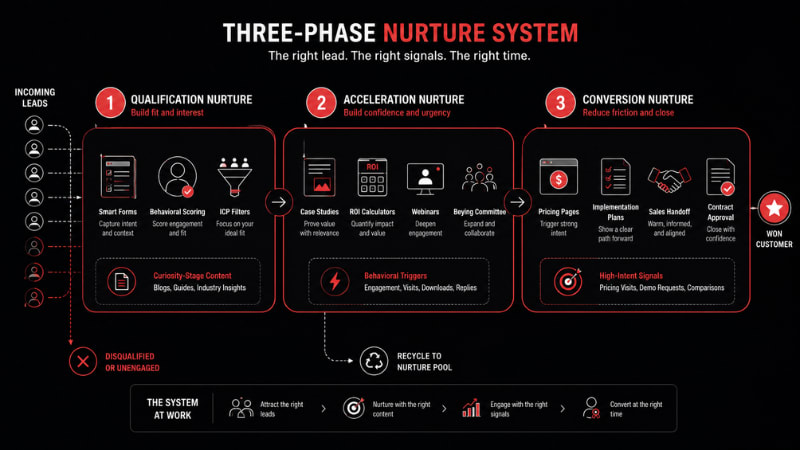
Think of nurture as three phases, each with a distinct job.
The job here isn’t to sell. It’s to learn.
You want to know if this person fits your ICP, has a real problem, and is part of the buying decision.
Use progressive profiling. Don’t ask for 12 fields on the first form. Ask two. Then ask more as they engage.
Use behavioral scoring, not just demographic scoring. Someone who visited your pricing page three times this week is more qualified than someone who matches your ICP but hasn’t engaged in a month.
Use intent-based sequencing. Downloaded a “what is X” guide? They’re early. Visited case studies and comparison pages? They’re evaluating.
Build nurture tracks that reflect that reality.
Now you’ve got the basics.
You know roughly who they are and what they’re interested in. This is where you give them reasons to move faster.
At this stage, your lead needs proof, specificity, and a reason to act.
Content that works here:
That last point matters.
In B2B, you’re rarely selling to one person. Your champion is probably having internal conversations with a CFO, an IT lead, or procurement.
Equip them.
They’re your inside sales rep.
If they’re still in your funnel and haven’t converted, one of three things is true:
For objection-stuck leads, send proof that removes friction: onboarding timelines, ROI data, implementation guides, customer outcomes.
For timing-stuck leads, back off the frequency. Stay visible without being annoying.
For unqualified leads, remove them from active nurture. Suppression is strategy, not failure.
Traditional drip campaigns work on time.
Email 1 on Day 1. Email 2 on Day 4. Email 3 on Day 7.
Simple. Predictable. And mostly wrong.
Your leads don’t operate on your schedule. Someone might be ready in three days because their company just had a triggering event. Someone else might need six months of education.
Behavior-based nurture responds to what people actually do.
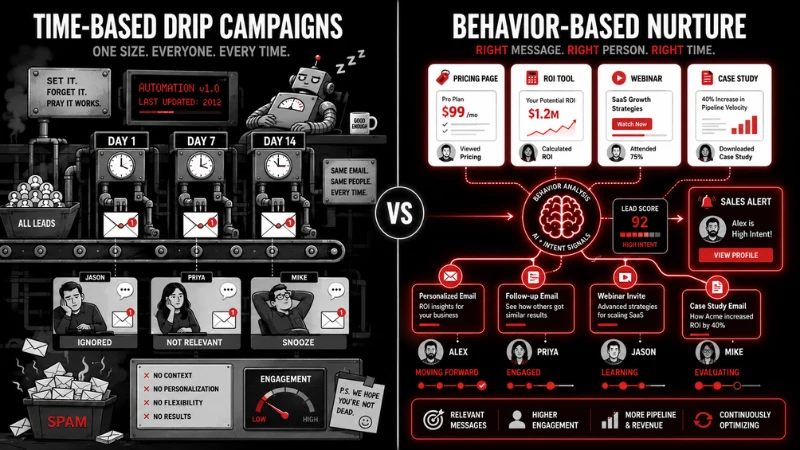
Triggers that should change your nurture:
The payoff is a nurture program that feels like it understands the buyer.
Different MQLs need different routes to SQL. The goal is to respond to the signal they already gave you.
Webinar attendee: Send the replay within 48 hours with timestamps and one key takeaway. Then send a related resource and a case study. Sales should step in if they ask a question, click the case study, or visit a demo/pricing page.
Pricing page visitor: Do not send beginner education. They are past that. Send proof: a case study, ROI explanation, or buying guide. Then address risk: implementation, onboarding, integrations, support, or time-to-value.
Content syndication lead: These leads may not know you yet. Remind them what they requested and why it matters. Then teach one useful idea, offer a diagnostic, and ask a soft segmentation question.
The source matters because it tells you how warm the relationship is.
Here’s the dirty little secret about lead scoring: most sales teams don’t trust it.
They’ve been burned too many times by “hot leads” that were actually just someone who accidentally left a tab open on your pricing page.
The fix is to build scoring models with sales, not just for sales.
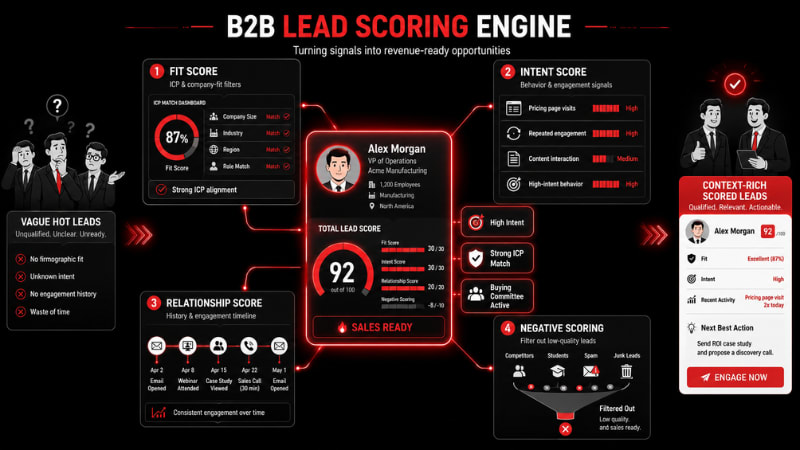
A good score has four dimensions:
Fit Score: Can this person or company actually buy and benefit from what you sell?

Intent Score: Are they showing fresh, meaningful behavior? Pricing visits, demo requests, comparisons, ROI calculators, return visits?
Relationship Score: Is this their first touch, or have they been in your ecosystem for months?
Negative Scoring: Job seekers, competitors, students, bad-fit companies, and personal emails for enterprise offers should not inflate your numbers.
Email opens and broad top-of-funnel downloads show attention. They do not automatically show buying intent.
Multiple pricing visits, demo page activity, direct replies, bottom-funnel asset clicks, and multiple stakeholders from the same account should trigger sales review.
Because the goal is not to send sales more leads.
The goal is to send sales leads they are glad to receive.
Some leads are not cold.
They are just stuck.
They clicked pricing but did not book. They attended the webinar but ignored the follow-up. They read three case studies but never replied. Someone else from the same account started engaging, but nobody has raised a hand.
This is where nurture has to get more useful, not louder.
If they clicked pricing but did not book, send proof, not pressure.
If they attended the webinar but ignored the follow-up, send the sharpest takeaway from the session.
If they read case studies but did not reply, send executive summaries, comparison guides, business case templates, or objection-handling resources.
Almost-ready leads do not need more generic nurture.
They need the next piece of evidence.
A strong fit score tells you who should buy, but it doesn’t tell you who is ready to buy right now.
Fit measures suitability. Intent measures timing.
This is why the Valasys AI Score (VAIS) layers Bombora’s intent data on top of baseline fit. By combining account fit with an NLP-driven analyzer tracking 16,000+ intent topics, it creates a real-time action matrix:
High VAIS + High Intent: Call now. Perfect fit, actively researching.
High VAIS + Medium Intent: Targeted outreach. The fit is there; keep them warm.
High Intent + Low VAIS: Qualify further before committing heavy sales resources.
It doesn’t just tell you who to target. It tells you exactly when to move.
AI can help identify the right lead, recommend the right content, optimize timing, and refine scoring.
What AI can’t do is replace the human touchpoint that matters most.
The best-converting nurture emails still have a distinct voice and a specific point of view.
That comes from people who actually understand their customers.
If you hand sales a name, email, company, and score, you have not handed them a lead.
You have handed them homework.
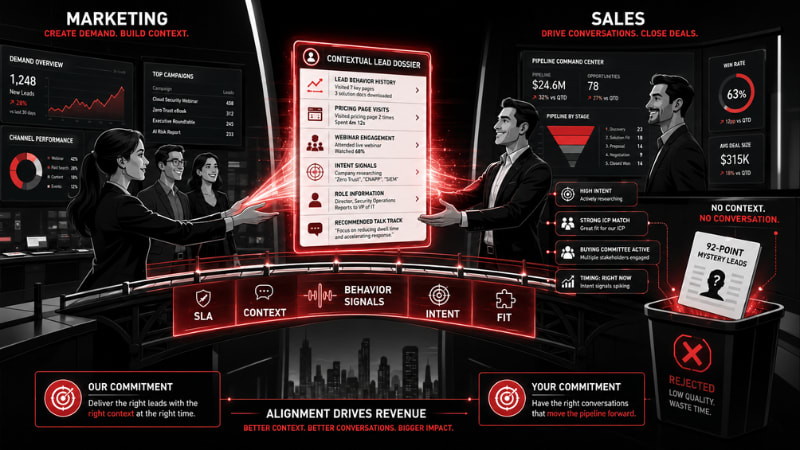
A real MQL-to-SQL handoff should include lead source, last meaningful action, content engaged with, likely pain point, buying role, company fit, engagement pattern, suggested opener, SLA for follow-up, and a feedback loop from sales.
A weak handoff sounds like this:
“Lead scored 82. Please follow up.”
A strong handoff sounds like this:
“VP Marketing at a 500-person SaaS company. Came in through the webinar on pipeline conversion, attended 48 minutes, clicked the ROI calculator, and returned to the pricing page twice this week. Likely evaluating nurture performance and MQL quality. Suggested opener: ask whether improving sales-ready lead conversion is a current priority.”
That is the difference between a cold call with better branding and an actual warm conversation.
Opens are a vanity metric.
Clicks are slightly less vanity.
The metrics worth obsessing over are further down the funnel:
MQL-to-SQL Conversion Rate: What percentage of your MQLs actually get to SQL?
Time to SQL: How long does it take from MQL to SQL?
Nurture-Influenced Pipeline: How much pipeline touched a nurture sequence before converting?
Engagement Rate by Sequence Type: Which tracks are actually working?
Sales Acceptance Rate: Of the SQLs handed to sales, what percentage do they actually work?
These metrics tell you whether nurture is creating revenue movement or just activity.
If you’re looking at your current nurture program and feeling some of this hit uncomfortably close to home, start here.
Week 1: Pull your MQL-to-SQL conversion rate for the last 6 months. If you don’t have this number, that’s your first problem.
Week 2: Map your current nurture sequences. Document what triggered each one, who it goes to, what it assumes, and what the next action is.
Week 3: Sit down with three salespeople and ask: “What do leads from marketing not know that they should by the time they reach you? What objections do you keep handling from scratch?”
Week 4: Build or revise one sequence based on what you learned. One well-built behavior-based track beats ten mediocre drip sequences.
Prove the model.
Then scale it.
1: What is the average MQL to SQL conversion rate in B2B?
The industry average MQL-to-SQL conversion rate in B2B is around 13%, though it varies significantly by industry, lead source, and company maturity. Companies with mature nurture programs and aligned sales-marketing teams often achieve 20-30%. If you’re below 10%, prioritize your qualification criteria and sales handoff process first.
2: How long does it take to nurture an MQL into an SQL?
In B2B, the typical MQL-to-SQL nurture window ranges from 14 to 90 days depending on deal complexity and product category. Enterprise SaaS deals may take 60-90+ days. Simpler products or high-intent leads can convert in under two weeks. Time to SQL is most influenced by lead quality, nurture content relevance, and how quickly sales follows up.
3: What’s the difference between an MQL and an SQL?
An MQL (Marketing Qualified Lead) has shown enough interest or fits enough criteria for marketing to flag them as worth pursuing, but isn’t yet ready for a direct sales conversation. An SQL (Sales Qualified Lead) has been verified, either by behavior, conversation, or scoring threshold, as having real intent, fit, and potential to buy. The distinction matters because treating an MQL like an SQL pushes them away, while treating an SQL like an MQL wastes time and loses deals.
4: What should the first email to an MQL say?
The first email to an MQL should not be a sales pitch. It should acknowledge the action they took (the download, the webinar, the trial), deliver immediate relevant value connected to that action, and make a very soft next step available without pressure. The goal is to earn their attention for email two, not close a deal.
5: How many emails does it take to convert an MQL to an SQL?
There’s no universal answer, but most B2B nurture programs require 5-12 touchpoints before a lead is ready for a sales conversation. What matters more than the number is the quality and relevance of each touch. A behavior-based program that adjusts based on engagement will outperform a fixed 7-email sequence almost every time.
6: What’s the best way to improve MQL to SQL conversion rates?
The highest-impact levers are: (1) tightening your ICP so MQLs are better qualified from the start, (2) building behavior-based nurture sequences instead of time-based drips, (3) aligning marketing and sales on SQL definition, and (4) creating content specifically designed to address late-stage objections. Most companies see the biggest gains by fixing the handoff process between teams.
7: How do you know when an MQL is ready to become an SQL?
A lead is typically ready for SQL status when they’ve crossed a defined score threshold that combines fit (ICP match) and intent (behavioral signals). Key intent signals include: multiple pricing page visits, repeated return visits, consuming high-consideration content (case studies, ROI calculators), and direct actions like demo requests or sales form submissions. Sales and marketing should agree on these thresholds together.
8: What is lead nurturing in B2B marketing?
Lead nurturing in B2B is the process of building relationships with leads who aren’t yet ready to buy, by delivering relevant content and experiences that move them through the buying journey over time. Effective nurture programs are personalized by role, behavior, and stage, and operate across email, retargeting, sales outreach, and other channels simultaneously.
9: What’s the role of content in MQL-to-SQL nurture?
Content is the vehicle for trust. In early nurture stages, educational content builds credibility. In mid-stages, social proof and use case content creates relevance. In late stages, objection-handling and decision-support content (comparisons, ROI data, implementation guides) removes barriers. Each piece of content should serve the lead’s decision process, not just demonstrate the brand’s thought leadership.
10: Can AI replace human touchpoints in B2B lead nurturing?
Not entirely, and attempting it usually backfires. AI is excellent at identifying which leads to prioritize, personalizing content recommendations, optimizing send timing, and monitoring intent signals at scale. But the high-stakes moments in nurture, such as a well-timed personal email from a sales rep, a genuine follow-up after a demo, a check-in during a buying committee stall, still perform better with a human behind them. The best programs use AI to make human touchpoints more timely and relevant.
MQL To SQL Conversion Optimization System
Turn marketing qualified leads into sales qualified opportunities