Buying Committee Email Personalization Framework
Tailor messaging for each stakeholder in buying committee
 Lead-Gen now on Auto-Pilot with
Build My Campaign
Lead-Gen now on Auto-Pilot with
Build My Campaign

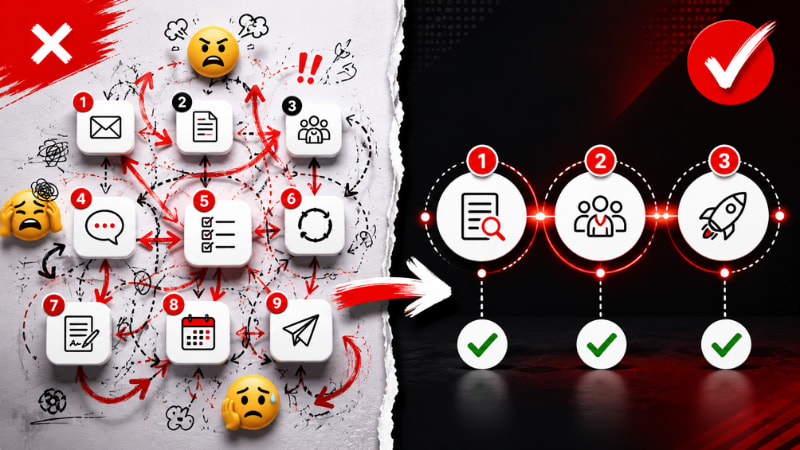
You're sending the exact same email to a CFO and a developer. And yes, it's actively killing your deals.

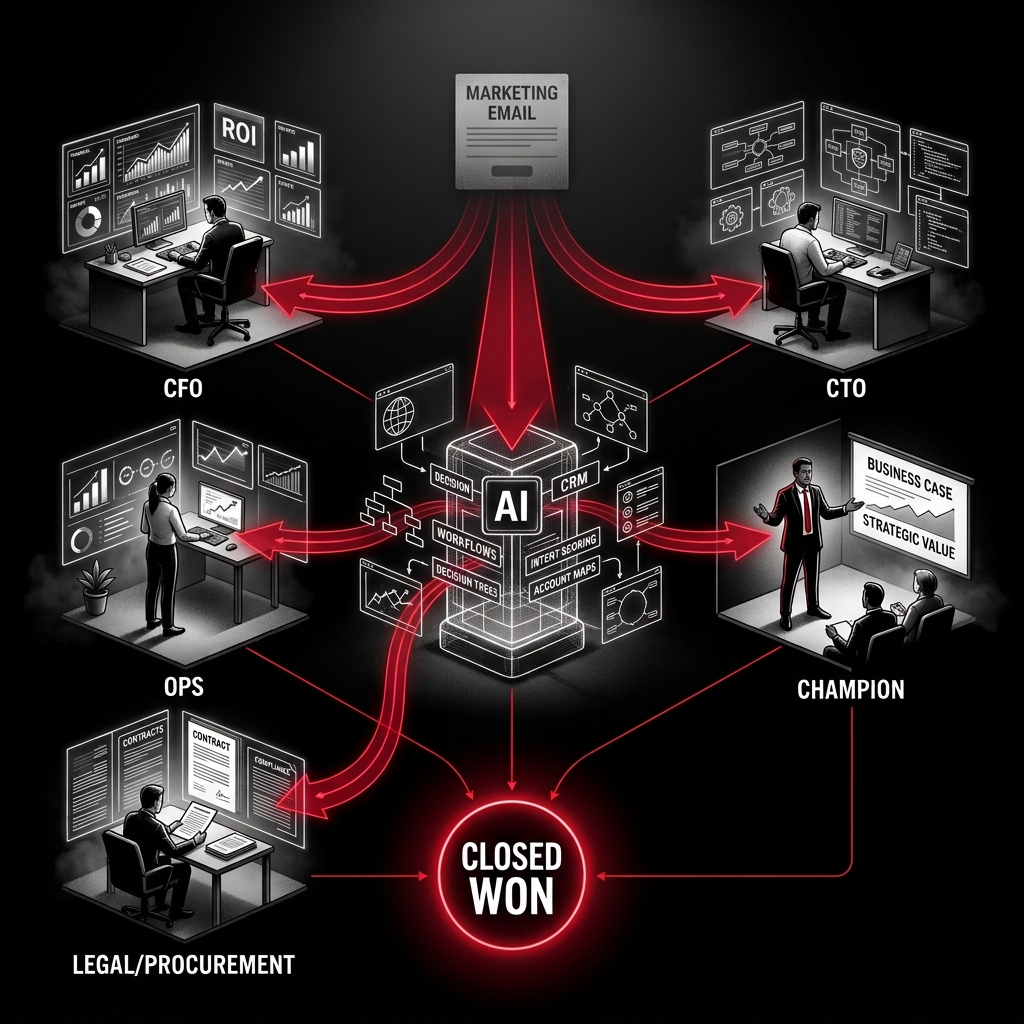
Buying Committee Email Personalization Framework
Tailor messaging for each stakeholder in buying committee
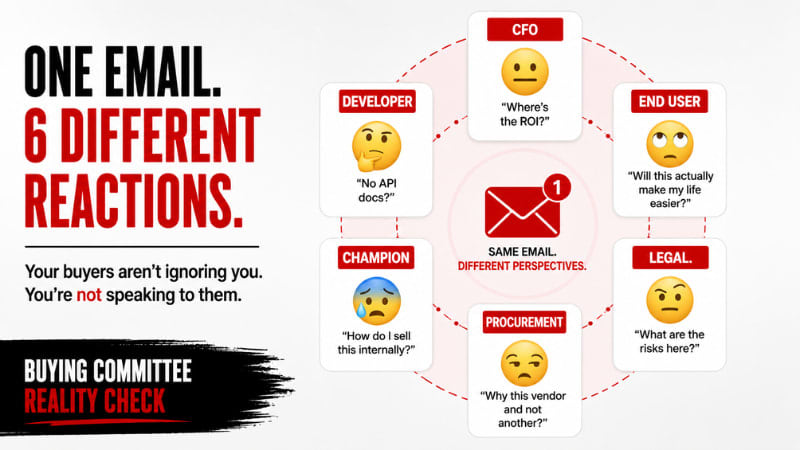
Look, let me assure you: the product you’ve spent days and nights building is perfectly fine. The nurture some AI wrote for you, however, is not doing it any justice. It’s failing because you’re sending the exact same email to a CFO and a developer and expecting them both to care equally.
They don’t. Not even a little.
Here’s a fact you shouldn’t skip: B2B deals today involve 6 to 17 stakeholders.
closed-won enterprise deals in 2025 averaged 17 decision-makers, according to sales research across 100+ B2B professionals. You know what closed-lost deals averaged? Five. The companies winning aren’t sending better emails. They’re sending more targeted ones, to more of the right people, with messaging that actually maps to what keeps each person up at night.
This blog is your playbook to do exactly that.
You know that feeling when a brand sends you a “personalized” email that starts with “Hi [FIRST NAME]” because the merge tag broke? That’s exactly how a CFO feels when you send them a feature comparison table. And how your end users feel when you lead with cost-of-ownership analysis.
Generic nurture campaigns don’t just underperform. They actively erode trust. And in 2026, buyers can spot recursive AI slop instantly. The moment your email reads like it was generated and blasted, you’ve lost them.
Buying Committee Email Personalization Framework
Tailor messaging for each stakeholder in buying committee
To turn things around, you must understand the fundamentals of how to move leads from MQL to revenue by treating accounts as dynamic committees rather than static email addresses.
The fix isn’t clever subject lines. It’s mapping your message to the person’s actual reality, their metrics, their fears, their Monday morning problems.
Let’s break down every buying committee role and exactly what to say to each one.
Before writing a single email, you need to know who’s on the committee. Typically, it breaks down like this:
| Role | What They Care About | Their Nightmare Scenario |
| Executive (CFO, CEO, VP) | ROI, TCO, risk, board optics | Approving a tool that doesn’t deliver |
| Technical Stakeholder (CTO, IT, Engineers) | Security, integrations, architecture | A tool that breaks the stack |
| End User / Operator (Manager, Analyst) | Ease of use, time saved, daily workflow | Another tool no one actually uses |
| Champion (Your primary contact) | Internal credibility, making the right call | Getting blamed if this goes sideways |
| Blocker (Legal, Procurement, Finance) | Compliance, SLA, vendor risk | Signing off on something non-compliant |
Each of these people is reading your email through a completely different lens. Write for all of them with the same copy, and you’re writing for none of them.
Their world: They’re in board meetings, quarterly reviews, and budget wars. They don’t want product demos. They want proof that your solution doesn’t become a line item they have to justify next quarter.
What to lead with: Bottom-line impact. Revenue protected, cost reduced, risk mitigated. Give them a number in the subject line if you can. “How [Company Type] reduced vendor costs by 34%” hits different than “Introducing Our New Feature.”
Content that converts:
Email tone: Peer-to-peer, not pitchy. Confident, brief. They don’t have 4 minutes. You have 45 seconds.
Sample subject lines:
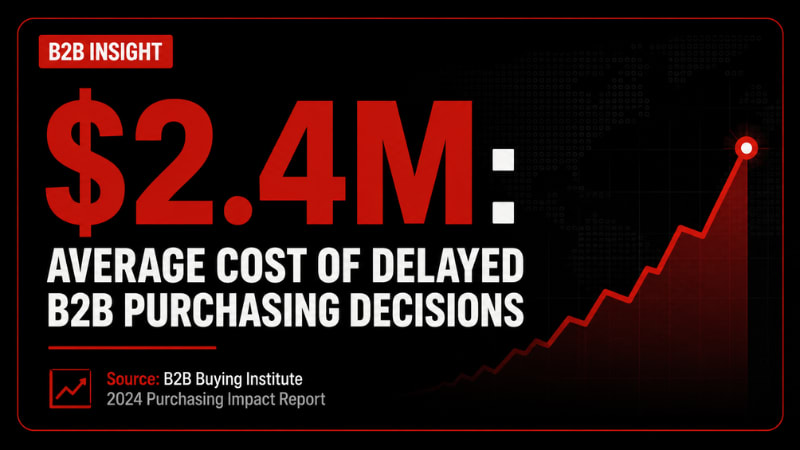
Their world: Every new vendor is a potential security liability, integration nightmare, or compliance gap. They want to know if your product plays nicely with the stack before they’re willing to green-light anything.
What to lead with: Architecture, security posture, and integration capabilities. Not “easy to use.” Not “saves time.” How it works, not just that it works.
Content that converts:
Email tone: Precise and factual. No marketing lexicon. If you say “enterprise-grade,” back it up with a spec sheet.
Sample subject lines:
Their world: They’re the ones who’ll actually use your product daily. They’ve been burned before by tools that looked great in demos and were a nightmare in practice. Their concern: “Will this actually make my job easier or just add another login?”
What to lead with: Time saved. Workflow simplified. “Here’s what your Tuesday looks like with us vs. without us.”
Content that converts:
Email tone: Warm, practical, relatable. Acknowledge the mess they’re dealing with now before you talk about your solution. The best nurture emails for this audience feel like a helpful Slack message, not a marketing campaign.
Sample subject lines:
This person is your biggest ally and your most underserved persona. Most marketers treat the champion like the buyer. They’re not. They’re the internal sellers. They’re going to bat for you in rooms you’ll never be invited to.
Their world: They found you, liked you, probably already believe in you. Now they need to convince a committee of skeptics without losing political capital. Their fear isn’t your product failing. It’s them looking bad for recommending it.
What to lead with: Arm them with what they need to win internally. Give them the ammunition.
Content that converts:
Email tone: Collaborative and conspiratorial (in a good way). “Here’s how we can make this easier for you to get approved.” Make them feel like you’re on the same team, because you are.
Sample subject lines:
Nobody talks about these people enough. They’re not trying to kill deals. They’re doing their jobs. The problem is most marketers ignore them entirely until they become the reason a deal stalls for three months.
Their world: Vendor risk management. Contract terms. GDPR, HIPAA, SOC 2. SLA guarantees. Data processing agreements. They need to know that signing off on you won’t blow up in their faces.

What to lead with: Reassurance through documentation. Make it easy for them to say yes by removing every possible reason to say no.
Content that converts:
Email tone: Formal but friendly. Precise. No ambiguity.
Sample subject lines:
Here’s where most teams drop the ball. They personalize one email and then go back to broadcasting. Personalization isn’t a moment, it’s a motion.
To make this execution flawless, top revenue teams rely on a proven MQLs into SQLs B2B nurture framework that maps specific content assets to the distinct stages of an account’s decision-making process.
Think of your nurture sequence as a coordinated play, not a solo email.
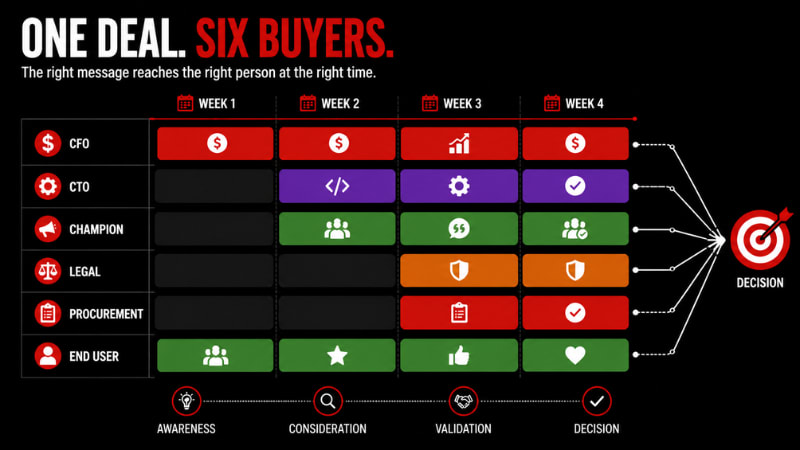
Week 1: Champion gets the business case kit. Executive gets the ROI benchmark report.
Week 2: Technical stakeholder gets the security whitepaper. End users get a workflow walkthrough.
Week 3: Everyone gets a relevant case study featuring their role prominently.
Week 4: Blocker gets the compliance package proactively, before they ask.
The goal is that when your champion walks into that buying committee meeting, every person in the room has already been nurtured individually toward the same conclusion. That’s how you turn 5-stakeholder closed-lost deals into 17-stakeholder closed-won ones.
If you are dealing with top-of-funnel leads generated from third-party content, remember that they require a dedicated cadence. Tailoring your email nurture flows for syndication leads ensures you bridge the gap between initial high-level interest and deep, committee-wide engagement.
Here’s something most nurture playbooks skip entirely: how buyers actually read emails.
Research from Google’s eye-tracking studies shows readers start at 2 o’clock and scan clockwise. They want to know who you are and what you want before they care about what your company does.
That means your first line cannot be “Hi, I’m [Name] from [Company] and we’re the leading…”
It has to pivot immediately to them: “The reason I’m reaching out is you [did this thing / said this thing / your company just did X].”
Lead with their world. Earn the scroll down to your CTA. Then make the CTA light, easy, and one-step. “Worth a 15-minute call?” beats “Schedule a full product demo” every time at the nurture stage.
The Gap Everyone’s Missing: The “Learner” Stage
Most CRMs have MQL, SQL, Opportunity. What they’re missing is a “Learner” stage, a deliberate holding lane for accounts that are curious but not yet intent-driven.
Buyers in 2026 explore tools out of curiosity or executive pressure, not always because they’re ready to buy. Dropping them into a standard drip that pushes for a demo too fast kills deals that would have converted with 60 more days of great content.
This is where your trigger methodology matters. When designing your flows, evaluating a behavior-based email vs. time-based drip setup becomes critical; you must deliver content based on what the buyer is doing, rather than an arbitrary calendar schedule.
Create a Learner segment. Feed it role-specific educational content. Only promote to MQL when you see genuine behavioral signals: multiple opens, content downloads, return site visits, or committee-level engagement. Patience here pays.
If the lead falls completely silent, don’t delete them, instead, apply a targeted strategy to reactivate cold B2B leads to quietly win back their attention without sending desperate “just checking in” notes. Patience here pays.
| Role | Primary Pain | Best Content Format | CTA Style |
| CFO / CEO | Justify the spend | ROI calculator, benchmark report | “See the cost model” |
| CTO / IT | Security & integration risk | Whitepaper, API docs, architecture overview | “Download security overview” |
| Manager / End User | Will this actually work for me? | Video walkthrough, peer case study | “Watch the 3-min demo” |
| Champion | Help me sell this internally | Business case deck, objection-handling guide | “Get the internal pitch kit” |
| Legal / Procurement | Can we sign off safely? | Compliance checklist, DPA, SLA summary | “Request the compliance pack” |
Most B2B companies are nurturing leads. Very few are nurturing committees.
The deal doesn’t close when your champion loves you. It closes when the CFO sees the ROI, the CTO clears the security review, legal signs off, and the end users believe they won’t hate using it. Your email sequence needs to be building toward that moment in parallel, not in sequence.
Stop writing one email for everyone. Start writing five emails for the five people whose thumbs-up you actually need.
The committee is waiting. Give them something worth reading.
Buying committee personalization means tailoring nurture email content to match the specific priorities, language, and concerns of each stakeholder involved in a B2B purchase decision, rather than sending the same message to every contact.
Research shows that 6 to 10 stakeholders are involved in most major B2B purchases. Enterprise closed-won deals have been found to involve an average of 17 stakeholders, significantly more than the 5 typically seen in closed-lost deals.
CFOs respond best to ROI calculators, benchmark reports, cost-of-inaction analysis, and executive summaries. Focus on total cost of ownership, risk mitigation, and bottom-line business impact rather than product features.
Technical stakeholders need security documentation, API references, architecture overviews, and integration guides. Lead with compliance certifications and answers to the questions they’ll be judged on internally, such as data residency, access controls, and uptime SLAs.
A champion is the internal advocate who believes in your solution and sells it to other stakeholders on your behalf. They need business case templates, ROI decks, objection-handling guides, and executive pitch materials to succeed.
Most nurture campaigns fail because they send generic content to all contacts, ignore non-champion roles like legal and procurement, push for demos too early, and lack a sequenced multi-stakeholder content strategy that builds consensus over time.
Proactively send compliance packages, data processing agreements, and vendor evaluation checklists before they ask. Waiting until legal gets involved at the end of a deal creates unnecessary delays and can kill deals that were otherwise ready to close.
The Learner stage is a deliberate CRM segment for accounts that are actively consuming educational content but haven’t yet shown clear purchase intent. Instead of pushing these contacts toward a demo prematurely, you nurture them with role-specific content until behavioral signals, like multiple content downloads or return site visits, indicate they’re ready to move forward.
Role-based personalization targets a contact’s job function and what their KPIs require, such as IT security for a CTO. Persona-based personalization layers in behavioral and psychographic attributes. For buying committee nurture, role-based is often more immediately actionable because you can segment by job title from your CRM.
Track engagement by role segment, not just overall open rates. Key metrics include content downloads per role, committee-level engagement coverage (have you reached more than one person at the account?), and, most importantly, pipeline velocity and conversion rates from nurtured accounts versus non-nurtured ones.
Buying Committee Email Personalization Framework
Tailor messaging for each stakeholder in buying committee