Lifecycle Driven Lead Nurture Framework Guide
Email nurture system for lifecycle-based lead management
 Lead-Gen now on Auto-Pilot with
Build My Campaign
Lead-Gen now on Auto-Pilot with
Build My Campaign

Build smarter B2B email nurture and lead reactivation flows that warm cold leads, convert MQLs to SQLs, and turn dormant CRM contacts into pipeline.


Lifecycle Driven Lead Nurture Framework Guide
Email nurture system for lifecycle-based lead management
You have fourteen tabs open right now. One of them is an article you fully intended to read three days ago. You keep it open because closing it feels like admitting defeat.
Your prospects have a tab open for you too. Somewhere in the back of their browser and their mind. They intended to look at your demo. They meant to reply to that email. But the now is always louder than the intended.
Nurture is the art of being the one tab they finally decide to click on.
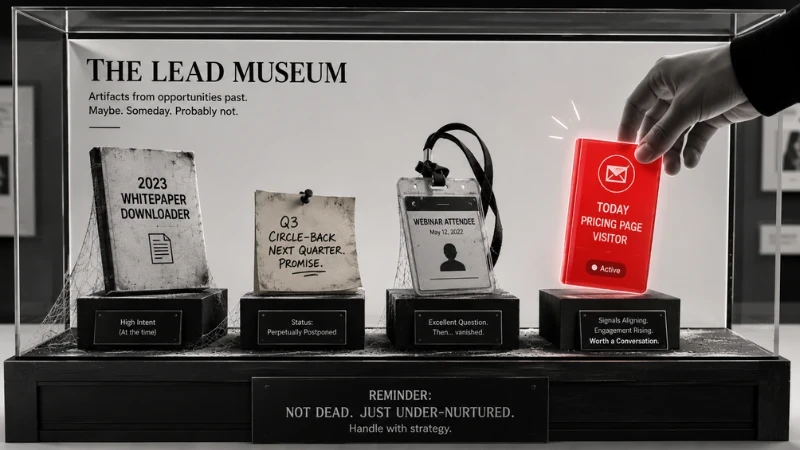
Many B2B databases function more like lead museums than active pipelines, filled with contacts that haven’t been properly nurtured or reactivated.
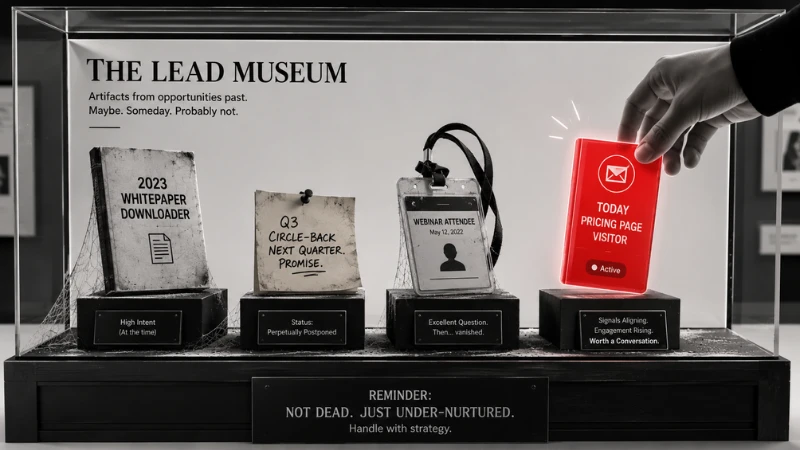
A whitepaper downloader from 2023. A webinar attendee who asked one good question and then vanished. A “circle back next quarter” contact who has now survived five quarters, two budget cycles, and one corporate rebrand. These aren’t dead leads. They’re badly handled ones.
Email nurture and lead reactivation are how you stop treating your CRM like a junk drawer and start treating it like a revenue system. Not by blasting “just checking in” emails that get deleted in 0.3 seconds. With a deliberate, intelligent system that meets buyers where they are, gives them a reason to engage, and moves them toward a decision whether they feel like moving or not.
Lifecycle Driven Lead Nurture Framework Guide
Email nurture system for lifecycle-based lead management
This is the complete B2B playbook. From the cold air of the top funnel to the solid ground of a closed win. Read it slowly.
Before we go deep, let’s be precise. These terms get conflated constantly, and the conflation costs revenue.
Email nurture is a planned series of relevant, useful messages that guides a lead from early curiosity to sales readiness. It’s not a drip campaign you built in 2022 and haven’t touched since. It’s an intelligent communication system that responds to where buyers are, what they need, and what they’ve already done.
Lead reactivation is the process of re-engaging cold, dormant, closed-lost, or ignored leads who once showed genuine interest but went quiet. The silence doesn’t mean the need disappeared. It usually means the timing shifted, the budget moved, or your follow-up ran out of ideas.
Nurture is the deliberate process of becoming useful. Reactivation is the tactical check-in that respects the buyer’s silence while offering a way out of it.
Together, they turn three expensive problems into one useful system:
Truth is, the intent is usually lower than we hope. That download isn’t a “yes”, it’s a “maybe, if I can convince the rest of the team.” They’re gathering ammunition, not an audience.
Nurture is about respect, and respect is about timing. With VAIS, we’ve automated that emotional intelligence, scoring leads not just by what they do, but by how much they actually mean it. It is not a gimmick to rush them. It’s a way to stay useful while they figure things out.
Nobody downloads a whitepaper and buys an enterprise platform before lunch. B2B buying is committee theatre, and the audience is unforgiving.
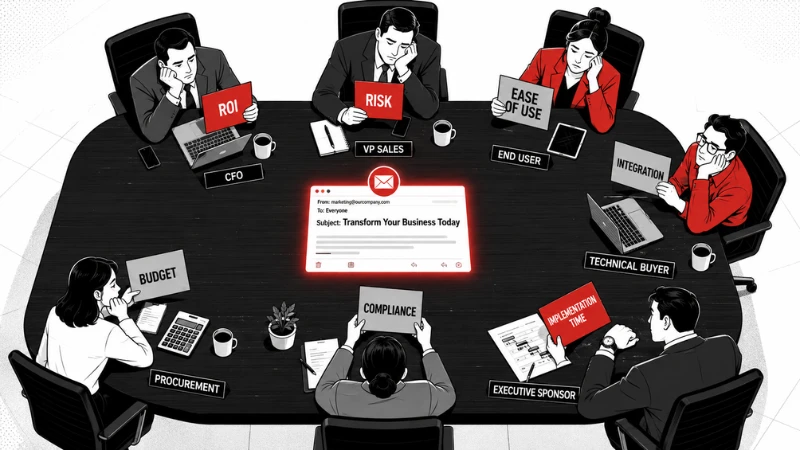
There are operators, managers, finance leaders, IT reviewers, legal teams, procurement, executive sponsors, and the one person who never joins calls but somehow holds veto power. Understanding this is the difference between a marketing team that generates leads and a revenue team that closes them.
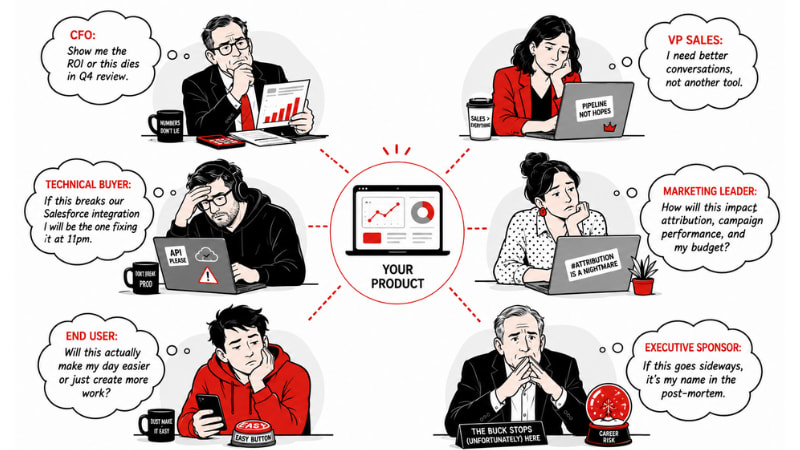
This is precisely why one-size-fits-all nurture fails. It treats a lead as one person with one problem. In reality, a B2B opportunity is a small crowd with competing anxieties.
Marketing wants attribution. Sales wants pipeline quality. The CFO wants proof of ROI. The end user wants relief. The technical buyer wants integration certainty. The executive sponsor wants to know they won’t be the person blamed if implementation goes sideways. Everyone wants less risk.
Email nurture works when it gives each stakeholder exactly what they need to move one step forward in their own internal decision process.
The best nurture programs don’t ask, “What email should we send next?” They ask, “What decision is this buyer trying to make right now, and how do we make it easier?” That one shift changes everything about how you design, sequence, and measure the work.
Let’s walk through this the way your buyer actually experiences it: not as a clean staircase but as a busy airport terminal with delays, detours, and one person who’s always looking for coffee.
At the top of the funnel, your lead has a problem. They don’t yet have a purchase plan. They may have downloaded a benchmarks report, attended the first half of a webinar, clicked a LinkedIn ad, or filled out a content syndication form while eating lunch and half-watching something.
This is where most brands make their first expensive mistake.
Someone downloads “2026 B2B Demand Gen Benchmarks” and immediately receives a calendar link asking them to book a demo. That’s the B2B equivalent of proposing on the first date because the shoe fits (it’s not a fairytale). They don’t want a meeting. They want to survive their Q3 planning session.
TOFU nurture has one job: help them name the problem clearly. Make them feel smarter for opening your email. Give them language they can use in meetings with people who sign budgets. The goal is not to pitch. The goal is to earn the next click.
Good TOFU emails teach one useful idea, connect it to a real business pain, and offer one low-friction next step. Nothing more.
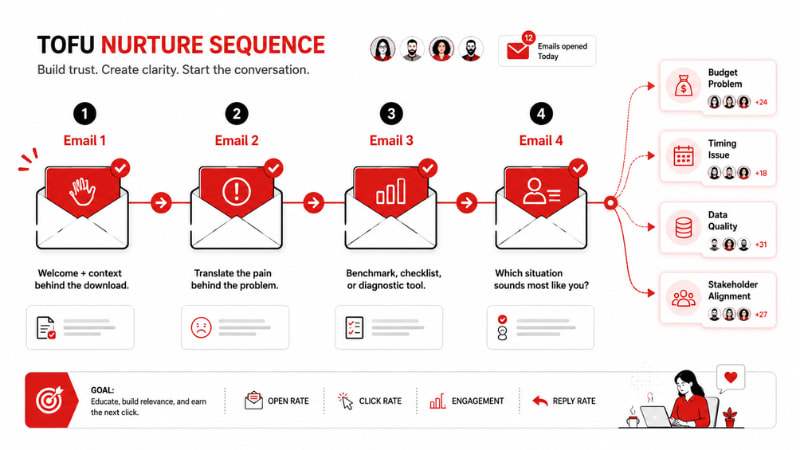
A strong TOFU sequence looks like this:
Email 1: The Welcome and Context Setter. Deliver what they asked for and reframe it around the bigger issue behind it. Not “here’s your download.” Instead: “Here’s the download, and here’s the larger problem it usually signals.”
Email 2: The Pain Translator. Why does this problem keep showing up, even when the team is doing everything right? This is where you earn authority, not by promoting your solution, but by demonstrating that you understand the problem better than anyone else in their inbox.
Email 3: The Diagnostic Tool. A benchmark, checklist, or scoring framework. Give them something they can use internally to spot whether the issue is strategy, process, data quality, or handoff failure.
Email 4: The Soft Segmentation Email. This one is underrated. Ask them to self-identify. Budget constraint? Timing issue? Stakeholder alignment challenge? Data quality gap? Once they click, your nurture stops guessing and starts being precise. That’s when a drip campaign becomes a real dialogue.
Middle of the funnel is where leads get serious without getting loud.
They click your comparison pages. They forward your emails to colleagues without replying to you. They read case studies but don’t fill out the demo form. They visit pricing and disappear, which is essentially the B2B equivalent of looking at rent in a nicer neighbourhood and quietly closing the tab.
MOFU nurture has a different job than TOFU. Here, you’re not explaining the problem. You’re helping the buyer compare options, justify the investment internally, and reduce the risk of choosing you. You’re essentially writing their internal business case for them, without them knowing it.
This is where you bring in case studies, ROI explainers, role-based content, objection handling, product education, and buying committee enablement. And this is where the voice of your emails shifts.
Bad MOFU: “Ready to transform your business?”
Good MOFU: “Here’s what most teams underestimate before they fix lead handoff.”
Bad MOFU: “Schedule your demo today.”
Good MOFU: “Use this checklist to see whether your MQLs are actually sales-ready.”
The difference isn’t subtlety. It’s relevance. One email sounds like it was sent to everyone. The other sounds like it was written for them.
The distance between a download and a deal is measured in trust. We design the frameworks that bridge that gap, ensuring your Sales team receives leads who are actually ready to talk, not just leads who are tired of being emailed. Build your nurture engine with Valasys →
Bottom of the funnel is not the place for brand philosophy or category education. Your lead already knows the category. They already know your name. What they’re deciding is whether to trust you enough to move.
BOFU leads have shown real intent. They returned to your pricing page twice. They clicked a competitive comparison. They asked a specific implementation question on a webinar. They may already be in a sales conversation.
Email’s job at this stage is singular: remove friction.
Every BOFU email should answer at least one of these questions for the buyer: Why change now? Why this solution over alternatives? Why trust this company with our data, our team, and our budget? What does implementation actually look like? Who else like us has made this work?
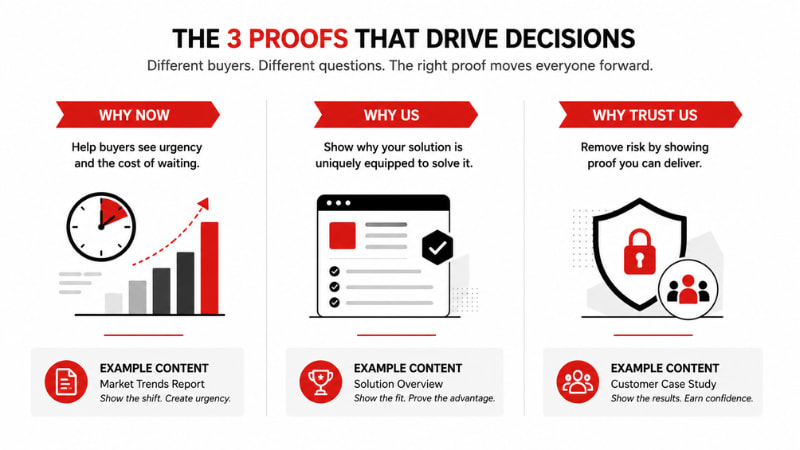
BOFU content should be specific, not inspiring. Think implementation timelines, security documentation, ROI calculators, analyst validations, reference customer stories by industry, and decision-stage buyer guides.
This is also the stage where marketing and sales need a handshake that doesn’t feel like two departments exchanging a hostage across a conference table.
A lead is not sales-ready because they opened three emails and have a score of 87. A lead is sales-ready when fit, intent, and context align. The right account. The right person. The right behaviour signals. And sales equipped with enough context to start a relevant conversation instead of a cold pitch dressed up as a warm one.
A sequence is not a strategy. It’s the visible part. The real architecture sits underneath.
Who entered the flow? Where did they come from? What do we know about their company and their role in the buying committee? What did they do before they entered? What should happen when they engage? What should happen when they don’t? When does sales step in? When do we stop emailing entirely?
Modern email nurture strategy, taught across leading marketing programmes and demand generation courses, returns consistently to the same foundations: relevance beats volume, segmentation beats guessing, automation needs clear goals, and performance must be measured beyond what’s flattering. The good stuff isn’t “write better subject lines.” The good stuff is treating content, list intelligence, CRM context, automation logic, deliverability, and reporting as one connected revenue machine.
Here’s the practical version.
A webinar lead is not the same as a content syndication lead. A pricing page visitor is sending a fundamentally different signal from a newsletter subscriber. A closed-lost opportunity is not the same as someone who ignored your last six emails.
Lead source tells you the starting temperature of the relationship. Use it.
Content syndication leads are often colder than they look. They exchanged contact information for content, usually on a third-party platform, often alongside three other assets from three other vendors. Don’t assume brand affinity. The first email should remind them what they requested and reframe why it matters. Build recognition before you build a relationship.
A content syndication nurture flow: deliver the asset with context about the bigger problem, share a “what most teams miss” insight, offer a diagnostic tool, ask a segmentation question, then route engaged leads into role or pain-specific sequences.
Webinar leads gave you time and attention, which is increasingly rare and therefore meaningful. Use attendance behaviour to personalise the path.
A webinar nurture flow: send the replay with useful timestamps rather than just a raw link, segment attended versus registered-but-no-showed, share the answer to the most valuable audience question, follow with a related case study, then trigger sales follow-up only for high-fit, high-intent engagement.
Demo page visitors should not receive beginner education. They’ve already self-identified as intent-ready. They need proof, risk reduction, and a frictionless next step.
Closed-lost leads should not receive “we miss you.” They need a relevant, substantive reason to reconsider, tied to something that has genuinely changed: a new capability, a pricing structure, a case study from a company exactly like theirs.
The source is the first clue. The sequence should honour it.
Behavior-Based Nurture vs. Time-Based Drip: Use Both, Confuse Neither
Time-based drip campaigns are easy to build and easy to forget. Send Email 1, wait three days, send Email 2, wait five days, send Email 3, pray quietly. They’re not useless. They’re just blunt instruments.
Behavior-based nurture reacts to what people actually do. Clicked the ROI calculator? Send proof of outcomes. Visited pricing twice in one week? Alert sales immediately. Ignored three consecutive emails? Slow the cadence, don’t escalate it. Watched 80% of your product demo? That person is not in education mode. Treat them accordingly.
The best programmes use a hybrid: time-based emails to create baseline momentum, behavior-based triggers to redirect the path when a buyer gives you a real signal.
Here’s the rule worth keeping: time-based nurture is your schedule. Behavior-based nurture is your manners.
When someone shows genuine interest and you ignore it, you look slow. When someone shows no interest and you push harder, you look desperate. Neither is a sustainable brand position.
“Hi {{first_name}}” is not personalisation. It’s a mail merge wearing a tiny hat.
Real personalisation addresses the person’s specific role in the buying decision. A CFO does not need the same nurture as an ops manager. A RevOps leader is not the same audience as a VP of Sales. A technical evaluator doesn’t need a thought leadership essay about transformation. They need to know whether your implementation will create three months of integration friction or three days.
| Role | What They Care About | Key Focus Areas |
| Executives | Strategic Survival | Business risk, market pressure, speed to value, and long-term outcomes. |
| Finance | The Bottom Line | Cost of inaction, ROI, payback periods, and budget protection. |
| Sales Leaders | Execution & Velocity | Pipeline quality, conversion lift, and eliminating “junk” MQLs. |
| Marketing Leaders | Scalability & Proof | Nurture architecture, source quality, attribution, and campaign performance. |
| RevOps | The Machine’s Health | Lifecycle stages, routing logic, CRM hygiene, and SLAs. |
| Technical Buyers | Stability & Friction | Integrations, data security, implementation timelines, and support. |
Same product. Six different proofs. This is how you stop sending your entire buying committee one big generic bowl of marketing soup.
Sales teams don’t reject marketing leads as a ritual. They reject vague marketing leads as a survival mechanism.
An MQL becomes an SQL when there is enough fit, intent, and context for sales to start a relevant conversation. Not because someone downloaded a PDF. Not because they opened a newsletter. Not because their company has a budget line and a pulse.
Most lead scoring models are built by marketing without sales input, which is precisely why sales ignores them. Build the model with sales. Not for them. The scoring criteria should reflect what sales has observed actually predicts a deal, not what’s easy to track in a CRM.
A scoring model that earns trust includes four layers:
Fit score. Does the account match your ICP? Company size, industry, region, revenue band, tech stack, use case profile. Hard criteria, not guesses.
Role score. Is this person a decision maker, an influencer, an end user, a researcher, or a vendor scouting for a future pitch? These are not the same thing and should not score the same way.
Engagement score. What meaningful actions have they taken? Not all engagement is equal. A pricing page visit outweighs a blog view. A webinar question outweighs a passive registration. A direct reply outweighs any automated click.
Timing score. Are there signals of active buying behaviour right now? Repeat visits, comparison content engagement, ROI tool usage, implementation page views, intent surges, recent stakeholder involvement.
And here’s the layer most programmes skip entirely: negative scoring. If a lead uses a personal Gmail address, works at a competitor, or is clearly a student using your whitepaper for coursework, they are not a prospect. They’re a distraction. A healthy pipeline requires filtering, not just filling.
A clean MQL-to-SQL rule might look like: strong ICP account fit + relevant buying role + at least two meaningful engagement actions + one BOFU signal or direct reply + source and pain category known + sales receives a routing note with recommended context. That last part matters more than the score itself.
When routing logic and scoring rules align, your pipeline stops being a list and starts being a journey. We help you architect the connected infrastructure that turns “MQL” from a metric into a meaningful revenue driver. Start with a lead management audit.
Not every cold lead is a lost cause. Some went quiet because timing was wrong. Some lost internal budget approval. Some chose a competitor and are already regretting it. Some got buried under an acquisition or a restructure. Some ghosted you because your follow-up sounded like it was written by a very polite robot.
Commercial intent doesn’t evaporate because a lead stopped clicking. It goes dormant. And dormant is the most underestimated asset in a B2B database.
Reactivation is the process of identifying who is still worth pursuing and offering them a fresh, relevant reason to reconsider. Done well, it generates a pipeline from a database you’ve already paid to build. Done badly, it torches the brand equity you’ve spent years accumulating.

Re-engagement targets subscribers who stopped opening or clicking emails. The question is: “Do you still want to hear from us?”
Reactivation targets leads, old opportunities, dormant accounts, or former customers with commercial potential. The question is: “Is this still a priority, or has the situation genuinely changed?”
The message, tone, timing, and success metrics are completely different. Conflating the two produces campaigns that feel wrong to the recipient because they are wrong.
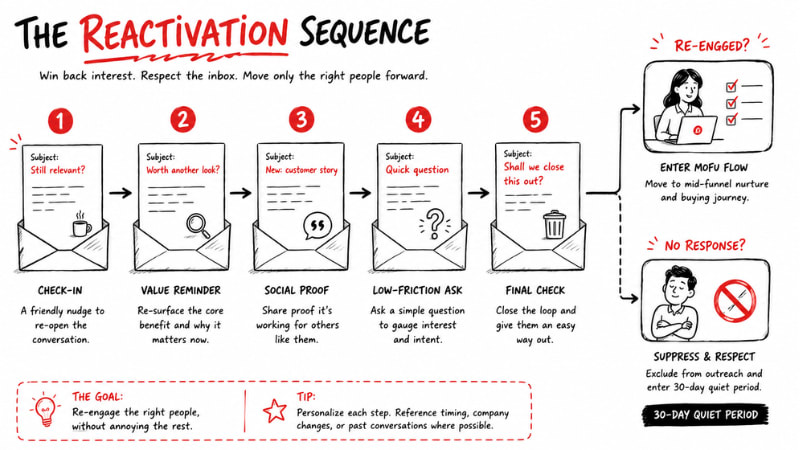
Don’t beg. Don’t guilt-trip. Don’t send “permission to close your file?” as though you’re managing a haunted filing cabinet. Use this instead.
Email 1: The Relevance Reset
Acknowledge the time gap and anchor the email in a likely current business pressure. No apology. No nostalgia. Just useful recontextualisation.
Example angle: “A few months ago, lead quality was on your radar. A lot of teams are revisiting that now because pipeline targets have become less forgiving and budgets for bad leads even more so.”
Email 2: The New Value Email
Give them something genuinely useful that didn’t exist when they first engaged. A new benchmark, a relevant case study, a market shift they should know about, a product capability that directly addresses the objection that may have slowed them down originally. Make this email worth reading even if they have no intention of buying.
Email 3: The Fork-in-the-Road Email
Ask them to choose a path. “Is this still active, pushed to a later quarter, or no longer on the agenda?” Three honest options. One click or one reply. No emotional pressure. No false urgency.
This email is more powerful than it looks. It generates replies. Not always buying replies, but real ones. And real data is worth more than a month of open rate reports.
Email 4: The Proof Email
A specific customer story or before-and-after result from a company in a situation directly comparable to theirs. Keep it brief. One outcome, one quote if appropriate, one line that makes them think “that’s exactly our problem.”
Email 5: The Clean Exit
Offer to stop outreach or transition them to occasional, genuinely useful updates. There is real power in a graceful departure. By choosing to stop before they ask you to, you protect the relationship rather than exhaust it. The leads who say “actually, not yet” in response to this email are the most valuable ones in your long-term pipeline.
Not all dormant leads should receive the same reactivation sequence.
Cold MQLs need a fresh angle and a low-friction next step. They engaged with content once and disappeared. Meet them with something new, not a reminder of what they ignored.
Closed-lost opportunities need a substantive reason to reconsider. A new integration. A pricing change. A relevant case study. A leadership change on your side or theirs. Timing triggers based on firmographic signals (new funding, executive hires, tech stack changes).
Dormant webinar leads need the most valuable practical moment from that session, not the full replay, framed as if it directly applies to what they’re working on right now.
Former customers need the most careful message of all. Focus on changed needs, new capabilities, or a changed context in their business. “We’ve missed your business” is the wrong frame. “Your situation may have changed, and so have we” is the right one.
Email Nurture Flows by Lead Source
Content syndication leads are colder than they appear. They exchanged contact information for a piece of content on a third-party site, often alongside several competing assets. Don’t assume brand awareness or buying intent.
Goal: Build recognition, confirm the pain exists, segment by interest, warm leads who show genuine fit.
Flow: Asset delivery with problem reframe → problem education email → diagnostic checklist → role-based branching question → proof or next-step content based on the path chosen → sales trigger on high ICP fit plus repeat engagement plus BOFU click.
Webinar Lead Nurture Flow
Webinar leads gave you something rare: deliberate attention. That’s a stronger starting signal than most TOFU sources. Use attendance behaviour to differentiate the path immediately.
Goal: Convert attention into active consideration.
Flow: Replay with practical timestamps → attendance-based branch (attended live versus registered no-show) → answer to the most valuable audience question → related case study matched to the webinar topic → workshop or tailored consultation CTA → sales trigger on attended live plus asked a question plus ICP match.
Pricing Page or Demo-Intent Nurture Flow
These leads have already crossed an intent threshold. Don’t educate them on the problem. Reduce friction on the decision.
Goal: Clear the path to a conversation.
Flow: Helpful follow-up framed as a buyer checklist → relevant proof by industry or use case → risk reducer content (implementation, integration, security, ROI) → offer a short fit call rather than a full demo → immediate sales routing if ICP fit is strong.
Goal: Identify active intent, revive valid timing, or cleanly remove leads that are genuinely not a fit.
Flow: Relevance reset → new insight or case study → fork-in-the-road reply email → role or pain-specific content → clean exit → sales trigger on reply, BOFU click, pricing revisit, meeting booked, or multiple stakeholders becoming active simultaneously.
The Metrics That Actually Move Revenue
Open rates are noisy. They’ve been noisy since Apple’s Mail Privacy Protection changed inbox behaviour in 2021, and the B2B measurement conversation still hasn’t caught up fully. If your nurture reporting leads with open rates, you are measuring the digital equivalent of someone walking past your shop window. Interesting. Not revenue.
Metrics worth caring about:
The best metric, ultimately, is movement. Did the lead progress from passive to active? Did one contact become three stakeholders from the same account? Did the opportunity open? Did the deal close?
Nurture is not for applause. It’s for progress.
AI will not rescue a weak nurture strategy. It will help you send poor emails more efficiently, which is not a competitive advantage.
Used with genuine intent, AI improves nurture in specific, evidence-backed ways. Predictive lead scoring uses historical conversion patterns to identify which leads are most likely to progress, outperforming static rules-based models significantly over time. Send-time optimisation analyses individual recipient behaviour to improve delivery timing at scale. Role identification across CRM and behavioural data helps map leads to buying committee positions before sales has to ask. Intent signal detection across multiple touchpoints surfaces reactivation candidates before they find a competitor.
The principle to hold onto: AI belongs in the decision-support role, not the decision-making one. It should help humans act faster and smarter. It should not replace the judgment about what matters, what the buyer actually needs, and when to stop.
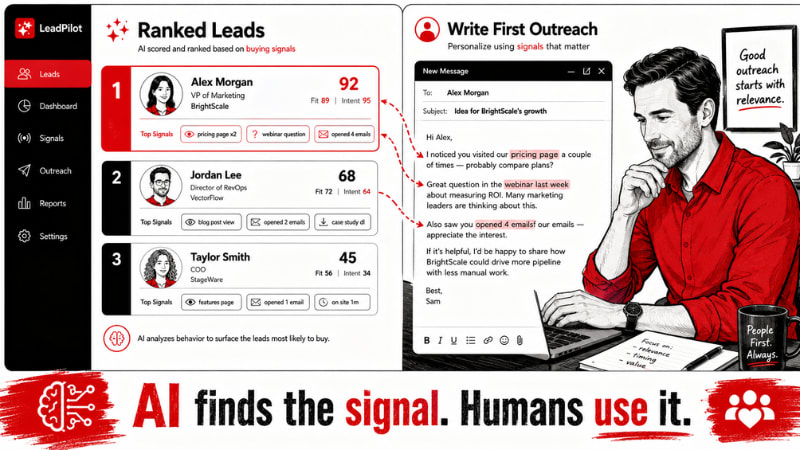 Good AI-assisted nurture still requires human answers to human questions: What pain are we addressing? Is this signal meaningful or coincidental? What should sales know before they call? What would actually feel useful to this buyer right now?
These aren’t theoretical. They happen in real programmes at real companies with real budgets, every quarter.
Treating every MQL like a demo request. A download is a content interaction. It is not a buying signal. Responding to it like one is the fastest way to train sales to ignore your leads entirely.
Sending the same nurture to every lead source. A webinar attendee, a content syndication lead, a closed-lost opportunity, and a pricing page visitor are not in the same conversation. Putting them in the same flow is not efficiency. It’s indifference.
Calling first-name merge tags personalisation. Personalisation means speaking to the person’s role, timing, and pain. The first name is table stakes. The real work is understanding what decision they’re trying to make and addressing it directly.
Using open rates as the final success metric. Open rate is just the beginning; it tells you whether your email earned attention, not whether it created momentum. The real measure is what happens next: clicks, replies, sales acceptance, conversion, pipeline movement, and buying committee engagement. Opens matter, but they should be treated as an early signal, not the primary success metric.
Making every CTA “book a demo.” TOFU leads are not ready for a demo. Asking for one at that stage is like proposing for marriage, remember?! Use CTAs that match the stage: read the guide, use the checklist, watch the clip, compare approaches, run the ROI model, get a diagnostic call.
Building nurture without sales input. If sales rejects the leads coming through your nurture system, the answer is not to send more leads. The answer is to understand why, and fix the scoring, routing, context, or content accordingly.
Ignoring deliverability. Reactivating old lists without proper segmentation, suppression, and sending hygiene can damage your sender reputation and hurt deliverability across your entire domain. The prospect isn’t worth the infrastructure damage.
No exit criteria. Every nurture flow needs a defined endpoint. Convert, route to sales, suppress, recycle, or exit. Leads that never leave a nurture sequence aren’t being nurtured. They’re being ignored with extra steps.
The Sales and Marketing Handoff: The Most Important Moment in the Funnel
Everything in this playbook culminates here. A lead has been educated. Scored. Behaviorally qualified. They’ve shown the right signals. Now they need to speak with a human.
This handoff should not be a Slack message saying “this one looks hot.” That’s not a system. That’s optimism dressed up as a process.
A proper handoff includes: a full context summary of what the lead engaged with, which behavioral signals they hit, their job role, their likely buying committee position, and their probable pain category. It includes a suggested opening line or talk track for sales, not just a score. It includes a clear SLA for when sales will follow up (within 24 hours for high-score leads, without exception). And critically, it includes a feedback loop.
Sales should be able to flag a lead as “not actually qualified” and have that signal feed back into the scoring model. Without that loop, the system never improves. Without that loop, marketing and sales stay in the same blame cycle they’ve been in for years.
The difference between a handoff that works and one that doesn’t is the story.
“Erica, VP Marketing at ACME, entered through our MQL-to-SQL webinar, attended live, asked specifically about sales handoff SLAs, then clicked the lead scoring checklist and visited pricing. Strong ICP fit.
Suggested opening: ask whether they’re currently reviewing their lifecycle stage definitions or their sales acceptance criteria this quarter.” That is useful. “Erica has 92 points” is numerology.
A “hot lead” is only hot if it reaches the right rep at the right time. We build the lifecycle stages and routing logic necessary to ensure no opportunity is left to wither in an inbox. Stop guessing where the friction is and start building the system that connects intent to action. Start with a lead management audit.
You don’t need a six-month transformation project. You need a prioritised set of moves that generates results inside one quarter. Here’s how senior leaders can drive this.
Week 1: Audit with commercial intent. Pull your lead sources, active workflows, MQL definitions, sales acceptance rates, and top-performing content. Ask the revenue question first: which leads are converting, and which aren’t? The gap between those two answers is your roadmap.
Week 2: Map by buyer journey, not by department. Build separate journey maps for TOFU, MOFU, BOFU, and reactivation. For each, define what decision the buyer is trying to make, what content enables that decision, and what signal triggers the next step. This is a revenue conversation, not a campaign calendar exercise.
Week 3: Build with precision, not volume. Start where intent is highest: webinar attendees, demo-intent leads, and the dormant closed-lost opportunities closest to your ICP. One sharp, relevant sequence outperforms a dozen generic ones. If an email doesn’t clearly articulate why it’s arriving now and why it matters, it shouldn’t be sent.
Week 4: Measure movement, not activity. Track engagement by source, role, and stage. Watch sales acceptance. Identify which content creates real progression. Kill weak emails early. Rewrite anything that sounds like it escaped a software brochure from 2019.
Nurture is not set-and-forget. It’s an iterative revenue system. The first version is a hypothesis. Every send is a test. The programmes that win are the ones that refuse to treat their first draft as sacred.
A great nurture email doesn’t feel like a campaign. It feels like good timing.
The buyer is wrestling with a problem, and your email helps them name it clearly. They’re trying to convince a sceptical CFO, and your email gives them the proof framework to do it. They went quiet six months ago, and your email gives them a dignified, low-pressure way back into the conversation.
That’s the work. Not louder emails. Better timing. Not more automation. More relevance. Not touchpoints. Actual help.
In B2B, the lead isn’t the prize. The decision is. And decisions happen when the right people have enough confidence, context, and internal alignment to move. Your nurture system should build that confidence, one useful email at a time.
The best nurture emails don’t interrupt the buyer’s day. They arrived exactly when the buyer needed them, from the company they were starting to trust anyway.
Build that system. The revenue compounds.
Email nurture is a series of targeted emails that helps B2B leads move from early interest to sales readiness. It usually includes educational content, proof, role-based messaging, and behavior-based triggers that guide prospects through the buying journey.
Lead reactivation is the process of re-engaging cold, dormant, closed-lost, or inactive leads who previously showed interest. The goal is to find renewed intent, restart relevant conversations, or cleanly remove leads that are no longer a fit.
Re-engagement usually focuses on inactive subscribers who stopped opening or clicking emails. Reactivation focuses on commercially valuable leads, old opportunities, former customers, or dormant prospects who may still have buying potential.
Most B2B nurture sequences work best with 4 to 7 emails, depending on the lead source and buying stage. Content syndication leads may need more education, while demo-intent leads may need fewer emails and faster sales follow-up.
To nurture MQLs into SQLs, combine fit data, behavior signals, role relevance, and timing. Use emails that educate, handle objections, show proof, and track meaningful actions like pricing visits, replies, webinar questions, and ROI tool usage.
A good nurture CTA matches the buyer’s stage. TOFU CTAs should invite low-friction learning, such as reading a guide or using a checklist. MOFU CTAs can offer case studies, comparisons, or ROI tools. BOFU CTAs can invite a demo, audit, or sales conversation.
Behavior-based nurture is usually stronger because it responds to real buyer actions. Time-based drips are useful for baseline education, but behavior-based triggers help personalize timing, content, and sales alerts based on actual engagement.
B2B nurture campaigns should track MQL-to-SQL conversion, sales acceptance rate, meetings booked, opportunity creation, pipeline influenced replies, buying committee engagement, unsubscribe rate, and deliverability. Opens can be directional, but they should not be the main success metric.
AI can help prioritize leads, detect intent patterns, summarize account activity, recommend next-best content, personalize emails by role, and identify cold leads worth reactivating. AI works best when paired with clear strategy, clean data, and human review.
A nurtured lead should be handed to sales when the account fits your ICP, the contact has role relevance, recent behavior shows meaningful intent, and marketing can provide context for outreach. Sales should know why the lead is ready and what to say next.
Lifecycle Driven Lead Nurture Framework Guide
Email nurture system for lifecycle-based lead management