An MQL score of 85 looks impressive on a dashboard. But ask sales what that number tells them about the prospect’s buying plans, and the answer may be surprisingly little.
Did the account identify a business problem? Is someone evaluating solutions? Are other stakeholders involved? Or did one contact simply accumulate enough points through content downloads and website visits?
The problem with many MQL-to-HQL conversion strategies isn’t a lack of engagement data. It’s the assumption that engagement automatically translates into buying readiness. A scoring threshold can identify active contacts, but qualification requires evidence that their activity connects to a potential business decision.
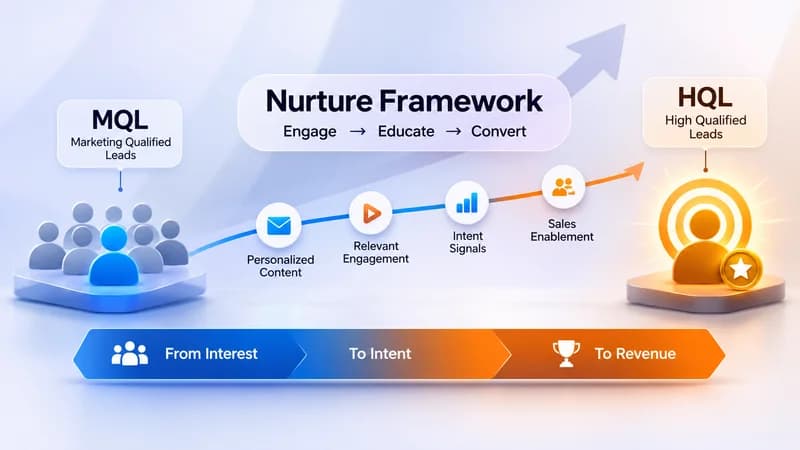
Moving MQLs into HQLs requires a process that does more than identify promising leads. Teams must understand what’s preventing an MQL from advancing, take relevant actions to develop buying interest, and validate whether the resulting engagement justifies sales attention.
How do you convert MQLs into HQLs?
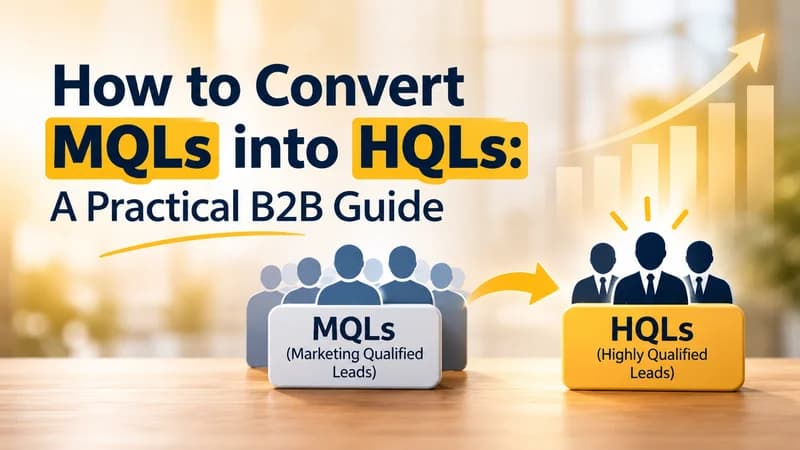
Converting MQLs into HQLs requires evaluating existing leads, identifying qualification gaps, and taking targeted actions to establish buying readiness. Teams should assess contact and account fit, use relevant nurturing to develop interest, monitor buying signals, evaluate account-level activity, and validate qualification with sales. Leads should advance when their business relevance and buying evidence meet agreed HQL criteria, rather than simply crossing an engagement-score threshold.
Before improving conversion, teams need to rethink what qualifies an MQL for further evaluation.
1. Stop Treating Every MQL as an Equal Opportunity
Two MQLs can have identical engagement scores and entirely different commercial potential.
Consider these examples:
- Lead A downloads three resources, attends a general industry webinar, and subscribes to your newsletter. Their activity shows interest in the subject, but there’s no clear indication of an active evaluation.
- Lead B visits product and pricing pages, returns to a solution comparison page, and interacts with content about implementation. Their activity suggests a more specific interest in evaluating a solution.
A conventional scoring model might rank both leads similarly if it assigns points to downloads, attendance, and page visits. A stronger qualification approach recognizes that the second lead has more meaningful evidence.
Engagement shows that someone interacted with your brand. Buying progress suggests those interactions connect to a potential business decision. When teams overlook this distinction, activity-heavy leads can crowd out contacts with stronger commercial potential. These MQL conversion gaps often begin when engagement is mistaken for buying readiness.
Start by segmenting your existing MQLs according to their conversion readiness.
Instead of sending every MQL through the same follow-up process, examine what the available evidence suggests about their next step.
| MQL segment | What the available evidence suggests | Recommended action |
| Strong fit, meaningful buying signals | The contact and account are relevant, with evidence of solution evaluation | Prioritize for sales validation and timely follow-up |
| Strong fit, incomplete buying signals | The account matches your ICP, but the business requirement or evaluation stage remains unclear | Move into targeted nurturing and monitor new activity |
| High engagement, weak account fit | The contact is active, but the organization or role may not match your target market | Investigate fit and data accuracy before advancing |
| Weak fit, limited engagement | Neither the profile nor activity supports further qualification | Deprioritize or disqualify based on your criteria |
These aren’t universal qualification rules. They’re a practical way to decide where existing MQLs need attention.
To understand the difference, examine the context behind each interaction:
- What was the person researching?
- Did they explore a specific solution or remain at the general information stage?
- Were their interactions recent and consistent?
- Did their activity indicate a developing business requirement?
A lead’s activity history should tell a story. If the only evidence is a collection of unrelated clicks, the qualification decision needs another look.
2. Evaluate the Evidence Behind Buying Intent
Not all engagement signals carry the same meaning. A newsletter subscription, a product comparison, and a request for implementation details represent different levels of interest.
The challenge is interpreting those actions without assuming that every high-intent-looking interaction signals an immediate purchase.
Consider three broad categories:
| Signal category | What it indicates | Examples |
| General engagement | Interest in a topic or brand | Blog visits, newsletter subscriptions, introductory downloads |
| Solution exploration | Interest in addressing a particular problem | Product-page visits, feature comparisons, integration research |
| Purchase evaluation | Possible movement toward a buying decision | Pricing research, demo requests, implementation questions |
These categories provide context, not automatic qualification rules.
For instance, a pricing-page visit may indicate commercial interest. It could also come from a competitor, a student, or someone conducting general research. Similarly, a demo request can be a strong signal, but it doesn’t establish that the account has a relevant business need.
The same action can mean different things depending on who performs it and what happens before or afterward.
Use the signals to determine what the MQL needs next.
For example:
- A prospect engaging with general educational content may need resources that help clarify the business problem.
- Someone researching product capabilities may benefit from a relevant solution comparison or customer use case.
- A contact exploring pricing and implementation may warrant a more direct conversation about their requirements.
- A previously active prospect who has stopped engaging may need a different approach rather than another automated promotional email.
This makes nurturing more relevant because the next interaction responds to the prospect’s actual behavior.
Consider recency and consistency
A prospect who visited your product page six times in one afternoon may appear highly engaged. But what if those visits happened several months ago? Another prospect who returned twice this week to explore a particular feature may offer stronger evidence of current interest.
Look at:
- Recency: How recently did the activity occur?
- Frequency: Is the person returning to relevant content?
- Consistency: Do interactions point toward the same business problem?
- Progression: Is the person moving from general research toward solution evaluation?
This prevents outdated or isolated interactions from carrying too much weight.
It also makes qualification more responsive to changing buyer behavior. A lead that once showed strong interest may no longer be actively evaluating a solution. Conversely, a previously quiet contact may begin showing meaningful activity.
3. Make Lead Scoring Reflect Buying Progress, Not Just Activity
Traditional lead scoring often assigns points to observable actions. Webinar attendance might earn points, a content download might earn more, and a pricing-page visit might push a contact over the MQL threshold.
The problem? A score can measure activity without explaining its commercial significance.
A more useful scoring approach considers the strength of the evidence behind each interaction.
| Interaction | Possible qualification implication |
| Downloads a general industry report | Shows topical interest |
| Visits a product page | Suggests solution exploration |
| Returns to a feature comparison page | May indicate active evaluation |
| Requests implementation information | Could indicate a more developed requirement |
| Stops engaging after initial activity | May weaken confidence in current interest |
These aren’t universal scoring values. Their significance depends on the business, buying cycle, and surrounding context.
Scoring models should also account for signals that weaken qualification confidence. An outdated contact, irrelevant job role, repeated disengagement, or activity unrelated to the product can change how a lead should be evaluated.
GitLab’s Marketo lead-scoring documentation provides an operational example of how organizations manage scoring and lifecycle changes. It reinforces an important principle: qualification status should reflect current evidence, not become a permanent label.
Teams should also review scoring outcomes against actual sales acceptance. If leads with similar scores produce consistently different sales outcomes, the model may be assigning too much weight to low-value interactions.
A score should help teams identify meaningful patterns. It shouldn’t replace the judgment required to interpret them.
4. Read Account Activity Alongside Contact Activity
B2B purchases rarely involve one person acting independently. A contact might research a solution, while other stakeholders evaluate technical suitability, operational impact, budget, or implementation risk.
Looking at account activity alongside individual engagement can reveal useful context.
Imagine a marketing manager downloads a guide about improving demand generation performance. A few days later, a RevOps leader from the same organization visits your integration page, while another relevant stakeholder explores product capabilities.
Individually, these actions may not establish purchase readiness. Together, they suggest that the organization could be exploring a solution from different perspectives.
Account-level signals worth examining include:
- Multiple relevant contacts engaging with the same solution area.
- Different stakeholders researching connected business requirements.
- Repeated evaluation activity across an organization.
- Changes in account engagement that strengthen or weaken qualification confidence.
This matters because a single contact’s activity may not reflect the full extent of an organization’s research.

Understanding which contacts and accounts deserve further evaluation is equally important. Qualification priorities can help teams distinguish accounts showing meaningful buying progress from those generating activity without a clear business requirement.
However, account activity shouldn’t automatically be interpreted as proof of an active buying committee. Teams need to establish whether the contacts and their actions are genuinely connected to a potential purchase.
A cluster of visits from unrelated departments, for example, may reflect general brand awareness rather than coordinated evaluation. Context remains essential.
5. Use AI to Connect Qualification Signals, Not Manufacture Intent
Qualification becomes harder when signals are scattered across CRM records, website activity, contact data, and account research. AI can help bring that information together, but its value depends on the quality and relevance of the evidence it uses.
For example, Microsoft’s Sales Qualification Agent can research lead backgrounds, assess alignment with an organization’s ICP, and support qualification and sales engagement. Microsoft also notes that the agent doesn’t replace human judgment.
A useful AI-assisted qualification process should:
- Consolidate evidence: Bring together relevant contact, account, engagement, and business information.
- Identify patterns: Highlight repeated evaluation behavior, stakeholder activity, and changes in engagement.
- Explain recommendations: Show which signals support advancing, monitoring, or deprioritizing a lead.
- Support human validation: Let marketing and sales review the evidence before making consequential qualification decisions.
Enterprise AI developments also point toward the importance of grounding agents in reliable business information. NVIDIA’s Agent Knowledge Foundation announcement discusses how enterprise agents can use company data and business relationships to support more grounded decisions. While it isn’t a lead-qualification product, it illustrates why connected, trustworthy data matters when AI supports business decisions.
Within Valasys, VAIS (Valasys AI Score) brings account intelligence into the qualification process. Its AI-Powered Account Intelligence feature helps teams assess context such as confidence, deal momentum, buyer stage, and priority. This adds another layer of information when evaluating whether an account deserves closer attention.
Still, AI recommendations need scrutiny. Incomplete CRM records, outdated contact information, and misleading activity can all produce poor recommendations. Automation doesn’t eliminate those problems. Without reliable data and human oversight, it can amplify them.
The best use of AI isn’t to declare every promising contact sales-ready. It’s to help teams understand the evidence, identify missing context, and make more informed qualification decisions.
6. Give Sales the Reason Behind the Qualification Decision
A lead can satisfy marketing’s MQL criteria and still leave sales wondering why it landed in their queue.
That usually happens when the handoff communicates a status but not the reasoning behind it.
Instead of sending sales a contact record with a high score, make the underlying qualification evidence visible.
Before advancing leads, marketing and sales should also agree on the conditions that trigger HQL status. These may include relevant company fit, a credible business requirement, meaningful buying signals, and sufficient contact or account information to justify further sales evaluation.
Once those conditions are met, the handoff should communicate:
- Account context: What relevant business information is available?
- Contact context: What is the person’s connection to the potential requirement?
- Engagement evidence: Which interactions suggest meaningful evaluation?
- Remaining questions: What still needs to be validated?
- Timing context: Is there evidence that follow-up is timely?
This gives sales a starting point for a relevant conversation instead of making the representative reconstruct the prospect’s history.
Teams should also establish clear ownership for the handoff. Marketing needs to know when an HQL has been accepted, rejected, or returned for additional nurturing. Sales needs a consistent process for reviewing and responding to qualified leads.
An agreed follow-up SLA can help establish expectations for response times, ownership, and feedback. The specific timeframe should reflect the organization’s sales model and lead volume rather than an arbitrary universal rule.
It also creates an opportunity to test whether marketing’s qualification assumptions hold up in actual sales conversations.
When sales rejects or recycles a lead, the reason should be specific enough to inform future decisions.
| Sales feedback | What it may reveal | Recommended response |
| No relevant business need | Engagement may have been mistaken for buying intent | Revisit the prospect’s requirements and nurturing approach |
| Contact lacks buying influence | The available contact context may be incomplete | Identify other relevant stakeholders |
| No current evaluation | Older activity may have carried too much weight | Reassess recency and buying signals |
| Account isn’t commercially relevant | The qualification evidence may have been insufficient | Review ICP alignment |
| Timing isn’t right | The lead’s interest may not translate into an immediate opportunity | Return the lead to an appropriate nurture track |
A rejection doesn’t automatically mean the lead was useless. It may reveal that the qualification decision was premature, incomplete, or based on the wrong signals.
Over time, this feedback can help teams understand which signals consistently correspond with genuine sales opportunities and which ones create false positives.
7. Measure Whether Qualification Decisions Lead to Opportunities
A higher MQL-to-HQL conversion rate is encouraging, but it doesn’t tell the entire story. Teams need to understand whether better qualification is creating better sales outcomes.
Track a combination of measures:
| Metric | What it reveals |
| MQL-to-HQL conversion rate | How many MQLs meet the next qualification standard |
| Sales acceptance rate | Whether sales agrees that advanced leads deserve attention |
| HQL-to-opportunity rate | Whether qualified leads progress into genuine opportunities |
| Rejection and recycling reasons | Where qualification decisions are breaking down |
| Time to qualification | How quickly meaningful evidence emerges |
| Pipeline contribution | Whether converted leads contribute to commercial outcomes |
Look at these measures together. A team might improve its HQL conversion rate by lowering qualification standards, but that improvement means little if sales acceptance and opportunity creation decline.
Likewise, a lower conversion rate isn’t necessarily a failure. If marketing advances fewer leads but sales accepts more of them and more progress into opportunities, the qualification model may be doing a better job.
Use the results to identify where existing MQLs are getting stuck.
For example:
- If many MQLs fail account-fit checks, revisit the original targeting and acquisition criteria.
- If leads match the ICP but rarely demonstrate buying intent, review nurturing relevance and timing.
- If HQLs receive low sales acceptance, examine qualification definitions and handoff evidence.
- If accepted HQLs rarely become opportunities, investigate whether the business requirement or buying readiness was validated adequately.
Leads that aren’t ready shouldn’t simply disappear from the pipeline. Teams can recycle suitable prospects into targeted nurturing and reassess them when new engagement or account information emerges.
The number of MQLs entering the funnel is useful context, but it shouldn’t be confused with evidence of better qualification. MQL volume trends should be considered alongside sales acceptance and pipeline contribution.
Ultimately, the goal is to measure whether qualification decisions are helping the business identify and progress genuine opportunities.
Conclusion: Better Conversion Starts With Better Evidence
Converting MQLs into HQLs isn’t about making every lead look more sales-ready. It’s about identifying what prevents an MQL from advancing and taking the right actions to close that qualification gap.
That requires more than engagement scores. Teams need to interpret buying behavior, consider account-level context, understand the limitations of scoring models, and validate their assumptions through sales feedback.
AI can help connect these signals, but reliable data and human judgment remain essential.
For organizations looking to strengthen the quality of their lead pipeline, Valasys combines human-led qualification with account and intent intelligence through its HQL programs. The underlying principle is simple: qualification should give sales a clearer picture of the opportunity, not just another list of active contacts.
Frequently Asked Questions
1. What is a good MQL-to-HQL conversion rate?
There isn’t one universal benchmark. Conversion rates depend on the organization’s qualification criteria, industry, sales cycle, and lead sources. A more useful measure is whether the rate improves alongside sales acceptance and HQL-to-opportunity conversion.
2. How long should an MQL take to become an HQL?
There is no fixed timeline. Some leads show strong evaluation signals quickly, while others need time to establish a business requirement. Qualification should depend on the evidence available, not an arbitrary number of days in the funnel.
3. Can a lead become an HQL without requesting a demo?
Yes. A demo request is one possible buying signal, not a mandatory qualification condition. Account activity, relevant stakeholder engagement, solution research, and a clear business requirement can also support qualification.
4. Why do sales teams reject highly qualified leads?
Common reasons include an unclear business need, an irrelevant contact, weak purchase intent, outdated information, or a mismatch between marketing’s qualification criteria and sales expectations. Reviewing rejection reasons helps identify which signals need stronger validation.
5. Can an HQL become unqualified later?
Yes. Qualification can change as new information emerges. A lead may initially show strong interest but later reveal that the requirement is delayed, the contact isn’t involved in the decision, or the account is no longer evaluating a solution. Its status should reflect the latest available evidence.
6. How does account-level intent improve MQL qualification?
Account-level intent helps teams see whether interest extends beyond one contact. When multiple relevant stakeholders show connected evaluation behavior, it can provide stronger context than an isolated individual interaction. Teams should still validate that the signals are relevant to the same potential business decision.