

How Should You Follow Up With Content Syndication Leads in the First 30 Days?
A 30-Day Follow-Up Plan for Content Syndication Leads: Email Flow, SDR Touches, Lead Scoring, and Pipeline Metrics

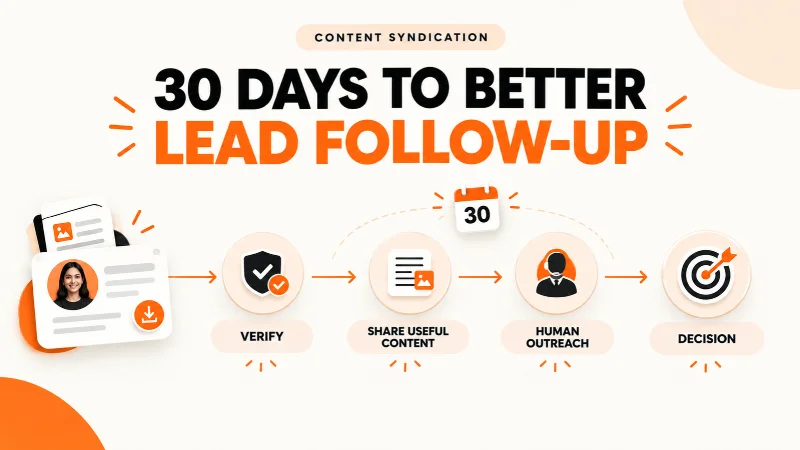
A lead downloads your content. What happens next determines whether they remember your brand or forget it by tomorrow.
What is the best 30-day follow-up plan for content syndication leads?
A 30-day follow-up plan for content syndication leads works in five phases: verify and route each lead within 24 hours, send a context-rich welcome on day one, deepen the topic with useful content through day nine, have sales development reps (SDRs) call high-fit accounts between days five and fourteen, then score, offer and recycle everyone else through day thirty.
Key Takeaways
- Syndicated leads have engaged with one asset, usually on someone else’s platform. Treat them as warm introductions, not sales-ready demand.
- Speed matters most in the first 24 hours. Verification, routing and a context-rich first email should all happen inside that window.
- Days 2 to 9 should teach, not pitch. Trust is built with useful content tied to the asset they downloaded.
- Only high-fit accounts should get SDR attention in days 5 to 14. Everyone else follows an email and LinkedIn track.
- A simple scoring model and clear exit rules stop leads from sitting in limbo for months.
- Measure each phase separately. Blended “lead to opportunity” rates hide where the plan is breaking.
A director of IT downloads your benchmark report on Tuesday night, but the lead isn’t followed up on until the following Monday.
By then, the prospect has moved on, and your brand is no longer top of mind. You paid for the introduction but lost the opportunity through delayed follow-up.
This is the most common way content syndication budgets get wasted, and it rarely shows up in a campaign report. The leads were real. The follow-up was late, generic, or missing. Sales then calls the leads “bad” and the program loses credibility.
If that pattern sounds familiar, our guide on why sales rejects content syndication leads covers the diagnosis.
This blog focuses on the solution: a practical, day-by-day 30-day follow-up plan to help marketing and sales engage prospects at the right time and turn content syndication leads into genuine sales opportunities.
Why Do Content Syndication Leads Need a Different Follow-Up Plan?
Syndicated leads differ from inbound leads in three ways, and each one changes how you follow up.
They did not come to you. A prospect who finds your website and fills in a demo form has chosen you. A prospect who downloads your ebook through a publisher’s content hub has chosen the topic. Your brand is a footnote to them.
They have seen exactly one asset. Your email cannot assume they know your product, your point of view or your category. Anything that starts with “I wanted to follow up on our solution” will feel like it came from a stranger, because it did.
They are probably one voice in a group. Gartner’s research on the B2B buying journey describes buying groups of six to ten decision makers and notes that buyers spend only a small fraction of their buying time meeting with any one supplier. The person who downloaded your asset is rarely the only person who matters, and a single email will not move the group.
Speed still matters. A Harvard Business Review study, The Short Life of Online Sales Leads, found that companies that contacted leads within an hour were far more likely to have meaningful conversations than those that waited even a little longer. That research looked at web-generated leads rather than syndicated ones, so treat it as directional. The principle holds: interest decays quickly, and a syndicated lead has less to begin with.
If your team is still shaping how syndication fits into sales, our overview of content syndication for B2B sales is a useful companion.
What Should You Set Up Before Day 0?
Most follow-up failures are decided before the first lead arrives. Five decisions need to be made while the campaign is still being planned.
- Define your ideal customer profile (ICP) and target account list (TAL). Your ICP describes the companies and roles you can serve best. Your TAL is the named list of accounts you want to win. Both drive who gets a human touch. Without them, SDRs either call everyone or call no one.
- Agree what “sales-ready” means. Sit down with sales and write the definition of a sales-qualified lead (SQL) and a marketing-qualified lead (MQL) for syndicated leads specifically. Agreeing on it up front is the single best protection against rejection later.
- Confirm consent and data permissions. Check what each lead agreed to when they registered, and where your outreach is allowed. Rules differ by region. In the US, the FTC’s CAN-SPAM compliance guide sets out the requirements for commercial email. In the UK and EU, GDPR and ePrivacy rules apply, so confirm the lawful basis with your vendor and your legal team.
- Set routing and response targets. Decide who receives leads, how often files are checked (daily, not weekly), and the maximum time between delivery and first touch.
- Put the plan inside the campaign brief. Follow-up should be written into the content syndication campaign brief alongside the audience, assets and goals. It should also match the outcomes you defined in content syndication goals for leads, pipeline and awareness. A campaign built for awareness should not be judged by SDR meetings booked.
Before any lead enters the cadence, run it through a basic quality gate. Our guide to validating content syndication leads walks through the steps, and the content syndication lead quality checklist is a handy reference for the criteria.
The Valasys 5-Phase 30-Day Follow-Up Cadence
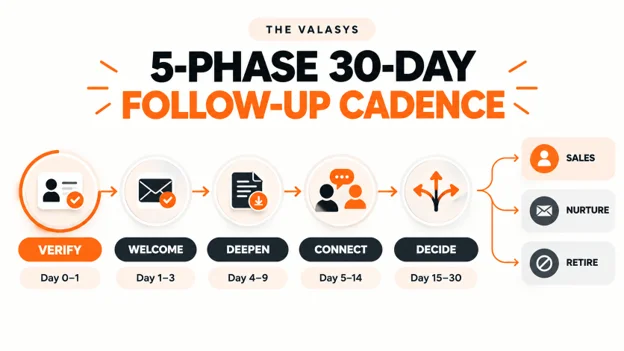
The cadence below covers the full 30 days. It runs on two tracks: an automated email and LinkedIn track for every verified lead, and a human track for leads that meet your fit and intent criteria.
| Phase | Days | Goal | Primary channel | Owner |
| 1. Verify and Route | 0 to 1 | Clean, deduplicate, tier and assign every lead | CRM and marketing automation | Marketing operations |
| 2. Welcome and Orient | 1 to 3 | Re-establish context and deliver the asset experience | Marketing | |
| 3. Deepen | 4 to 9 | Build trust with related, non-promotional value | Email, LinkedIn | Marketing |
| 4. Human Touch | 5 to 14 | Start a conversation with high-fit leads | Phone, email, LinkedIn | SDRs |
| 5. Decide | 15 to 30 | Offer, score, recycle or retire | Email, LinkedIn, retargeting | Marketing and sales |
Phase 1: Verify and Route (Day 0 to 1)
What to do: Upload the lead file the same day it arrives. Deduplicate against your CRM, check email validity, match each lead to your TAL, and assign a tier.
Why it matters: Every hour a lead waits, its connection to the asset gets weaker. Verification also keeps SDRs from spending time on duplicates, competitors, students and existing customers.
How to execute: Create three tiers.
- Tier A: Matches your ICP on company size, industry and job level, or sits on your TAL.
- Tier B: Matches on two of those three criteria.
- Tier C: Matches on one or none.
Tools and process: CRM, marketing automation platform, a data enrichment source and a standard intake checklist.
Common mistake: Letting files sit in an inbox until someone has time to “batch process” them.
Success measure: Percentage of leads uploaded, tiered and assigned within 24 hours of delivery.
Phase 2: Welcome and Orient (Day 1 to 3)
What to do: Send one email on day one that references the exact asset, explains why it matters, and gives a single useful next step. Send a short second message on day three only to those who did not open the first.
Why it matters: This email has one job: remind the reader who you are and why they heard from you. Without that, every later message is read with suspicion.
How to execute: Here is a model day-one message.
Subject: The benchmark report you downloaded, plus one way to use it
Hi Maya,
You recently downloaded our pipeline benchmark report through a partner site, so I wanted to make sure you had a copy you can share with your team. It is linked below.
The section most readers find useful first is the one on how long leads wait before first contact. If you only have five minutes, start there.
If it is helpful, I can send over a short worksheet for comparing your own numbers with the report. Just reply and I will share it.
Notice what the email avoids. There is no demo request, no product pitch and no fake familiarity.
Common mistake: Sending a generic “thanks for your interest” email that never mentions the asset.
Success measure: Delivery rate, unique open rate and click rate on the first email. Track unsubscribes and spam complaints closely. They are your earliest warning that the lead source or the message is off.
Phase 3: Deepen (Day 4 to 9)
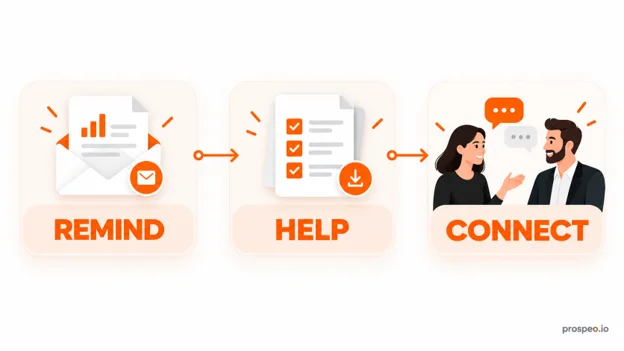
What to do: Send two or three messages that build on the topic of the original asset. Offer a template, a checklist, a short explainer or a relevant article. Include one LinkedIn connection request from a named person on your team, not a company page.
Why it matters: Prospects in this stage are still researching. If you help them do that, you become part of their thinking before you ever ask for a meeting.
How to execute: Make each message about one idea and give it one call to action. For example, if the original asset covered account-based marketing, the day-five email might share a one-page worksheet for scoring target accounts, and the day-eight email might link to a short article on aligning sales and marketing around a shared account list.
Tools and process: Marketing automation with behavior-based branching. Anyone who clicks a second asset moves up one tier. Anyone who unsubscribes stops immediately.
Common mistake: Sending five emails in five days. Compressing the sequence damages trust faster than it builds interest.
Success measure: Click-to-open rate on secondary content, number of leads who engage with a second asset, and number of replies.

Phase 4: Human Touch (Day 5 to 14)
What to do: SDRs reach out to Tier A leads and any Tier B lead who has engaged with a second asset. Use two or three touches across phone, email and LinkedIn.
Why it matters: Email alone rarely creates a conversation. Human outreach, anchored to the content the lead read, is what converts a reader into a participant.
How to execute: Give SDRs a short, honest opener.
“Hi Maya, this is Priyanshi from Valasys. You downloaded a benchmark report on lead response times a few days ago. I am not calling to sell anything today. I am curious how your team currently decides which leads get a call first.”
That opener is specific, it earns a reply, and it starts with the lead’s reality rather than your product.
Tools and process: A sales engagement platform, a short call guide, and a shared note field in the CRM that records what the lead downloaded and clicked.
Common mistake: Asking for a 30-minute demo on the first call. The ask should match the relationship, which is brand new.
Success measure: Connect rate, conversations started, and the share of Tier A leads that SDRs touched by day 10.
Phase 5: Decide (Day 15 to 30)
What to do: Review every lead against your scoring rules. Extend a low-pressure offer such as a benchmark session, a live webinar or a short audit. Recycle, escalate or retire each lead by day 30.
Why it matters: Without a decision point, leads drift. Drifting leads clutter pipeline reports and make conversion rates look worse than they are.
How to execute: Use these outcomes.
- Escalate to sales: The lead has met your threshold for fit and intent.
- Recycle into long-term nurture: The lead fits your ICP but has not shown intent. Move them to a slower monthly stream.
- Retire: The lead does not fit, has not engaged at all, or has asked to stop.
Common mistake: Keeping every lead in active follow-up forever “just in case.”
Success measure: Percentage of leads with a recorded outcome by day 30, plus conversion rate from escalated leads to qualified opportunities.
The cadence above is a practical starting point, not a fixed rule. Adjust the timing to your sales cycle and to the kind of asset you syndicated. A technical buyer’s guide may justify a longer gap between touches than a short checklist does.
Want a more detailed view of what happens after day 30? Our nurture framework for syndicated leads covers the long-term stream.
What Does the 30-Day Calendar Look Like Day by Day?
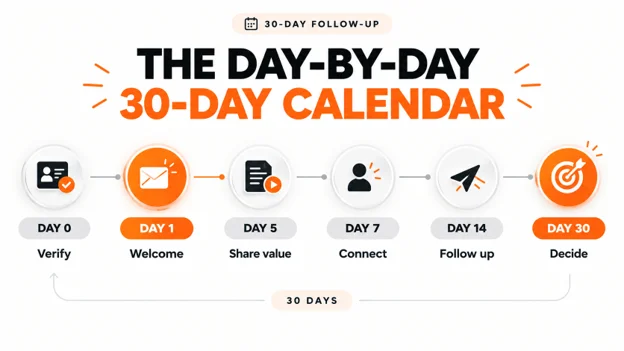
This calendar puts the five phases onto a single timeline. Use it as a working template.
| Day | Action | Channel | Branching rule |
| 0 | Receive, upload, deduplicate and tier leads | CRM | Remove invalid and duplicate records |
| 1 | Welcome email referencing the asset | Tier A also flagged for SDR review | |
| 3 | Short resend or reminder | Send only to non-openers | |
| 5 | Deepening email 1 (useful template or checklist) | Click moves lead up one tier | |
| 5 to 7 | First SDR touch for Tier A | Phone and email | Log the outcome in the CRM |
| 7 | LinkedIn connection request | Send from a named person | |
| 9 | Deepening email 2 | Reply stops automated emails | |
| 12 | Second SDR touch for Tier A and engaged Tier B | Phone and LinkedIn | Move to Day 14 if no response |
| 14 | Final SDR touch with a specific question | Close the human track if no reply | |
| 17 | Soft offer (webinar, benchmark or audit) | Click or registration triggers score review | |
| 21 | Peer example or case study | Email, LinkedIn | Track clicks on pricing or service pages |
| 24 | Second soft offer, different format | Escalate any lead that crosses your score threshold | |
| 28 | Short “is this still useful?” check-in | Non-response moves lead to retirement review | |
| 30 | Decision: escalate, recycle or retire | CRM | Record the outcome for reporting |
How Do You Score and Route Leads During the 30 Days?
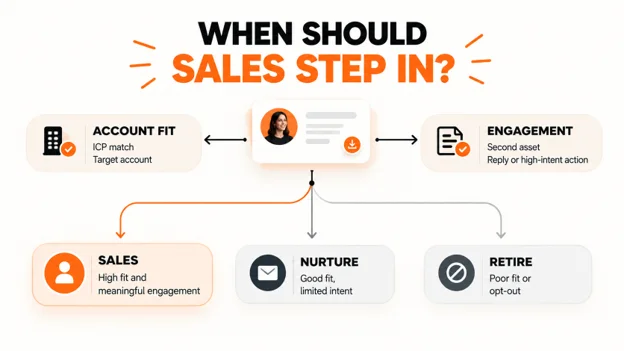
Fit tells you whether a lead could buy. Intent tells you whether they are acting like someone who will. You need both, and they should be tracked separately.
Here is a simple model you can adapt. The point values are illustrative. Calibrate them using your own closed-won and closed-lost history.
| Signal | Type | Suggested score | Action |
| Account is on your TAL | Fit | High | Prioritize for SDR outreach |
| Job level and function match your ICP | Fit | High | Fast-track to human touch |
| Company size and industry match | Fit | Medium | Include in standard cadence |
| Opened two or more emails | Intent | Low | Keep in sequence |
| Clicked a second asset | Intent | Medium | Move up one tier |
| Replied to an email or call | Intent | High | Stop automation, assign to a rep |
| Visited a pricing or services page | Intent | High | Notify the owner immediately |
| Registered for a webinar or booked a session | Intent | High | Escalate to sales |
| Unsubscribed or marked as spam | Negative | Remove | Suppress and review the source |
Two rules keep this model honest. First, never escalate on a single email open. Opens are not as reliable a signal on their own. Second, review the model every quarter. If sales keeps rejecting leads that score highly, your scoring is wrong, not your sales team.
Which Metrics Should You Track at Each Phase?
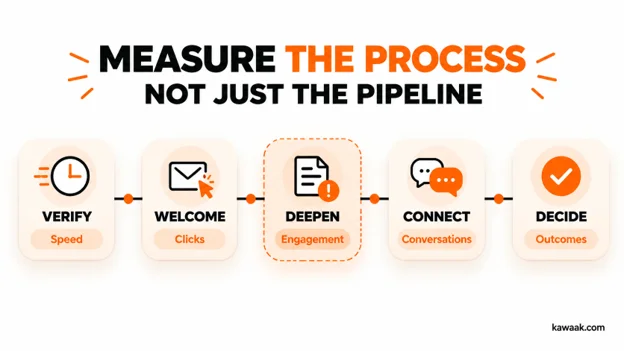
A single blended number, such as “download to opportunity rate,” hides where leads are being lost. Track one or two metrics for each phase instead.
| Phase | Primary metric | What a weak number usually means |
| 1. Verify and Route | Leads tiered and assigned within 24 hours | Process or ownership gap |
| 2. Welcome and Orient | Click rate and unsubscribe rate on email 1 | Weak context, wrong audience or poor consent |
| 3. Deepen | Share of leads engaging with a second asset | Content does not match the original interest |
| 4. Human Touch | Connect rate and conversations started | Poor targeting, bad contact data or a weak opener |
| 5. Decide | Outcome recorded by day 30, plus SQL rate | Unclear decision rules or sales misalignment |
This also helps you diagnose lead quality honestly. If Phase 2 results are healthy but Phase 4 is weak, the problem is probably in targeting or data. If Phase 1 results are weak, you have an internal speed problem, not a vendor problem. For a deeper look at the trade-off between scale and precision, see our comparison of lead volume vs lead quality in content syndication.
If you want to improve the leads themselves, not just how you treat them, our guide on how to improve lead quality in content syndication covers targeting, filtering and vendor controls.
What Are the Most Common Follow-Up Mistakes, and How Do You Fix Them?
| Mistake | Why it hurts | Fix |
| Waiting a week to start | Interest and context fade quickly | Set a 24-hour service level for upload and first touch |
| Sending a sales pitch in the first email | The lead only knows the asset, not your company | Reference the asset and offer a useful next step |
| Calling every lead | SDR time is wasted and reps lose trust in the program | Tier leads and call only the high-fit group first |
| Using one generic email sequence for every asset | Messages feel irrelevant | Write a short branch for each asset theme |
| Ignoring the buying group | One contact rarely decides alone | Identify and engage other roles at Tier A accounts |
| Never closing the loop | Pipeline reports fill with stale leads | Require a recorded outcome by day 30 |
| Blaming the vendor for everything | You miss internal process gaps | Review fit, speed and message quality before judging the source |
Many of these overlap with problems that begin earlier in the program. Our blog on content syndication mistakes that hurt lead quality covers the upstream issues, and our B2B content syndication strategy shows how to build a program that avoids them.
What Is the Follow-Up Checklist You Can Use Today?
Copy this into your campaign brief or operations document.
Before the campaign starts
- ICP and TAL are documented and shared with sales
- MQL and SQL definitions for syndicated leads are agreed in writing
- Consent scope and regional rules are confirmed with the vendor
- Lead delivery frequency and routing owner are set
- Email branches are written for the asset being syndicated
In the first 24 hours of each batch
- Leads are uploaded, deduplicated and validated
- Each lead is tiered A, B or C
- Tier A leads are assigned to a named SDR
- The welcome email is scheduled or sent
During days 2 to 14
- Deepening emails are going out on schedule
- SDRs have logged at least two touches on every Tier A lead
- Engaged Tier B leads have moved up
- Replies and unsubscribes are handled the same day
By day 30
- Every lead has a recorded outcome: escalate, recycle or retire
- Phase-level metrics are reported to marketing and sales together
- Learnings are fed back into the next campaign brief
What Should You Do Next?
A 30-day follow-up plan for content syndication leads does not need complicated technology. It needs a fast first touch, content that matches what the lead already read, human outreach where the account justifies it, and a decision at the end of every cycle.
Start small. Pick one live campaign, apply the five phases, and compare its results with your last campaign. The gap between “leads delivered” and “leads sales is willing to work” is almost always a follow-up problem before it is a lead problem.
If you want a second opinion on your current process, the team at Valasys Media can help you review your cadence, scoring and handoff rules against what is working in B2B programs today.
Frequently Asked Questions
-
What is a content syndication follow-up plan?
It is a structured set of emails, calls and LinkedIn touches that begins the moment a syndicated lead is delivered. Its purpose is to remind the lead why they heard from you, build trust with useful content, and decide within a fixed window whether to pass them to sales, nurture them or retire them.
-
How soon should you contact a content syndication lead?
Send a first email within 24 hours of delivery, and ideally the same day. Research on web leads shows that response speed strongly affects conversation rates. Syndicated leads have even less existing connection to your brand, so a fast, context-rich first message is especially important.
-
Should SDRs call every syndicated lead?
No. Call leads that match your ICP or sit on your target account list first, plus lower-fit leads who show real engagement such as clicking a second asset or replying. Calling everyone burns SDR time, lowers connect rates, and makes sales skeptical of the program.
-
How many follow-up touches do syndicated leads need?
Most cadences use six to ten touches over 30 days across email, phone and LinkedIn, with fewer touches for lower-fit leads. The right number depends on your sales cycle and the asset type. Watch unsubscribe and complaint rates as signals that you are contacting too often.
-
Which tools do you need to run a 30-day follow-up plan?
At minimum, you need a CRM, a marketing automation platform for email branching, and a way for SDRs to log calls and notes. A sales engagement platform and a data enrichment source help at scale, but the plan works without them if routing and ownership are clear.
-
When should you stop following up with a syndicated lead?
Stop when the lead replies that they are not interested, unsubscribes, or reaches day 30 without any engagement and without strong ICP fit. Leads that fit your ICP but have not shown intent should move into a slower monthly nurture stream, not stay in active follow-up.