
How to Validate Content Syndication Leads Before Sales Handoff
A 5-gate process to validate content syndication leads before sales handoff: data, source, fit, intent & handoff packet. Includes checklist.

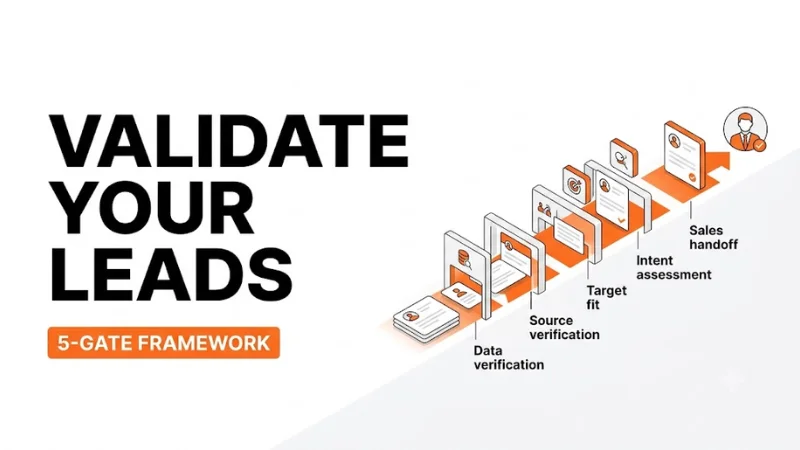
You know a lead can look perfect on paper but still give zero context to sales, that difference comes down to how and what you validate before passing it along.
How do you validate content syndication leads before sales handoff?
To validate content syndication leads before sales handoff, verify contact data, confirm the person and account match your Ideal Customer Profile (ICP) and Target Account List (TAL), check that the lead received the promised asset and engaged with it, then assign a readiness tier. Route only validated leads to sales; send the rest to nurture with a reason code.
Key Takeaways
- Verify beyond the email: Confirm contact accuracy, ICP fit, and the right buying role.
- Validate the source: Check audience compliance, content delivery, and engagement evidence.
- Score readiness, not downloads: Route leads to sales, nurture, or rejection based on fit and intent.
- Set acceptance rules before launch: Document criteria in your content syndication campaign brief.
- Make handoffs actionable: Give sales the asset, engagement context, account details, and recommended next step.
- Learn from rejections: Track reason codes and refine validation rules monthly.
Why do good syndication campaigns still produce rejected leads?
Content syndication can deliver exactly what a campaign brief requests and still fall short of what sales needs. The problem often starts when delivery requirements are clear, but sales-acceptance criteria are not.
Marketing may measure success by lead volume, delivery and cost per lead. Sales needs to know whether those contacts match the ideal customer profile, reach the right people and provide a credible reason for follow-up.
When those expectations aren’t aligned before launch, rejection becomes a downstream symptom of a preventable handoff problem.
For a closer look at the common causes, our guide on why sales rejects content syndication leads covers the key rejection reasons. Here, the focus is on preventing those issues through a consistent validation process.
What does “validated” actually mean for a syndication lead?
A validated lead is one that has passed defined checks on data quality, source integrity, ICP fit and engagement context, and has been placed in a readiness tier. It is a judgment about usefulness to sales, not a technical check on an email address.
This matters because content syndication works differently from inbound demand. A prospect who downloads a report on a third-party site was interested in the topic at that moment. They did not ask to hear from your sales team. Validation closes that gap by asking whether this person is worth a rep’s time, and what the right next step is.
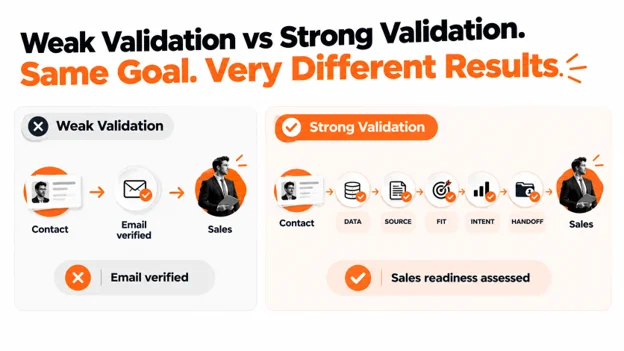
Here is how weak and strong validation compare:
| Dimension | Weak validation | Strong validation |
| Definition of “valid” | Email passes a format check | Passes five gates: data, source, fit, intent, packet |
| Who decides | Vendor or marketing alone | Marketing and sales agree criteria before launch |
| Output | One list sent to sales | Tiered routing: sales-ready, nurture, reject |
| Rejection feedback | “These leads are garbage” | Reason codes reviewed monthly |
| Context for sales | Name, email, title | Asset, engagement, account signals, suggested opener |
The Valasys 5-Gate Lead Validation Framework
Every syndicated lead should pass five gates in order. A lead that fails an early gate does not move forward, which keeps expensive checks (like account research) for leads that deserve them.
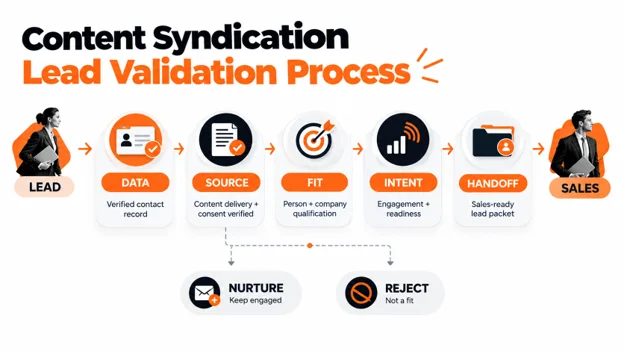
Gate 1: Data integrity
What to do: Confirm the contact record is real, complete and unique.
Why it matters: Bad data wastes rep time and damages sender reputation. It is also the cheapest thing to catch.
How to execute:
- Validate email syntax and deliverability with a verification tool.
- Remove personal domains (Gmail, Yahoo, Outlook) unless your ICP includes small founders who use them.
- Confirm the company name maps to a real organization with a working corporate domain.
- Check required fields: first name, last name, job title, company, industry, company size, location.
- Scrub duplicates against the CRM, including contacts tied to open opportunities or recent campaigns.
Tools and process: Email verification service, CRM duplicate rules, enrichment provider for missing firmographics.
Common mistake: Treating a passed email check as proof the lead is good. It only proves the mailbox exists.
Success measure: Share of delivered leads that clear Gate 1 without manual repair.
Gate 2: Source and consent integrity
What to do: Verify the lead came from the audience you agreed to and actually received the promised content.
Why it matters: This is the gate most competitors skip, and it explains many “nobody remembers us” calls. If a lead was never in your target audience, or never saw your asset, no later check can save them.
How to execute:
- Compare each lead against the targeting parameters in your campaign brief: titles, industries, company sizes, geography.
- Confirm the asset was delivered and that the lead opted in to be contacted by you, not just by the publisher.
- Check the stated engagement (download, registration, webinar attendance) against the vendor’s delivery log.
- Look for patterns: many leads from one domain, identical job titles, or implausible timestamps.
If you email US contacts, note that the FTC states the CAN-SPAM Act makes no exception for business-to-business email, and recipients must be able to opt out (FTC CAN-SPAM compliance guide). Confirm your consent and opt-out handling with your legal team; this article is not legal advice.
Tools and process: Vendor delivery reports, campaign brief, consent records, a sample audit on every batch.
Common mistake: Accepting a batch on volume without sampling it against the agreed audience.
Success measure: Percentage of sampled leads that match the agreed audience and consent terms.
Gate 3: ICP and target account fit
What to do: Check that the person and the company belong in your market.
Why it matters: A correct email on someone with no buying role is still a dead end.
How to execute:
- Role and seniority: does the title and department fit your buying committee (decision maker, influencer, evaluator)?
- Firmographics: employee count, revenue range, industry and region against your ICP.
- Target account match: is the account on your active ABM list, or in a category you are researching?
- Account state: is it already a customer, a competitor, or in an open deal with a different owner?
Tools and process: ICP scorecard, TAL in your CRM or ABM platform, enrichment data.
Common mistake: Judging fit on job title alone. Titles vary wildly between companies, so pair them with department and company size.
Success measure: Percentage of Gate 2 survivors that match ICP, split by campaign and asset.
Gate 4: Intent and engagement context
What to do: Decide how ready this person is, based on what they did.
Why it matters: Content syndication usually captures early-stage interest. Someone who downloaded a broad benchmark report is in a different place from someone who requested a pricing guide.
How to execute:
- Classify the asset by funnel stage: educational, evaluative, or purchase-oriented.
- Check whether other contacts from the same account have engaged recently.
- Look at the lead’s history with you: prior assets, site visits, email engagement.
- Add any available third-party intent signals for the account’s category research.
- Use a confirmation step, such as a short qualifying question or double opt-in, where it fits your program.
Tools and process: Asset-stage mapping, CRM activity history, intent data, a simple scoring model.
Common mistake: Giving every lead the same score regardless of the asset they engaged with.
Success measure: Conversion rate by readiness tier. If the top tier does not convert better, your scoring needs work.
Gate 5: Handoff packet
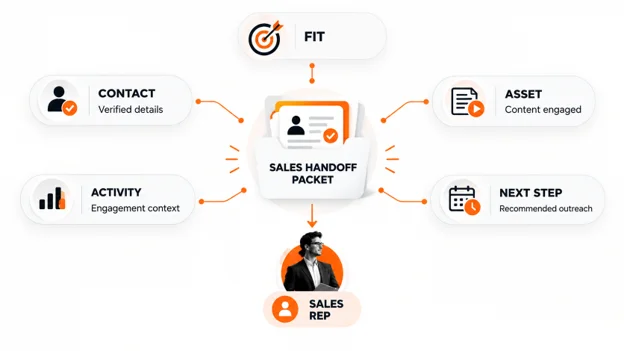
What to do: Assemble the context sales needs to act, then route by tier.
Why it matters: A rep with only a name and email will open with a generic pitch. A rep with context can open with something relevant.

How to execute: Attach the fields below to every sales-ready lead, and set a follow-up deadline.
| Handoff packet field | What it tells sales |
| Asset and topic | What the person was interested in |
| Engagement date | How fresh the interest is |
| Persona and buying role | Who they likely are in the decision |
| ICP and TAL status | Why this account matters |
| Other account activity | Whether there is a wider buying group |
| Validation tier | How ready the lead is |
| Suggested opener | A first line tied to the asset |
Common mistake: Sending leads in a spreadsheet with no context and expecting reps to research each one.
Success measure: Time to first touch, and sales acceptance rate by tier.
How should you route leads once they are validated?
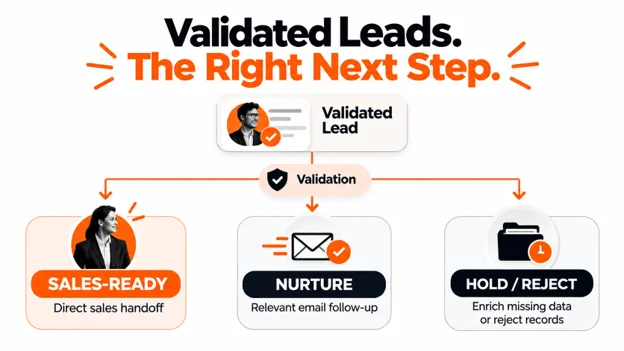
Not every validated lead should go to a rep. Tiering protects sales time and keeps early-stage prospects in a nurture path where they are more likely to convert later.
The example below is a starting point. Treat the thresholds as illustrative and calibrate them against your own conversion data.
| Tier | Typical profile | Route | Follow-up window |
| Tier 1: Sales-ready | Passes all gates, on TAL, senior buying role, evaluative or purchase-stage asset, or multiple account contacts engaged | Direct to sales with handoff packet | Within 24 to 48 hours |
| Tier 2: Nurture-ready | Passes Gates 1 to 3, early-stage asset, no wider account signals | Targeted nurture, sales alerted on new engagement | Nurture track starts immediately |
| Tier 3: Hold or enrich | Missing fields or unclear fit | Enrich, then re-run gates | Within one week |
| Reject | Fails Gate 1 or 2, or clearly outside ICP | Return to vendor with reason code | Per vendor terms |
For the nurture track, see our guide to email nurture flows for syndication leads.
Speed matters for the leads you do route. Harvard Business Review research on online sales leads found that firms contacting prospects within an hour were nearly seven times as likely to qualify them as firms that waited even one more hour (Oldroyd, McElheran and Elkington, Harvard Business Review, 2011). That study looked at inbound web inquiries rather than syndicated leads, so treat it as directional support for a fast first touch, not a syndication benchmark.
A simple scoring model you can adapt
If you want a numeric model, keep it simple. The weights below are an illustrative example, not a Valasys benchmark. Replace them with weights based on your own closed-won analysis.
| Factor | Example points |
| Title and department match buying committee | 0 to 30 |
| Company matches ICP firmographics | 0 to 25 |
| Account on TAL | 0 to 20 |
| Asset stage (educational, evaluative, purchase) | 0 to 15 |
| Multiple contacts or repeat engagement | 0 to 10 |
Set the sales-ready threshold only after you compare scores with actual outcomes.
Want to see how your current handoff compares with a five-gate process? Explore how Valasys Media approaches content syndication for B2B sales.
What should be in your pre-handoff validation checklist?
Use this checklist on every batch of syndicated leads. It works as a final review before anything lands in a rep’s queue.
Data
- Email is deliverable and uses a business domain
- Company and domain are real and match each other
- Required fields are complete
- No duplicate in CRM or open opportunity
Source
- Lead matches the agreed audience from the brief
- Asset delivery and opt-in are confirmed
- Batch sample shows no suspicious patterns
Fit
- Title, department and seniority match the buying committee
- Company size, industry and region match ICP
- Account status is checked (customer, competitor, open deal)
Intent
- Asset stage is recorded
- Other account engagement is noted
- Readiness tier is assigned
Handoff
- Packet is complete
- Owner and follow-up deadline are set
- Rejection reason code field is ready
If your team keeps finding the same gaps, a clearer brief and tighter targeting usually fix them at the source. See how to improve lead quality in content syndication.
How do you agree on acceptance criteria before the campaign starts?
The cleanest validation happens before the first lead arrives. Sit down with sales and the vendor and write the answers to five questions into the campaign brief:
- Who counts as the target persona, by title, function and seniority?
- Which firmographic limits apply?
- Which accounts are excluded (customers, competitors, active deals)?
- What counts as a valid delivery, and what proof will the vendor provide?
- What will be returned or replaced, and within how many days?
Without this, every rejection becomes an argument about opinion. With it, you can point to a line in the brief. Our campaign brief guide shows how to structure it, and the goals guide helps you decide whether you are buying leads, pipeline or awareness, because the answer changes the criteria.
How do you turn sales rejections into better validation rules?
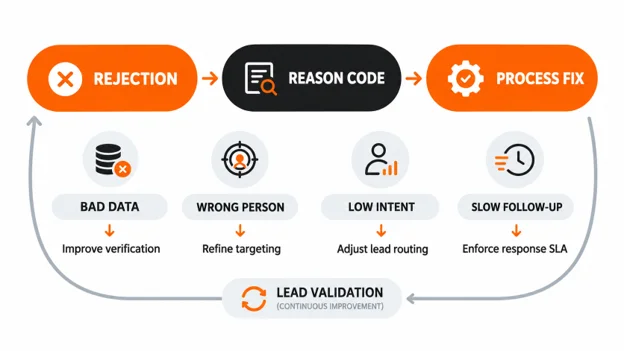
Sales feedback is useful only when it is specific. Ask reps to tag each rejected lead with one reason code instead of a general complaint.
A workable code set:
- R1: Bad or incomplete data
- R2: Wrong persona or no buying role
- R3: Outside ICP or out of market
- R4: Did not recall the content or interest
- R5: Already in an active deal or existing customer
- R6: Follow-up was too slow
Then run a monthly audit. Pull around 25 recently rejected leads from one campaign, tag them, and count the codes. If R1 dominates, tighten Gate 1 and push back on the vendor. If R2 and R3 lead, fix targeting. If R6 leads, the problem is your follow-up speed, not lead quality.
This step keeps both sides honest, because it separates vendor problems from process problems. For a deeper breakdown, read our guide on why sales rejects content syndication leads.
Which mistakes undermine content syndication lead validation?
| Mistake | Why it hurts | Fix |
| Validating only email and phone | Valid contacts can still be the wrong people | Add Gates 2 to 4 |
| Skipping the batch sample | Audience drift goes unnoticed | Sample every delivery against the brief |
| Sending all leads to sales | Early-stage leads burn rep goodwill | Tier and route to nurture |
| No written acceptance criteria | Rejections become disputes | Put criteria in the brief |
| Slow follow-up | Interest fades; reps blame lead quality | Set a 24 to 48 hour window for Tier 1 |
| Generic rejection feedback | Nothing improves | Use reason codes |
| Never reviewing rules | Criteria go stale | Audit monthly, adjust quarterly |
Many of these are program-level problems. Our guide to content syndication mistakes that hurt lead quality covers them in more detail.
Do smaller teams need all five gates?
Not always. If you receive a few dozen syndicated leads a month, a spreadsheet and the checklist above are enough: run Gates 1 to 3 by hand and skip numeric scoring. Add scoring and automation when volume makes manual review the bottleneck.
How do volume and quality affect validation effort?
As a general pattern, higher volume means more leads to check, and pass rates tend to fall when targeting loosens. That pushes cost per validated lead up even when cost per delivered lead looks low, which is why many teams measure cost per accepted lead instead of cost per lead. Your own gate pass rates will show whether this holds in your program.
What metrics show whether content syndication lead validation is working?
Track these by campaign, asset and vendor:
- Gate pass rate at each stage
- Sales acceptance rate by tier
- Time to first touch
- Lead-to-opportunity conversion by tier
- Rejection rate by reason code
- Cost per accepted lead
If the pass rate at Gate 2 is low, talk to the vendor. If Gate 3 is low, revisit targeting. If acceptance is low but all gates pass, the problem is probably in how sales receives and follows up on leads.
Choosing a partner that supports this level of transparency also matters. See our overview of the best B2B content syndication services and our B2B content syndication strategy guide for the wider context.
Final Thoughts
To validate content syndication leads before sales handoff, you need more than a clean email list. When marketing and sales agree on what “ready” means, check source and fit as well as data, and hand over context instead of a list, rejection rates drop and conversations improve.
Start small. Take your last batch, run the five gates by hand, and see where leads fall out. That single exercise will tell you more about your program than another month of lead volume reports.
Ready to put a validation process behind your next content syndication campaign? Contact Valasys Media to learn how our data-driven approach to content syndication can turn more of your leads into accepted pipeline.
Frequently Asked Questions
-
What is content syndication lead validation?
Content syndication lead validation is the process of checking data accuracy, source integrity, ICP fit, and engagement context before sales handoff. It helps route sales-ready leads to reps while directing early-stage prospects to nurture and invalid records for review or rejection.
-
What should I check first when validating a lead?
Start with data integrity: verify the business email, confirm the company and domain, complete required fields, and remove CRM duplicates. Then check source and consent records, ICP fit, and engagement context before assigning a readiness tier.
-
How do I know if a lead really engaged with the content?
Check the vendor’s delivery records to confirm the reported action, such as a download or registration. Review consent records and sample each batch for suspicious patterns, including repeated domains, identical job titles, or implausible timestamps.
-
What is the difference between ICP fit and intent?
ICP fit tells you whether a person and company match your target market based on factors such as role, industry, company size, and region. Intent indicates how relevant or timely their interest may be, based on content engagement and available account signals. A strong-fit lead with limited intent may be better suited to nurture than immediate sales outreach.
-
Who should define lead acceptance criteria?
Marketing and sales should agree on acceptance criteria before the campaign launches, with the syndication vendor involved where appropriate. Document the target personas, firmographic requirements, exclusions, delivery evidence, and replacement terms in the campaign brief so everyone works from the same standards.
-
How do I measure whether lead validation is improving results?
Track validation pass rates, sales acceptance by readiness tier, time to first touch, lead-to-opportunity conversion, rejection reasons, and cost per accepted lead. If higher-scoring leads do not convert better than lower-scoring leads, revisit your qualification criteria and scoring model.