
How to Build a Content Syndication Campaign Brief
Learn how to build a content syndication campaign brief with clear goals, target audiences, content strategy, distribution channels, & KPIs.

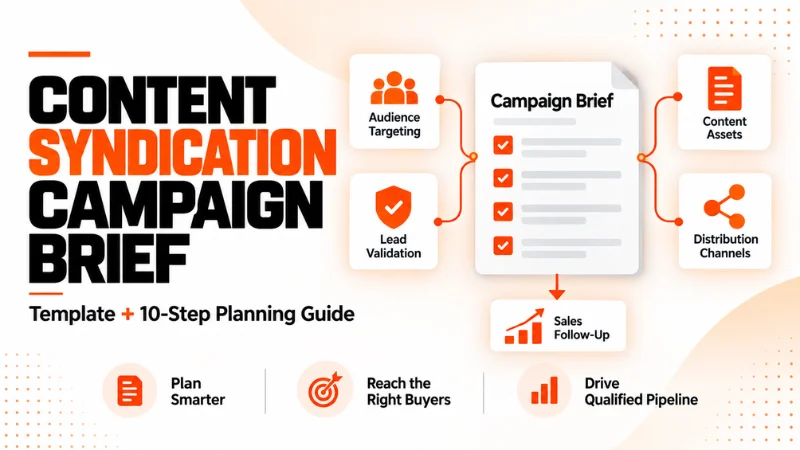
Building a content syndication campaign brief means creating a structured campaign document that clearly defines your campaign goals, target audience, content assets, syndication partners and channels, CTA, timeline, budget, and KPIs so internal teams and external partners know exactly what to distribute, to whom, where, and how campaign success will be measured.
A content syndication campaign can look perfectly organized on a media plan and still produce leads that sales does not want.
The problem often begins before distribution starts. Marketing has one definition of the audience. The syndication partner has another. Sales expects a different level of qualification. Operations discover the required CRM fields only after leads begin arriving.
A content syndication campaign brief prevents those gaps by turning campaign expectations into explicit operating rules.
It should tell every party not only who to target, but also what counts as an acceptable lead, what should be rejected, what information must accompany each record, how consent should be handled, how leads will be followed up, and how success will be judged after delivery.
How Do You Build a Content Syndication Campaign Brief?
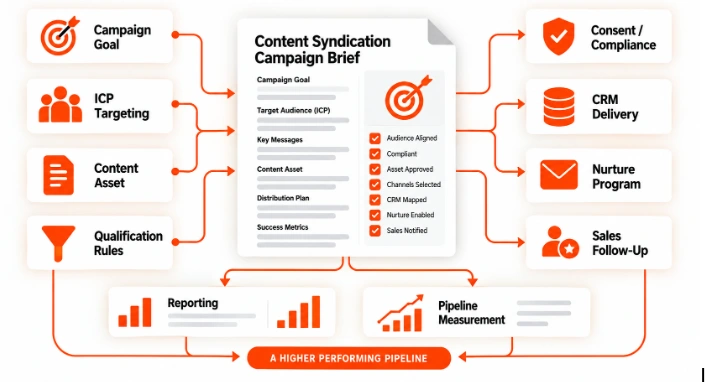
To build a content syndication campaign brief, define the campaign goal, target audience, content asset, distribution approach, qualification criteria, lead acceptance rules, data requirements, follow-up workflow, reporting process, and success metrics. A clear brief ensures marketing teams, sales teams, operations teams, and syndication partners follow the same process from campaign launch to lead conversion.
That definition matters because content syndication works across several systems at once: content, audience targeting, lead capture, data validation, CRM routing, nurture, sales follow-up, and reporting.
If any one of those systems is left undefined, somebody has to make assumptions after the campaign launches.
The brief exists to remove those assumptions.
The process can be broken into 10 practical steps:
- Define the business outcome
- Specify the ICP
- Match the content asset to the buying stage
- Define lead qualification criteria
- Set qualification questions
- Document rejection and replacement rules
- Set privacy and consent requirements
- Specify lead data and intelligence requirements
- Plan the follow-up workflow
- Define measurement criteria
Content Syndication Campaign Brief Template
Use these core sections to build the brief before launching a campaign.
| Brief section | What to define |
| Campaign goal | Business outcome and primary KPI |
| Target audience / ICP | Industry, company size, geography, roles, seniority, and target accounts |
| Content asset | Asset, topic, format, funnel stage, and intended next step |
| Distribution | Approved syndication partners, publishers, or channels |
| Lead qualification | What makes a lead qualified, excluded, or invalid |
| Lead data & delivery | Required fields, delivery format, CRM destination, and cadence |
| Follow-up | Nurture, retargeting, SDR routing, and escalation rules |
| Measurement | Lead acceptance, qualification, opportunities, pipeline, and revenue |
DO NOT POST THIS LINE
1. Start With the Business Outcome, Not the Lead Quantity
“Generate 1,000 leads” is a delivery target. It is not enough to define campaign success.
A stronger brief explains what those leads are expected to contribute to. That may be accepted demand from a new market, engagement within named accounts, qualified contacts for an existing nurture program, or pipeline creation around a specific solution.
This distinction changes how the campaign is designed.
A program optimized only for maximum form fills may make very different targeting, channel, and qualification choices from one judged on sales acceptance or opportunity creation.
Looking beyond cost per lead helps teams evaluate lead acceptance, nurture engagement, and pipeline contribution.
Your brief should therefore name both the immediate campaign metric and the downstream business metric.
Example: Turning Lead Volume Into a Business Outcome
A past content syndication campaign Valasys ran for Workday shows why the business outcome needs to be defined before lead volume.
The campaign was not simply designed to generate a fixed number of content syndication leads. The business objective was to increase top-of-funnel (TOFU) inflow that could feed MQL and SDR qualification further down the funnel and ultimately support qualified pipeline.
That changes how the campaign brief should be written.
| Metric level | Campaign focus |
| Delivery | Relevant content syndication leads |
| Quality | Leads that meet the defined ICP and qualification criteria |
| Funnel | TOFU inflow that can progress toward MQL and SDR qualification |
| Commercial | Contribution to qualified pipeline |
The campaign ultimately generated 17,000+ content syndication leads during the engagement. The more useful lesson, however, is not the volume itself. It is how the campaign objective connected lead generation to the next stages of the funnel.
That distinction matters when building your own brief. A target such as “generate 5,000 leads” tells a syndication partner how much to deliver. An objective such as “generate relevant TOFU demand that can progress through MQL and SDR qualification” tells the partner what the campaign is actually supposed to accomplish.
You do not need to pretend every syndicated download is revenue-ready. You do need to define what progress should look like after that download.
2. Define the ICP More Precisely Than “Job Title + Company Size”
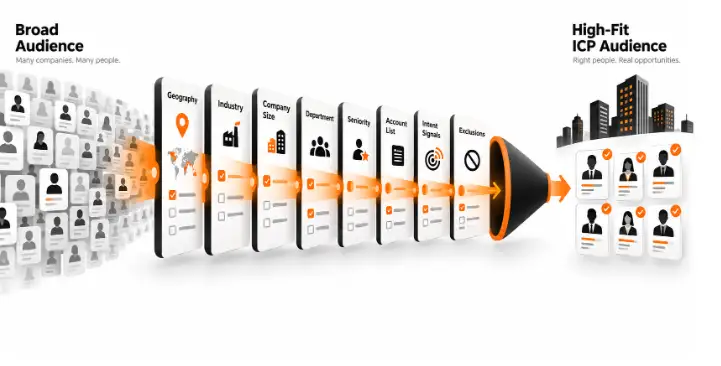
Most syndication briefs include targeting. Far fewer define targeting precisely enough to prevent interpretation.
“IT decision-makers at enterprise companies” leaves too much room for variation. Which industries? Which countries? What employee or revenue band? Which functions? Does “decision-maker” include managers? Are consultants allowed? What about subsidiaries?
A usable ICP section should make those decisions clear.
Valasys content syndication services describe audience filtering using factors including job title, industry, company size, geography, and intent.
The brief should turn those available targeting dimensions into campaign-specific rules.
| Dimension | Campaign definition |
| Geography | United States, Australia, New Zealand |
| Industry | B2B software, financial services, manufacturing |
| Company size | Defined employee or revenue band |
| Functions | IT, security, data |
| Seniority | Director and above |
| Accounts | Named account list if applicable |
| Exclusions | Existing customers and competitors |
For buying committees, do not assume a single title represents the whole account.
A technical evaluator, economic buyer, operational user, and procurement stakeholder may respond to different value propositions even when they are researching the same solution.
3. Match the Content Asset to the Buying Stage
The campaign brief should explain not just which asset is being syndicated, but why that asset belongs in this campaign.
A broad educational report may work well for an audience still defining the problem. A detailed comparison, implementation framework, business case, or customer proof asset may fit a buyer closer to evaluation.
Content syndication works best when content is matched to the buyer’s stage rather than distributed indiscriminately.
Example: Using Practical Content to Create TOFU Inflow
The Workday campaign also illustrates why the asset itself needs to be defined as part of the campaign strategy.
The campaign used whitepapers and eBooks covering everyday HR and finance solutions rather than treating content as a generic download offer. That gave the campaign a clear educational entry point for people researching problems and solutions relevant to their roles.
| Asset field | Workday campaign example |
| Asset format | Whitepapers and eBooks |
| Content focus | Everyday HR and finance solutions |
| Funnel role | TOFU demand generation |
| Intended outcome | Generate relevant engagement that could feed downstream qualification |
The point is not that whitepapers or eBooks are automatically the right choice for every syndication campaign. The point is that the asset should have a defined job in the funnel.
If the campaign objective is TOFU demand generation, the content needs to give the target audience a useful reason to engage. The brief should document that connection so the distribution partner understands what it is promoting and why.
This also gives the nurture and sales teams context for what the prospect originally engaged with before the lead enters the next stage of the funnel.
4. Define Exactly What Counts as a Qualified Lead
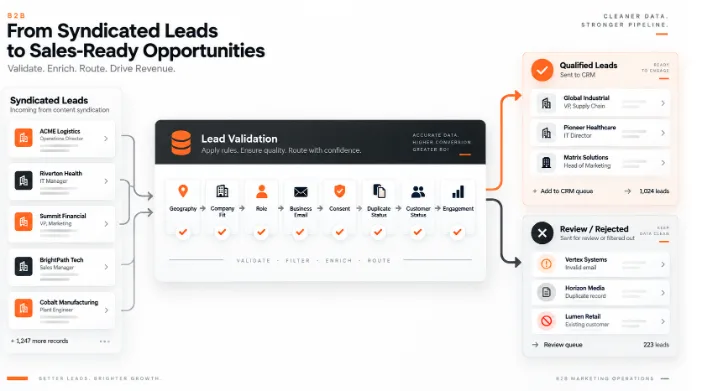
This may be the most important part of the entire brief.
The phrase “qualified lead” means almost nothing unless the qualification logic is written down.
A lead might technically match the job-title filter while working for the wrong industry. One might match the account profile but use a personal email. Another contact may already be an open opportunity, while someone else may have previously downloaded the same asset.
If those cases are not defined in advance, lead-quality discussions become subjective.
Create an acceptance matrix before launch.
| Criterion | Accept | Reject or review |
| Geography | Inside approved markets | Outside approved markets |
| Company | Matches ICP | Outside required segment |
| Role | Approved function/seniority | Irrelevant role |
| Valid business contact if required | Invalid or prohibited contact type | |
| Consent | Required collection/notice standard met | Required consent evidence unavailable |
| Duplicate | Outside agreed lookback | Inside suppression period |
| Customer status | Net-new where required | Existing customer if excluded |
| Competitor | No | Yes, if excluded |
| Asset interaction | Required engagement completed | No qualifying engagement |
The exact rules will vary by campaign.
A past Workday campaign demonstrates why this level of specificity matters. Rather than treating “HR and finance professionals” as a sufficiently precise audience definition, the campaign used a well-defined ICP to determine which contacts qualified for content syndication.
That meant the campaign could evaluate leads against agreed audience criteria rather than relying on a broad definition of relevance.
The practical lesson is simple: the ICP should not exist only in the campaign strategy deck. It should become an operational qualification rule that the syndication partner can apply when sourcing and validating leads.
Marketing, sales, operations, and the syndication provider should agree on those rules before the first record arrives.
For further campaign-planning context, see How to Generate Content Syndication Leads .
5. Add Qualification Questions Only When They Change What You Do
More form fields do not automatically create better leads.
A good qualification question should help marketing, sales, or the vendor make a decision.
If the answer does not affect prioritization, routing, segmentation, nurture, or qualification, reconsider whether the question needs to be asked.
For example, “What is your biggest business challenge?” can produce vague data.
A campaign may gain more useful information from a tightly defined question about project priority, current environment, purchase timeframe, or area of interest, provided that information genuinely changes the next action.
The brief should specify the exact wording, allowed responses, and whether the answer is mandatory.
It should also state whether a particular response changes the lead’s eligibility.
Otherwise, teams collect “qualification data” that never actually qualifies anything.
6. Specify Lead Rejection and Replacement Rules Before Launch
Most campaign briefs explain who should be delivered.
Strong briefs also explain what should happen when a record should not have been delivered.
Define the invalid-lead categories in advance and decide which ones qualify for replacement.
This could include records outside the ICP, invalid contact information, duplicates inside an agreed suppression period, excluded accounts, or leads without the required collection evidence.
| Question | Decision to document |
| Who reviews rejected leads? | Marketing ops / campaign owner |
| How quickly must rejection be reported? | Agreed SLA |
| What evidence is required? | CRM record, validation result, or other proof |
| Which rejection reasons qualify for replacement? | Pre-agreed categories |
| When are replacements delivered? | Agreed cadence |
| Is there a dispute process? | Campaign-owner escalation |
This may seem procedural.

It is actually part of campaign economics because an inexpensive CPL becomes expensive very quickly when a large percentage of records cannot be used.
7. Build Privacy and Consent Requirements Into the Brief
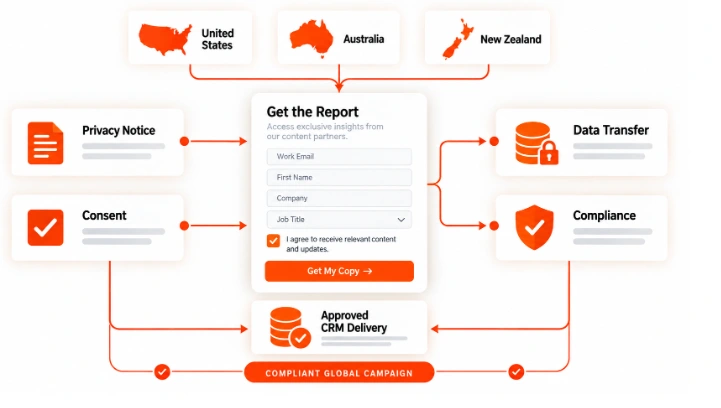
Privacy should not be handled as an afterthought between the vendor and legal team.
If lead information is being collected and transferred, the brief should define which regions are in scope, how prospects are informed about collection, who receives the information, what evidence is retained, and what privacy-policy or collection-notice requirements apply.
For California, businesses subject to the CCPA must provide specified information in a notice at collection, including the categories of personal information collected and the purposes for which they are used. See the California Department of Justice CCPA guidance .
In Australia, APP 5 requires covered entities collecting personal information to take reasonable steps to notify individuals of relevant matters. See the OAIC APP 5 guidance .
In New Zealand, Privacy Act 2020 Principle 3 addresses notification when information is collected directly. IPP 3A, which came into force on May 1, 2026, also introduces notification obligations around certain indirect collections. See the Office of the Privacy Commissioner guidance on IPP 3A .
The campaign brief is not a replacement for legal review.
Its job is to stop privacy and consent expectations from being left undefined until after leads have already been collected.
8. Define Exactly What Data Must Arrive With Each Lead
A content syndication lead is more useful when the receiving team knows the context behind it.
Do not limit the delivery specification to first name, last name, and email.
Depending on the program, the record may need company information, title, geography, asset name, source, engagement timestamp, qualification responses, consent information, campaign ID, and any agreed account or intent context.
At Valasys content syndication service describes reporting that can include lead source, asset engagement, and time of interaction.
| Campaign field | CRM destination |
| Asset name | Lead source detail |
| Campaign ID | Campaign member field |
| Job title | Title |
| Country | Country |
| Engagement date | Content engagement date |
| Qualification response | Custom campaign field |
| Source/vendor | Original source |
A technically valid lead file can still create operational problems if the CRM cannot interpret it cleanly. But for more sophisticated campaigns, the question is also what additional intelligence the sales and marketing teams need to decide what to do with the lead.
Example: Going Beyond Basic Lead Fields
The Workday campaign went beyond traditional content syndication fields by providing additional business intelligence alongside the lead data.
This included information such as:
- Buying committee personas associated with the account
- Intent mapping to understand what relevant topics the account was showing interest in
- Key messaging and outreach context aligned with that intent
- An intent surge score against highly relevant intent topics
That additional context changes the role of the lead record.
Instead of receiving only who downloaded the asset, the receiving team can have more information about who the person represents within the buying committee, what the account may be researching, and how that context can inform follow-up.
The exact intelligence fields will depend on the campaign, but the principle is worth adding to your brief:
Define not only the information required to accept a lead, but also the information required to act on it.
For a basic campaign, that might simply mean source, asset, title, company, and engagement date. For an ABM or intent-led program, the specification may need to go considerably further.
| Data layer | Example |
| Contact data | Name, business email, title |
| Firmographic data | Company, industry, geography, company size |
| Campaign data | Asset, source, campaign ID, engagement date |
| Buying committee data | Persona or role within the buying group |
| Intent data | Relevant intent topic and intent signal |
| Action context | Key messaging or outreach angle |
| Prioritization | Intent surge score or agreed account signal |
The goal is not to collect as much data as possible. It is to provide the information that helps the next team make a better decision about qualification, prioritization, messaging, or outreach.
9. Plan the Follow-Up Before You Buy the Leads
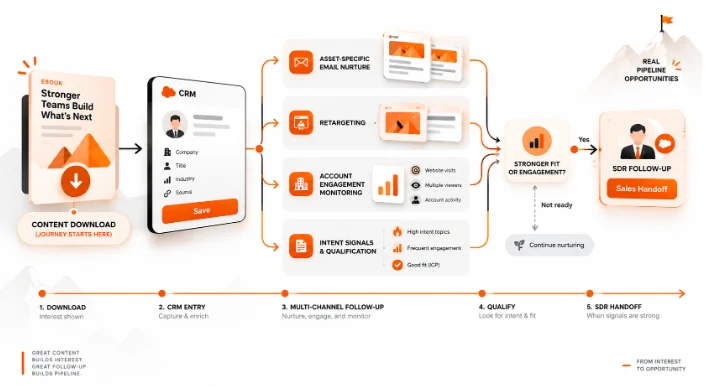
Content syndication does not end when a lead file reaches the CRM.
In many cases, that is when the important work begins.
A person who engages with an educational asset may be showing interest in the topic, but that does not necessarily indicate immediate buying intent. Syndicated leads are often still early in the buyer journey, so they should be supported with relevant nurture, retargeting, and timely sales follow-up rather than treated as sales-ready from the outset.
| Lead state | Next action |
| New syndicated lead | Enter asset-specific nurture |
| ICP match + repeat engagement | Increase priority |
| Target account engagement | Notify account owner |
| Strong qualification response | Route for SDR review |
| Low engagement | Continue educational nurture |
| Sales-disqualified | Return to nurture where appropriate |
For the follow-up process, see Email Nurture Flows for Content Syndication Leads .
The campaign brief should connect the distribution event to that next journey.
10. Measure Accepted Demand and Pipeline, Not Just CPL
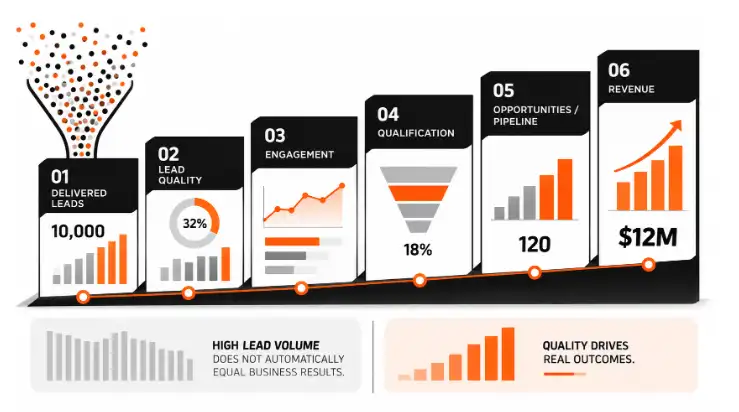
CPL is useful. It is not enough.
Two vendors can deliver the same number of leads at the same CPL and create completely different business outcomes.
That is why your brief should define a measurement ladder before launch.
| Measurement layer | What to track |
| Delivery | Leads delivered, pacing, geography, and segment mix |
| Quality | Validity, rejection rate, acceptance rate, duplicates |
| Engagement | Nurture activity, additional content engagement, account activity |
| Qualification | MQL, SAL, SQL, or your organization’s equivalent stages |
| Pipeline | Opportunities, pipeline created or influenced |
| Revenue | Closed-won revenue where attribution is appropriate |
Similarly, leading content syndication approaches distinguish raw lead volume from pipeline quality, emphasizing account fit and buying signals.
A strong brief tells the vendor what will be measured. An even stronger one tells your own team who will measure it and when.
What a Content Syndication Brief Looks Like in Practice
The individual examples above show how the pieces work separately. The past Workday campaign brings them together in one program. The campaign generated 17,000+ content syndication leads and was structured around a broader funnel objective rather than lead volume alone.
The campaign was designed to increase TOFU inflow that could support MQL and SDR qualification further down the funnel.
| Brief field | How it was approached |
| Business objective | Increase TOFU inflow that could feed MQL and SDR qualification and support qualified pipeline |
| Content assets | Whitepapers and eBooks focused on everyday HR and finance solutions |
| ICP | Defined qualification criteria aligned with the campaign’s target audience |
| Lead generation | Content syndication against the agreed ICP |
| Lead volume | 17,000+ content syndication leads generated during the engagement |
| Buying committee context | Additional persona-level information beyond the individual lead |
| Intent intelligence | Relevant intent topics and intent surge signals |
| Messaging context | Key messaging and outreach considerations linked to account intent |
| Downstream use | Information designed to support qualification, prioritization, and follow-up |
The useful takeaway is not simply that the campaign generated 17,000+ leads. It is that the brief connected content, ICP, funnel objective, qualification, and downstream intelligence.
That is what turns a content syndication campaign from a lead-delivery exercise into a more structured demand-generation program.
What Should You Ask a Content Syndication Vendor Before Approving the Brief?
- Where will the audience come from, and can the provider disclose the types of channels or networks being used?
- Which targeting criteria can be enforced rather than treated as preferences?
- What exactly must happen before a contact counts as a billable lead?
- How are contact details, duplicates, exclusions and consent requirements validated?
- What source, asset, timestamp and qualification information will arrive with each record?
- Which invalid leads qualify for replacement, and what is the dispute process?
- What reporting is available beyond delivered leads and CPL?
You are not only buying distribution.
You are agreeing on how audience selection, qualification, data collection, and delivery will operate.
Common Content Syndication Brief Mistakes
Treating Every Download as Sales-Ready
Content engagement is a signal. It is not automatically proof of an active buying project.
Define follow-up according to the strength of the signal rather than forcing every record straight into sales.
Defining Targeting but Not Exclusions
Knowing who you want is only half the job.
Customers, competitors, duplicate records, unwanted segments, and open opportunities should be addressed before launch.
Leaving Qualification Subjective
“Relevant decision-maker” cannot be audited.
Specific functions, seniorities, firmographic requirements, and acceptance conditions can.
Measuring Only Cost per Lead
A low CPL can still produce poor economics if a large percentage of records are rejected or never progress.
Measure what happens after delivery.
Forgetting CRM and Routing Requirements
Lead generation and lead usability are not the same thing.
Define field mappings, ownership, suppression, and follow-up before the campaign begins.
Adding Privacy Review at the End
Regional collection and disclosure requirements can affect the form, vendor process, and data fields themselves.
Put them into campaign planning rather than treating them as a final checkbox.
Content Syndication Campaign Brief vs. Media Plan
A campaign brief and media plan are related, but they answer different questions.
| Document | Primary purpose |
| Campaign brief | Defines the audience, asset, lead standard, qualification, data requirements, workflow and success criteria |
| Media plan | Defines where, when and how campaign distribution or media activity will run |
| Insertion order / commercial agreement | Defines contracted volume, pricing, dates and commercial terms |
| CRM mapping document | Defines how delivered data enters internal systems |
The campaign brief should normally exist before the final execution details are locked.
Otherwise, commercial decisions may be made before the business has agreed on what a useful lead actually looks like.
Final Content Syndication Campaign Brief Checklist
Before launching, a decision-maker should be able to read the brief and answer all of the following without asking the vendor for clarification:
- What business outcome is this campaign trying to influence?
- Who exactly should receive the content?
- Which accounts, roles or segments must be excluded?
- Why is this the right asset for the audience and stage?
- What qualifies a lead for delivery?
- What makes a lead invalid?
- Which rejected records qualify for replacement?
- What consent and privacy requirements apply?
- Which fields and campaign context must accompany each lead?
- How are duplicates handled?
- Where does the lead go after delivery?
- What nurture or sales action follows?
- How often will the campaign be reviewed?
- Which downstream metrics determine whether the campaign actually worked?
If several of these questions remain unanswered, the campaign is probably not ready to launch.
Turn the Brief Into a Content Syndication Campaign
A good content syndication campaign brief removes guesswork before the budget starts moving.
The next step is execution: mapping the audience, selecting the right asset and distribution approach, validating delivered leads, and connecting those leads to a measurable follow-up process.
Our content syndication offering combines ICP-based audience targeting, gated opt-in lead generation, verification, campaign reporting, and content distribution across B2B networks.
The Workday example shows why those pieces need to work together. The campaign started with a defined funnel objective, matched content to that objective, applied a specific ICP, and added intelligence that could help teams understand and act on the resulting leads.
Ready to turn your campaign brief into qualified demand? Schedule a demo with Valasys Media.
Frequently Asked Questions
- What Is a Content Syndication Campaign Brief?
A content syndication campaign brief is the operating document that defines a syndication campaign’s objective, target audience, content asset, qualification criteria, lead acceptance rules, data requirements, follow-up process, and measurement plan. It aligns marketing, sales, operations, and the syndication provider before distribution begins.
- How Long Should a Content Syndication Campaign Brief Be?
A straightforward campaign may need only one or two pages, while enterprise or ABM programs may require supporting account lists, suppression files, and CRM specifications. Completeness matters more than length: every decision that affects targeting, lead acceptance, delivery, or measurement should be documented.
- What Should Be Included in a Content Syndication Brief?
At minimum, include the campaign objective, ICP, buying roles, asset and funnel stage, targeting and exclusions, qualification criteria, required form and delivery fields, consent requirements, rejection and replacement rules, CRM routing, follow-up plan, reporting cadence, and downstream KPIs.
- Who Should Approve the Campaign Brief?
Marketing should normally own the campaign objective and audience, while sales validates lead usefulness, marketing operations confirms data and routing requirements, and privacy or legal stakeholders review applicable data-collection requirements. The syndication partner should confirm that the agreed rules can actually be executed before launch.