
How to Improve Lead Quality in Content Syndication Campaigns
Sales rejecting syndicated leads? Use this 6-step framework to improve lead quality, vet vendors, and measure cost per accepted lead.

What Is the Fastest Way to Improve Lead Quality in Content Syndication?
To improve lead quality in content syndication campaigns, define acceptance criteria with sales before launch, target named accounts and decision-maker titles, match each asset to a buying stage, verify contact and engagement data at source, and judge partners by sales-accepted leads and pipeline, not cost per lead.
Picture the Monday pipeline review.
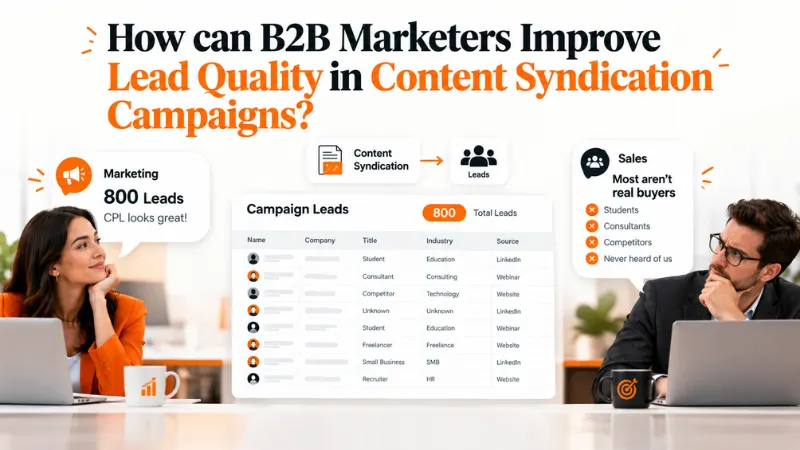
Marketing reports 800 syndicated leads at a CPL everyone is happy with. Sales reports that most of them were students, consultants, competitors, or people who have never heard of your product. Both teams are looking at the same spreadsheet and drawing opposite conclusions.
A scenario we know all too well.
This is the most common failure in content syndication, and it rarely comes from bad intent. It comes from one missing step: nobody agreed on what a good lead was before the campaign started.
The cost goes beyond wasted budget. SDRs stop trusting marketing-sourced leads, follow-up slows, and good prospects get buried under bad ones. Syndication gets labeled “low quality” as a channel, when the real problem was how it was briefed, bought, and measured.
This blog covers how to fix that, step by step.
Key Takeaways: 6 Steps to Improve Lead Quality in Content Syndication
- Define lead acceptance criteria with sales before launching campaigns.
- Target accounts and buying committees instead of only job titles.
- Match content assets to the buyer’s stage.
- Verify lead data and engagement at the source.
- Score leads based on fit and engagement before routing.
- Use sales rejection data to improve future campaigns.
Why Does Lead Quality Break Down in Content Syndication?
Lead quality breaks down because syndication optimizes for what is easy to count (downloads) instead of what is hard to count (buying relevance).
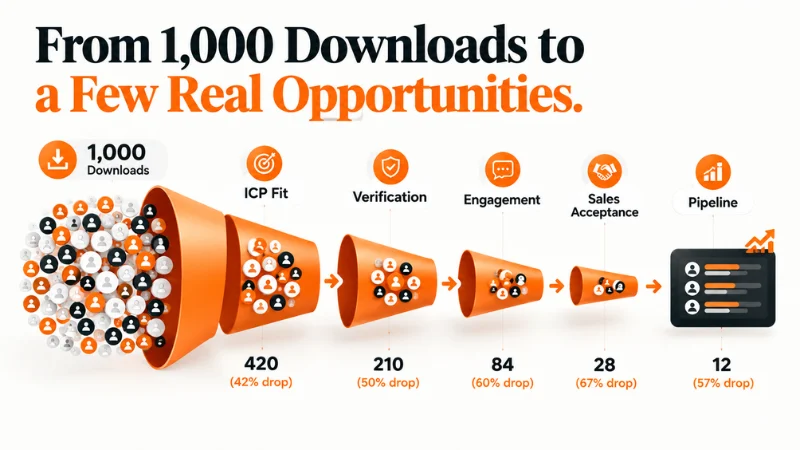
A publisher network is paid per lead, so it has every incentive to deliver volume. Your job is to make quality the cheaper thing to deliver.
Three structural problems cause most of the damage:
- Vague targeting. “Mid-market SaaS, marketing leaders” can describe a hundred thousand people, most of whom will never buy.
- Misaligned incentives. CPL-only contracts reward volume, not fit.
- No feedback. If rejected leads never get categorized, the next campaign repeats the same mistakes.
Think of syndication like hiring through a staffing agency. If you send a vague job description and only measure how many resumes arrive, you will get a lot of resumes.
For a broader look at how content syndication fits into B2B demand generation, see Content Syndication Strategy for B2B Demand Generation.
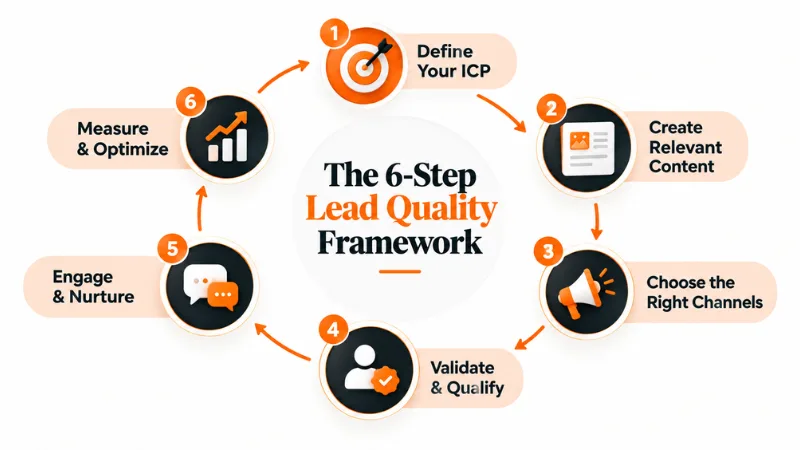
The Valasys 6-Step Lead Quality Framework
This framework turns lead quality from a hope into a process.
Each step has an owner, a method, and a measure.
Step 1: Define “Accepted” Before You Launch
What to do: Write a one-page lead acceptance agreement with sales. Include the target industries, company size range, seniority and function, geography, exclusions (competitors, students, agencies, free email domains), and the minimum fields required.
Why it matters: Without this, “quality” means whatever the person reviewing the leads feels that day. A shared definition removes that argument.
How to execute: Pull your last 20 closed-won deals and last 20 rejected leads. Look for patterns in title, company profile, and engagement. Turn those patterns into pass/fail rules. Add a short list of “accept with review” cases.
Before the campaign goes live, it also helps to document these requirements in a clear campaign brief so your internal team and syndication partner are working from the same criteria. See Content Syndication Campaign Brief for a practical framework.
Tools/process: CRM reports, a shared doc signed off by sales and marketing, and the same criteria pasted into your vendor brief.
Common mistake: Defining quality in marketing language (“engaged, relevant”) that sales cannot test.
Success measurement: Sales acceptance rate on syndicated leads, and the number of disputed leads per campaign.
The right asset also depends on what the campaign is designed to achieve, whether that’s generating leads, building pipeline, or increasing awareness. See Content Syndication Goals: Leads, Pipeline, and Awareness for a deeper look at how to align syndication with the outcome you want.
Step 2: Target Accounts, Not Just Titles
What to do: Give your syndication partner a named account list (or a tightly defined firmographic profile) plus the buying-committee roles you want, not only a single title.
Why it matters: A VP of Marketing at a 50-person company and a VP of Marketing at a 5,000-person company are different leads. B2B deals are also bought by committees, so reaching three people at one target account is often worth more than ten at random accounts.
How to execute: Tier your accounts. Tier 1 gets named-account delivery. Tier 2 gets firmographic targeting. Add technographic or industry filters where your product has a clear fit.
Tools/process: Your ABM account list, intent data if you use it, and suppression lists for existing customers and open opportunities.
Common mistake: Targeting by title alone, which fills the funnel with the right job at the wrong company.
Success measurement: Percentage of leads from target accounts, and number of accounts with two or more engaged contacts.
Step 3: Match the Asset to the Buying Stage
What to do: Choose the asset for the stage you want to reach, not the topic that gets the most downloads.
Why it matters: Broad, generic content pulls in curious readers. Specific content pulls in people with a problem. A “State of the Industry” report and a “How to Evaluate Vendors” checklist attract very different audiences.
How to execute: Map each asset to a stage:
| Asset type | Typical stage | Expected lead profile |
| Trend report, broad ebook | Awareness | Wider, lower intent, needs nurture |
| Framework, how-to guide, webinar | Consideration | Problem-aware, researching options |
| Buyer’s guide, comparison, ROI calculator, case study | Decision | Narrower, higher intent, faster follow-up |
Tools/process: Content audit against your buyer journey, then pick one or two assets per campaign.
Common mistake: Syndicating your most popular asset rather than your most relevant one.
Success measurement: Accepted-lead rate by asset, so you learn which content attracts buyers rather than browsers.
Step 4: Verify at Source, Not After the Fact
What to do: Require verification before leads reach you, and know exactly what your vendor does.
Why it matters: Cleaning bad data inside your CRM is slower and costs more than refusing it at the door. Quality problems also spread: a bad lead gets scored, routed, and followed up before anyone notices.
How to execute: Ask vendors for these specifics:
- Is the contact data first-party, or sourced from third-party lists?
- Is there human verification (phone or email confirmation), or only automated checks?
- Are custom qualification questions supported, and are answers passed through?
- How are duplicates, role accounts, and personal email domains handled?
- Is consent captured and documented?
Tools/process: Email and domain validation, deduplication against your CRM, and a short sample review before full delivery.
Common mistake: Accepting a “verified” label without asking what verified means.

Success measurement: Bounce rate, duplicate rate, and percentage of leads passing your own sample audit.
Step 5: Score and Route by Fit and Engagement
What to do: Don’t send every syndicated lead straight to an SDR. Score on two axes, fit (do they match the ICP?) and engagement (what did they do?), then route accordingly.
Why it matters: A content download is an introduction, not a buying signal. Treating all downloads the same overloads sales with early-stage contacts and under-serves the ones who are ready.
For teams looking to connect syndication more closely with sales follow-up, Content Syndication for B2B Sales covers how syndicated content can support the sales process beyond the initial lead capture.
How to execute:
| Fit | Engagement | Action |
| High | High (multiple assets, qualification answers, return visits) | Route to sales fast |
| High | Low | Nurture sequence, watch for signals |
| Low | High | Review manually; may be a partner, influencer, or adjacent role |
| Low | Low | Suppress or archive |
Tools/process: Your marketing automation or CRM scoring model, plus a nurture sequence for high-fit, low-engagement leads.
Common mistake: Pushing everything to sales (volume) or nothing to sales (waste).
Success measurement: Speed to first touch for high-fit leads, and meeting rate by score band.
Step 6: Close the Loop With Rejection Data
What to do: Require sales to tag every rejected lead with a reason, and review the tags after each campaign.
Why it matters: This is the step most teams skip, and it is what separates a channel that improves from one that stays flat. Rejection reasons tell you exactly which targeting rule to change.
How to execute: Use a short, fixed list of reasons: wrong industry, wrong size, wrong seniority, not a decision-maker, competitor, bad contact data, no interest or recognition. Review monthly and adjust the brief.
Tools/process: A required picklist field in your CRM, and a 30-minute sales and marketing review per campaign.
Common mistake: Collecting free-text rejection notes nobody reads.
Success measurement: Rejection rate trend over consecutive campaigns, and share of rejections by reason.
Want to see how your current syndication approach holds up against this framework? Talk to Valasys about a lead quality review of your last campaign.
Why Should You Measure Cost Per Accepted Lead Instead of CPL?
Cost per accepted lead is total campaign spend divided by the number of leads your sales team accepts. It shows what you actually paid for usable pipeline input, while CPL only shows what you paid for a form fill.
Here is an illustrative example. The numbers are hypothetical, to show the math:
| Vendor A | Vendor B | |
| CPL | $60 | $110 |
| Leads delivered | 100 | 100 |
| Total spend | $6,000 | $11,000 |
| Sales-accepted leads | 20 | 55 |
| Cost per accepted lead | $300 | $200 |
Vendor A looked 45% cheaper on CPL and turned out to be 50% more expensive per usable lead. Carry the same logic further down the funnel and you get cost per meeting and cost per opportunity.
Metrics worth tracking, in order of importance:
- Sales acceptance rate
- Cost per accepted lead
- Lead-to-meeting rate
- Pipeline and revenue influenced
- CPL (useful as context only)
We recommend establishing a sales-acceptance baseline from historical campaign data and evaluating performance by syndication source, rather than relying on a universal benchmark.
How Do You Vet a Content Syndication Vendor?
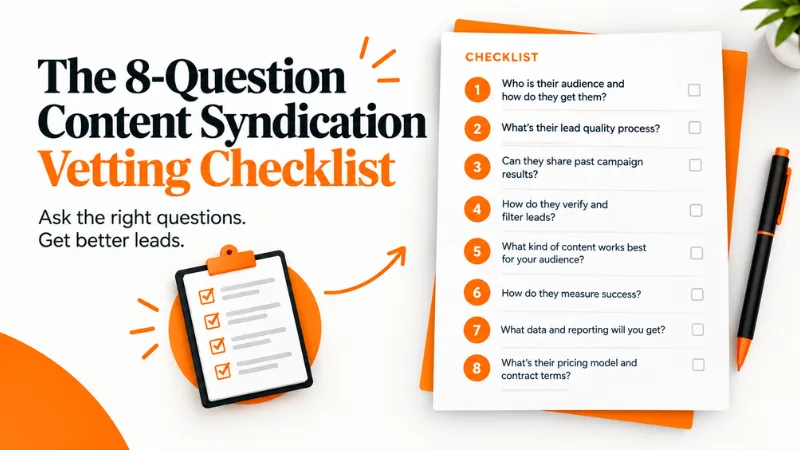
Vet a vendor by asking where the leads come from, how they are verified, what happens to rejected leads, and whether targeting can be controlled at the account level. A vendor who answers these precisely is usually a better bet than one who leads with price.
Vendor vetting checklist:
- Leads come from first-party audiences or owned publisher networks, not resold lists
- Human verification or double-confirmation is part of the process
- You can supply a named account list and exclusions
- Custom qualification questions are supported
- Lead-level reporting shows source, timestamp, and asset engaged
- Rejected leads are replaced or credited under a written policy, with a defined review window
- Consent and data-privacy handling is documented
- References or sample data are available before you commit
Red flags: Guaranteed volume with no targeting detail, unusually low CPL, vague sourcing answers, resistance to sample audits, and no replacement policy.
Evaluating partners right now? See how Valasys Media approaches verification and targeting, then compare it with your shortlist.
What Are the Most Common Content Syndication Mistakes (and Their Fixes)?
| Mistake | What it causes | Fix |
| Buying on CPL alone | Volume without fit | Track cost per accepted lead |
| Targeting by title only | Right role, wrong company | Add firmographics and account lists |
| Syndicating the most popular asset | Browsers, not buyers | Choose the asset closest to the problem you solve |
| No acceptance criteria | Endless sales/marketing disputes | Sign a one-page lead acceptance agreement |
| Sending all leads to SDRs | Overload and slow follow-up | Score on fit and engagement; nurture the rest |
| Ignoring rejection reasons | The same mistakes repeat | Tag, review, and adjust the brief every campaign |
| No suppression lists | Paying for existing customers and open deals | Upload exclusions before launch |
Old Approach vs. a Lead-Quality-First Approach
| Dimension | Volume-first syndication | Quality-first syndication |
| Success metric | CPL, lead count | Cost per accepted lead, pipeline |
| Targeting | Titles and industries | Accounts, buying committee, exclusions |
| Content choice | Most downloaded asset | Stage-matched asset |
| Handoff to sales | Every lead | Scored and routed |
| Vendor relationship | Transactional | Shared definitions, feedback loop |
| Optimization | Occasional | Every campaign, using rejection data |
For a closer look at the mistakes that can undermine syndication performance, see Content Syndication Mistakes That Hurt Lead Quality.
How Do You Audit Lead Quality Yourself?
You can audit a syndicated batch in under an hour. Pull a random sample of 25 to 30 leads, then check each against your acceptance criteria.
- Fit: Does the company match your ICP?
- Role: Is the person a decision-maker or influencer?
- Data: Is the email deliverable, and does the phone connect?
- Intent: Did they answer qualification questions or engage with more than one asset?
- Recognition: Do they remember downloading the asset when contacted?
Score the pass rate and compare it across vendors and campaigns. If a vendor’s pass rate is consistently weak, you have evidence for a conversation about replacements or targeting changes.
What Should Happen After the Download?
A download is the start of qualification, not the end. Plan the first 14 days before the campaign goes live:
- Day 0 to 1: A relevant follow-up email that references the asset they downloaded.
- Day 2 to 5: A related resource that deepens the topic rather than pitching.
- Day 5 to 10: An SDR touch for high-fit, high-engagement leads, with a note about what they read.
- Day 10 to 14: A softer offer (a webinar, a benchmark, an audit) for those who haven’t responded.
Multi-channel follow-up (email, LinkedIn, phone) helps, but only when the outreach reflects what the person was actually reading.
If you want to build this into a more structured follow-up sequence, see 6-Email Nurture Flow for Syndication Leads in 21 Days for a practical approach to nurturing leads after the download.
Conclusion
Improving lead quality in content syndication is mostly about discipline before launch and honesty after it. Agree on what an accepted lead looks like. Target accounts, not just titles. Match content to the stage. Verify at source. Route by fit and engagement. Then use every rejection to sharpen the next brief.
Do that for two or three campaigns and the conversation with sales changes. They stop asking why marketing sends bad leads, and you stop defending CPL.
Ready to turn syndication into a pipeline channel your sales team trusts? Book a consultation with Valasys Media and we’ll review your targeting, assets, and acceptance criteria.
Frequently Asked Questions:
1. What is a lead rejection window, and how long should it be?
It is the contractual period after delivery when you can flag leads that fail the agreed criteria and request a credit or replacement. Set it in writing before launch, long enough for sales to actually review the batch. Without a defined window, rejections become disputes instead of routine adjustments.
2. How do I avoid paying for competitors, students, and existing customers?
Upload suppression lists before launch: current customers, open opportunities, competitor domains, and excluded job functions. Add rules to block personal email domains and non-target titles. Confirm the vendor applies suppression at delivery, not afterward, so you never pay for contacts you would reject on sight.
3. Does form length affect syndicated lead quality?
Yes. Short forms raise volume but let in more casual downloaders. Adding one or two qualification questions, such as role, timeline, or project status, filters out low-intent contacts and gives sales context for follow-up. The trade-off is fewer leads, so judge it by cost per accepted lead rather than volume.
4. How long should I run a syndication campaign before judging results?
Judge in two stages. Audit a sample of the first delivery within days to catch targeting or data problems early. Judge pipeline impact only after leads have moved through nurture and sales follow-up, which depends on your sales cycle. Early CPL and acceptance rates are signals, not verdicts.
5. How can I confirm a syndicated lead actually opted in?
Ask your vendor for lead-level records showing the source, timestamp, asset requested, and the consent language the person saw. Spot-check a sample by contacting leads and asking whether they recall the download. Vendors who can’t produce this documentation are a compliance risk and a quality warning.
6. How should SDRs follow up on syndicated leads without annoying prospects?
Reference the exact asset the person downloaded and offer something relevant to it, such as a related checklist or benchmark, rather than going straight to a demo request. Prioritize high-fit, high-engagement leads for direct outreach, and place the rest in nurture. Relevance in the first message sets the tone for the whole conversation.