
Content Syndication for Long B2B Sales Cycles
Learn how to structure B2B content syndication for sales with the right assets, ICP filters, nurture cadence, and ROI timeline.

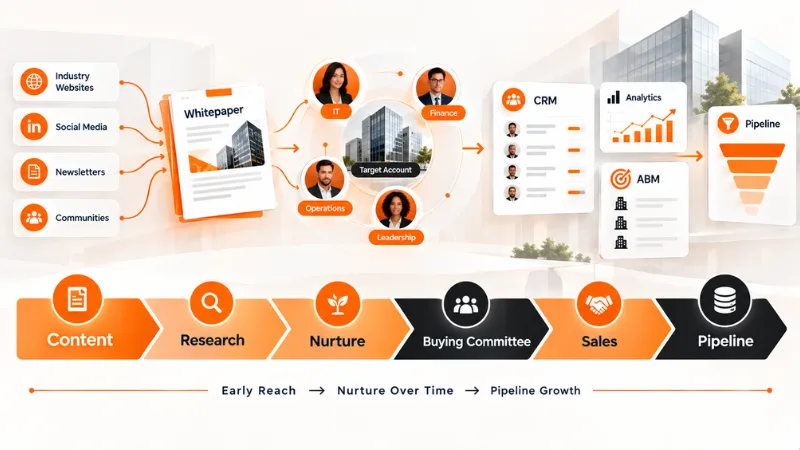
Content syndication works best for B2B sales cycles when the goal is not limited to a lead quota but is to reach the buyer at the right decision stage.
Content syndication can help B2B brands reach buyers long before they’re ready to talk to sales. It involves distributing gated, educational content, such as whitepapers, research reports, and guides, through vetted third-party networks, putting useful resources in front of buyers while they’re still researching a problem.
That early visibility matters.
B2B buying cycles can stretch for months, and buyers often form preferences before they ever contact a vendor. Forrester’s research has found that many buyers pre-select a vendor before issuing a formal RFP. In that kind of buying journey, showing up early can matter more than simply showing up often.
Here’s where many B2B marketers hit a wall with content syndication: the leads arrive on schedule, the CPL looks healthy, and then sales calls the first ten people.
Half of them don’t even remember downloading the content.
That’s not necessarily a syndication problem. It’s a timing problem.
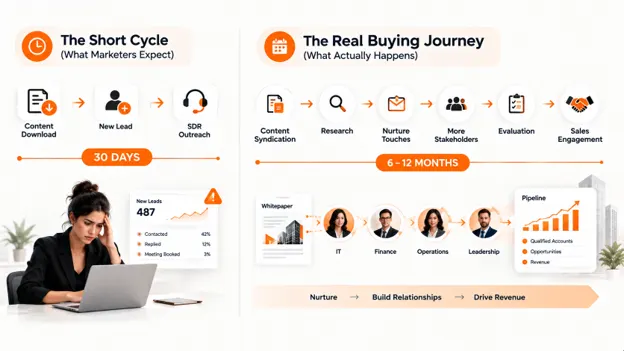
A tactic built for a 30-day sales cycle won’t work the same way when the deal takes six to twelve months to close. And B2B buying cycles have only become more complex. Since 2021, sales cycles have stretched by 20–30%, while the average buying group now involves around 11 stakeholders who need to align before a deal moves forward.
So if your syndication program treats every lead as sales-ready within two weeks, you’ll frustrate your SDRs and waste budget at the same time.
The answer isn’t to abandon syndication.
For long B2B sales cycles, it can be one of your most valuable early-funnel channels, precisely because it can reach buyers before they’re actively talking to vendors.
The real fix is to build the program around the buying cycle: the right asset, the right audience filters, the right nurture cadence, and enough patience to let demand develop.
Key Takeaways
- In a long B2B buying cycle, syndication is about getting in front of potential buyers early. It’s not just a quick way to hit the lead target but is a way to build a pipeline.
- Lead quality makes a significant difference. Well-targeted syndication programs can see conversion rates of around 5.31%, compared with the broader B2B average of about 2.23%. The difference depends heavily on strong ICP targeting and reliable vendors.
- The content should reflect where the buyer is in their journey. Use a whitepaper to support early research, then move toward more decision-focused assets such as comparison guides or ROI calculators as buyers approach the shortlist stage.
- Nurture shouldn’t be an afterthought. Have the follow-up journey ready before launching the campaign, because a syndication lead without relevant follow-up can quickly lose interest.
- Revenue takes time to show up. Syndication leads may take roughly three months to convert on smaller deals and up to 18 months for enterprise opportunities. Looking at performance over only 30 or 60 days can therefore give a misleading picture of the channel’s value.
- Don’t choose vendors based on CPL alone. A low-cost lead from an unverified source can consume more SDR time than it’s worth, while a higher-cost lead from a vetted, opted-in network may deliver.
Why Long Sales Cycles Change the Syndication Playbook
Most content syndication advice looks at demand generation as a whole. But the rules change when you’re working with a sales cycle that can stretch from six months to a year.
A longer buying cycle affects three things: when you need to reach buyers, how many people may need to engage before a deal moves forward, and how long it takes for a lead to become sales-ready.
Why it matters: With a 30-day sales cycle, a syndicated lead might be ready for an SDR within a few days. In a mid-market or enterprise sale that takes anywhere from 60 days to a year, the same lead may need several more relevant touches before a sales conversation feels timely. Reach out too soon, and you risk turning a potential buyer away before they’re ready to engage.
How it works in practice: B2B buying rarely happens in a neat sequence. One stakeholder might download your whitepaper today, while the technical buyer joins the conversation months later. Procurement may not get involved until the shortlist is already taking shape.
That means your syndication strategy needs to account for the whole buying committee, not just the person who filled out the form. The goal is to keep engaging relevant stakeholders from the same account as the buying process develops.
Example: Imagine a mid-market cybersecurity vendor promoting a technical whitepaper. The VP of Security downloads it in week one. Then the account goes quiet for two months. Later, the CFO engages with a pricing comparison.
Those aren’t necessarily two separate opportunities. They could be two stakeholders from the same buying committee, engaging at different points in the same purchase journey. Your nurture strategy and sales process need to be able to connect those signals and respond accordingly.
The Valasys 5-Step Framework for Long-Cycle Content Syndication
Long sales cycles need a different syndication playbook.
This framework is built around how extended B2B buying journeys actually unfold.
Step 1: Match Content to the Buying Timeline
What to do:
Stop thinking about content only in terms of TOFU, MOFU, and BOFU. Map each syndicated asset to a real moment in the buyer’s decision process: early research, active evaluation, or final justification.
Why it matters:
A buyer who is already three months into vendor evaluation probably doesn’t need another generic “What Is X?” whitepaper. At that point, it feels less like help and more like someone handing you a map after you’ve already reached the destination.
How to execute:
Look at recent closed-won deals. Identify which content buyers consumed and when they consumed it. Use those patterns to assign syndicated assets to specific stages of the buying journey.
Tools/process:
CRM deal-stage tagging and a simple content-audit spreadsheet.
Common mistake:
Running the same three assets across every audience and hoping the funnel sorts itself out.
Success measurement:
Track lead-to-MQL conversion by asset type to see which content actually moves buyers forward.
Step 2: Make Your ICP Filters Uncomfortably Specific
What to do:
Go beyond job title and company size. Layer in industry, company fit, and signals that suggest a wider buying committee is forming; for example, multiple contacts engaging from the same account.
Why it matters:
Long sales cycles reward account quality, not random volume. If your leads are scattered across companies that don’t fit your ICP, your nurture budget gets stretched thin with very little to show for it.
How to execute:
Set your firmographic and intent filters with the syndication vendor before launch. Don’t wait for the first batch of disappointing leads to convince everyone that targeting matters.
Tools/process:
Vendor targeting controls combined with account-level intent data and buying signals.
Common mistake:
Relaxing your filters halfway through the campaign because someone wants to see a bigger lead number on the dashboard.
Success measurement:
Measure the percentage of leads that meet your complete ICP criteria. A target of 80% or higher indicates that your targeting is staying focused.
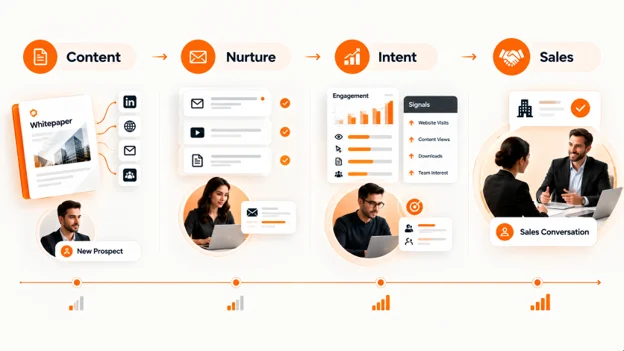
Step 3: Build the Nurture Journey Before You Buy the Leads
What to do:
Have the follow-up journey ready before the campaign goes live. Build a multi-touch sequence around the problem the content addresses instead of sending the usual “Thanks for downloading!” email and calling it nurture.
Why it matters:
Syndicated leads often need many more interactions before they’re ready for sales. Without a thoughtful sequence, even a good lead can disappear into the digital wilderness within a few weeks.
How to execute:
Write the nurture emails, define the lead-scoring logic, and prepare the sales talk track before briefing your syndication vendor.
Tools/process:
Marketing automation, lead scoring, and coordinated sales follow-up.
Common mistake:
Sending every new lead directly into an SDR call queue on day one and expecting a warm conversation.
Success measurement:
Monitor MQL-to-SQL conversion. A 15%+ conversion signal can indicate healthy lead quality, depending on your sales model and baseline.
Step 4: Set Lead Quality Rules Before the Leads Arrive
What to do:
Decide in advance what qualifies as a usable lead. Define acceptable business emails, disqualifying conditions, and any required custom questions before a record is allowed into your CRM.

Why it matters:
Bad data doesn’t stay bad in one place. It creates wasted SDR time, contaminates reporting, and makes campaign performance harder to judge. A soft bounce or personal Gmail address shouldn’t suddenly become sales’ problem.
How to execute:
Agree on clear validation requirements with the vendor and make those requirements part of the campaign agreement. If a lead doesn’t meet the rules, there should be a defined process for rejecting it.
Tools/process:
CRM validation rules and a clear vendor SLA.
Common mistake:
Accepting every record that arrives and then wondering why sales isn’t excited about following up.
Success measurement:
Keep the hard-bounce rate below 5% and monitor other quality indicators consistently.
Step 5: Give the Campaign a Timeline It Can Actually Survive
What to do:
Set your first meaningful ROI checkpoint at 90 days, rather than expecting a complete picture in 30. And don’t make lead volume your primary success metric. Track the pipeline those leads influence.
Why it matters:
A 30- or 60-day report can tell you what happened early. It can’t necessarily tell you what a long-cycle syndication program will ultimately be worth. Judging the entire channel too soon is a little like cancelling a six-month sales cycle because nothing closed in week three.
How to execute:
Connect every syndicated lead to its CRM record and follow its journey through MQL, opportunity, and closed-won. Keep tracking even when the buying process takes months.
Tools/process:
Multi-touch attribution and CRM-based pipeline reporting.
Common mistake:
Shutting down the program because one monthly report didn’t produce impressive revenue numbers.
Success measurement:
Review pipeline-influenced revenue at six and twelve months, alongside the shorter-term engagement and conversion metrics.
See how Valasys structures Content Syndication for long, multi-stakeholder deals →
Traditional Lead Gen vs. Long-Cycle Content Syndication
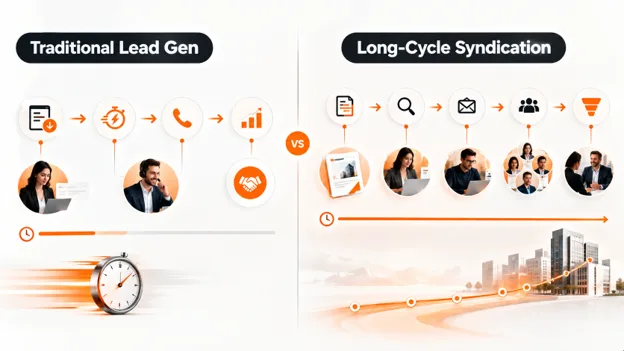

| Dimension | Traditional Paid Lead Gen | Long-Cycle Content Syndication |
| Timing goal | Fast conversion, short follow-up window | Early interception, patient nurture |
| Lead readiness | Often low-intent, click-driven | Higher intent, buyer spent time with content |
| Measurement window | 30 days | 90+ days minimum |
| Success metric | Cost per click / cost per lead | MQL-to-SQL rate, pipeline influence |
| Sales handoff | Immediate | After nurture qualifies the lead |
| Trust signal | Low, ad-driven | Higher most B2B buyers report trusting a brand more after receiving useful content from it |
Mistake vs. Fix: The Most Common Long-Cycle Syndication Errors
| What Goes Wrong | Why It Hurts in a Long Sales Cycle | What to Do Instead |
| Sending every lead straight to sales | Most leads aren’t ready for a sales conversation yet. Push too early and you risk frustrating reps and wearing out the account before the buying process has even started. | Put leads into nurture first. Bring sales in when clear intent signals show that the buyer is ready. |
| Calling the ROI at 30 days | A syndication lead can take 3–18 months to turn into revenue, depending on deal size. Judging the program too early can make a healthy channel look like a failure. | Give the program at least 90 days before making meaningful performance judgments. |
| Picking the vendor with the lowest CPL | Cheap leads aren’t necessarily cheap. Poorly verified data can cost more in wasted SDR time than a higher-quality lead ever would. | Evaluate vendors on data accuracy, verification, and opt-in quality, not CPL alone. |
| Turning content into a sales pitch | Buyers looking for useful information aren’t necessarily looking to hear a sales pitch. Promotional assets can create friction where educational content builds interest. | Start with research, frameworks, and practical guides. Introduce the sales message later, when the buyer is further along. |
| Using the same nurture for everyone | A technical buyer, an executive, and a procurement stakeholder may be at completely different points in the same buying journey. One generic sequence won’t account for that. | Tailor nurture based on role, buying stage, and engagement signals so each stakeholder gets a more relevant next step. |
Checklist: Before You Launch a Long-Cycle Syndication Campaign
- Choose the right asset: Make sure it supports early-to-mid-stage research rather than reading like a sales deck.
- Tighten your ICP: Filter by job title, company size, industry, and signals that show account-level engagement.
- Prepare nurture first: Have the nurture sequence written, approved, and ready before the first lead comes in.
- Set lead-quality rules: Agree on validation and qualification requirements with the vendor in writing.
- Set up CRM tracking: Capture the lead source and track each lead through the journey to closed-won.
- Align with sales: Make sure the team knows these leads may need nurturing—not an immediate sales call.
- Give ROI time: Schedule the first meaningful performance review for 90 days, rather than judging the campaign after 30.
This is Where it Fits in Your Broader Pipeline
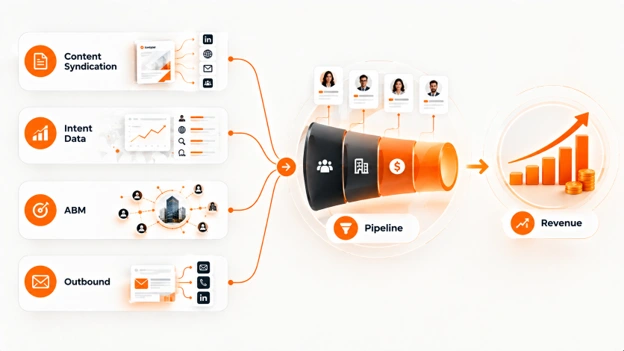
Content syndication isn’t meant to replace ABM, intent data, or outbound. It gives those channels something to build on.
In a strong long-cycle strategy, syndication often starts the conversation. It brings an account into view, intent data helps confirm when interest is building, and ABM takes over to coordinate the longer, multi-stakeholder journey.
Think of it as a relay, not a standalone tactic. Each channel has a role, and the handoff matters.
If you’re still working out how all the pieces fit together, our B2B Content Syndication Strategy playbook breaks down the full 7-step process.
You can also use our content syndication campaign brief template to give your vendor a clearer brief from the start, because fixing a vague brief after the campaign launches is rarely anyone’s idea of fun.
Want to see how a syndication program built around your actual sales-cycle length could perform? Explore Valasys’ Content Syndication Services →
The Right Partner Makes the Difference.
A solid checklist can tighten up your internal process. What it can’t do is stop a vendor from sending unverified list-scraped contacts and calling them “opt-in leads.”
That distinction becomes even more important when your sales cycle runs for months. The difference between a syndication program that builds real pipeline and one that simply adds clutter to your CRM often comes down to the partner behind it.
How do they source their contacts? How do they verify them? What filters do they apply before a lead ever reaches your team?
Those details matter long before the first lead lands in your CRM.
Long sales cycles don’t make content syndication less valuable, they make precision more important. When the content, ICP filters, nurture cadence, and vendor quality are matched to how your buyers actually decide, syndication becomes one of the most reliable ways to build a pipeline that compounds over months. Valasys Media works with B2B teams to structure exactly this kind of long-cycle syndication program, from vendor vetting through pipeline attribution.
Ready to build a content syndication program matched to your sales cycle? Contact Valasys Media to see how our data-driven approach can accelerate long-cycle B2B pipelines.
Frequently Asked Questions
-
What’s the difference between content syndication and paid advertising for B2B?
Paid advertising puts your message in front of an audience. Content syndication takes your existing content and distributes it through networks where buyers are already looking for information.
The distinction matters in longer B2B buying journeys. Forrester has highlighted concerns around over-reliance on digital advertising and the importance of trusted, expert content in the buying process. When buyers spend months researching a purchase, credibility can matter just as much as getting the click.
-
How long does it take to see ROI from content syndication?
Don’t expect a long-cycle program to reveal its full value in a few weeks. A 90-day minimum evaluation window gives the program time to generate meaningful signals, while full revenue attribution can take anywhere from 3 to 18 months, depending on deal size and sales-cycle length.
Looking for revenue in the first 30 days can tell you very little about where the program is ultimately headed.
-
What type of content performs best for syndication in long sales cycles?
Start with content that helps buyers understand the problem rather than content that immediately asks them to buy.
Whitepapers, research reports, frameworks, and practical guides tend to fit early-stage research better because the buyer is still learning, comparing, and building a case internally. Save the heavier sales message for later in the journey.
-
Can I choose which job titles and industries receive my syndicated content?
Yes. Established syndication partners typically allow targeting by factors such as job title, industry, company size, and geography.
The more closely those filters match your ICP, the less likely you are to spend budget nurturing people who were never a realistic fit in the first place.
How many touches does a syndicated lead usually need before it’s sales-ready?
There isn’t a universal number because readiness depends on the buyer, account, offer, and sales cycle. But syndicated MQLs can require 18 to 24 touches before they’re ready for a meaningful sales conversation.
That’s why nurture needs to be part of the strategy from day one—not something you figure out after the leads start arriving.
-
Is content syndication still effective in 2026, or has it been replaced by intent data and ABM?
It isn’t an either-or decision. Syndication, intent data, and ABM can work together.
Syndication can create an initial engagement signal. Intent data can help identify when interest is increasing, while ABM can coordinate the broader account strategy across multiple stakeholders.
In other words, syndication can open the door. The other channels help you understand what happens after someone walks through it.