

How to Build a B2B Content Syndication Strategy That Generates Qualified Demand
Build a B2B content syndication strategy that improves lead quality, supports ABM and nurture, and measures accepted leads, SQLs, & pipeline.

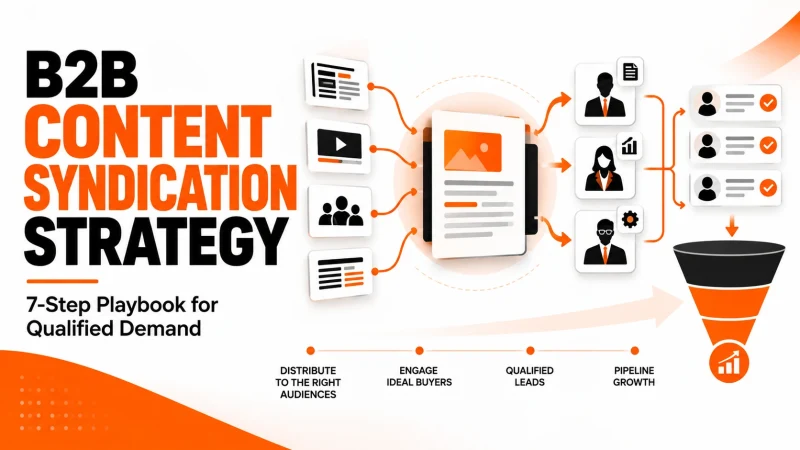
Direct answer:
Content syndication works best as part of the demand generation system, not as a way to buy a batch of names. Strong programs combine relevant content, clear audience targeting, sales alignment, and downstream measurement so success is judged by lead quality and pipeline progression rather than downloads alone.
That approach aligns with Content Marketing Institute and MarketingProfs’ 2026 research, where 65% of effective B2B marketers cited content relevance and quality, 45% cited sales alignment, and 40% cited measurement and reporting as factors improving effectiveness.
How does a B2B content syndication strategy generate qualified demand?
A B2B content syndication strategy distributes valuable content through first party and third-party channels to reach ideal-fit buyers. To generate qualified demand, define the goal, define the audience, choose the asset, score partners, establish lead governance, design nurture, and optimize performance against accepted leads, SQLs, opportunities, pipeline, and revenue.
Syndicated content can include research reports, white papers, guides, webinars, case studies, checklists, comparison content, videos, and interactive tools. Distribution channels can include industry publishers, newsletters, professional communities, content syndication networks, media partners, and intent-based platforms.
There are three useful forms to distinguish:
- Gated asset syndication places an asset such as a report or guide behind a registration form operated by a publisher or syndication partner. It is primarily used for lead generation.
- Ungated content syndication republishes or distributes articles or other freely accessible content to expand reach and authority.
- Intent-informed syndication combines distribution with behavioral or account-level intent signals so campaigns can prioritize organizations showing interest in relevant topics.
The distinction matters because each type serves a different objective. A syndicated article may increase discovery without producing identifiable leads, while a gated research report may generate contact data but introduce more friction.
What is the real goal of content syndication?
The goal is qualified demand, not the maximum possible number of downloads.
A useful syndication lead should tell you whether the person and company fit your ICP, what topic they engaged with, and what follow-up makes sense. That signal should connect to CRM routing, lead scoring, nurture, ABM, sales follow-up, and performance reporting.
For example, a security director at a 3,000-person target account downloading a ransomware-readiness report is materially more valuable than an unrelated student or a prospect outside your service region.
Both may appear as “leads” in a campaign report. They do not have equal business value.
How does B2B content syndication work?
A content syndication campaign moves a buyer from third-party discovery into your demand generation system.
A typical workflow has seven stages:

A typical workflow looks like this:
- A publisher or distribution partner exposes the asset to the agreed audience.
- A prospect discovers the content and, for gated programs, provides information to access it.
- The lead is validated against required fields, exclusions, consent rules, and ICP criteria.
- Accepted data is passed into the CRM or marketing automation platform with the correct source, campaign, asset, and timestamp.
- The prospect enters an appropriate nurture or account-based sequence.
- Additional engagement, fit, or explicit buying intent determines whether and when sales should engage.
- Marketing measures downstream qualification, opportunity creation, pipeline, and revenue contribution.
A weak program stops after the download. A strong program validates the lead, routes it correctly, nurtures the prospect, and measures what happens through qualification, opportunity creation, pipeline, and revenue.
Why does content syndication matter for B2B demand generation?
Content syndication extends the reach of valuable assets while creating additional buying signals outside your owned channels.
It is especially useful when strong content has limited organic distribution. A research report that reaches only people who already find you through search, social, referrals, or email can reach new relevant professionals when distributed through carefully selected third parties.
Distribution, however, cannot rescue weak content. The 2026 CMI research reinforces that relevance and quality matter. Syndicate your strongest assets, not the content you are struggling to promote internally.
Which content assets work best for syndication?

The best asset depends on the buyer’s stage, problem awareness, and reason for engaging.
| Buyer stage | Useful syndicated asset | Why it fits | Example |
| Awareness | Original research, trend report, expert guide | Helps buyers understand a problem or market change | “2026 State of Ransomware Readiness” |
| Problem-aware | Checklist, benchmark, maturity model | Helps buyers assess their current situation | “Cloud Security Risk Assessment Checklist” |
| Solution-aware | Comparison guide, webinar, implementation framework | Helps buyers compare approaches | “Manual vs. Automated Compliance Monitoring” |
| Vendor-aware | Case study, ROI model, buyer’s guide | Provides proof and purchase justification | “How to Build the Business Case for Automated Compliance” |
Original research and practical guides are particularly useful syndication assets because they can offer buyers information, benchmarks, frameworks, or insights that generic promotional content does not provide.
A useful test is to ask: Would a member of our ICP still want this asset if our logo were removed from the cover?
If the answer is no, it is probably too promotional for cold syndication.
How do you build a B2B content syndication strategy?
A practical content syndication strategy can be organized into seven steps: define the goal, define the audience, choose the asset, score partners, establish lead governance, design nurture, and optimize performance.

Step 1: Define the demand generation goal
Start with the business outcome rather than a lead-volume target.
A campaign might exist to generate qualified demand, engage target accounts, support an ABM program, introduce a new category, increase webinar participation, or influence pipeline.
A more useful objective is:
Generate qualified engagement from IT and security leaders at North American mid-market companies researching ransomware resilience, then measure how those leads progress into accepted sales opportunities.
That is materially better than “generate 1,000 leads.”
Decide the success metrics at the same time you define the goal. Otherwise, the channel is likely to be optimized around whatever number happens to be easiest to produce.
Step 2: Define your audience and exclusions
Specific targeting improves the usefulness of every lead that follows.
Define:
- industries;
- regions;
- employee or revenue ranges;
- target job functions;
- seniority;
- named accounts where relevant;
- technology environment;
- relevant problem or use case;
- buying-stage signals.
Exclusions deserve equal attention. Depending on the campaign, you may need to suppress competitors, agencies, students, existing customers, open opportunities, unsupported regions, or companies below a minimum size.
“Technology decision-makers” is not an ICP.
A CIO at a global bank and a systems administrator at a 50-person company may both work in technology, but they have different authority, priorities, budgets, and content needs.
Step 3: Match the content asset to the buyer stage
Do not syndicate the same asset to every segment.
Top-of-funnel audiences generally need education. Buyers who understand the problem may need benchmarks or diagnostic tools. Solution-aware prospects can benefit from implementation frameworks and comparisons. Later-stage prospects need evidence, business cases, technical validation, and proof.
The common mistake is sending product-heavy content to a cold audience.
A buyer who is still defining the problem is unlikely to find a vendor brochure compelling simply because it has been converted into a gated PDF.
Step 4: Score syndication partners before spending

Choose partners based on audience and data quality, not headline CPL.
When evaluating options, compare content syndication networks and platforms based on audience relevance, targeting capabilities, distribution model, transparency, and lead-quality controls rather than reach alone.
Ask each potential partner:
| Criterion | What to ask |
| Audience | Where will the content appear, and who can see it? |
| Targeting | Can you filter by function, seniority, company, industry, region, or account? |
| Validation | How are business emails, companies, job roles, and duplicates checked? |
| Consent | What does the user actually agree to when registering? |
| Transparency | Will source, asset, timestamp, campaign ID, and relevant engagement data be provided? |
| Pacing | Can leads be delivered weekly rather than in one large batch? |
| Replacement policy | What happens to invalid or non-compliant records? |
| Reporting | Can performance be analyzed by asset, segment, and source? |
Evaluate content syndication partners based on audience fit, lead verification quality, data delivery, privacy compliance, and transparency about where your content will appear.
A cheaper lead is not necessarily a cheaper customer acquisition path.
Step 5: Establish lead governance before launch
Lead governance defines what happens to every record before it reaches sales.
These rules should also align with your broader data governance and CRM hygiene standards so that consent, attribution, validation, and lead status remain usable after the record enters your systems.
At minimum, the campaign record should make it possible to identify:
- who the prospect is;
- their company and role;
- the asset they accessed;
- the syndication source;
- when the interaction occurred;
- the campaign that generated it;
- whether the lead meets ICP requirements;
- what follow-up permission was captured.
Then define which records become MQLs, which enter longer-term nurture, which are associated with ABM activity, and which are rejected.
Do this before the first file arrives.
Step 6: Design nurture before you buy the leads
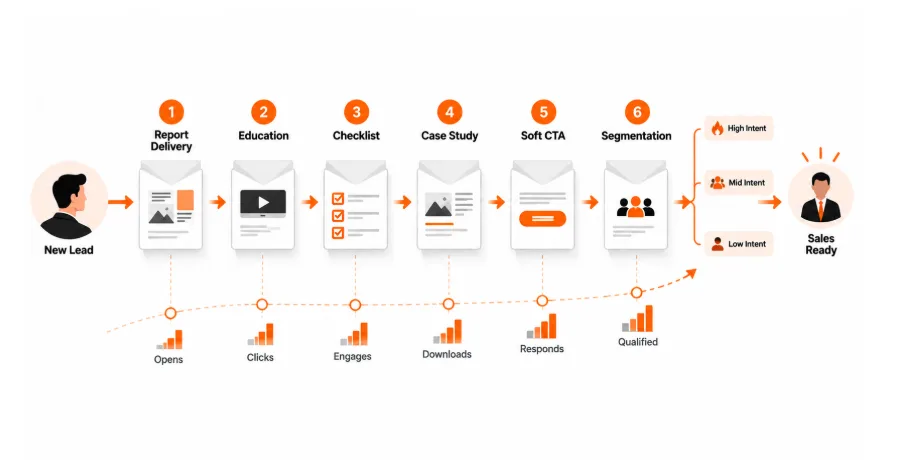
Most syndicated leads should not be treated like demo requests.
Someone who accesses a report through a publisher may have meaningful interest in the topic without having meaningful awareness of your brand.
A practical B2B lead nurturing sequence might move from asset fulfillment to related education, then to a diagnostic resource, evidence or a case study, and finally to a relevant next step.
For example:
| Timing | Follow-up | Purpose |
| Day 0 | Deliver requested report | Fulfill the interaction |
| Day 3 | Related educational article | Build topical relevance |
| Day 7 | Checklist or framework | Add practical value |
| Day 14 | Case study or benchmark | Add evidence |
| Day 21 | Soft CTA | Test buying interest |
| Day 30 | Segment by engagement | Route to next motion |
The mistake is assuming that a content download and a hand raise mean the same thing.
Step 7: Optimize on downstream quality
Evaluate which combinations of partner, asset, persona, account type, and follow-up path produce business outcomes.

Review early data-quality indicators frequently after launch. Once enough volume accumulates, compare:
- accepted lead rate;
- ICP match rate;
- duplicate and invalid rates;
- cost per accepted lead;
- MQL rate;
- sales acceptance;
- MQL-to-SQL conversion;
- account engagement;
- opportunity creation;
- influenced pipeline;
- revenue.
Review performance by partner, asset, audience segment, and downstream conversion rather than relying on campaign-wide CPL alone.
What metrics should you use to measure content syndication?
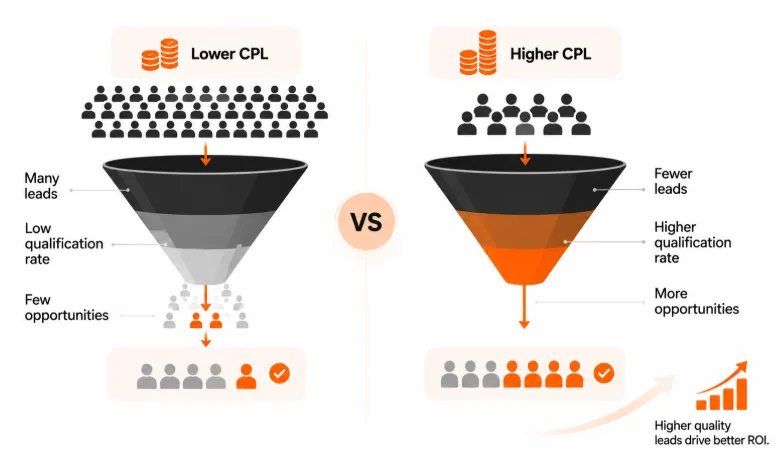
Measure quality and progression, not just acquisition cost.
CPL answers, “How much did we spend to acquire a record?”
That distinction between volume and lead quality is critical in B2B demand generation because a large number of low-fit records can increase downstream qualification and sales costs rather than improve pipeline.
Consider two partners:
- Partner A delivers leads for $40 each, but only 10% meet your qualification requirements.
- Partner B delivers leads for $80 each, but 40% qualify.
Partner A produces qualified leads at an effective acquisition cost of $400. Partner B produces them at $200.
The lower-CPL partner is twice as expensive on the metric that matters.
This example shows why cost per MQL or cost per accepted lead can reveal campaign efficiency more accurately than raw CPL alone.
Treat benchmark ranges carefully
Use benchmark ranges for metrics such as invalid lead rate, duplicate rate, ICP match, and sales acceptance as directional guidance rather than universal targets.
A cybersecurity campaign targeting Fortune 500 CISOs should not be measured against the same benchmarks as a lower-cost SaaS campaign aimed at managers in small businesses. Deal size, buying committee complexity, audience scarcity, geography, and sales cycle all affect performance.
For stronger, more defensible benchmarks, companies should rely on their own historical campaign data wherever possible and compare results by audience, asset, partner, and funnel stage.
Content syndication vs. paid search, paid social, and organic distribution
Content syndication is one distribution channel, not a substitute for every other channel.
| Channel | Strongest use | Main advantage | Main limitation |
| Content syndication | Reaching defined B2B audiences with valuable assets | Extends distribution outside owned audiences | Quality varies significantly by targeting and partner |
| Organic search/content | Long-term discovery and authority | Visibility can compound over time | Requires time and competitive search visibility |
| Paid search | Capturing explicit search demand | Strong intent for suitable queries | Competitive B2B keywords can be costly |
| Paid social | Persona/account targeting and retargeting | Flexible targeting and creative formats | Audience characteristics do not necessarily equal buying intent |
| Partner co-marketing | Shared audiences and credibility | Leverages complementary relationships | Performance depends on audience and promotional alignment |
It is one part of a broader distribution mix; paid media, organic content, and partner channels serve different roles and should be measured accordingly.
Content syndication can also be combined with other B2B lead-generation motions. For teams deciding between content syndication, webinar programs, and BANT campaigns, the right choice depends on whether the immediate objective is reach, engagement, or sales qualification.
How can content syndication support account-based marketing?
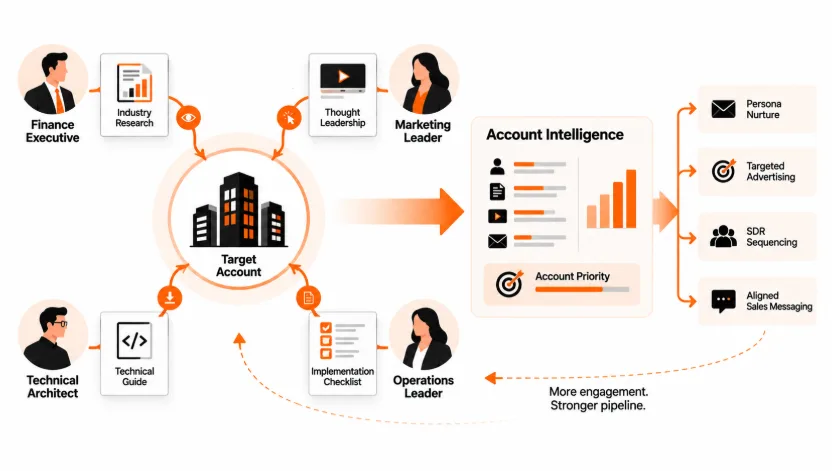
Content syndication can strengthen an account-based marketing (ABM) strategy by showing which people or roles inside priority accounts are consuming relevant content and topics.
For example, a finance executive accessing a total-cost-of-ownership guide and a technical architect accessing an integration document represent different signals from the same account.
Those interactions can inform:
- account prioritization;
- persona-specific nurture;
- SDR sequencing;
- advertising audiences;
- sales messaging;
- content recommendations.
Syndication engagement can help prioritize target accounts and inform ABM follow-up when content consumption is combined with account fit, persona, topic, and other buying signals.
That fits broader 2026 B2B trends. Among marketers using ABM who had measured its results, CMI reports that 65% said ABM campaigns outperform traditional marketing to some degree.
What are the limitations of B2B content syndication?
Content syndication creates reach and signals, but it also creates operational and quality risks.
The most important limitations are lead-quality variation, data and consent requirements, nurture dependency, attribution complexity, and the possibility of creating duplicate search content when full articles are republished.
It can also generate misleading economics if marketing teams optimize for inexpensive leads while ignoring rejection rates and downstream conversion.
Content syndication is therefore a stronger fit when the company already has:
- a reasonably clear ICP;
- content worth distributing;
- CRM and marketing automation infrastructure;
- lead-routing rules;
- sales and marketing alignment;
- capacity to nurture early-stage prospects;
- meaningful downstream measurement.
It is a weaker fit when the organization needs every content download to become a sales conversation immediately.
Does syndicated content create an SEO duplicate-content problem?
Republishing identical articles can create duplicate URLs, so publishers should define indexing rules before syndication begins.
This is an area where current Google guidance deserves particular attention.
Google explains that canonicalization selects a representative URL from similar or duplicate pages, but a canonical declaration remains a signal rather than a guarantee.
More importantly, Google Search Central’s current 2026 guidance says rel=”canonical” is not the recommended solution specifically for preventing duplication caused by syndication partners. Google says the most effective approach is for syndication partners to block indexing of the syndicated copies.
That is more current than the canonical-only recommendation contained in parts of the supplied draft.
For gated PDFs or assets that are not republished as indexable article text, the SEO considerations are different.
Should you manage content syndication in-house or use a partner?
The right model depends on internal expertise, publisher access, operational capacity, and the amount of control you need.
An in-house team provides more direct control over targeting, systems, and vendor relationships, but requires staff time and partner infrastructure.
An external syndication partner can provide faster access to publisher networks, campaign operations, lead validation, and delivery infrastructure, but quality depends on the transparency and capabilities of the partner.
A hybrid model can be practical: retain ICP definition, positioning, lead rules, nurture, and measurement internally while using an outside specialist for distribution, publisher relationships, lead validation, or campaign execution.
The decision should be based on operating capability rather than the assumption that outsourcing is always easier.
Who is content syndication best suited for?
Content syndication is strongest for B2B organizations with valuable content, clearly defined audiences, and a system for converting engagement into further buyer activity.
It is particularly relevant to mid-market and enterprise demand generation teams selling technology, SaaS, professional services, or complex solutions where buyers spend meaningful time researching before engaging sales.
Content syndication is particularly relevant for demand generation and marketing teams at mid-market and enterprise technology, SaaS, and IT services companies with longer research and buying cycles.
Content syndication is less attractive when there is no meaningful content asset, no clear differentiation between qualified and unqualified leads, or no nurture path after the initial engagement.
What are the most common content syndication mistakes?
The most expensive content syndication mistakes usually happen when teams optimize for activity instead of buyer quality.
- Syndicating every available asset. Select only content strong enough to earn attention from the intended ICP and support a meaningful next step.
- Targeting too broadly to hit a lead quota. Higher volume is not useful if a large share of the leads fall outside the target audience or never progress.
- Skipping lead-acceptance rules. Marketing and sales should agree before launch on what qualifies as an accepted lead, what enters nurture, and what should be rejected.
- Sending every download directly to sales. A content download does not automatically indicate purchase intent. Many syndicated leads need additional context and nurture before direct outreach.
- Measuring CPL in isolation. Cost per lead should be evaluated alongside accepted lead rate, qualification, SQL conversion, opportunities, and pipeline contribution.
- Ignoring consent and data provenance. Teams should know where each lead came from, how the data was collected, and what follow-up the prospect agreed to.
- Running syndication separately from the rest of demand generation. Content syndication works better when it is connected to CRM routing, ABM, nurture, retargeting, sales follow-up, and performance reporting.
A strong operating model also includes clear ICP criteria, asset selection, partner evaluation, CRM source tracking, suppression rules, nurture setup, and regular quality reviews.
Conclusion
A strong B2B content syndication strategy starts with a demand generation question, not a lead order: Who are we trying to reach, what problem are they researching, what content deserves their attention, and what should happen after they engage?
Answer those questions first. Then choose distribution partners, define lead-governance rules, build the nurture path, and measure whether the resulting audience progresses toward opportunities and revenue.
Content syndication works best as part of a connected demand system. It cannot compensate for weak content, vague targeting, poor data quality, or missing sales alignment. But when the audience, asset, partner, nurture, and measurement model reinforce one another, syndication can extend the value of existing content and create qualified demand beyond your owned channels.
Valasys Media has managed hundreds of B2B content syndication campaigns across technology, finance, and healthcare; turning that operating experience into an anonymized benchmark dataset would make this resource materially more authoritative.
Frequently asked questions
-
Is gated or ungated content better for B2B content syndication?
Use gated and ungated content for different objectives. Ungated syndication is useful when the priority is discovery, education, referral traffic, or category visibility. Gated syndication is better suited to permission-based lead capture. A demand generation program can use ungated content to create familiarity and higher-value gated assets when collecting contact information is justified.
-
How much does B2B content syndication cost?
There is no reliable universal CPL for B2B content syndication. Pricing varies with seniority, geography, industry, company size, targeting depth, lead validation, account restrictions, intent signals, and volume. The supplied Valasys draft uses roughly $35–$65 for some publisher-network programs and $60–$120 for intent-triggered programs, but those should be treated as planning ranges, not universal market benchmarks, unless backed by current campaign data.
-
Should syndicated leads go directly to sales?
Usually not. A content download normally indicates interest in a topic, not necessarily immediate purchase intent. Route the lead according to fit and engagement. High-fit accounts with additional buying signals may justify faster outreach; other leads are generally better served by a topic-specific nurture sequence first.
-
What is the difference between content syndication and guest posting?
Guest posting normally involves creating new content for another publication, while syndication distributes or republishes content that already exists. Guest content is frequently used for thought leadership, reach, or referral visibility. Gated syndication programs are more directly associated with lead capture and demand generation.
-
Does content syndication hurt SEO?
Not inherently, but uncontrolled full-text republication can create competing duplicate URLs. Google currently recommends that publishers concerned about syndicated copies competing in Search ask partners to prevent those copies from being indexed; cross-domain canonical tags are not Google’s preferred solution specifically for syndication duplication.
-
How should content syndication work with ABM?
Use syndication to identify and deepen engagement within priority accounts. Target account lists and personas where the distribution partner supports them, capture engagement by topic and role, then feed those signals into account scoring, nurture, advertising, and sales prioritization. The content should still match the persona’s problem and stage rather than simply carry account-level personalization.